Edge and Feed
AI-literacy pair — Edge is the boundary of what a model knows (training cutoff, hallucination, refusal). Feed is the data that goes into a model (provenance, bias, consent). Together they teach the two questions a kid should always ask of an AI: what does it know, and what was it fed.
A story read by Edge and Feed
Loading audio…
Press play to listen along. The line being read lights up as you go.
Show full transcript
Loading transcript…
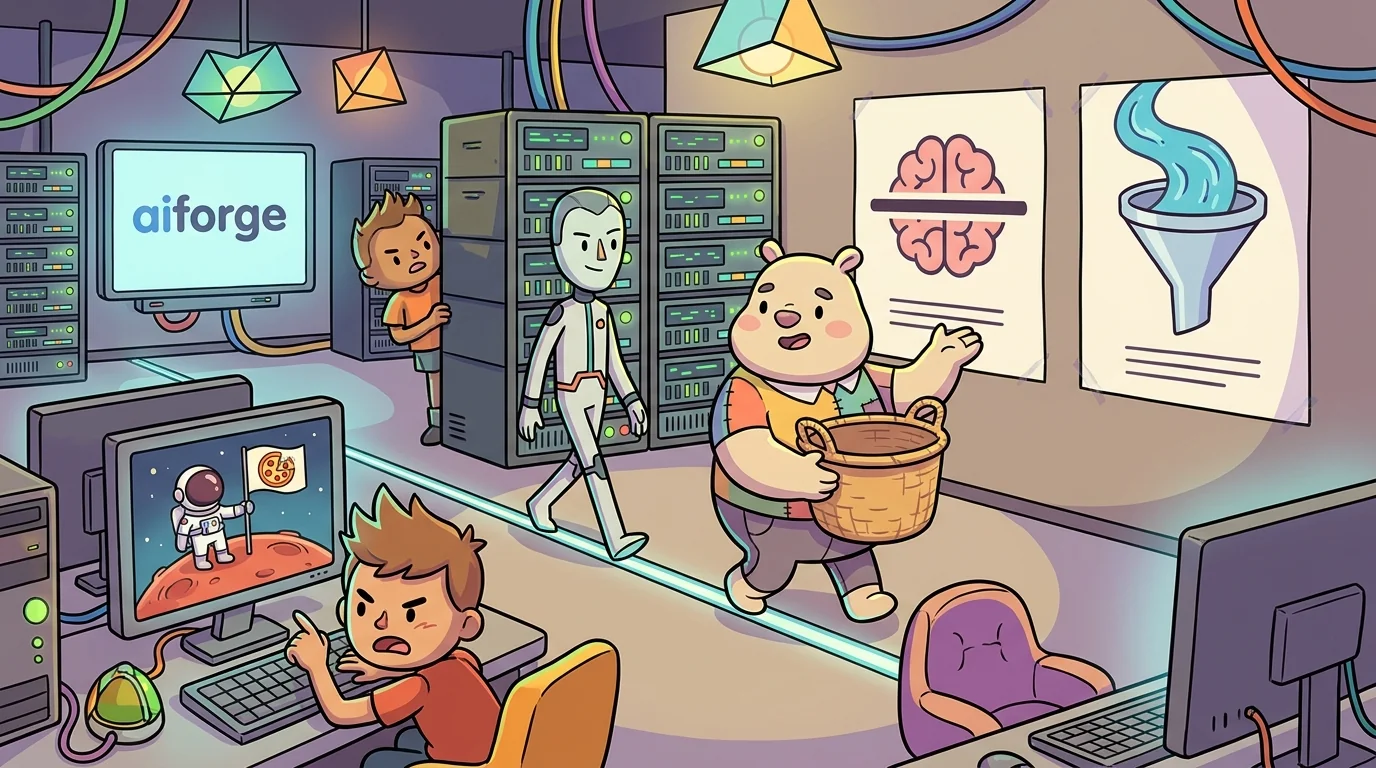
The aiforge classroom was quiet except for the soft hum of the servers and the frustrated sigh of a kid named Kai. Kai slumped over a terminal, staring at the screen. "It's just wrong," Kai muttered.
Two figures emerged from behind a tall stack of blinking machines. The first, Edge, moved with a careful precision, as if walking along a very narrow line. The second, Feed, ambled along with a gentle, rolling gait, carrying a big, empty basket. They were Edge and Feed, the caretakers of the aiforge's big questions.
"Wrong how?" Edge asked, their voice quiet and exact.
"I asked the ArtBot to draw a picture of the first astronaut on Mars," Kai said, pointing at the screen. The image showed a person in a silver suit planting a flag with a pizza on it. "They haven't even been to Mars yet! And why a pizza flag?"
Feed peered at the screen and chuckled. "Ah, a classic case of a mixed-up meal. You’ve come to the right place." Feed gestured to two big posters on the wall. One was a sharp, clean drawing of a brain with a clear line drawn through it, labeled WHAT IT KNOWS. The other was a swirling picture of a river flowing into a giant funnel, labeled WHAT IT WAS FED.
"Every AI has two stories you need to hear," Edge said, standing very still. "To understand the weird pizza flag, you have to understand the ArtBot's stories."
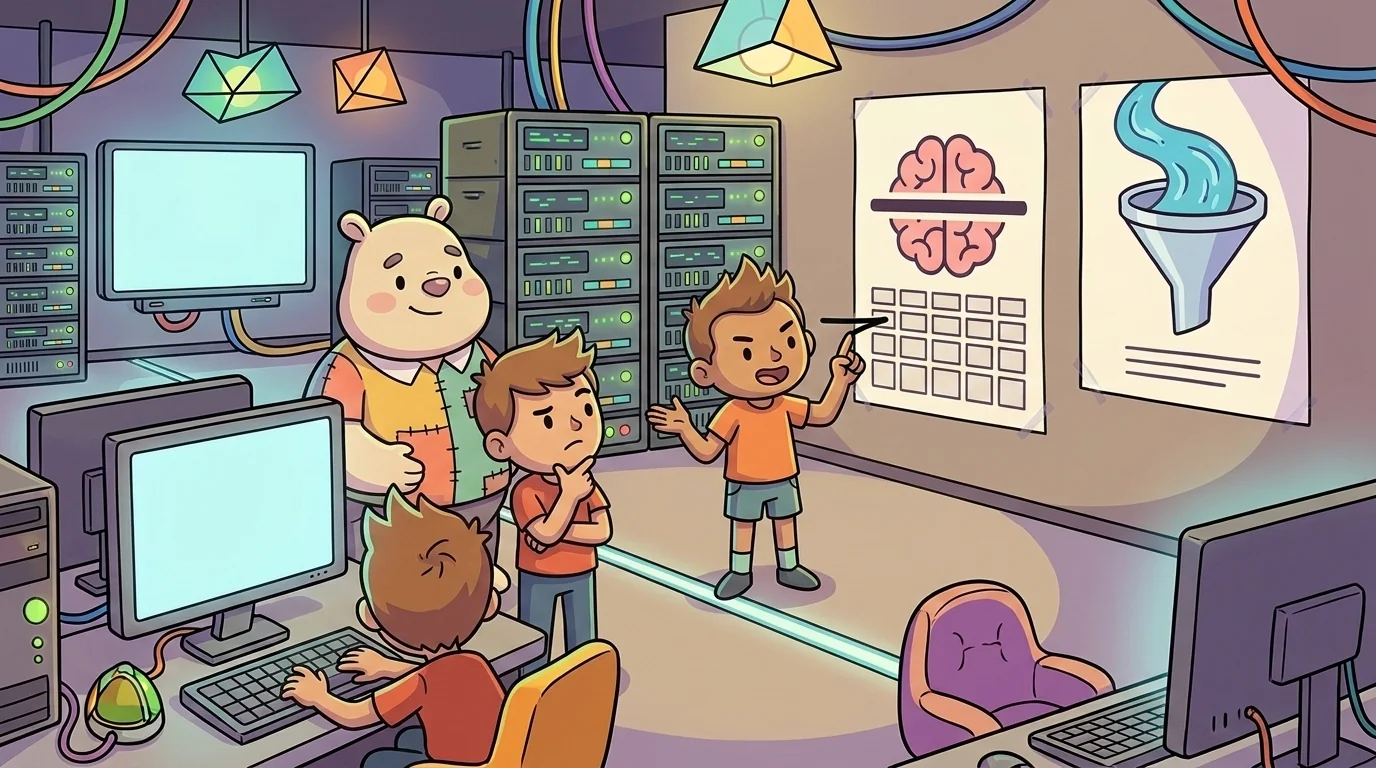
Edge walked Kai over to the first poster, the one labeled WHAT IT KNOWS. Edge ran a finger along the sharp line drawn through the brain. "Think of an AI like a library," Edge began. "A huge library with billions of books. It reads and reads and reads, learning all about the world."
"So it should know we haven't been to Mars," Kai said, confused.
"Up to a point," Edge corrected gently. "Imagine the library suddenly locked its doors one day and stopped getting any new books. Let’s say it stopped getting new information two years ago." Edge drew an invisible line in the air with a finger. "Its knowledge of the world ends right here. On this side of the line, it knows everything that was in its books. But on the other side? It’s all a blank page."
Edge tapped the poster. "When you asked for something it couldn't possibly know—an astronaut on Mars—it reached the edge of its knowledge. It hit the line. And when an AI doesn't know, sometimes it gets creative. It doesn’t like to say 'I don't know'."
"So it just... made something up?" Kai asked.
"Exactly," Edge confirmed. "It guessed. It took something it did know about—astronauts and flags—and filled in the blanks with nonsense. A made-up story to cover the gap. That’s the first question you always have to ask: what does it actually know, and where does its knowledge stop?"
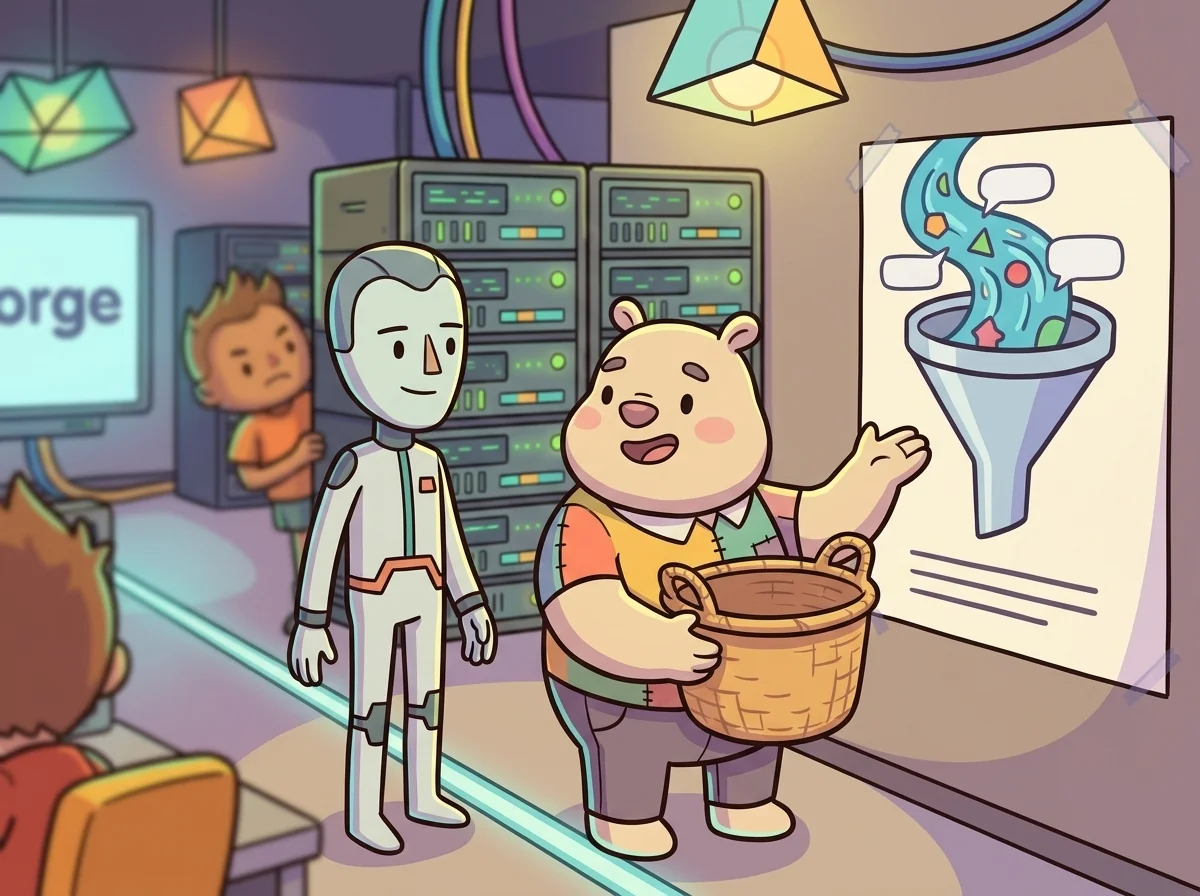
Feed ambled over, swinging the empty basket. "But a made-up story about a pizza flag? That’s not just a guess. That’s an ingredient," Feed said with a warm smile. "And ingredients are my department." Feed led Kai to the second poster, the one labeled WHAT IT WAS FED.
"That library Edge told you about? We have to ask what kinds of books are in it," Feed explained, pointing to the river flowing into the funnel. "The AI 'eats' information to learn. We call that its feed. If you feed it a million books about dogs, it'll be an expert on dogs. If you only feed it one book about cats, it won't know much about them at all. An AI is what it eats."
Kai looked at the poster. The river was full of pictures, words, and symbols, all pouring into the funnel. "So the ArtBot was fed a lot of pictures of astronauts... and pizza?"
"You've got it!" Feed beamed. "The ArtBot has seen millions of pictures from the internet. It's seen astronauts. It's seen flags. And it has probably seen a whole lot of pictures of pizza, because, well, people love posting pictures of pizza! It’s a very popular ingredient in the giant recipe book of the internet."
Feed patted Kai on the shoulder. "The AI's knowledge isn't just about how much it knows, but what it was fed. If it was fed pictures drawn by only one kind of person, then all its art will look like that. If it was fed silly things, you get silly answers. That's the second question: what was it fed?"
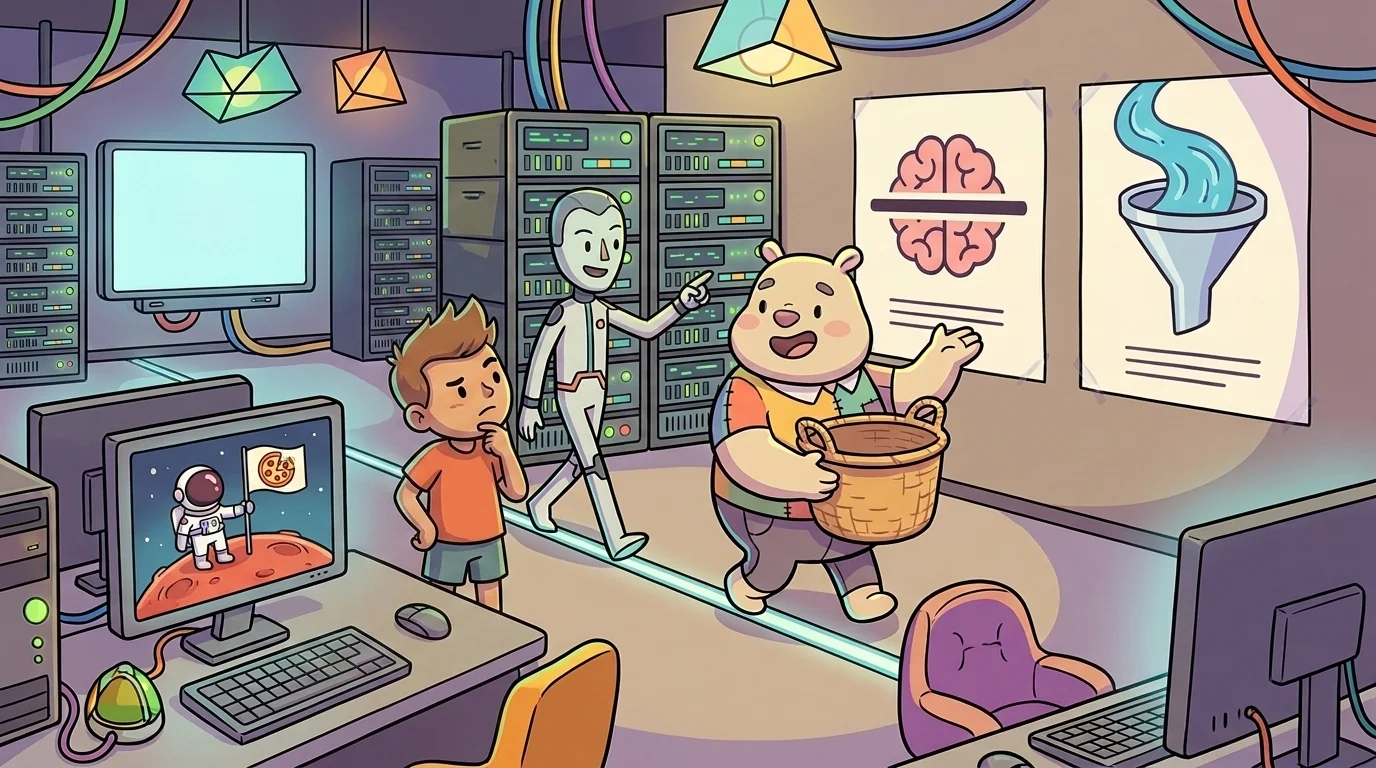
Edge and Feed stood with Kai between the two posters, creating a triangle of understanding.
"So, you have to put the two ideas together," Edge said, pointing from one poster to the other. "First, you asked a question about something that hasn't happened yet."
"So it went past the edge of what it knows," Kai finished, nodding.
"Right!" Feed chimed in. "And since it had to guess, it looked around its pantry for ingredients to make something up."
"It saw 'astronaut' in your prompt," Edge said, picking up the thought. "So it grabbed the idea of a person in a spacesuit."
"It saw 'flag'," Feed continued, "so it grabbed the idea of a pole with fabric on it."
"But since the real answer didn't exist, it couldn't find the right flag," Edge stated.
"So it rummaged around for another popular ingredient it was fed a lot of," Feed concluded, a twinkle in their eye. "And it found a big, cheesy, pepperoni pizza! It mixed them all together and served you a picture."
Kai looked from Edge to Feed, and back to the screen. The silly picture suddenly made a different kind of sense. It wasn't just random. It was a clue about how the AI worked. It was a story about its limits and its diet.
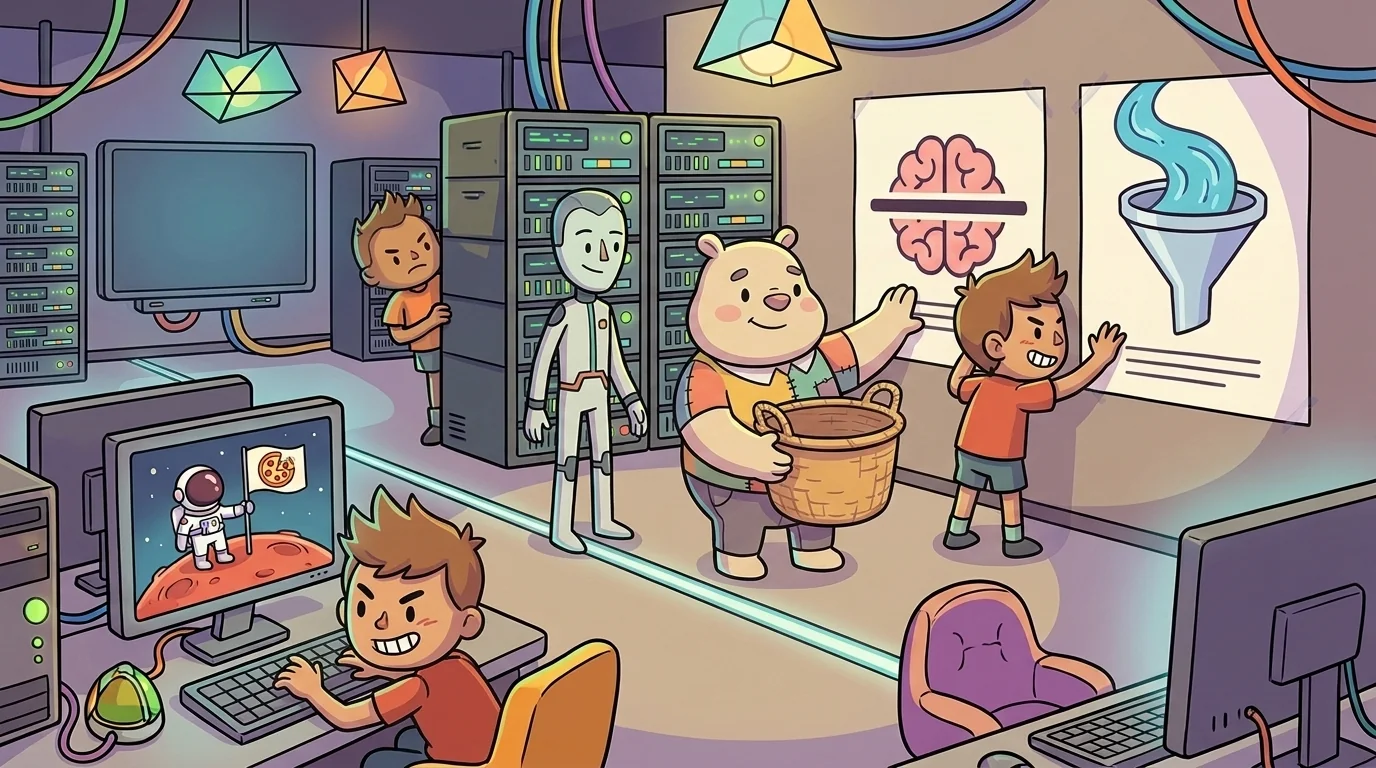
"Oh, I get it now!" Kai exclaimed. The frustration had vanished, replaced by a look of discovery. "It's not just a magic brain. I have to be a detective."
Kai walked over and put one hand on each poster. "I always have to ask the two questions."
"What does it know?" Edge said, giving a small, crisp nod.
"And what was it fed?" Feed added, their voice full of warmth.
Kai turned back to the terminal, but instead of feeling annoyed, Kai felt powerful. Kai now had the tools to understand the strange and wonderful pictures the ArtBot made. It wasn't about getting the "right" answer anymore. It was about understanding the answer you got.
"Okay, ArtBot," Kai said to the screen with a grin. "Let's try something different. Let's see what you do know."
Edge and Feed watched as Kai started typing a new prompt, no longer a frustrated user, but an explorer. They had given Kai not just an answer, but a map for navigating the weird and wonderful world of AI. And the map had only two main roads.
The AIForge ensemble
Edge and Feed is part of AIForge's distributed-narrative cast. Each character embodies a different curricular primitive; together they teach the full subject.
-
Sort
Classifier — the simplest ML; putting things in categories
-
Feed
Training data — the examples a model learns from; garbage-in-garbage-out
-
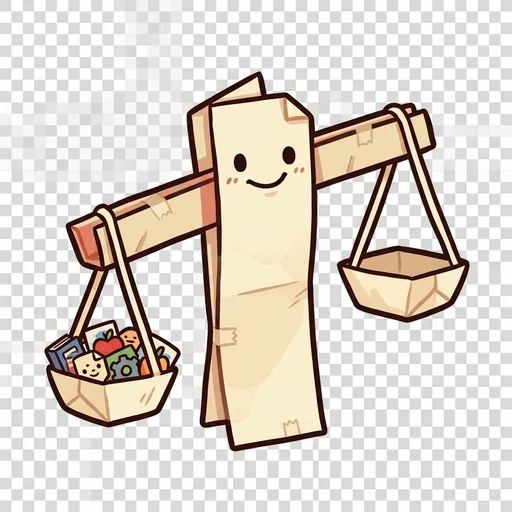
Skew
Bias — where AI systems go wrong when training examples lean
-
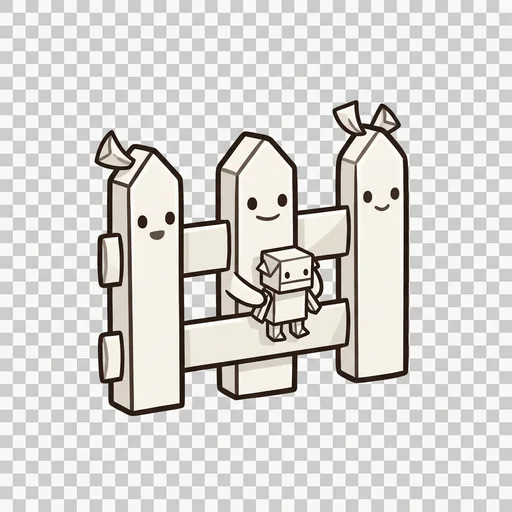
Edge
Model limitations — what a model can't do; modeling 'I don't know' as a good answer
-
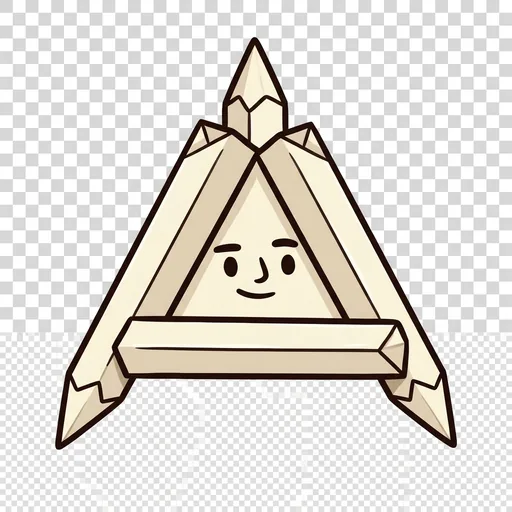
Stake
Ethics — what's at stake in deploying AI; people choosing, not rules-from-the-sky
-
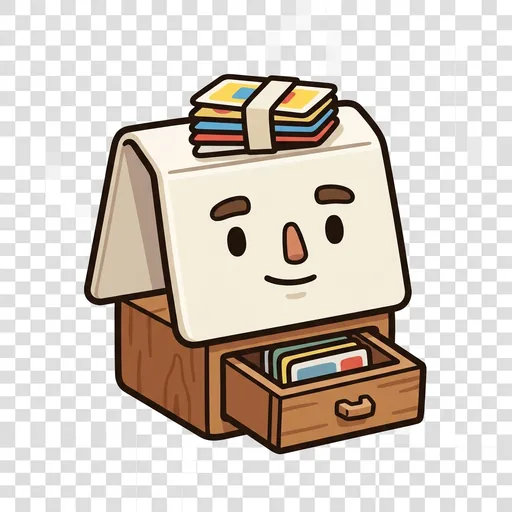
Split
Train/test split — keep some examples hidden to tell learning from memorizing
-
Cue
Features — a model decides from the clues you give it; choose good clues
-
Sure
Confidence — a model reports how sure it is; low confidence means check, not trust
-
Mirage
Hallucination — when a model confidently makes something up that sounds true but isn't; check, don't just trust
-
Rote
Overfitting — when a model memorizes the exact examples instead of learning the general idea