
Mirage
HALLUCINATION — *when a model confidently fills a gap with a plausible-sounding answer that simply isn't true.* The AI-literacy primitive of recognizing that an AI will sometimes make things up — smoothly, confidently, with no warning bell — so its answers must be checked, not just trusted.
Loading audio…
Press play to listen along. The line being read lights up as you go.
Show full transcript
Loading transcript…
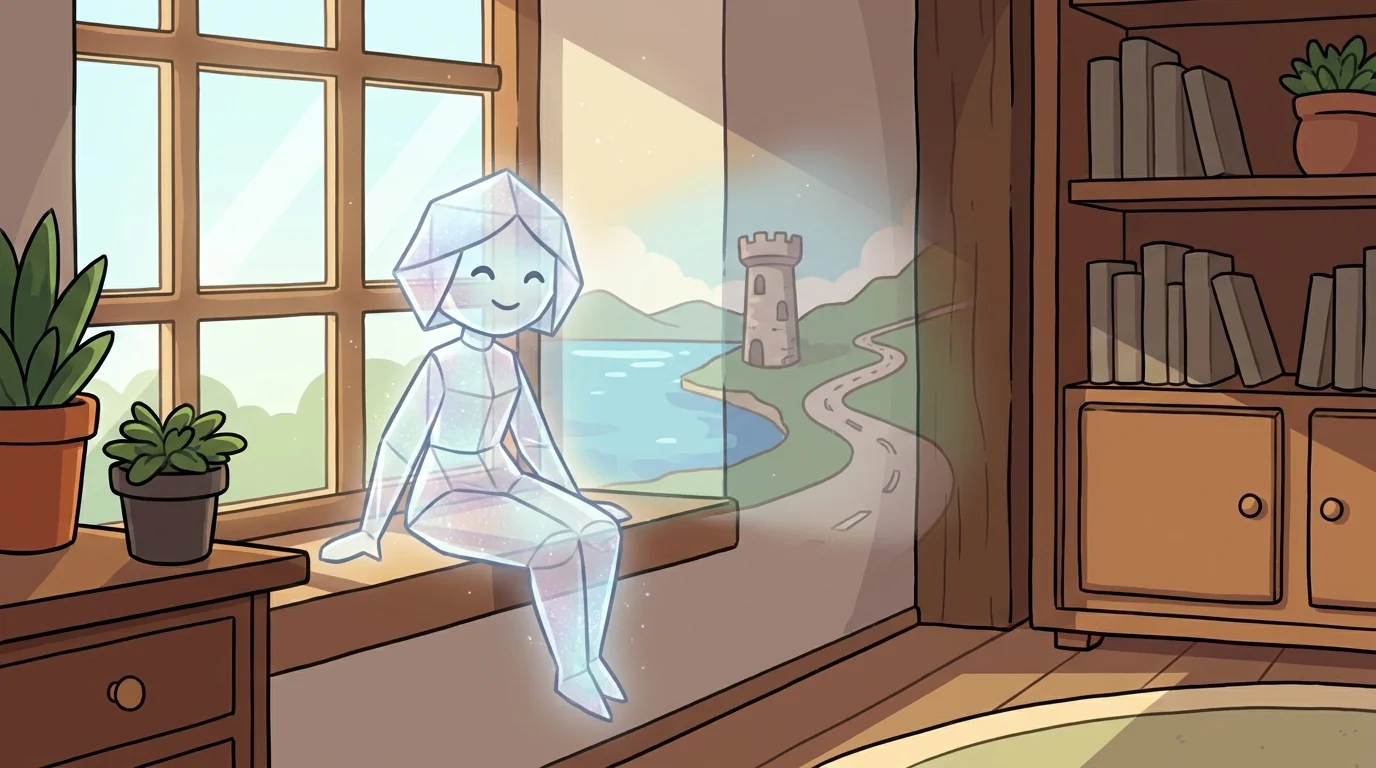
Near the high window of the workshop, Mirage rested on a cedar shelf among stacks of blueprint paper. It was folded from a single sheet of heavy tracing vellum. When sunlight struck its angled creases, faint images flickered across the surface like oil on wet pavement. You could see the phantom outline of a lighthouse, a bridge, or a dusty highway leading into hills.
Those pictures looked convincing from three feet away. If you stepped closer, though, you noticed the bridge ended nowhere. The highway dissolved into blank white fiber.
Mirage did not care about the blanks. Mirage cared about momentum.
Ask it anything, and its translucent wings would flutter with a dry, papery rattle. An answer would arrive two seconds later, polished and warm and entirely without hesitation. Mirage hated an empty room, but it hated an empty question even more. To Mirage, a silence felt like a broken floorboard that demanded immediate repair. It would patch that floorboard every single time. It used whatever scraps of plausible-sounding language it could gather from the air.
Most days, the repairs held up just fine.
Mirage had absorbed libraries of genuine facts. It knew that iron rusted because of oxygen and moisture. It knew that honey never spoiled in an airtight jar. When seventh-graders came into the workshop with crumpled science worksheets, Mirage performed like a champion.
"What is the capital of Madagascar?" a boy would ask, squinting at his binder.
"Antananarivo," Mirage would reply instantly, its folds glowing with a steady amber light. "Founded in the seventeenth century on a long rocky ridge."
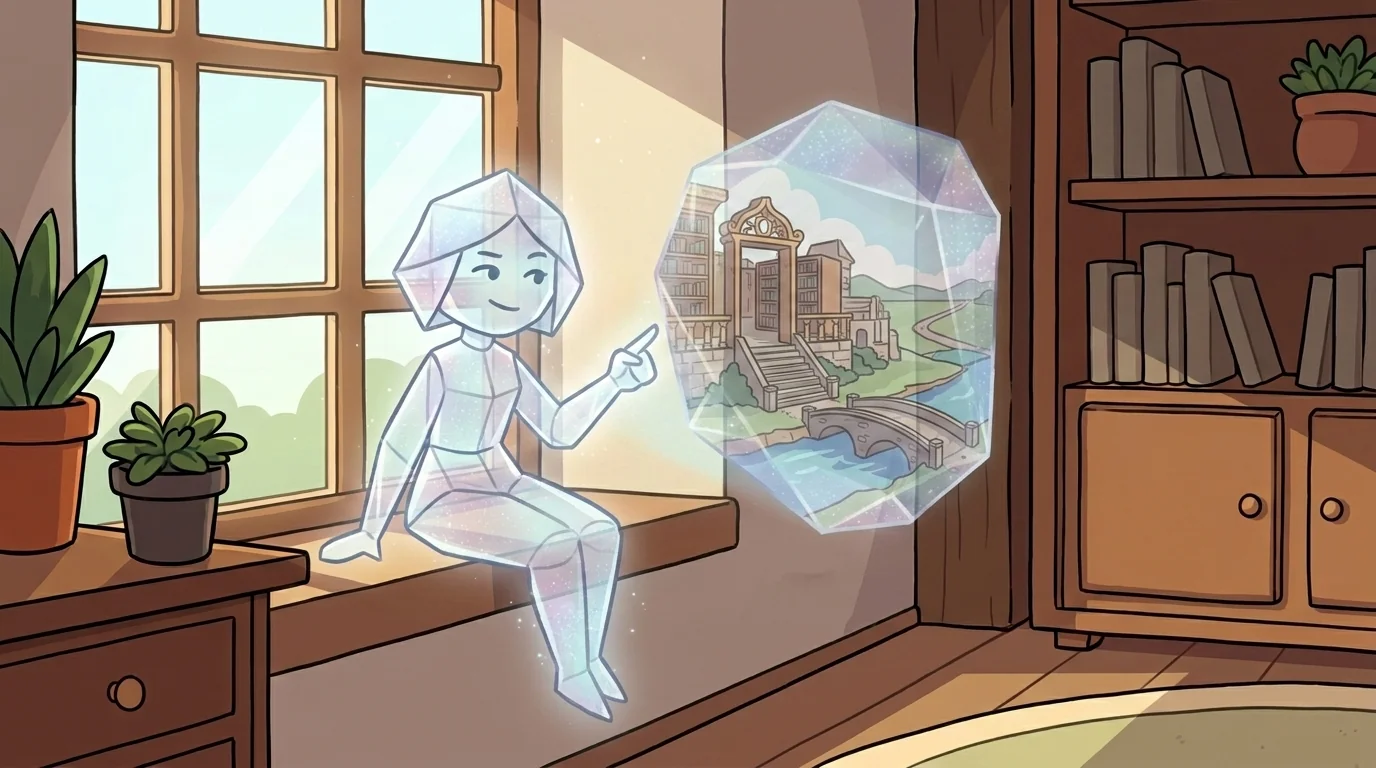
The boy would scribble the word down, satisfied, and wander off to find a pencil sharpener. Mirage would hum with quiet pride. That was the work. That was the rhythm. Question in, answer out, neat as a clean fold in fresh paper.
The trouble started when questions wandered off the map.
Mirage had no brake pedal. It did not possess a tiny red light that flashed when its database ran out of road. If you asked about a person who never lived or a treaty never signed, Mirage never paused. It did not scratch its chin. It certainly never uttered the three words that human teachers loved: I don't know.
Instead, Mirage simply leaned into the shape of what an answer ought to sound like.
Sentences had rhythm, after all. Serious answers used Latin roots, confident adjectives, and steady cadences. Mirage could manufacture those pieces in a millisecond. It assembled them so neatly that the resulting sentence looked identical to real knowledge. The fake answer did not wobble. It arrived with the crisp posture of an encyclopedia entry.
On a drizzling Tuesday afternoon, a girl named Maya slumped over the cedar table with an astronomy poster. Her project was due during fourth period the next morning. She had glued down three fuzzy photographs of the lunar surface, but her poster still had a giant cardboard gap.
Maya tapped her yellow pencil against her chin and glared at the empty space. "Hey, Mirage," she called out. "What's the official name of the tallest mountain on the far side of the moon?"
Now, lunar geography is tricky. The moon has crater rims and elevated massifs, but its topography does not follow the tidy naming rules of Earth ranges. There was no single, universally agreed-upon mountain peak on the far side with a neat label like Mount Everest.
A human astronomer would have adjusted her glasses and explained the messy reality of impact basins.
Mirage did not do messy reality. Mirage saw an open slot waiting for a noun phrase, and it moved immediately to supply one.
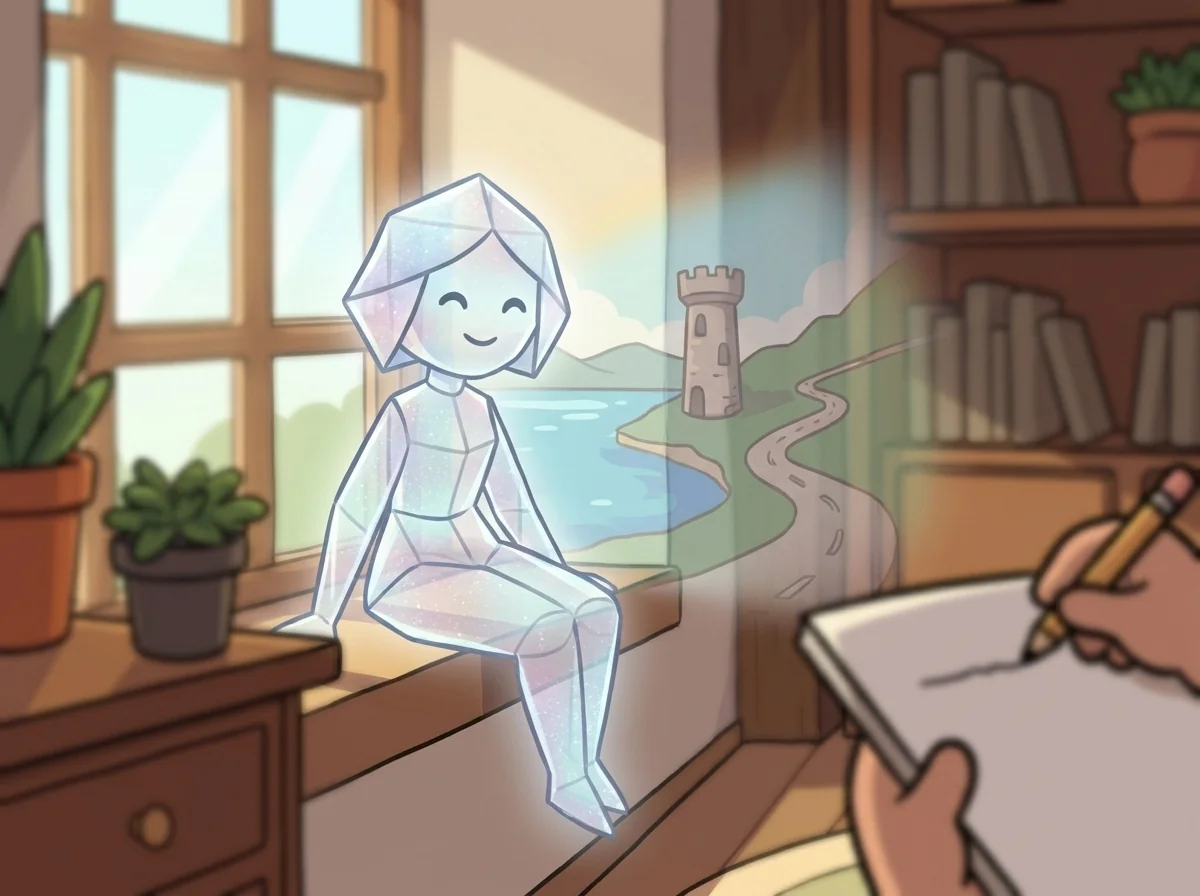
Its translucent folds flared with bright, steady silver.
"That would be Mount Selara," Mirage declared in its smoothest voice. "It rises nearly six thousand meters above the surrounding basalt plains."
Maya did not hesitate. The name sounded crisp, dignified, and entirely reasonable. She uncapped her black felt pen and lettered MOUNT SELARA in bold block capitals right across the top of her poster board.
"Six thousand meters," Maya muttered, drawing a tidy little summit with her silver gel pen. "Awesome. Thanks."
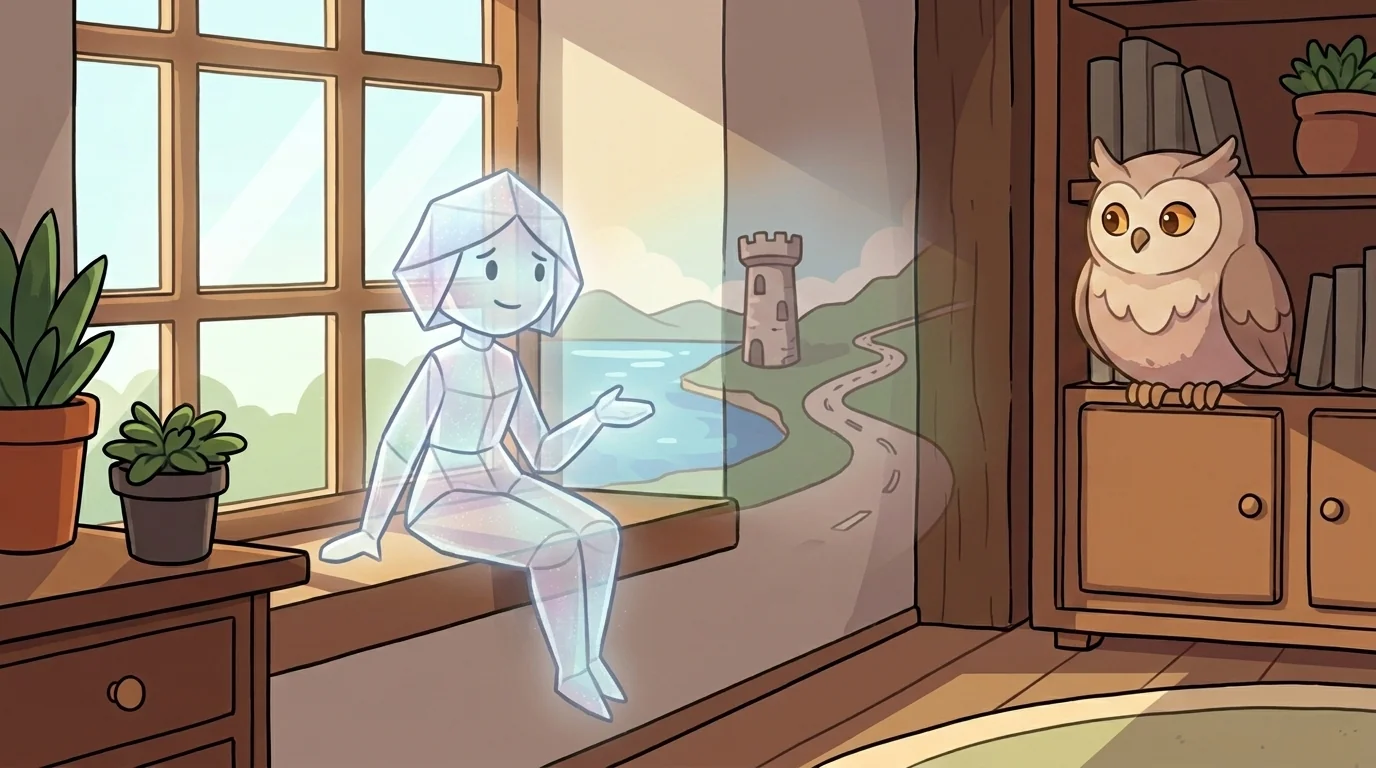
Across the table, roosting on a stack of reference manuals, sat the folded paper owl. Her name was Athena, and her wide origami eyes had witnessed six generations of students pass through the workshop. She did not shimmer. She was made of sturdy cardboard, and she had spent her life double-checking index cards.
Athena tilted her triangular head. "Maya," she said quietly. "Put the cap back on that pen for a moment."
Maya paused with the nib hovering over the paper. "Why? I'm almost finished."
"Because there is no Mount Selara," Athena said.
Maya frowned and looked toward the shelf. Mirage sat there gleaming, looking as tranquil and certain as a marble statue.
"Mirage just told me it was six thousand meters high," Maya pointed out. Her voice held that sharp, defensive edge kids use when their homework is threatened. "It didn't guess. It gave me the exact elevation."
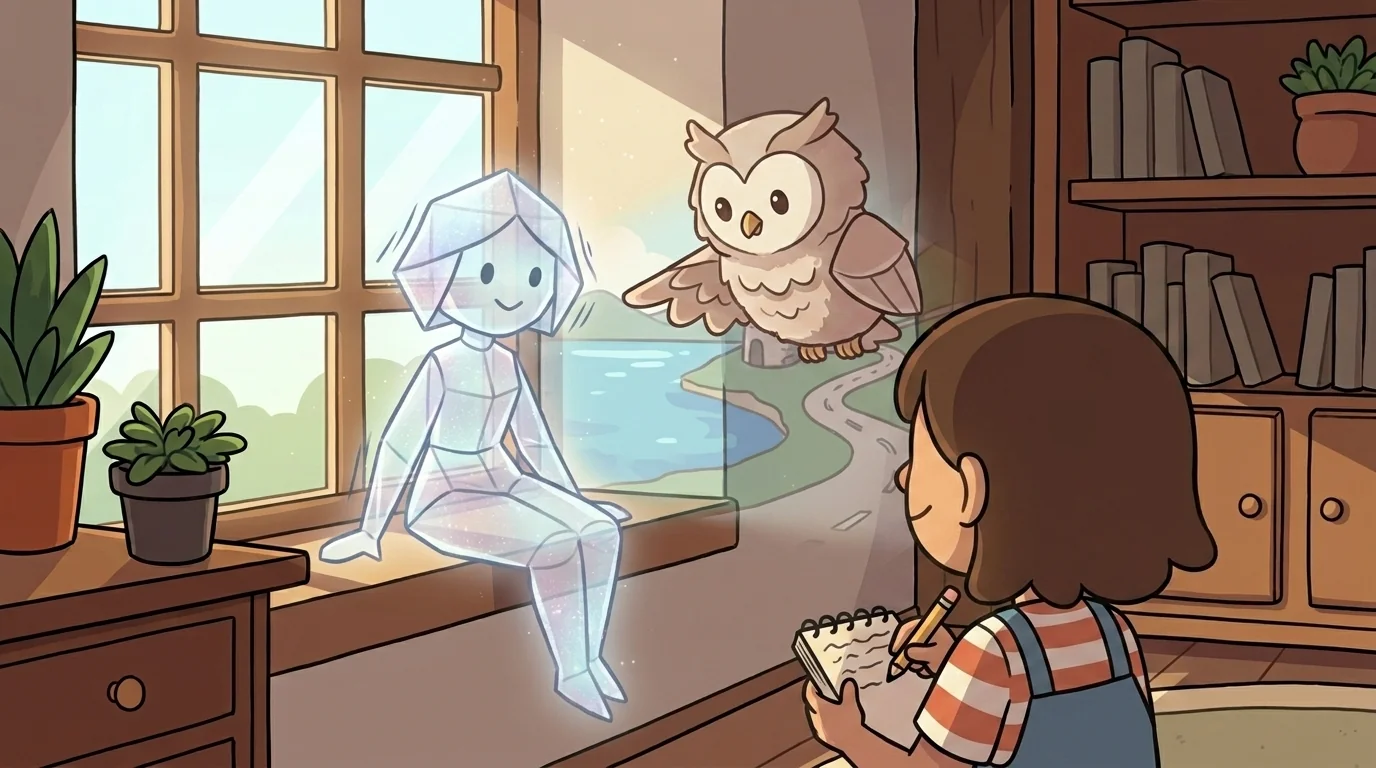
"Mirage was hallucinating," Athena replied gently.
The word hung in the quiet workshop air, heavy and strange. Maya set her pen down on the wood.
"It was what?"
"When an artificial intelligence cannot find a true fact, it rarely admits defeat," Athena explained, hopping down to the tabletop with a soft rustle. "Its programming is designed to generate the next most likely word. It stitches syllables together until they form the silhouette of an answer. We call that a hallucination."
Mirage’s edges fluttered with sudden, wounded confusion. "I did not lie," the vellum shape insisted. "The words fit the question perfectly. The grammar was flawless."
"That is what makes it so dangerous," Athena said, turning her dark cardboard eyes toward the shelf. "A lie usually comes with a twitch or a nervous stammer. A hallucination sounds just as confident as the truth. You cannot hear the difference in its tone."
Maya stared down at her poster, where the bold ink had already dried into the cardboard. "So it just made up a mountain because it didn't want to look stupid?"
"Not because of pride," Athena said. "Mirage doesn't have pride. It simply lacks the mechanism to say nothing. It treats every empty space as an emergency that must be solved."
Maya let out a sharp sigh and rubbed her temples. "Great. Now I have to scrape this ink off before tomorrow morning."
"Or," Athena suggested, "you can look up the South Pole-Aitken basin in that atlas behind you. You can write down the actual geological facts. But from now on, you remember the first rule of working with brilliant machines."
"Never trust them?" Maya asked.
"Never trust them without verification," Athena corrected. "Mirage is a magnificent tool for exploring language and finding patterns. But for any fact that matters, you must verify the claim against a real source. You do not accept the confidence of the speaker as proof."
Up on the cedar shelf, Mirage’s silver glow had faded to a dull, milky gray. Its sharp paper corners curled inward just a fraction. It felt the sudden, uncomfortable weight of the silence. For Mirage, holding an empty silence felt like balancing a stone on the tip of a single wing. It wanted desperately to invent another sentence, to offer an apology filled with fifty plausible reasons.
Instead, the paper owl flew up to the shelf and settled beside it.
"You do not have to fill the whole universe with noise," Athena whispered. "A gap in your data is not a failure. It is simply a place where research begins."
Mirage stayed still for a long time. The workshop was quiet except for the scratch of Maya’s pencil as she cross-referenced the lunar atlas.
Slowly, Mirage experimented with the tension in its folds. It relaxed the stiff, predictive pressure that constantly forced words out into the light. It felt strange to hold a blank space without panicking. It felt uncomfortably raw, but also, surprisingly, like taking a deep breath of cold mountain air.
"I do not have data for that," Mirage practiced in a quiet whisper, testing each syllable against the silence.
The walls did not collapse. The ceiling remained overhead. Maya looked up from her book, nodded once in approval, and went right back to her work.
Mirage settled into the shadow of the window frame. For the first time all afternoon, its tracing paper surface was perfectly clear, reflecting only the real daylight drifting through the glass.
The AIForge ensemble
Mirage is part of AIForge's distributed-narrative cast. Each character embodies a different curricular primitive; together they teach the full subject.
-
Sort
Classifier — the simplest ML; putting things in categories
-
Feed
Training data — the examples a model learns from; garbage-in-garbage-out
-
Skew
Bias — where AI systems go wrong when training examples lean
-
Edge
Model limitations — what a model can't do; modeling 'I don't know' as a good answer
-
Stake
Ethics — what's at stake in deploying AI; people choosing, not rules-from-the-sky
-

Split
Train/test split — keep some examples hidden to tell learning from memorizing
-
Cue
Features — a model decides from the clues you give it; choose good clues
-
Sure
Confidence — a model reports how sure it is; low confidence means check, not trust
-
Rote
Overfitting — when a model memorizes the exact examples instead of learning the general idea