
Rush
RUSH — *tempo. how fast the pulse runs. speeding up (accelerando) and slowing down (ritardando) to steer a song's whole feeling.*
Loading audio…
Press play to listen along. The line being read lights up as you go.
Show full transcript
Loading transcript…
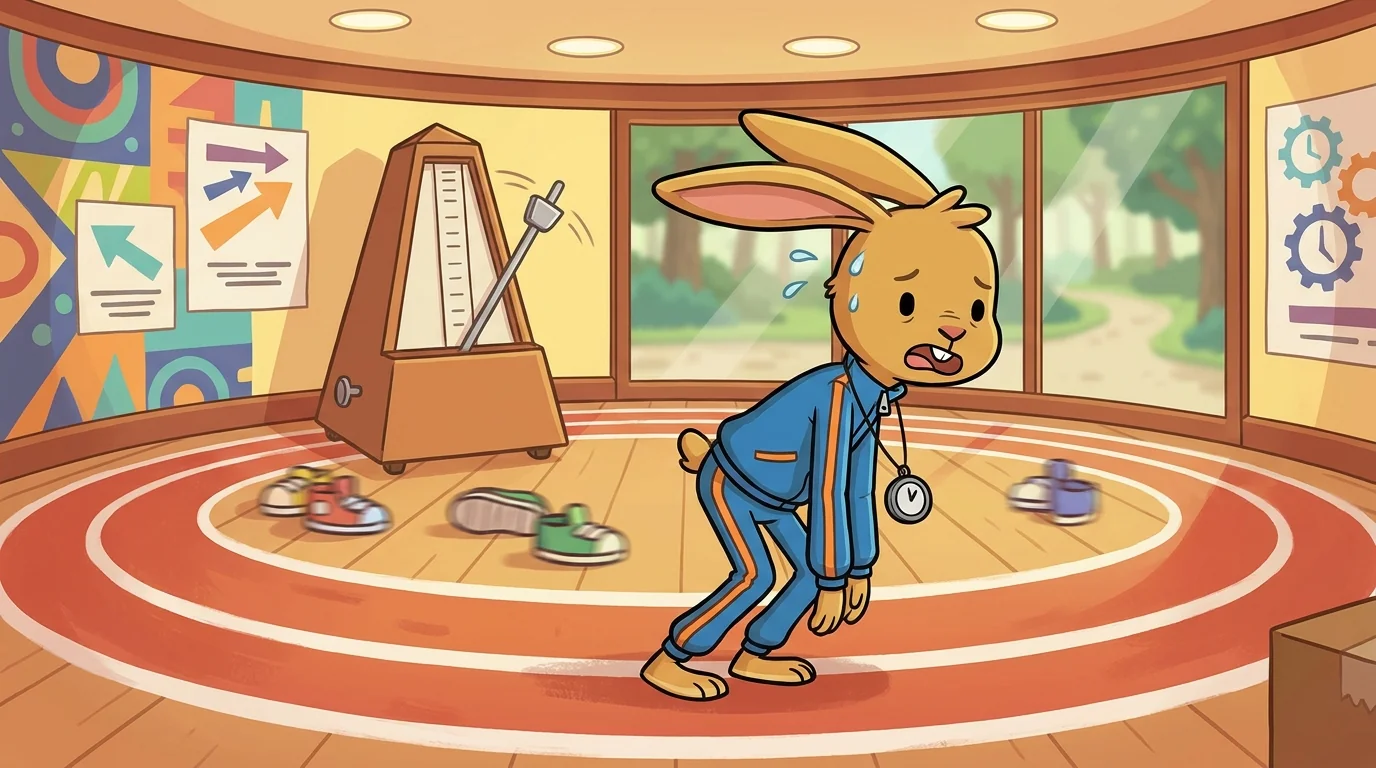
The hallway outside Rush’s room did not sound like the rest of the academy, where brass instruments usually droned. Today, a frantic wooden clicking leaked through the heavy oak door, sounding like a giant insect trapped inside the wall. The clicks sped up, crowding together until they became a solid hum, then suddenly stretched into a slow, sleepy yawn. The heavy wooden clicks echoed through the quiet corridor with a steady, lazy rhythm: tock, tock, tock. Pip paused with her hand on the brass doorknob while the other students exchanged nervous glances behind her.
She pushed the door open and stepped into a vast, circular room filled with dozens of ticking metronomes. Their silver pendulums swung back and forth in silent disagreement, casting long shadows across the floor. In the center of the room, a running track was painted on the worn floorboards. The wood inside the white lines was worn down to the pale grain from years of frantic running.
Rush was already in motion, a lean, tawny hare wearing a faded blue tracksuit. His long ears were pinned flat against his skull to cut the wind as he ran. A silver stopwatch bounced against his chest, chiming softly with every rapid stride. He rounded the far curve, his sneakers squeaking loudly, before skidding to a halt right in front of them. Dust motes danced in the shaft of sunlight he had just crossed as he stood there panting. His chest heaved under the polyester fabric, and his ears slowly twitched back to their upright position.
"You made it!" Rush panted, his face lit with a bright, manic energy that filled the room. "Okay, quick question for everyone here. Did you walk to my room, or did you hurry?"
Pip opened her mouth to answer, but the hyperactive hare was already pacing the floor again.
"It doesn't actually matter," he said, waving a paw dismissively before anyone could even speak. "The only real difference between those two actions is the tempo."
Pip frowned, looking down at her own dusty paws as she processed the word. It sounded like a term from a textbook, but Rush made it feel alive.
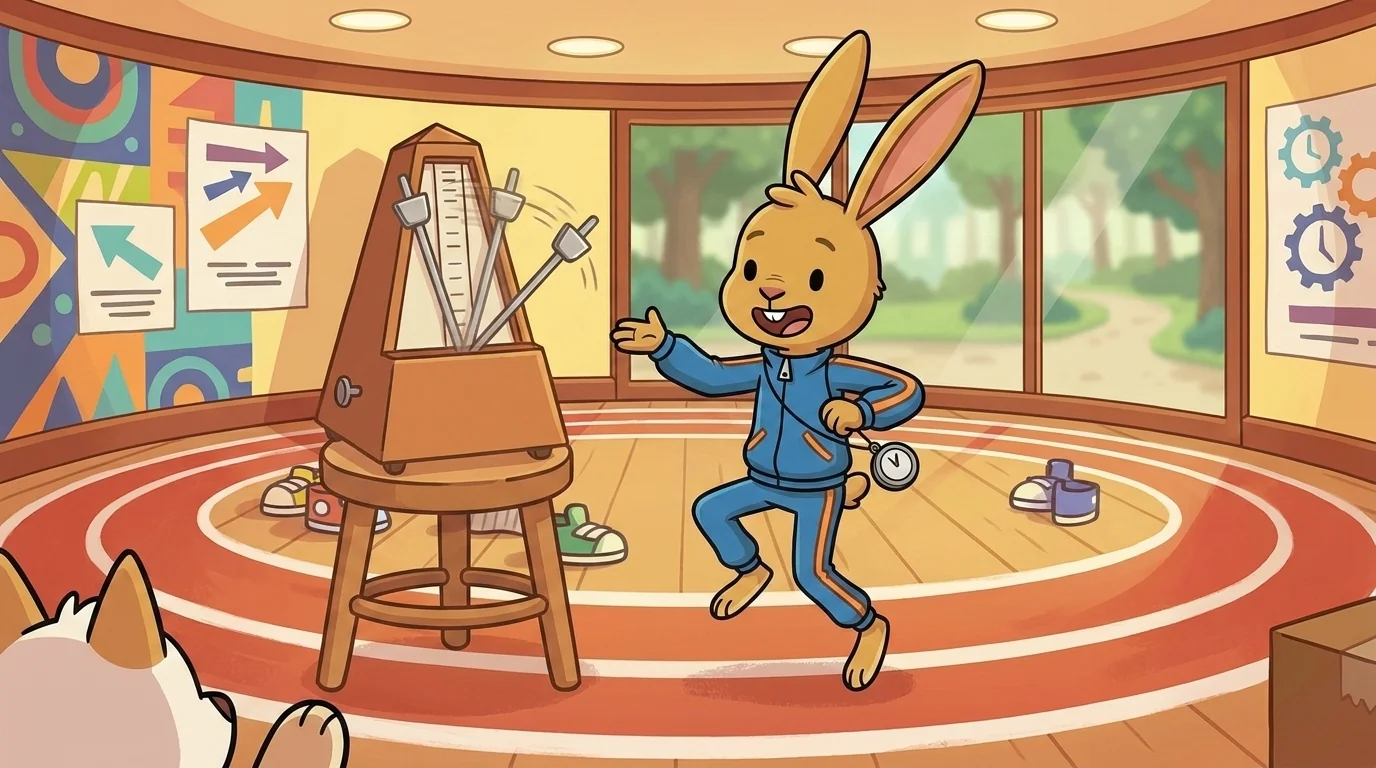
"Isn't that just Throb's department?" she asked, her voice cautious as she remembered their last lesson. "He is always talking about the pulse and keeping the beat steady."
"No, no, close but totally different," he said, hopping excitedly from foot to foot. "Throb keeps the clock steady, making sure the ticks are always perfectly even. I am about how fast the clock runs in the first place, and how we change it."
He reached over and grabbed a small, pyramid-shaped metronome from a nearby wooden stool. It was made of dark, polished mahogany that caught the dusty sunlight from the high window. He wound the brass key on the side with a dry, clicking sound. Then he slid the metal weight all the way to the top of the pendulum. He released the silver arm, and it began to swing in a wide arc. The heavy wooden clicks began to echo through the quiet room with a slow, lazy rhythm.
"That is a slow tempo," Rush said, his voice dropping to a calm murmur. He leaned against the wooden stool, his shoulders finally dropping as his breathing slowed. "It feels calm, right? Like a lullaby, or walking home in the rain."
Pip nodded, feeling her own breathing start to match the slow, steady rhythm of the wood. It felt like a quiet Sunday afternoon when the sun was warm on the rug.
Suddenly, Rush reached out and pinched the sliding metal weight between his quick fingers. He dragged it down the metal spine, locking it near the very bottom of the arm. The pendulum went wild, shivering back and forth in a tight blur that made her dizzy. The lazy afternoon vanished instantly, replaced by a sudden, sharp spike of nervous energy.
"And that is a fast tempo!" Rush yelled over the loud racket. His long ears stood straight up like two fuzzy exclamation points against the white wall. "Feels like a chase scene, or your heart when you drop a glass."
He stopped the pendulum with one finger, restoring a sudden, ringing silence to the space.
"Same clicks," he whispered, leaning in close to Pip with a wide, excited grin. "Same perfect evenness, but the whole feeling of the room is completely different."
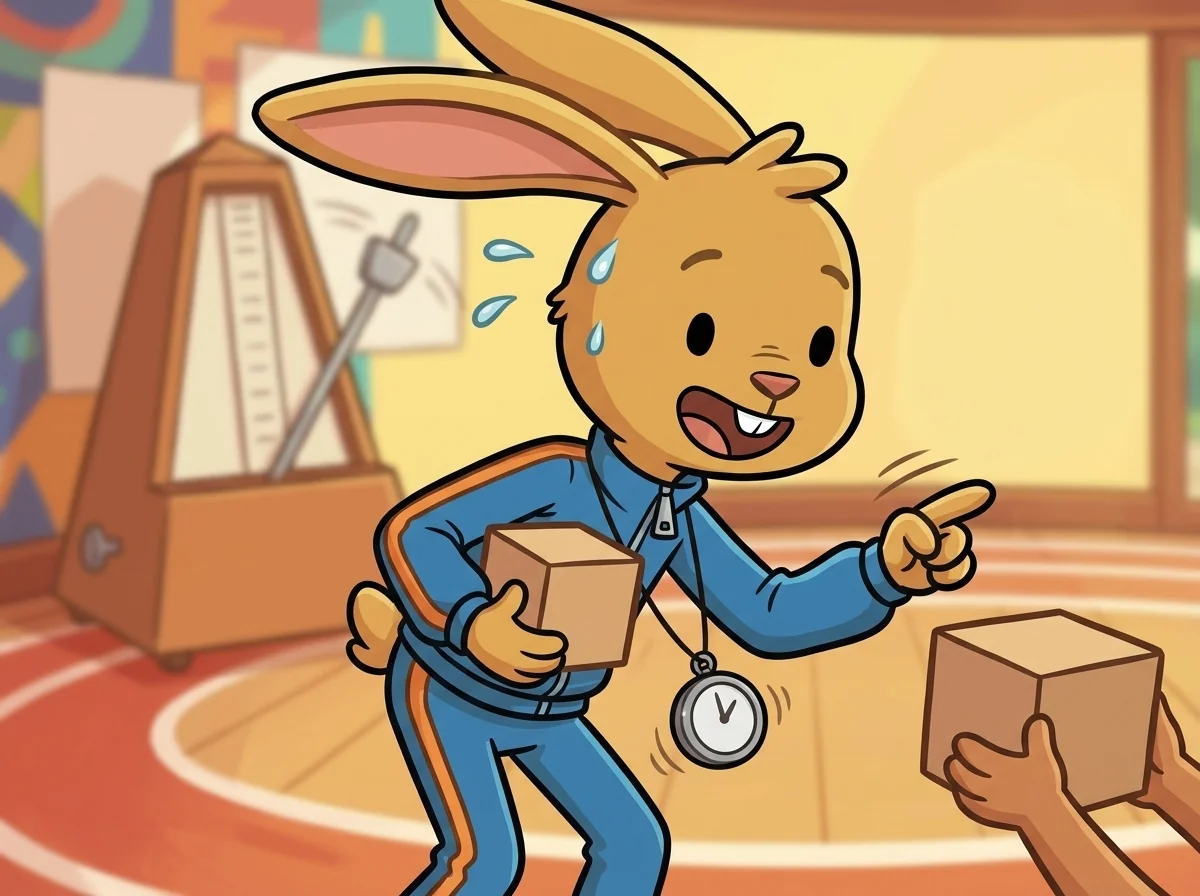
Rush reached into a wooden crate and pulled out a hollow, rectangular woodblock. He pressed the smooth instrument into Pip’s hands, along with a rubber-tipped mallet.
"Your turn," he said, stepping back to give her plenty of room on the track. "Give me a simple pattern of just four beats, but keep it slow."
Pip gripped the wooden mallet, her knuckles turning slightly white as she focused on the block. She tapped the center of the maple block, letting the hollow sound ring through the rafters. It sounded like a sleepy woodpecker working lazily on a hollow oak tree in autumn.
"Perfect," Rush whispered, nodding his head in time with his eyes closed. "Nice and drowsy, so now give me the exact same pattern, but twice as fast."
Pip took a deep breath, tightened her grip, and struck the wood in a rapid sequence. She struck the wood in a rapid, snapping sequence that echoed off the high walls. The notes bounced around the high ceiling, bright and full of sudden, nervous energy. A surprised laugh escaped her throat before she could even think to stop it.
"It is the exact same pattern!" she said, looking down at the simple instrument. "But the first one was a sleepy yawn, and this one was a wild sprint."
"Exactly!" Rush shouted, spinning a full circle on his heel with a dramatic flourish. His polyester tracksuit rustled loudly in the quiet space as he landed. "One melody, but two different speeds make them feel like two completely different animals. A funeral march and a birthday parade can use the exact same sequence of notes. The only thing that actually changes is how fast you decide to play them."
He tapped the scratched face of his stopwatch with a long, yellow claw.
"People use fancy Italian words for this stuff, but you do not need them. You just need to feel the difference between a lazy stroll and a sprint."
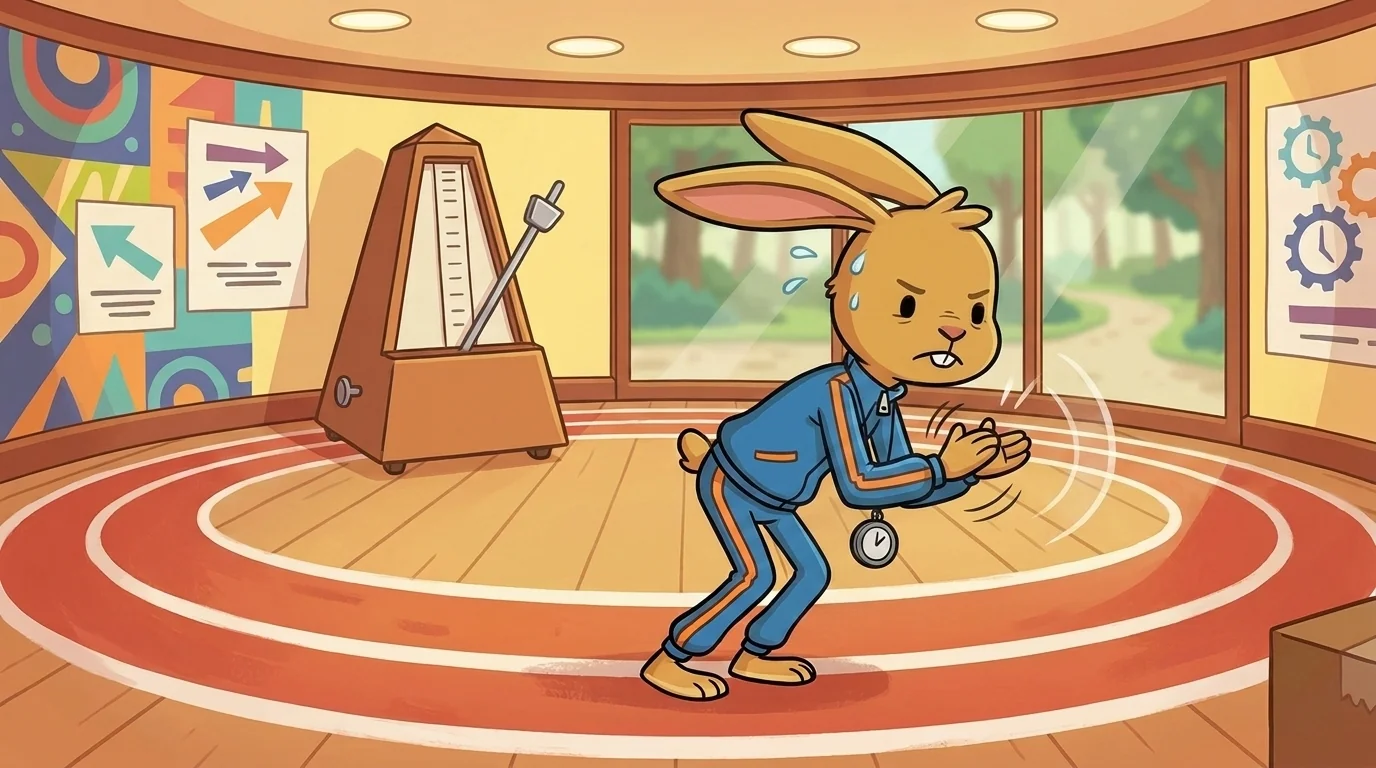
Rush stopped spinning and forced his feet together, clamping his hands at his sides. It looked like he was trying to hold back a small explosion of energy.
"Now comes the real magic," he said, his voice dropping to a conspiratorial whisper. "Anyone can run fast because going fast is the easiest part of playing music. The real craft is changing your speed on purpose, smoothly, right in the middle."
He started a simple, steady clap at a comfortable, unhurried walking pace that everyone could follow. Pip and the other students began to clap along, matching his steady rhythm exactly. Then, almost invisibly, Rush began to shave a fraction of a second off the silence between claps. It was so subtle at first that Pip genuinely thought she was imagining the shift. But then the rhythm began to lean forward, pressing them to move a bit faster. The entire room was suddenly swept up in a breathless, charging gallop of clapping hands.
"That is speeding up," Rush called out, his voice rising with the frantic tempo. "Musicians call it an accelerando, like a steam train leaving the station. It is the sound of pure excitement building up inside your chest as you run."
Then, he raised his hands high, signaling for a sudden change in direction. He did not stop clapping, but he began to stretch the space between each beat. He pulled at the rhythm, as if he were dragging a heavy sled through sand. The class struggled to follow him, their hands naturally wanting to keep racing forward. Pip had to physically hold her hands apart to keep from clapping too early. Slowly, the frantic gallop softened into a steady trot, then a slow walk. Finally, they landed together on one last, heavy beat and fell completely silent.
"And that is slowing down," Rush said, letting his tired arms drop. He looked genuinely exhausted, as if he had just run a long marathon. "The fancy word is a ritardando, showing how a song says goodbye. I will tell you a secret: slowing down is much harder than speeding up."
He looked directly at Pip, his dark eyes suddenly becoming very serious and quiet.
"Every single muscle in my body always wants to run at full tilt. Choosing to ease off when my whole body says go is the hardest thing I do."
When the lesson finally ended, the other students drifted out toward the sunny courtyard. Pip stayed behind, pretending to adjust the worn leather strap on her instrument case. She watched Rush walk slowly over to the far edge of the painted track, where he sat down on the dusty floorboards. His long ears, usually so alert and upright, draped softly over his shoulders now. He was taking long, deep breaths, his thin shoulders rising and falling in the quiet.
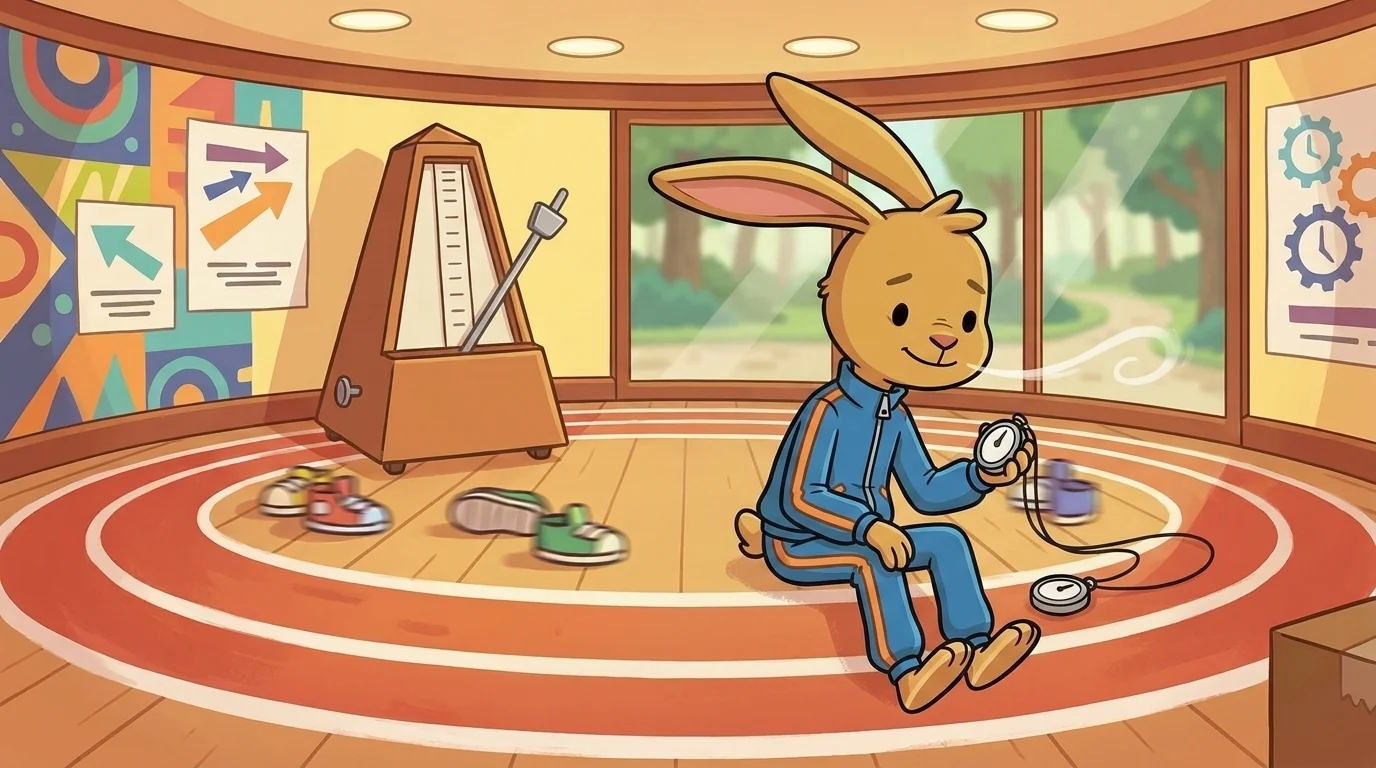
Pip walked over quietly and sat down on the warm wood right beside him.
"Are you okay?" she asked softly, looking at his tired profile. "You are always moving so fast."
Rush let out a dry, quiet laugh that sounded incredibly tired in the empty room.
"Between you and me, going fast is actually the easy part," he admitted softly. He picked up his heavy silver stopwatch, turning it over slowly in his paw. "Fast is just where I hide when I do not want to think about things. But a real musician has to learn how to let the song breathe sometimes. You can race all the way to the top of the mountain, but if you do not slow down at the end, the music is just noise."
He leaned his head back against the warm wood paneling of the high wall. Pip watched his chest, seeing the frantic, rapid rhythm of his heart begin to slow. The wild vibration in his frame gradually settled into a calm, steady rise and fall.
"Can you feel that?" he murmured, closing his eyes in the warm sunlight. "My own heart is doing a beautiful ritardando right now. Everything that runs so hard has to learn how to land eventually."
He opened one eye and offered her a small, surprisingly gentle smile.
"Go as fast as you want when the music really wants to fly, Pip. But do not ever be afraid to slow it all the way down. That is where the most tender parts of the music always hide."
Pip did not say anything, because she did not want to break the quiet. She was usually the student who could not stand still for more than a minute. But right now, sitting next to the fastest kid in the academy felt completely different. She matched her breathing to his, letting the silence stretch out between them. The room felt completely still, and for once, that quiet was exactly enough.
The BeatForge ensemble
Rush is part of BeatForge's distributed-narrative cast. Each character embodies a different curricular primitive; together they teach the full subject.
-

Throb
The steady pulse — the underlying clock every other rhythm hangs from
-

Snap
Subdivision — splitting a beat into equal smaller parts (eighths, sixteenths, triplets)
-
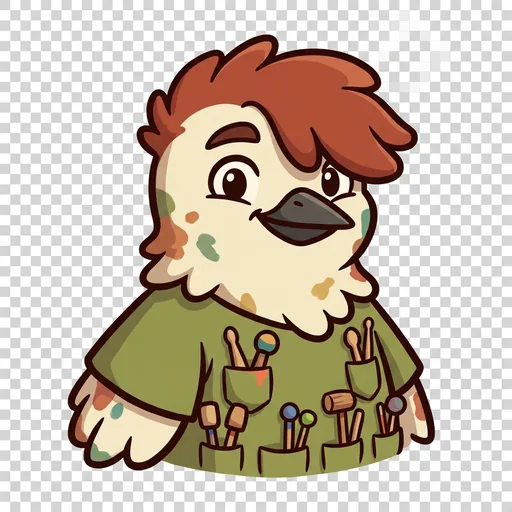
Hammer
Accent — emphasis on specific beats (the downbeat, the backbeat, polyrhythmic emphasis)
-
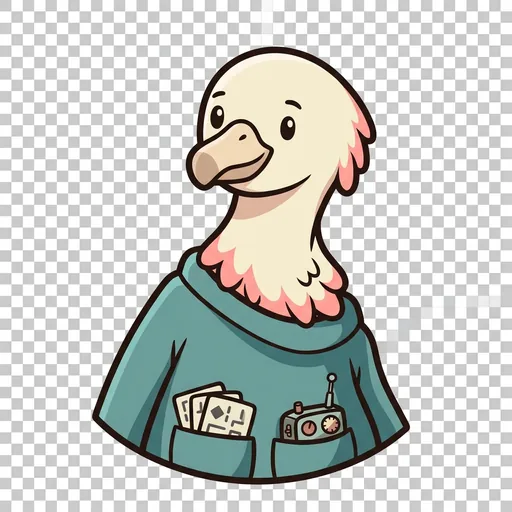
Tilt
Syncopation — placing weight off the expected beat to create pull and forward motion
-

Spin
Groove — the looping pattern that emerges when pulse + subdivision + accent + syncopation cohere; the thing that makes a beat feel like a particular genre
-
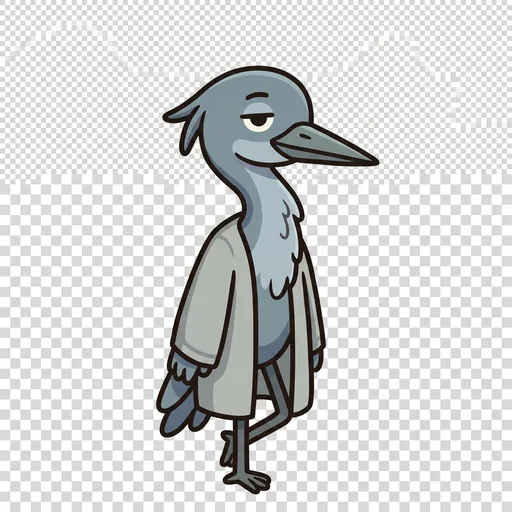
Lull
The rest — the beat you leave empty on purpose; silence counted as part of the music, so the next sound lands bigger
-

Crest
Dynamics — how loud or soft the music is, swelling louder and easing softer to give a song its waves
-

Volley
Call-and-response — one player calls a phrase and the others answer it back; music as a conversation traded around a circle
-

Flurry
The fill — the quick burst of drum notes that carries a song across the turn from one section into the next
-
The Jam
The whole rhythm section playing together — how pulse, subdivision, accent, and syncopation lock into one groove that lifts everybody up at once