
Coil and Store
timing pair — Coil (inductance, resists sudden current change, magnetic field) + Store (capacitance, resists sudden voltage change, charge tank). Alone each merely resists a change; wired in a loop they hand energy back and forth — field to tank to field — and the current rings. That back-and-forth rhythm is the electronics primitive of oscillation and timing.
Loading audio…
Press play to listen along. The line being read lights up as you go.
Show full transcript
Loading transcript…

On the workshop bench sat a hare and a beaver, each keeping watch over a favorite thing. Coil, the hare, rested one paw on a loop of wound wire, springy and ready, the way a runner rests on the blocks. Store, the beaver, patted a small drum-shaped tank the way she patted a water-barrel — fondly, as if it might answer.
A student stopped in the space between them, looking from one to the other. "You both say the same thing," she said slowly. "You both resist a change. Coil, you fight it when the current tries to stop; Store, you fight it when the voltage tries to jump. So what happens," she asked, "if I stop treating you as two separate lessons — and wire the two of you into one loop?"
Coil's ears went straight up. Store tilted her head. Neither of them, in all their years of teaching the same idea from opposite sides, had ever actually tried it. In the doorway, Watt the mentor leaned against the frame and said nothing at all. He only watched, the way you watch something you suspect is about to become interesting.

Coil went first, because hares always do. She ran current through her wound loop and swept it past a paperclip, which leapt up and clung to the wire though nothing had touched it. "This is my whole trick," she said. "I turn current into a reach — a magnetic field wound out of a moving current. And the thing you have to understand about me is that I hate a sudden stop. Cut my current off fast and I won't let it die all at once; I keep it coasting, just for a moment, the way a heavy flywheel keeps spinning after you take your hand away." She flicked the current off, and the paperclip clung an instant too long before it dropped. "Sudden change is the one thing I fight. I hold the current going."
That was Coil's one astonishing job: to store energy as an invisible magnetic reach, and to refuse — stubbornly, on principle — to let the current start or stop in a single instant. Inductance, she'd remind them, measured in henries: the exact size of that refusal.

Store went next, calm where Coil was springy. She tapped her little drum-shaped tank and set a real water-barrel beside it so the student could see them agree. "Mine is a tank," she said. "Not for water — for charge. When there's plenty of it, I fill up quietly. When there's suddenly a shortage, I hand what I've stored back out. And where Coil hates a sudden stop, I hate a sudden jump. Push my voltage up too fast and I soak the surge into my tank; let it fall too fast and I pour charge back out to hold the level steady." She let the student throw bump after bump at a little light, and each time her tank flattened it into a calm, even glow. "Fill on the surge, empty on the dip. I don't make charge — I only store it and give it back at the right moment."
That was Store's craft: to store energy as charge in a tank, measured in farads, and to refuse — patiently, on principle — to let the voltage leap or crash all at once. Two creatures, the student thought. Two opposite refusals. Each one, alone, forever bracing.
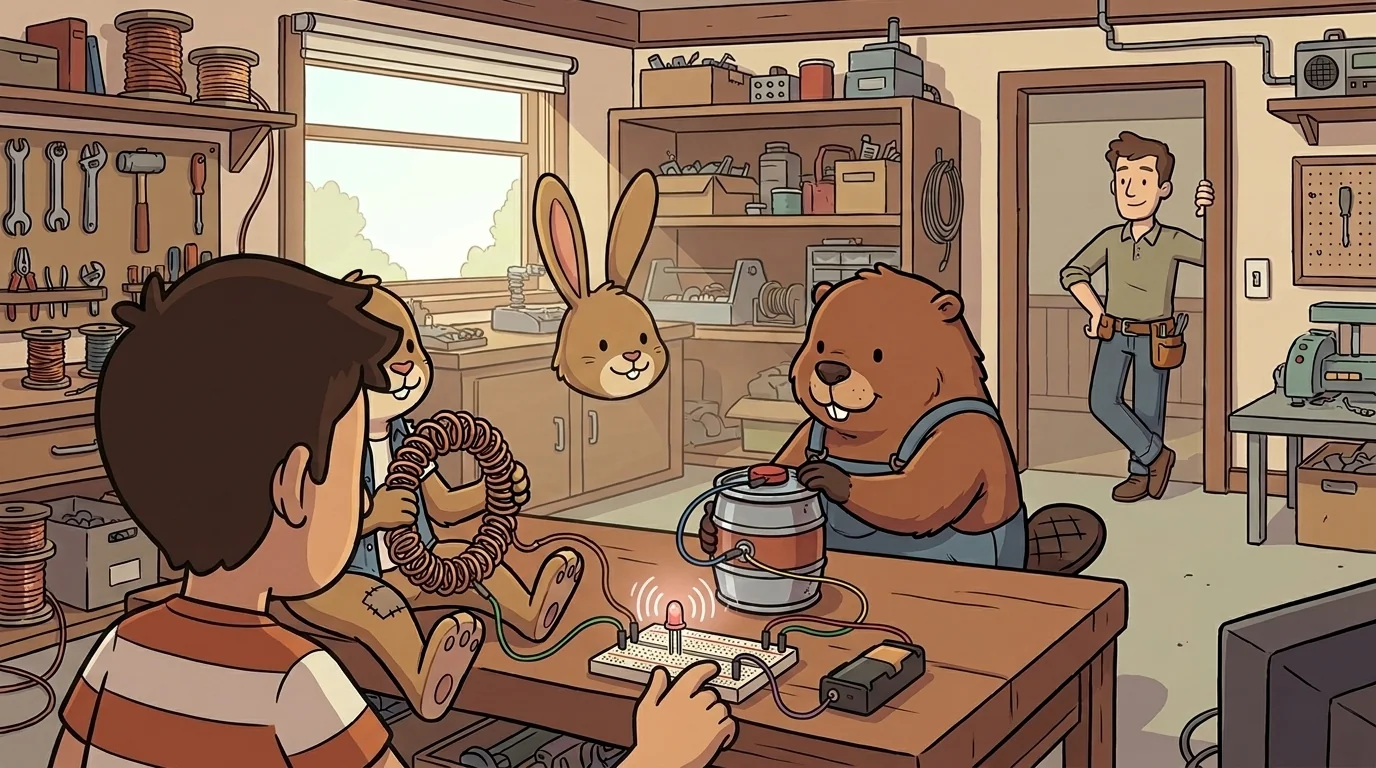
Then she did it. She wired the hare's coil and the beaver's tank into a single loop, gave the loop one push of current, and lifted her hands away.
And the loop began to ring. Coil's coasting current, refusing to stop, poured itself into Store's tank until it brimmed full — and then Store's full tank, refusing to sit still, pushed all its charge back out through Coil, who caught it and coasted it onward, rebuilding her magnetic reach — which collapsed, in turn, straight back into the tank. Field to tank to field to tank, back and forth, tick — tick — tick. On the breadboard a small light pulsed in time with it: blink, blink, blink, a steady patient beat. The two change-resisters, wired together, had stopped merely bracing against change and started trading it.
"That's a rhythm," the student breathed. "You made a clock."
"We made a heartbeat," Coil said, watching the current slosh from one of them to the other. "Neither of us could ever do this alone — I only ever coasted, she only ever smoothed. But hand the energy back and forth between us and it keeps time. Tune the loop right and you have a timer, a tuner, the beat under a song, the tick under a computer's whole day." Watt smiled from the doorway at last. "Together," he said, "your primitive is oscillation and timing. You are appointed — the two of you, as one loop. Build it, students: a coil, a tank, a single push. Then watch the current ring."
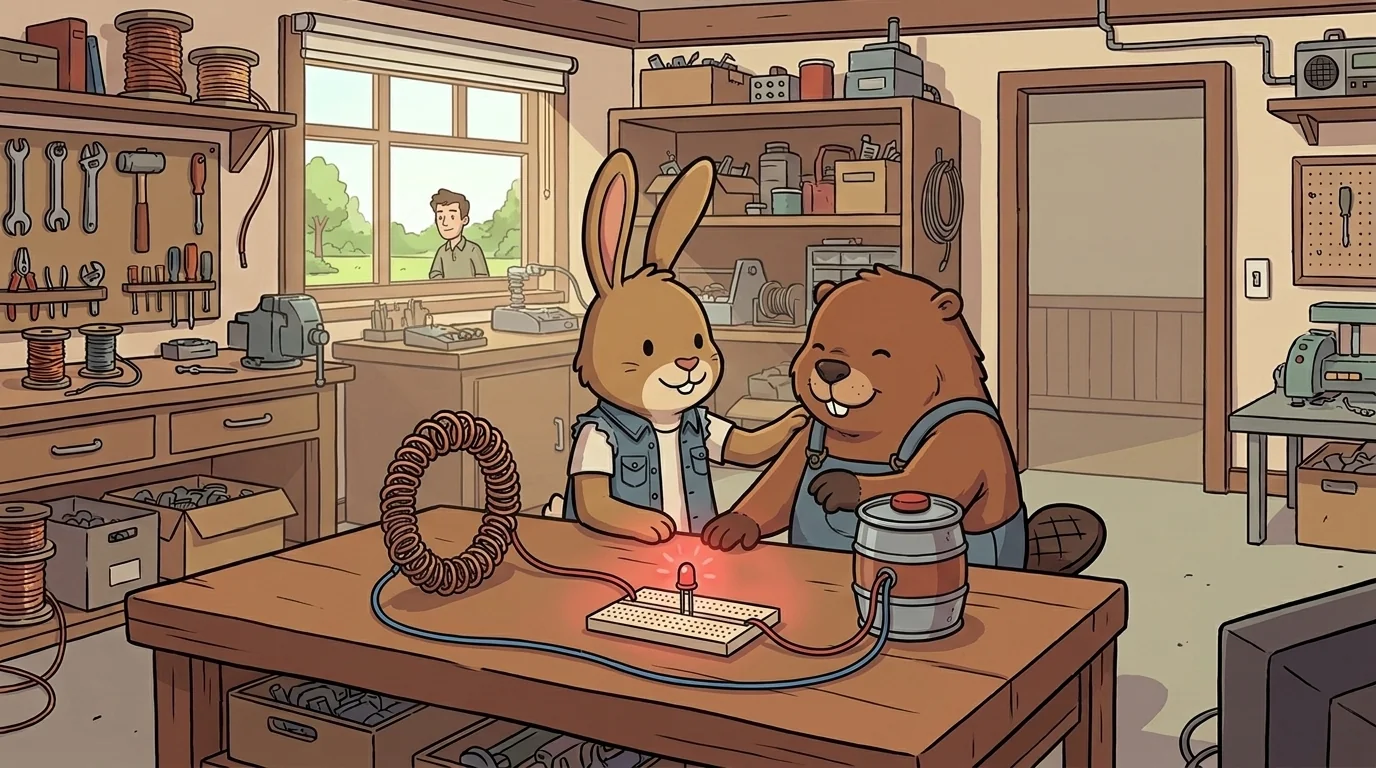
Coil and Store sat close together and watched the little light keep its beat, blink after patient blink — the rhythm they had built between them out of two stubborn refusals.
For so long each of them had spent every lesson bracing alone: the hare digging in against every sudden stop, the beaver flattening every sudden jump, both of them holding on, waiting, guarding. Now the holding-on had turned into a pulse — one of them leaning into the other and then back again, and again, and again — and Coil felt the old restless coasting in her springy body finally settle into something steady and glad. It was a heartbeat, she understood, that she could only ever have made with a friend: the moment your bracing stops being a lonely fight and becomes, instead, a rhythm you keep together.
The CircuitForge ensemble
Coil and Store is part of CircuitForge's distributed-narrative cast. Each character embodies a different curricular primitive; together they teach the full subject.
-

Push
Voltage — the pressure difference that drives current; measured in volts
-

Flow
Current — electrons moving through wires; measured in amperes
-

Damp
Resistance — the slowdown; measured in ohms; Ohm's Law (V = I × R) emerges from Push + Flow + Damp together
-

Branch
Series vs parallel topology — one path or many; the topology decides the behavior
-

Build
Component-wiring craft — every component has a job; wire them together and the circuit comes alive
-

Store
Capacitance — a tank that fills with charge and hands it back; smooths bumps
-

Coil
Inductance / electromagnetism — a wound wire turns current into a magnetic reach
-

Relay
Switching / control — a gate the circuit can flip itself; small flips big
-
Diode
Diode — the one-way gate; current flows one direction and is blocked the other
-

Fuse
Fuse — the deliberate weak link that melts to break the circuit when current runs too high, protecting the line