
Diode
DIODE — the one-way gate. A diode lets current flow in only ONE direction and blocks it completely the other way — the valve that keeps the river running the right way round.
Loading audio…
Press play to listen along. The line being read lights up as you go.
Show full transcript
Loading transcript…
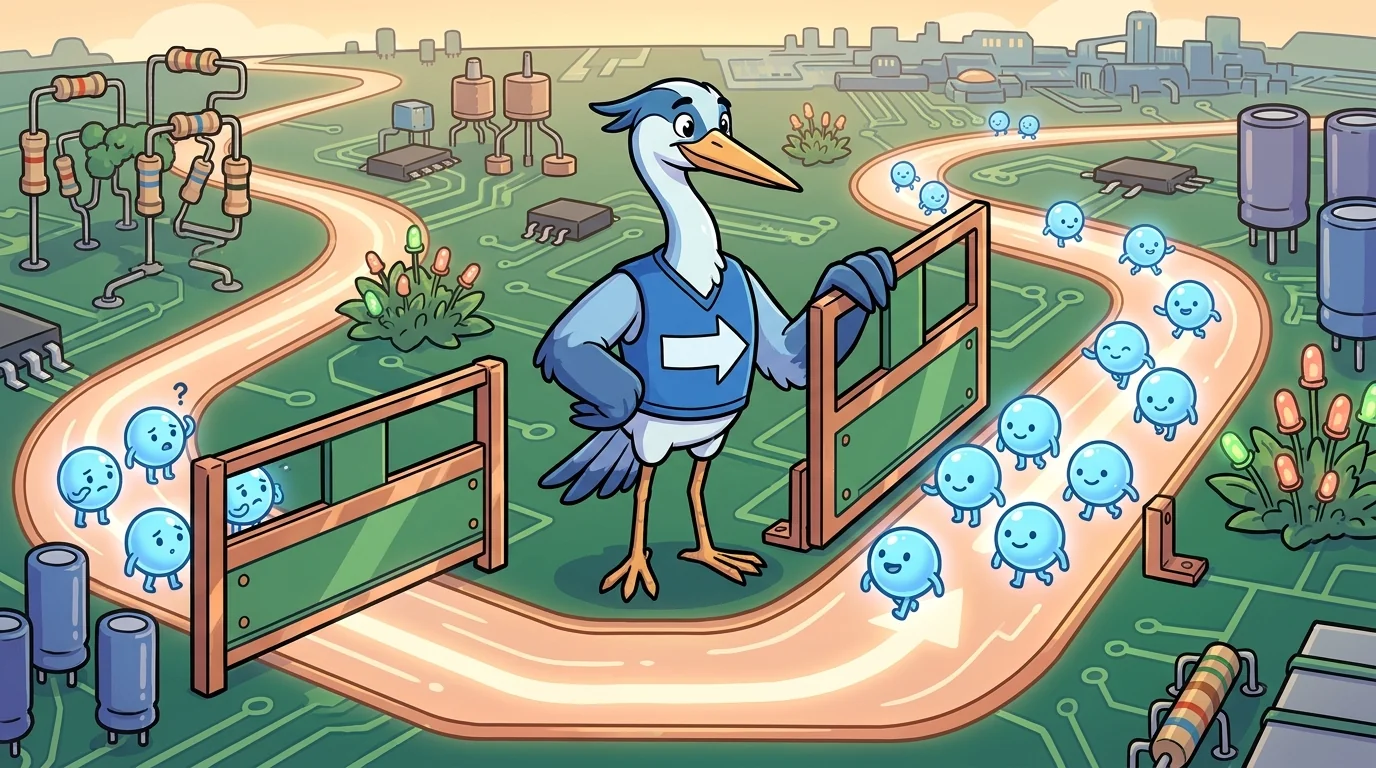
Diode was a heron — tall, unhurried, and still — who stood planted in the middle of the wire like a gate set across a stream. On his chest he wore a single painted arrow, and that arrow always pointed the same way, no matter how you turned him. He had exactly one rule, and he took it more seriously than the flashier parts thought any single rule deserved.
"This way," he would say, tipping his long beak downstream, and he'd let the current of electrons stroll right through the gate, easy and unbothered. "Not that way," he would say to any electron that came at him from the wrong direction — and he'd close the gate flat and let nothing past. The newer components on the line found him rather severe. "Why only one direction?" a young wire asked him once. "Wouldn't it be friendlier to let everyone through, both ways?"
"Friendlier," Diode agreed. "Not safer. Some circuits only work if the river runs the right way round. That's my whole job — to make certain it does."

Here is what Diode understood that the shinier parts around him did not.
Current is supposed to travel one way around a loop — out from the source, through each component in turn, and home again. Most of the time it behaves. But some sources, and a great many honest mistakes, can shove the current backwards — reversed, running the wrong way through parts that were only ever built to take it going forwards. And backwards current is not a small thing. A motor spins the wrong way. A part fills when it was built to empty. A battery gets forced full of charge when it should have been resting, until it swells and strains and leaks.
The trouble was that nothing else on the line could tell forwards from backwards. To a plain wire, to a bulb, to a switch, current was simply current — a push was a push, whichever way it came. Only Diode, standing at his gate with his one fixed arrow, could feel the direction of the thing. The circuit didn't need more current. It needed the current going the right way. And Diode was the only one who was watching for that.
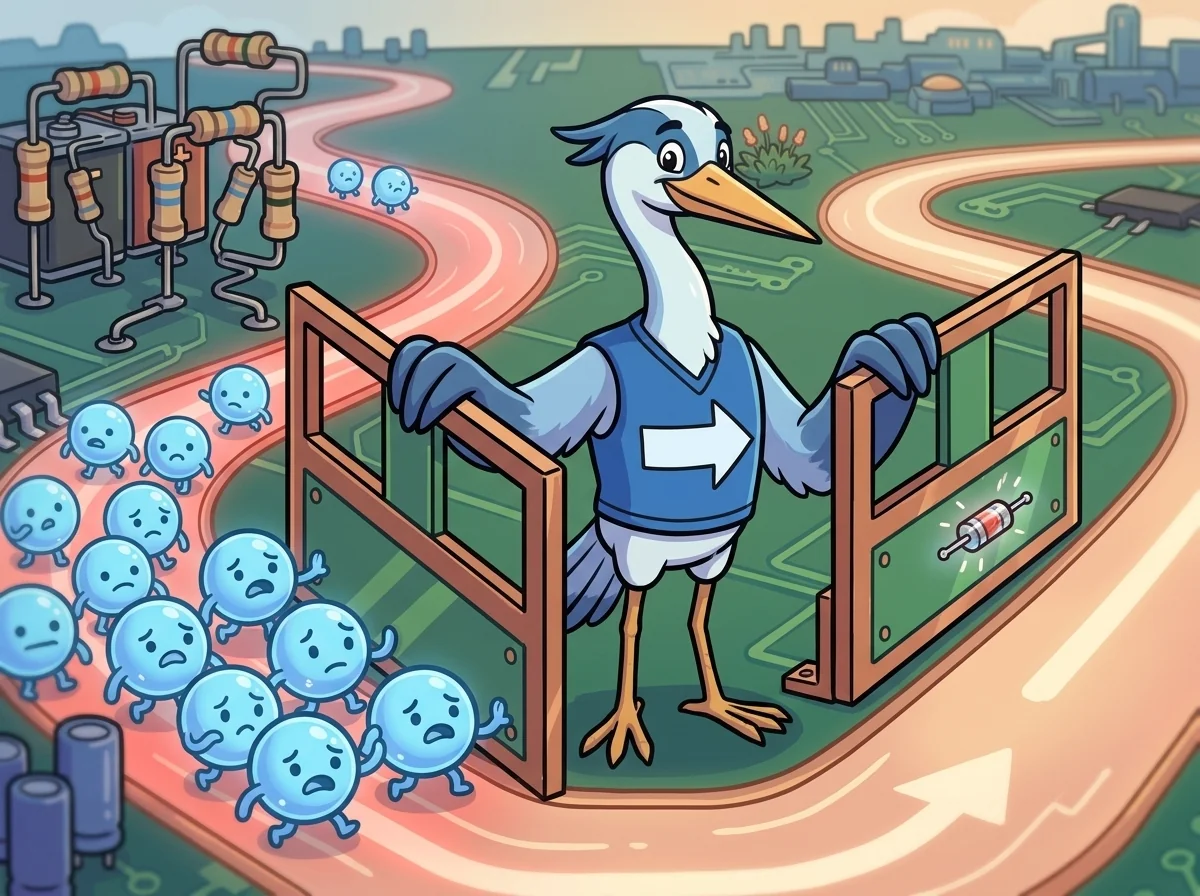
One day it happened for real. Someone connected a source the wrong way round, and the whole river tried to reverse at once — a great backwards surge, shoving hard against the proper flow, heading straight for a small delicate part downstream that a single moment of reversal would have ruined.
The other components never noticed; current was current to them, and this felt like plenty of it. But Diode felt the push arrive from the wrong side — felt it lean its whole weight against his gate. He did not waver. He did not tell himself well, perhaps just this once. He held his single arrow firm, closed the gate flat, and let nothing through. The backwards river hit him and simply — stopped. Blocked. Turned away at the gate. Not one reversed electron reached the delicate little part standing safe behind him.
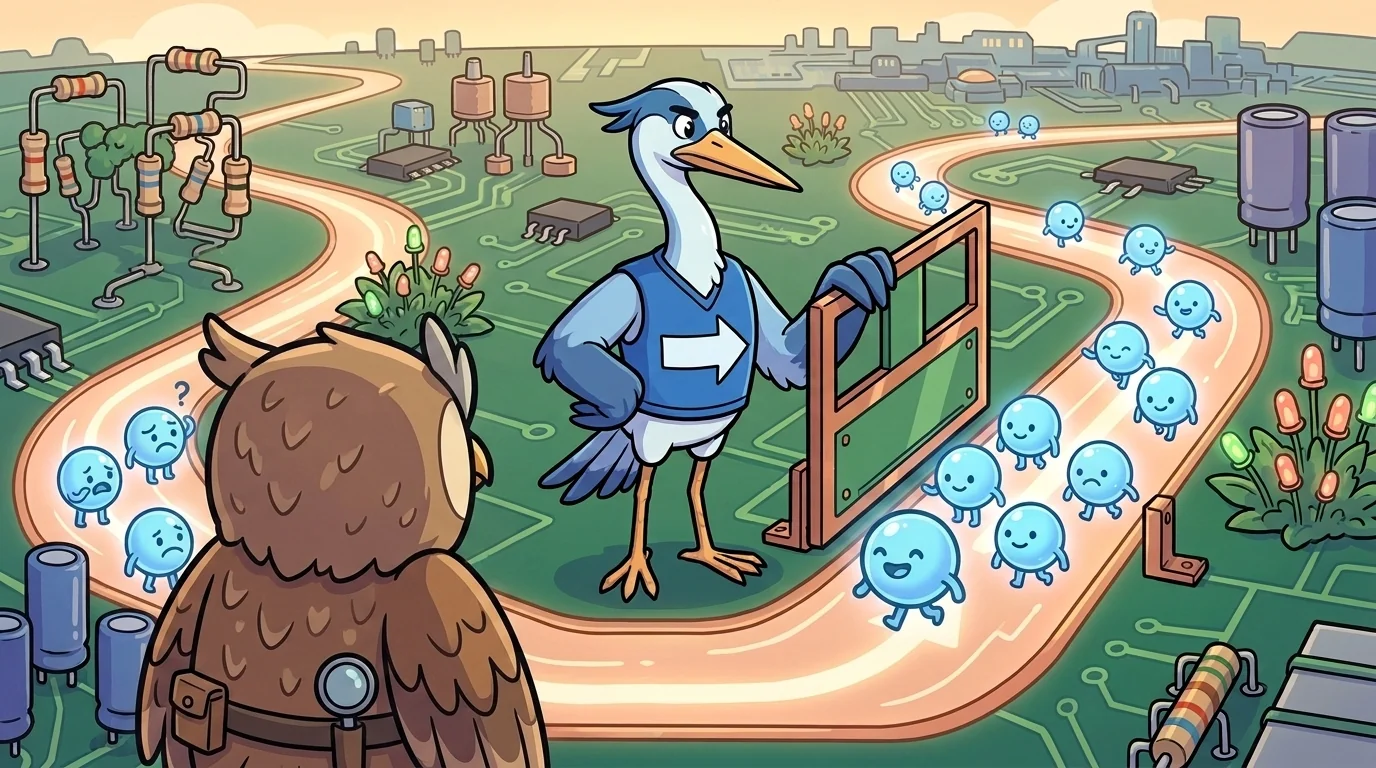
An old owl repairman came by afterward to check the circuit and found the delicate part perfectly, entirely unharmed. He looked at Diode, still standing calm with his gate shut against the wrong-way push, and he nodded with real respect. "He held the line," the owl told the worried components gathered round. "This is what a diode is: a one-way gate. Current coming forwards? It walks straight through, no trouble at all. Current coming backwards? Blocked — completely, every time. He looks strict. But that firm, unglamorous 'not that way' is exactly what saved this little one behind him from a reversed river." Then the owl reached in, gently corrected the source, and the current settled back into its proper direction — and Diode, feeling it run true again beneath him, opened his gate at once and let it flow. "See?" said the owl, softer now. "He isn't against the current. He's for it — going the right way."
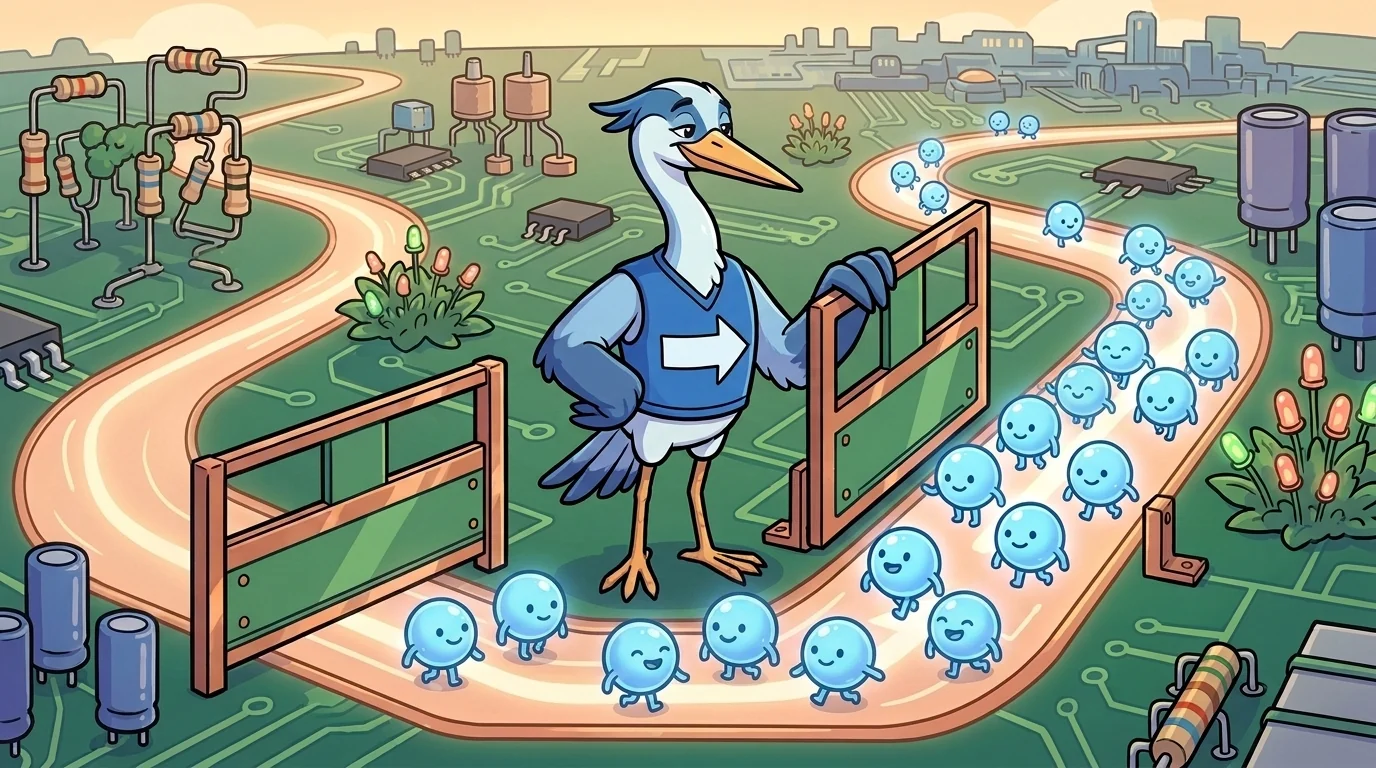
Diode returned to his tall, patient stillness in the middle of the wire, and felt the quiet, grounded steadiness of a creature who is entirely sure of his one rule. He would never be the brightest part on the line, or the busiest. His whole life came down to a single painted arrow and a single firm word: this way, not that way.
But there was a deep calm folded inside that plainness. He understood now that holding the gate had never been stubbornness, and it had never been lonely either — it was a kind of care that only wore the costume of strictness. His steady, unshowy "no" to the wrong direction was the exact thing that let everything downstream run safe and true. And standing his watch there, arrow pointing ever forward, felt to him not rigid at all but restful — the settled, contented ease of a heron who knows precisely which way the river ought to run, and is glad, all the way through, to be the one who makes sure it does.
The CircuitForge ensemble
Diode is part of CircuitForge's distributed-narrative cast. Each character embodies a different curricular primitive; together they teach the full subject.
-

Push
Voltage — the pressure difference that drives current; measured in volts
-

Flow
Current — electrons moving through wires; measured in amperes
-

Damp
Resistance — the slowdown; measured in ohms; Ohm's Law (V = I × R) emerges from Push + Flow + Damp together
-

Branch
Series vs parallel topology — one path or many; the topology decides the behavior
-

Build
Component-wiring craft — every component has a job; wire them together and the circuit comes alive
-

Store
Capacitance — a tank that fills with charge and hands it back; smooths bumps
-

Coil
Inductance / electromagnetism — a wound wire turns current into a magnetic reach
-

Relay
Switching / control — a gate the circuit can flip itself; small flips big
-

Fuse
Fuse — the deliberate weak link that melts to break the circuit when current runs too high, protecting the line