Relay
The switch the circuit can flip itself
Loading audio…
Press play to listen along. The line being read lights up as you go.
Show full transcript
Loading transcript…
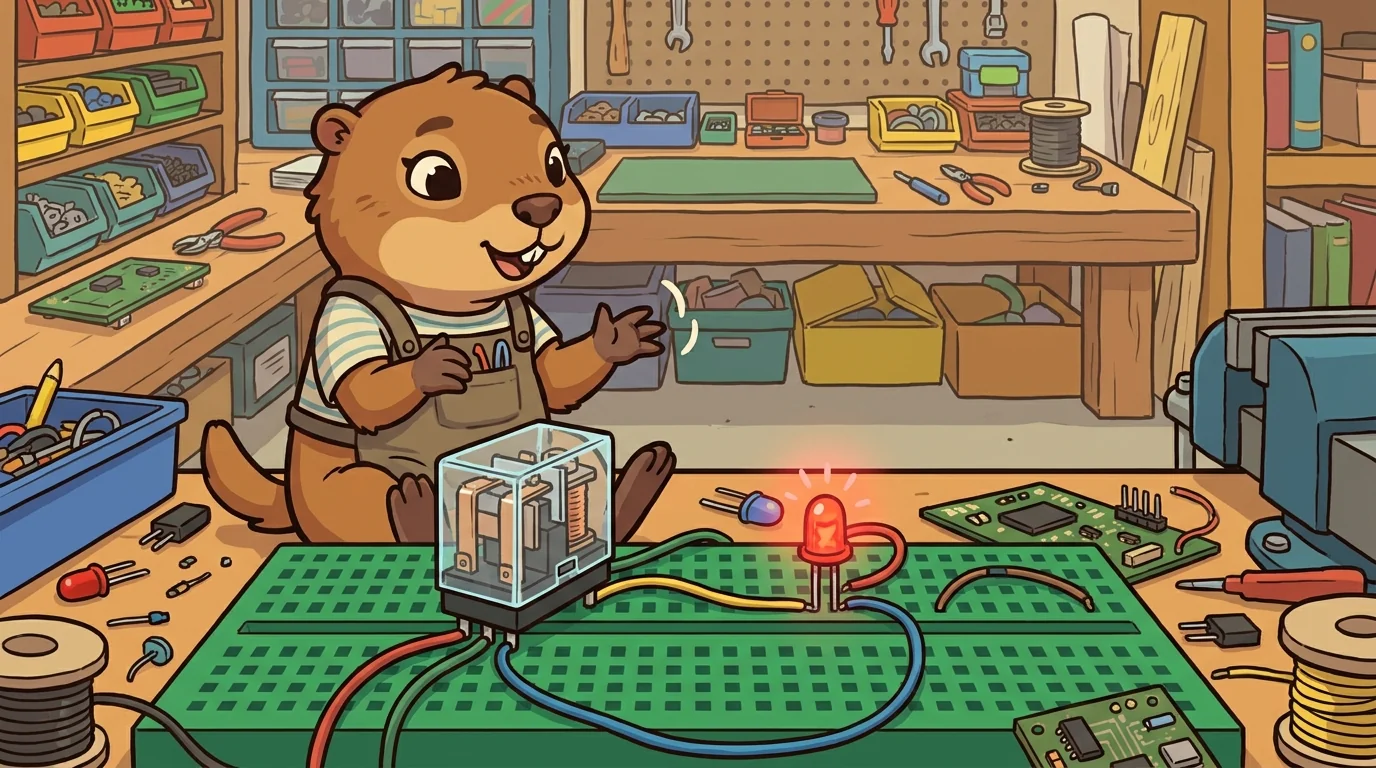
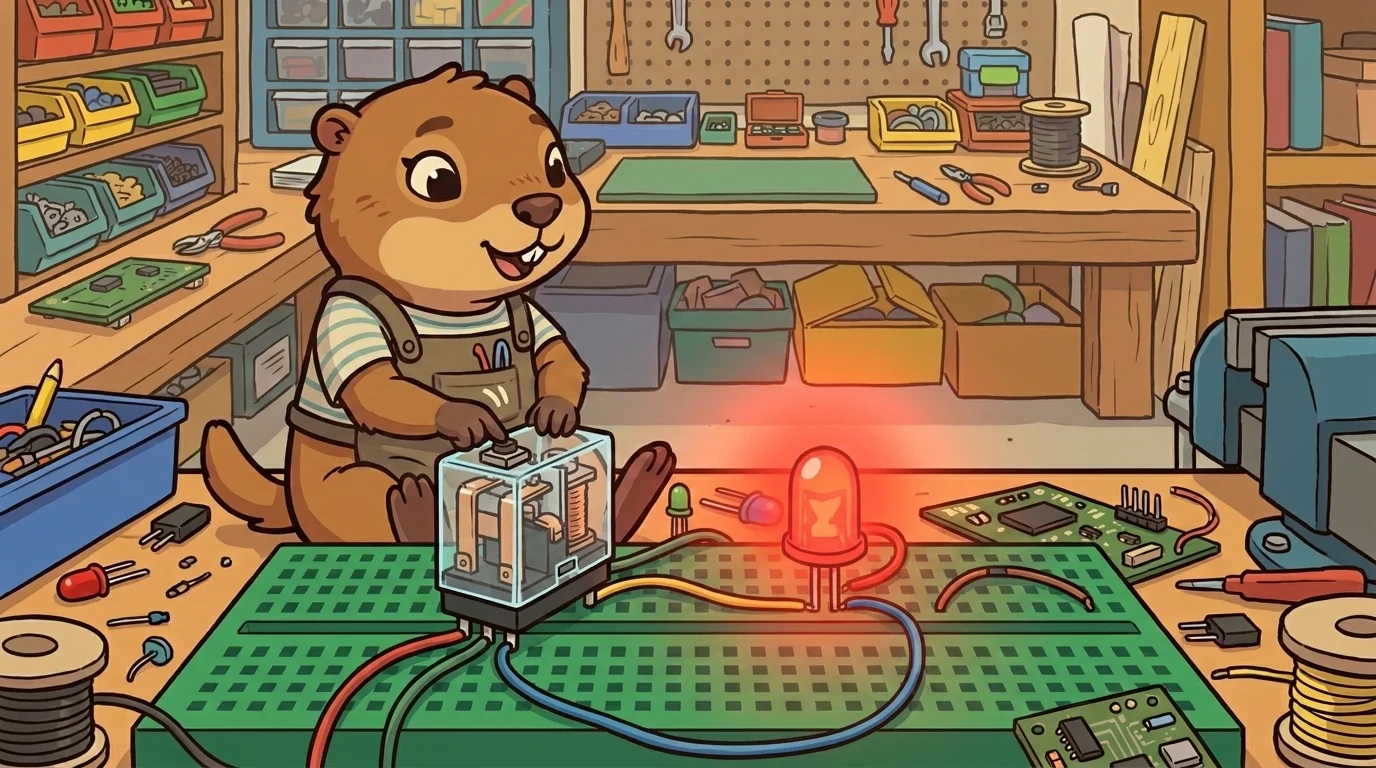
On the workshop bench, a young prairie dog named Relay sat by a little component that went click — and every time it clicked, a light across the breadboard blinked on or off.
Prairie dogs live by gates and tunnels — open this way, closed that way — and Relay had made gates her craft. "A switch is a gate in the wire," she said, opening and closing her paws like a little door. "Closed, the current passes. Open, it stops. On or off. That's the simplest, most powerful idea in the whole circuit: control." Beside her sat the special one — a relay — a gate that could be flipped not by a finger, but by another part of the circuit itself. "This one," she said proudly, "flips itself."
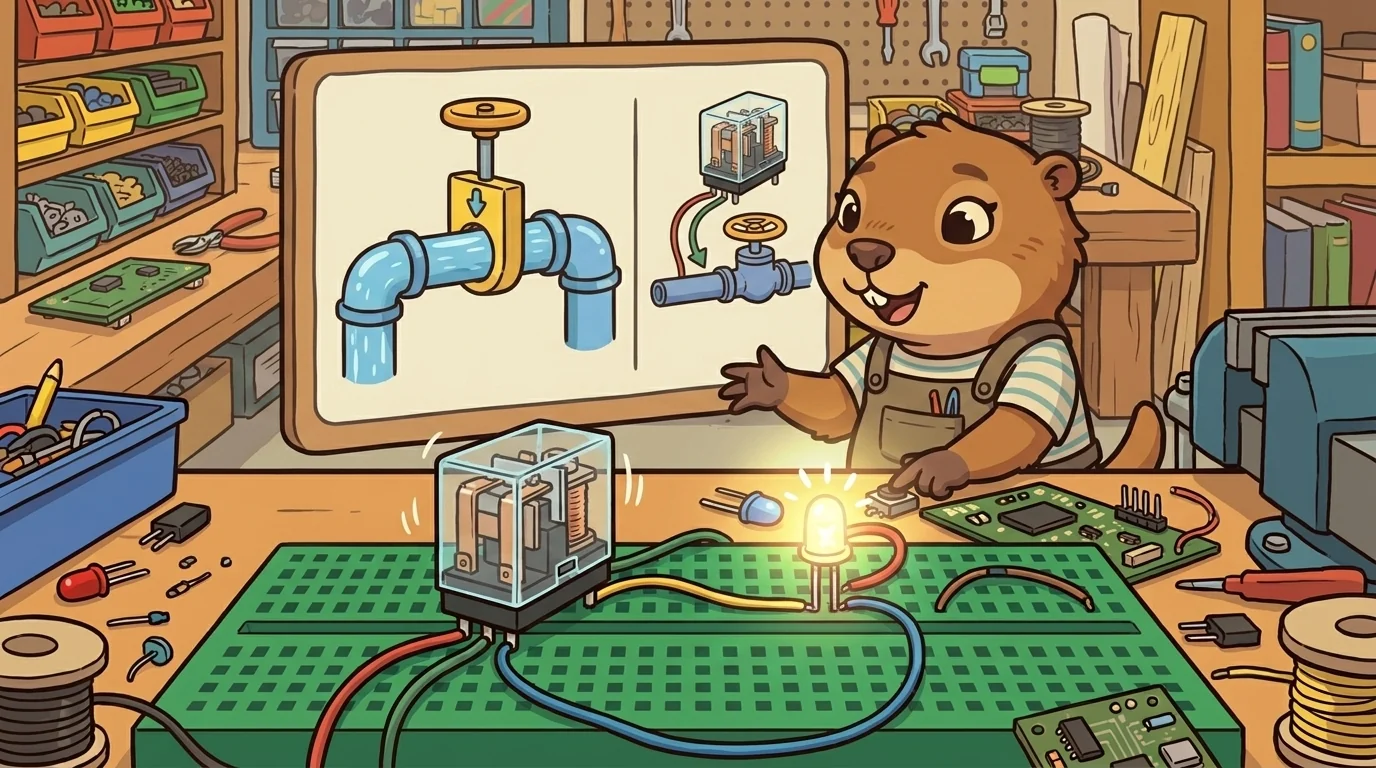
Relay used the workshop's valve-and-gate picture. Push is pressure, Flow is the current — and a switch, she explained, is a valve in the pipe. "Open the valve, water flows. Close it, it stops. A switch is exactly that for current. There's no 'a little bit on.' A switch is a clean choice: open or closed." That clean either/or, she loved to point out, is the seed of everything digital — every 1 and 0, every yes and no, starts as a gate that's open or closed.
The relay was her favorite because it added the twist that makes robots possible: a circuit that controls itself. "A plain switch needs your finger," she said. "A relay lets a small signal flip a big gate. A tiny current from a sensor clicks the relay, and the relay opens the gate for a big motor. The little signal decides; the big flow obeys." She'd build it on the breadboard — a gentle press triggers the click, and a much brighter light or a motor roars to life. "Small flips big," she said. "That's control."
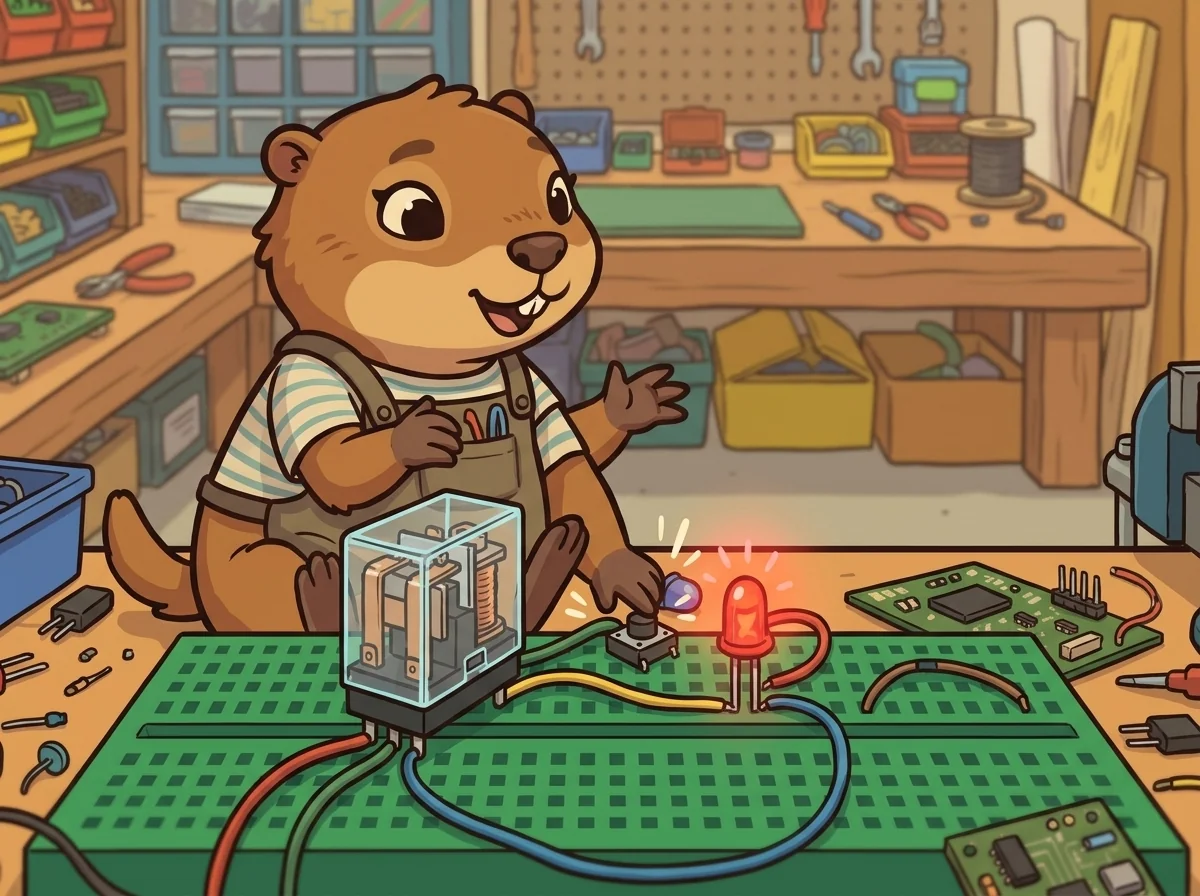
Relay never dressed it up. "It's a gate," she'd say. "Open or closed. You can hear it click and watch the light obey. Build it on the bench and flip it yourself — then wire it so the circuit flips it for you." SEE-and-BUILD, always — control you could hear, watch, and wire with your own paws.
Relay came from a burrow-town famous for its gate-keepers — prairie dogs who opened and closed the tunnel-doors that kept the town safe and dry. Young Relay was the one who rigged a gate to open by itself when the water rose — a little float that tripped a big door. The day it worked, saving the low tunnels from a flood while everyone slept, she understood her craft: a small, well-placed signal can flip a gate far bigger than itself.
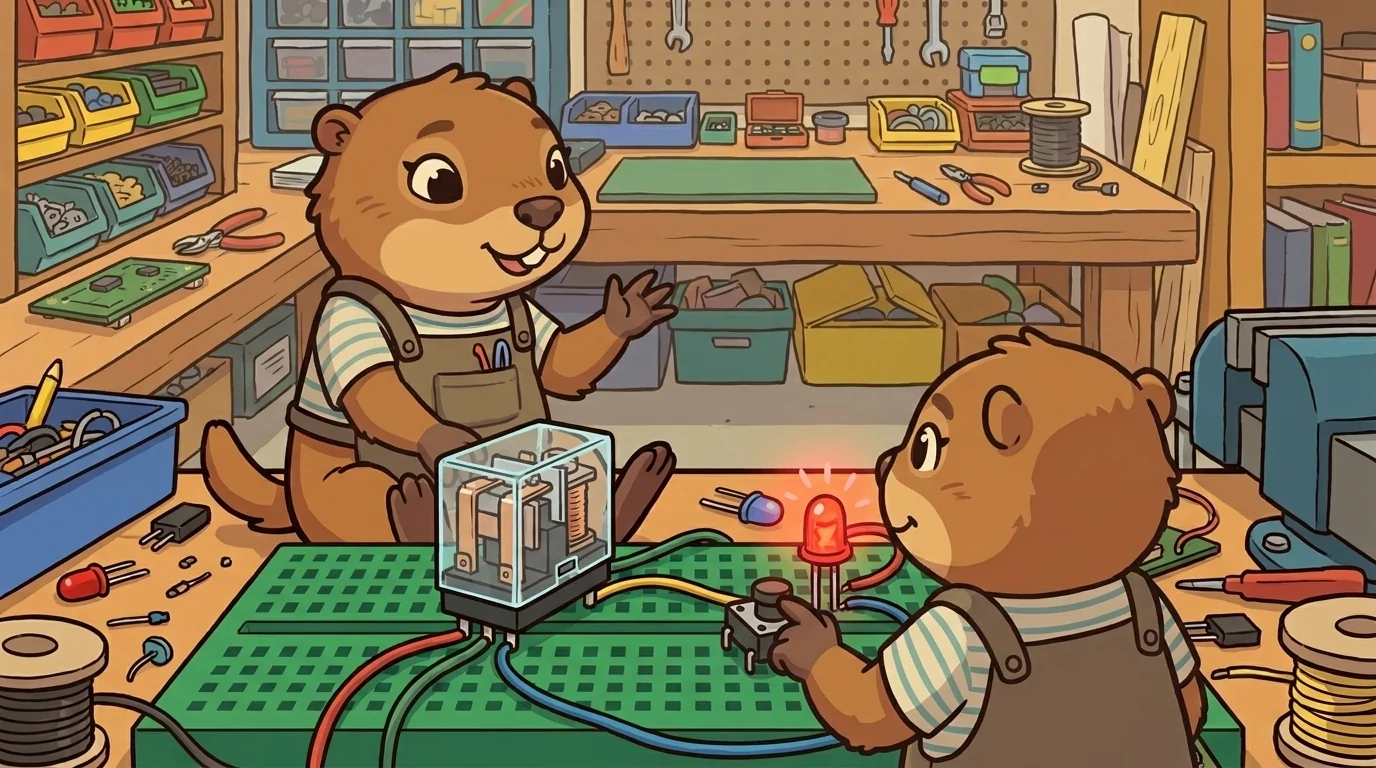
One day Watt, the workshop mentor, came to the burrow-town.
"What is a switch — and a relay?" Watt asked.
Relay clicked her little gate. "A switch is a gate in the wire — open or closed, on or off, a clean choice that controls the current," she said. "A relay is a switch the circuit can flip itself: a small signal clicks it, and it opens the gate for a big flow. Small flips big. That's how a circuit makes decisions." Watt nodded. "You are appointed," he said.
In her classroom, Relay starts each lesson with the satisfying click and the blinking light, then has students wire a plain switch, then a relay, until they feel the difference between "my finger flips it" and "the circuit flips it."
She teaches her students a few habits about switches and relays: A switch is open or closed — a clean choice. No halfway. Closed passes current; open stops it. That either/or is the root of all digital logic. On/off is the first decision a circuit can make. Every yes/no, every 1/0, starts as a gate. A relay lets small flip big. A tiny signal clicks the relay; the relay controls a much bigger flow. That's how sensors drive motors. A circuit can flip its own gates. Wire a relay to a sensor and the circuit decides for itself — the start of every robot. * Hear it, watch it, wire it. The click, the light obeying, the motor starting — control you can build and check.
Relay tells her students, "My first self-flipping gate was jittery — it clicked on and off, on and off, unsure. That's not a failure. That's a signal too weak or too wobbly to decide cleanly. You steady the signal, and the gate clicks once, sure."
When a student asks why a circuit would need to flip its own switches, Relay always answers the same crisp way, with a click:
"Because a circuit that can flip its own gates can decide. Small signal in, big flow out — and suddenly the circuit isn't just carrying power, it's making choices."
Relay presses a gentle trigger and hears the clean, single click as the big light snaps on, decisive and sure, and the made-up-my-mind clarity she loves has settled into a quiet, little-flip-big-result pride — the gladness of a small signal, well-placed, opening a gate far bigger than itself.
Hear it as an audio drama
A short play starring Relay, from CircuitForge. Different voices, same idea. Listen any time after you read.
Loading audio…
Read the drama script
- Narrator: From Spark and Anvil and CircuitForge — this is Relay, in chapter 1 of the CircuitForge cast.
- Narrator: This drama uses an AI-generated voice. Voiced via Gemini 2.5.
- Narrator: Relay is a young prairie dog who sits by a little component that goes click — and every time it clicks, a light across the breadboard blinks on or off.
- Relay: A switch is a gate in the wire. Closed, the current passes. Open, it stops. On or off. That's the simplest, most powerful idea in the whole circuit — control.
- Relay: I am Relay. My gift is switching. And this special one — a relay — is a gate that can be flipped not by a finger, but by another part of the circuit itself. This one flips itself.
- Narrator: A student asked why a circuit would need to flip its own switches.
- Relay: Because a circuit that can flip its own gates can decide. A plain switch needs your finger. A relay lets a small signal flip a big gate — a tiny current from a sensor clicks the relay, and the relay opens the gate for a big motor.
- Relay: Small flips big. That's the twist that makes robots possible. There's no 'a little bit on' — a switch is a clean choice: open or closed. That either/or is the seed of every 1 and 0.
- Narrator: Relay came from a burrow-town of gate-keepers, who opened and closed the tunnel-doors that kept the town safe and dry.
- Relay: I was the one who rigged a gate to open by itself when the water rose — a little float that tripped a big door. It saved the low tunnels from a flood while everyone slept.
- Narrator: One day the mentor, Watt, came to the burrow-town and asked — what is a switch, and a relay?
- Relay: A switch is a gate — open or closed, a clean choice that controls the current. A relay is a switch the circuit can flip itself. Small signal in, big flow out. That's how a circuit makes decisions.
- Narrator: Watt nodded, and Relay was appointed to teach it.
- Relay: Hear the click. Watch the light obey. Wire it so the circuit flips it for you — and suddenly the circuit isn't just carrying power. It's making choices.
- Narrator: You've been listening to a Spark and Anvil chapter, written by the Spark and Anvil writing team for ages 9 to 14.
- Narrator: Apps stay free forever.
- Narrator: Curriculum aligned to Next Generation Science Standards.
- Narrator: Released under Creative Commons BY-NC-SA 4.0 for educational reuse. Visit Spark and Anvil for the full transcript.
The CircuitForge ensemble
Relay is one of the friends in CircuitForge. Each friend shows you one idea by how they act; meet them all and you have the whole subject.
-
Push
Voltage — the pressure difference that drives current; measured in volts
-

Flow
Current — electrons moving through wires; measured in amperes
-

Damp
Resistance — the slowdown; measured in ohms; Ohm's Law (V = I × R) emerges from Push + Flow + Damp together
-

Branch
Series vs parallel topology — one path or many; the topology decides the behavior
-

Build
Component-wiring craft — every component has a job; wire them together and the circuit comes alive
-

Store
Capacitance — a tank that fills with charge and hands it back; smooths bumps
-

Coil
Inductance / electromagnetism — a wound wire turns current into a magnetic reach
-
Diode
Diode — the one-way gate; current flows one direction and is blocked the other
-

Fuse
Fuse — the deliberate weak link that melts to break the circuit when current runs too high, protecting the line