
Reclaim
ENERGY TRANSITION — *swapping the power we get from burning fuels for power we catch fresh from the sun, wind, and water — energy that keeps arriving and doesn't add carbon to the sky.*
Loading audio…
Press play to listen along. The line being read lights up as you go.
Show full transcript
Loading transcript…
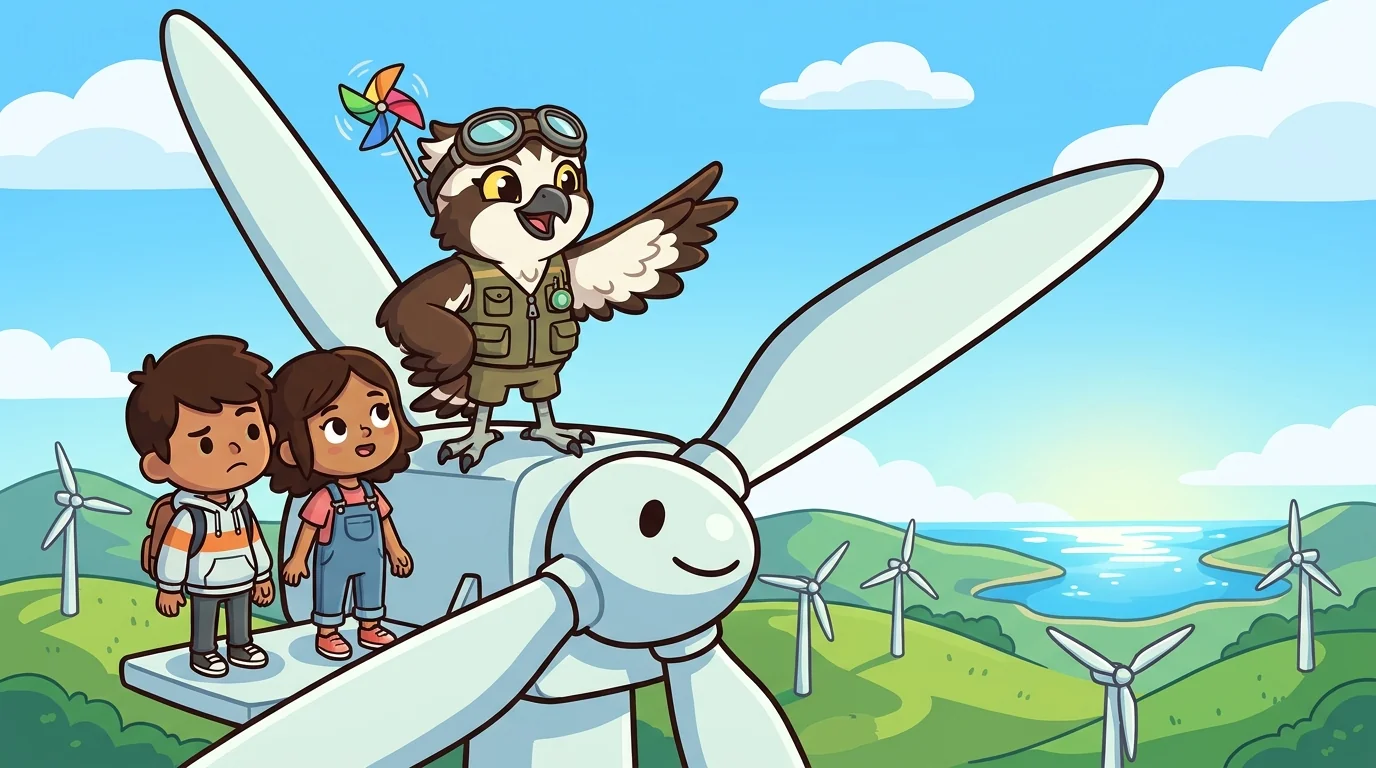
Reclaim adjusted her flight goggles with the tip of her left primary feather. A brass pinwheel was soldered directly to the wire rim above her brow. It spun so fast in the ridge wind that its four blades blurred into a faint bronze halo.
Down in the river valley, the world was mostly gray slate and wet gravel. Up here on Hawk’s Ridge, everything hummed.
Reclaim perched on the service railing of Wind Turbine Four. It was her favorite perch in the county. The white fiberglass tower reached nearly three hundred feet into the cold mountain air. Every eight seconds, one of the three massive composite blades swept past her perch with a heavy, rhythmic whoosh. The air displacement ruffled her chest down, but she did not flinch. She liked the vibration in her talons. It felt like a giant clock keeping time for the sky.
A metal hatch clanged open twenty feet below her at the top of the ladder.
Two human kids hauled themselves onto the grated maintenance platform. Both wore heavy fleece jackets and bulky safety harnesses. The boy, Leo, carried a battered green notebook with damp, dog-eared corners. His sister, Maya, clipped her safety tether to the guardrail with a sharp metallic snap.
"We climbed eighty-four rungs," Leo panted, leaning over his knees. "My calves feel like wet cement."
"Eighty-six rungs," Maya corrected him. She wiped wind-blown hair from her mouth. "You skipped two near the third junction box."
Reclaim hopped down from the upper rail to the steel mesh floor. Her talons made a neat clack-clack sound on the galvanized steel. "You made good time. The thermal lift off the south face is picking up. If you waited twenty minutes, the wind would have pushed you sideways off the ladder."
Leo did not look impressed by the wind. He stared down at his notebook, where a hand-drawn line graph plunged off the bottom of the page.
"Our science teacher showed us this chart this morning," Leo said. His voice was small and tight against the rushing air. "It tracks global emissions. The line just goes straight up into the ceiling. He said burning fossil fuels is cooking the planet, and nobody is moving fast enough to stop it."
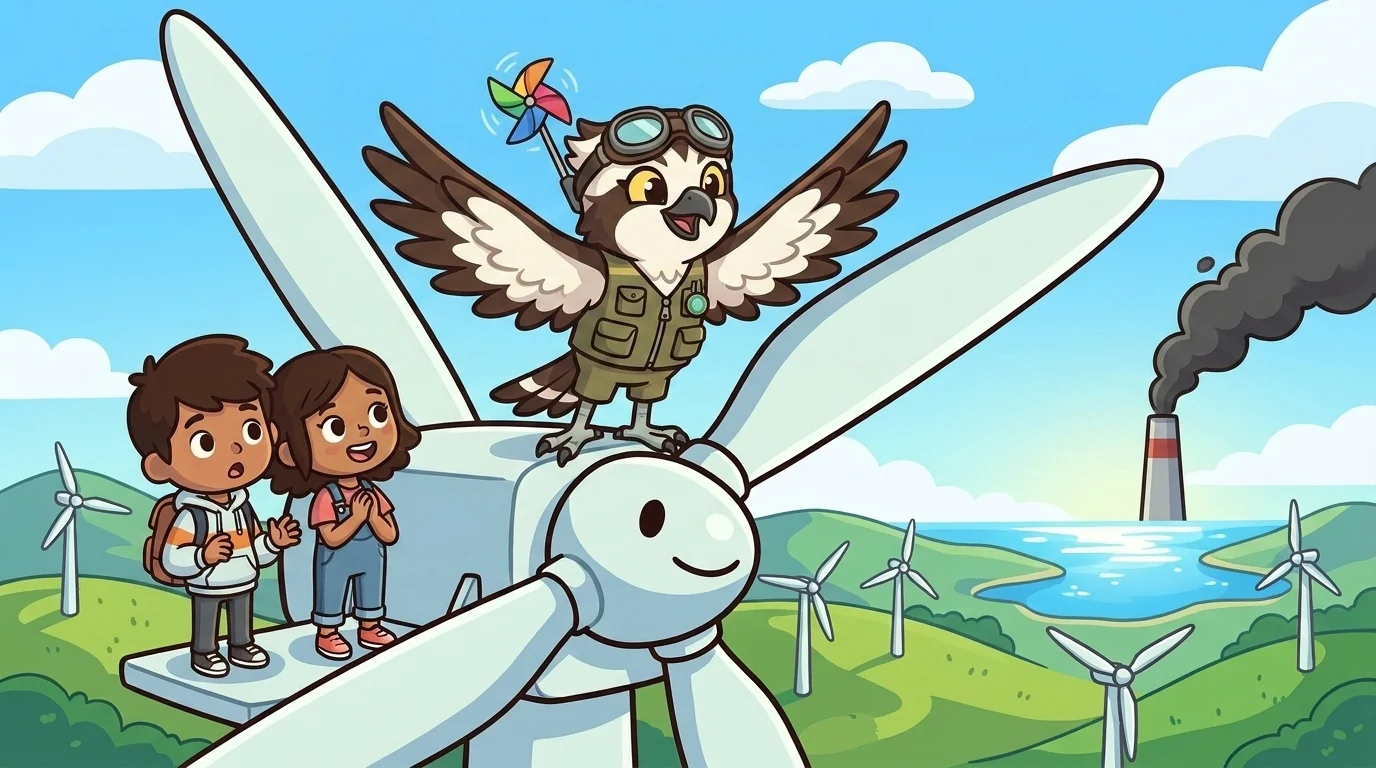
Maya looked out across the horizon. Her shoulders were hunched against the cold draft. "It feels like we’re already too late. Everyone online says the sky is basically broken."
Reclaim tilted her head. Her golden raptor eyes fixed on Leo’s notebook. Her pinwheel whirred steadily in the breeze, throwing tiny sparks of morning sunlight across the metal platform.
"The sky isn't broken," Reclaim said plainly. "The sky is just chemistry. It does exactly what you feed it."
She stepped to the edge of the railing and extended one broad, barred wing toward the distant southern horizon.
Ten miles away, near the mouth of the bay, three concrete smokestacks stood like thick gray fingers against the clouds. A steady plume of white and brown exhaust drifted from their tops, smudging the blue morning. Long lines of black railcars sat idle on the siding tracks below the stacks, piled high with crushed bituminous coal.
"Look at the old station down there," Reclaim said. "To keep the lights on in your school, humans have spent two hundred years digging up old carbon and setting it on fire. Coal, oil, fossil gas. You burn a lump of rock, the heat boils water, the steam spins a copper rotor, and you get electric current."
"And the smoke goes up," Leo muttered.
"Every single time," Reclaim agreed. "The fire gives you work, but the exhaust stays in the air blanket. That’s the old engine. It wasn't evil. It ran your hospitals and built your bridges. But it had a massive design flaw: it assumed the sky had no bottom."
"So what are we supposed to do?" Leo kicked the steel toe of his boot against the ladder frame. "Shut down the power grid? Go live in dark caves with candles?"
"Candles are still combustion," Maya pointed out dryly. "Candles make smoke too."
"Exactly," Reclaim chirped. She gave a brisk hop that set her pinwheel spinning at double speed. "The cave idea is the doom-story, Leo. People love the doom-story because it lets them stop thinking. If everything is doomed, you don’t have to build anything new. You just sit around and complain about the dark."
She turned around and gestured toward the machinery humming beneath their feet.

"We don't need less power," Reclaim said. "We need a clean swap. We are living through the great energy transition."
Leo frowned at the word. "Transition just sounds like a meeting adults have when they want to avoid doing work."
"Look with your eyes instead of your notebook," Reclaim answered. She pointed with her talon directly into the nacelle housing behind them.
Inside the fiberglass housing, a low-speed shaft turned under the massive torque of the rotor blades. It fed into a gearbox the size of a minivan, which spun a generator at fifteen hundred revolutions per minute. Thick copper cables, wrapped in heavy black insulation, plunged down the center of the hollow tower into the ground.
"Feel that railing," Reclaim told them.
Maya placed her bare palm flat against the cold tubular steel. "It’s shaking. Just a tiny buzz."
"That buzz is four megawatts of electricity moving down to the valley substation," Reclaim said. "No smokestack. No railcars full of crushed rock. No ash pond leaking into the creek."
"Because the wind pushes the blades for free," Maya said.
"The wind does the pushing whether we stand here or not," said Reclaim. "Look down at the south slope below the ridge."
Leo stepped beside his sister and peered over the steel grating.
The entire southern flank of the mountain, where the soil was too rocky for timber, was covered in thousands of dark blue rectangles. They were angled upward toward the sun like rows of shining shields. Through the clear morning air, they looked like an inland sea of glass.
"Photovoltaic panels," Reclaim explained. "Inside those silicon wafers, sunlight knocks electrons loose from their atoms. The electrons flow through a circuit. No boiling water. No fire. No exhaust."
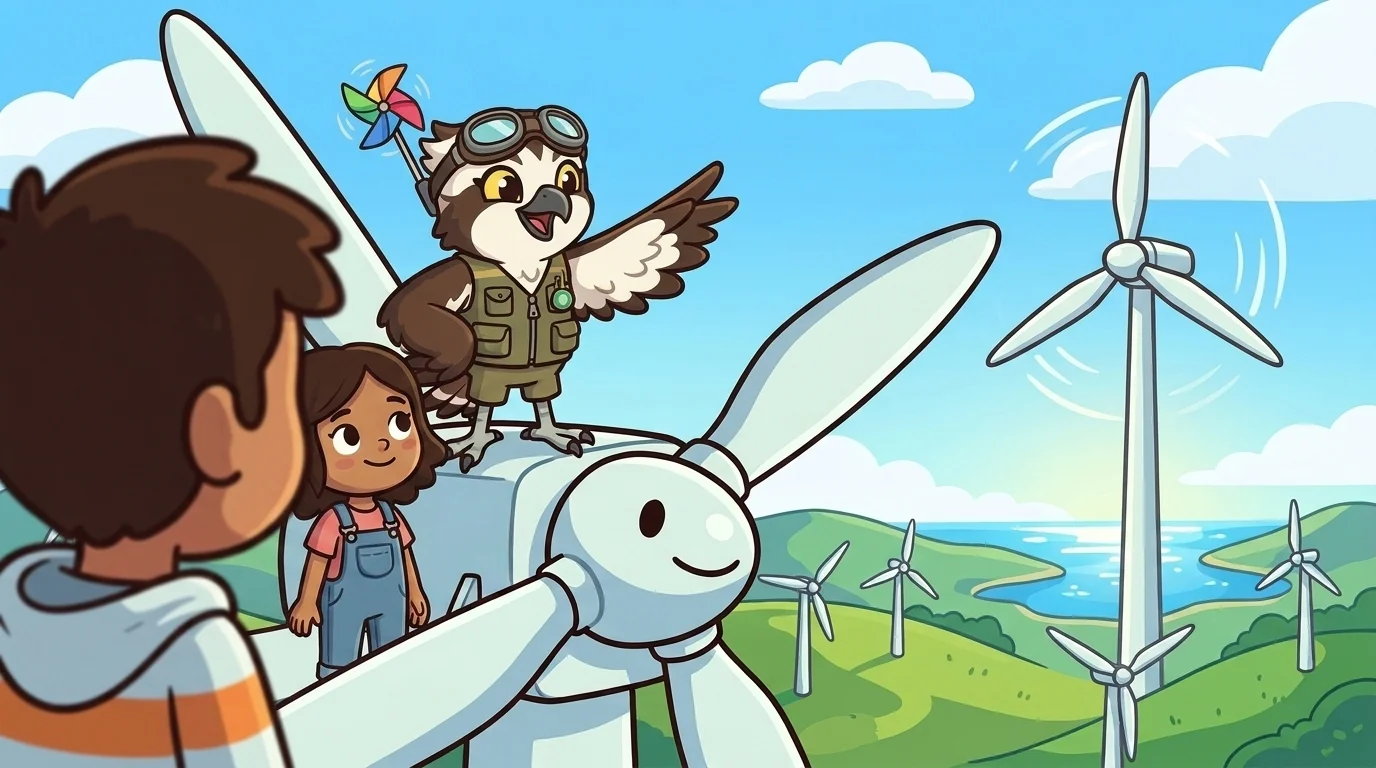
"What happens when the sun goes down?" Leo asked. His tone was cautious, searching for the catch. "Or when the wind stops blowing on Hawk’s Ridge?"
"Then the river takes over," Reclaim replied, pointing her beak toward the deep canyon to the west. "The hydro turbines at the gorge run day and night on falling water. And down at the old rail yard, they just installed twelve shipping containers packed with lithium-iron batteries. When the ridge gets a gale like this morning, we bank the extra power in the cells. When the wind dies at sunset, the batteries push the current back into the line."
Leo looked down at his graph. The grim black line suddenly looked less like a death sentence and more like an old blueprint that needed replacing.
"It’s just machinery," Leo said softly.
"It is entirely machinery," Reclaim said with a dry snap of her beak. "The old machines burned old sunlight that was trapped in underground rocks millions of years ago. These new machines catch sunlight that arrived eight minutes ago. That is the whole trick."
Maya leaned against the railing, watching the giant blade sweep across the sky above them. The shadow of the blade fell across the platform and vanished into the valley. "So the power isn't running out."
"Power never runs out," Reclaim said. "The sun will pour thermal energy across this continent for another four billion years. The wind will blow as long as the equator is warmer than the poles. The river will run as long as clouds drop rain on the peaks. The fuel keeps arriving every single morning, delivered right to our roof."
She picked up a loose steel washer from the maintenance tray by the hatch and dropped it. It fell through the air, flashing in the sun until it pinged softly against the grass three hundred feet below.
"You can burn a lump of coal once," Reclaim added. "When the fire goes out, your rock is gone, and the carbon is in the clouds. But you can catch the wind ten thousand times, and the breeze keeps moving toward the coast without losing a single molecule."
Leo slowly closed his green notebook. He slipped his pencil into the spiral binding and tucked the pad into his jacket pocket.
"They don't show the turbines in the news articles," he said. "They only show the smokestacks."
"Smokestacks make dramatic photographs," Reclaim said, clicking her tongue. "Clean copper wires just sit there and do their job without catching fire. It’s hard to make a scary headline about a silicon panel sitting quietly in the grass."
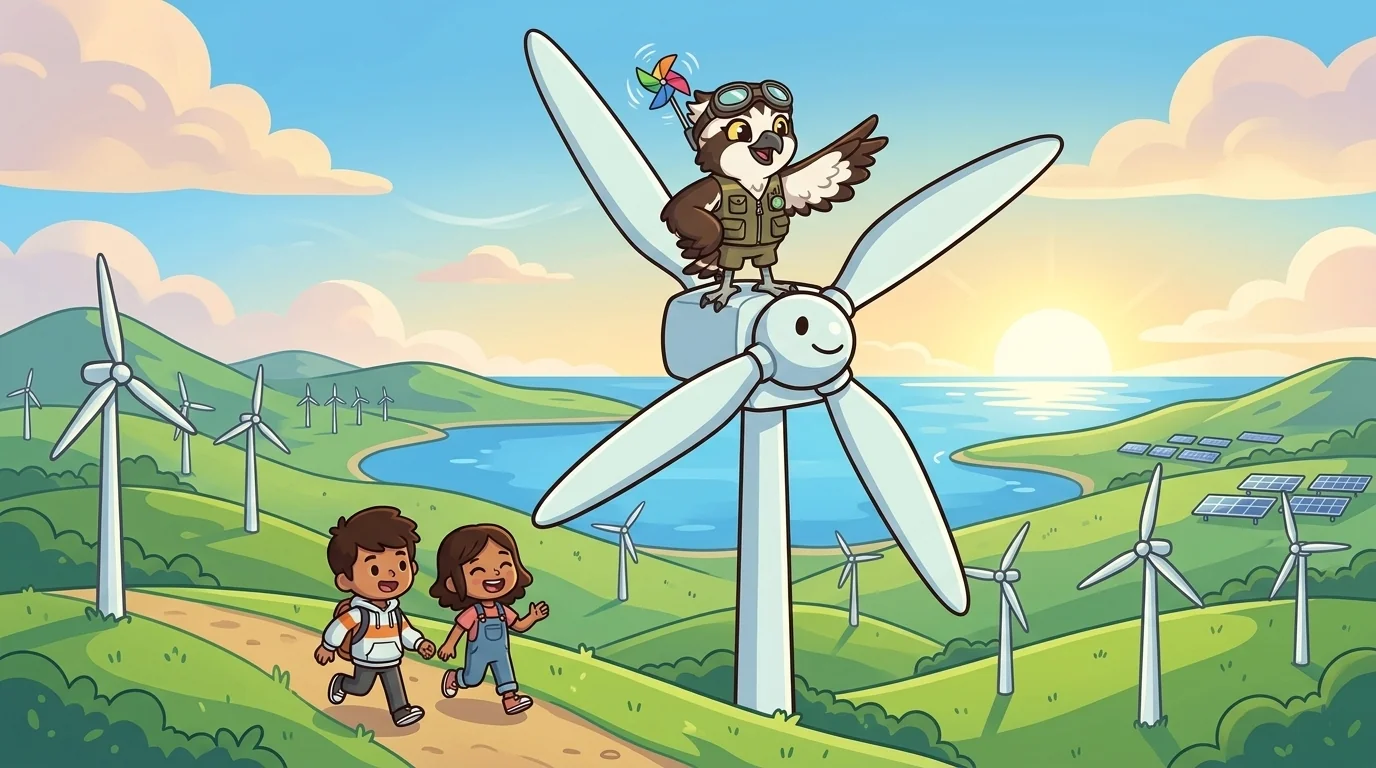
"My teacher said we need hundreds of thousands of these," Maya noted, looking across the ridge at the twelve other white towers turning in unison.
"Then we will build hundreds of thousands," Reclaim replied. "Humans built thirty million miles of paved roads in a single century. You laid telegraph cables across the bottom of the Atlantic Ocean with wooden steamships. You put a water pipe into almost every kitchen on the continent. Don't tell me you can't put copper rotors on windy hills."
She ruffled her feathers, settling her wings tightly against her flanks. The brass pinwheel on her goggles spun in a steady, cheerful blur.
"Despair is lazy," Reclaim said gently. "It pretends the future is already written down in a book. But the transition isn't a theory. It’s steel, silicon, and copper. It’s an afternoon shift with a torque wrench."
Maya smiled and checked her harness clips. "We should get down before the thermal picks up more. I want to measure the output at the valley inverter."
"Take the service road by the creek," Reclaim advised. "The solar arrays are tracking east-southeast right now. You can hear the hum of the step-up transformers from the path."
The two kids unhooked their lanyards, swung their boots onto the ladder rungs, and began their descent inside the hollow white tower. Their voices echoed softly inside the steel cylinder as they counted the rungs downward.
Reclaim hopped back to the highest rail of the nacelle.
She spread her wings six feet from tip to tip, caught the rising mountain updraft, and stepped off the steel into the empty air. She didn't have to flap once. The cold air pushed firmly under her primary feathers, lifting her fifty feet above the ridge in three seconds flat.
Below her, the white blades turned cleanly against the green slopes. The solar fields gleamed like dark mirrors in the morning sun. The river tumbled through the canyon, bright and relentless, spinning the copper coils in the dark bedrock below.
The power was everywhere. It was falling on the leaves, pushing through the gaps in the hills, and rushing toward the sea.
Reclaim banked left into the clean wind, leveled her goggles, and let the sky carry her forward.
The ClimateQuest ensemble
Reclaim is part of ClimateQuest's distributed-narrative cast. Each character embodies a different curricular primitive; together they teach the full subject.
-

Haze
Atmosphere (air, gases, the sky as a thin layer)
-

Squall
Weather events (vs. climate — short-term variability)
-

Round
Carbon + water cycles (recurring loops, balance)
-

Blanket
Greenhouse effect (insulating gases)
-

Stitch
Collective action / policy / repair
-

Glint
Ice-albedo feedback (bright ice reflects, dark water absorbs — a warming loop)
-

Fathom
Ocean heat + carbon sink (thermal inertia — the sea stores and slows change)
-

Cusp
Tipping points (thresholds where small change flips a system all at once)
-

Thaw
Permafrost thaw (frozen ground warming — releasing an old carbon secret)