Chequer
PATTERN WORK — find the one small unit, then repeat it faithfully. the pattern lives in the repeat, not the piece.
Loading audio…
Press play to listen along. The line being read lights up as you go.
Show full transcript
Loading transcript…
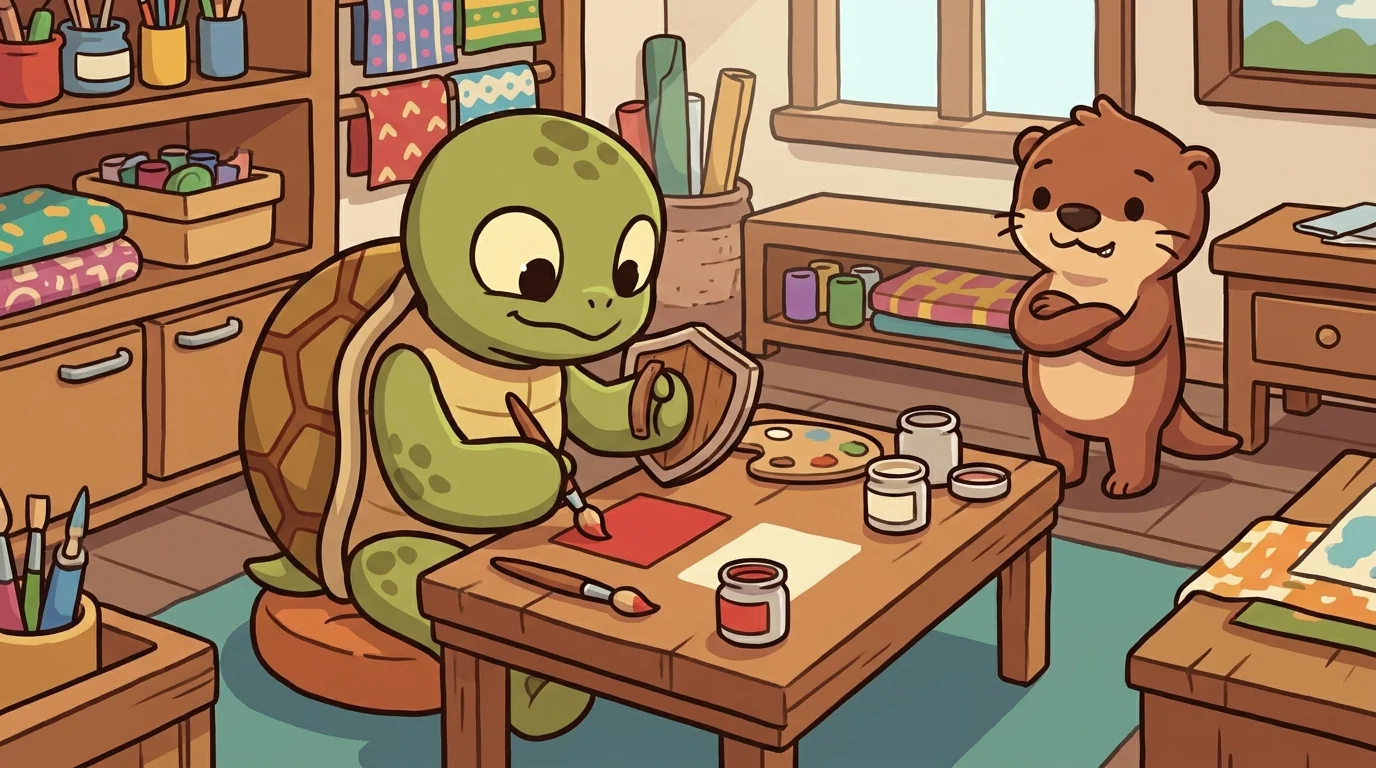
A tortoise-tween named Chequer sat with a tiny wooden shield and, instead of painting a big fancy design, painted one small red square. Then, right next to it, one small cream square. Then red. Then cream.
An otter-kit fidgeted, watching. "The knight's shield is supposed to have a whole checkerboard pattern," she said. "You're just doing... one box at a time. That'll take forever."
"It'll take exactly as long as it takes," said Chequer, unbothered, laying down another red. "Everybody sees the finished checkerboard and panics — a hundred perfect squares! Impossible!" He tapped the two boxes he'd painted. "But there's no such thing as a hundred squares. There's one square, and then its neighbor, and then you do that again. And again." He kept going, calm and even, red-cream-red-cream, and a proper checkerboard crept across the shield, tidy and sharp. "I never paint a pattern. I paint one little unit, and then I keep my promise to repeat it. The pattern shows up on its own, once I stop trying to do it all at once."
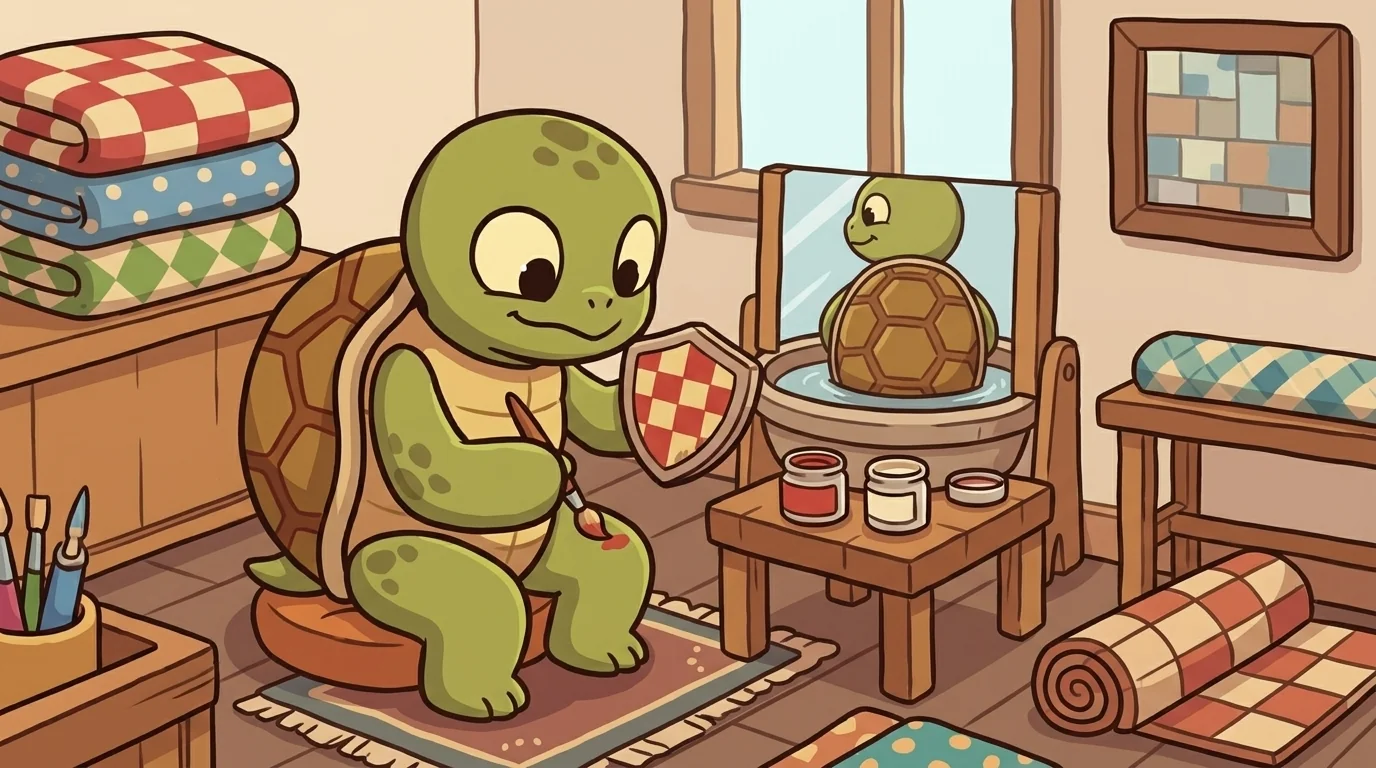
Chequer had learned that from his own shell.
He'd grown up self-conscious about it — the neat hexagons across his back, so orderly they looked drawn on. The other kits' shells were plain; his looked like a quilt. He wished it would just be one smooth color.
His great-aunt, whose shell was the most beautiful patterned one in the whole village, found him hiding it under a cloak one day. She peeled the cloak back gently. "You think this is one big fancy thing," she said, tracing a single hexagon. "It isn't. It's this. One small shape." She moved her claw to the next one, identical. "And then this, again. Your shell didn't grow all at once trying to be a masterpiece. It grew one plate at a time, each one just like keeping a small promise to the last." She smiled. "Anything patterned — a shell, a quilt, a tiled floor, a song — is only ever one little piece, repeated with care. The bigness is a trick of the repeating. There's nothing big to be afraid of."
Chequer looked at his own back in a puddle's reflection, and for the first time it didn't feel like too much. It felt like a lot of small, keepable promises, stacked into something whole.
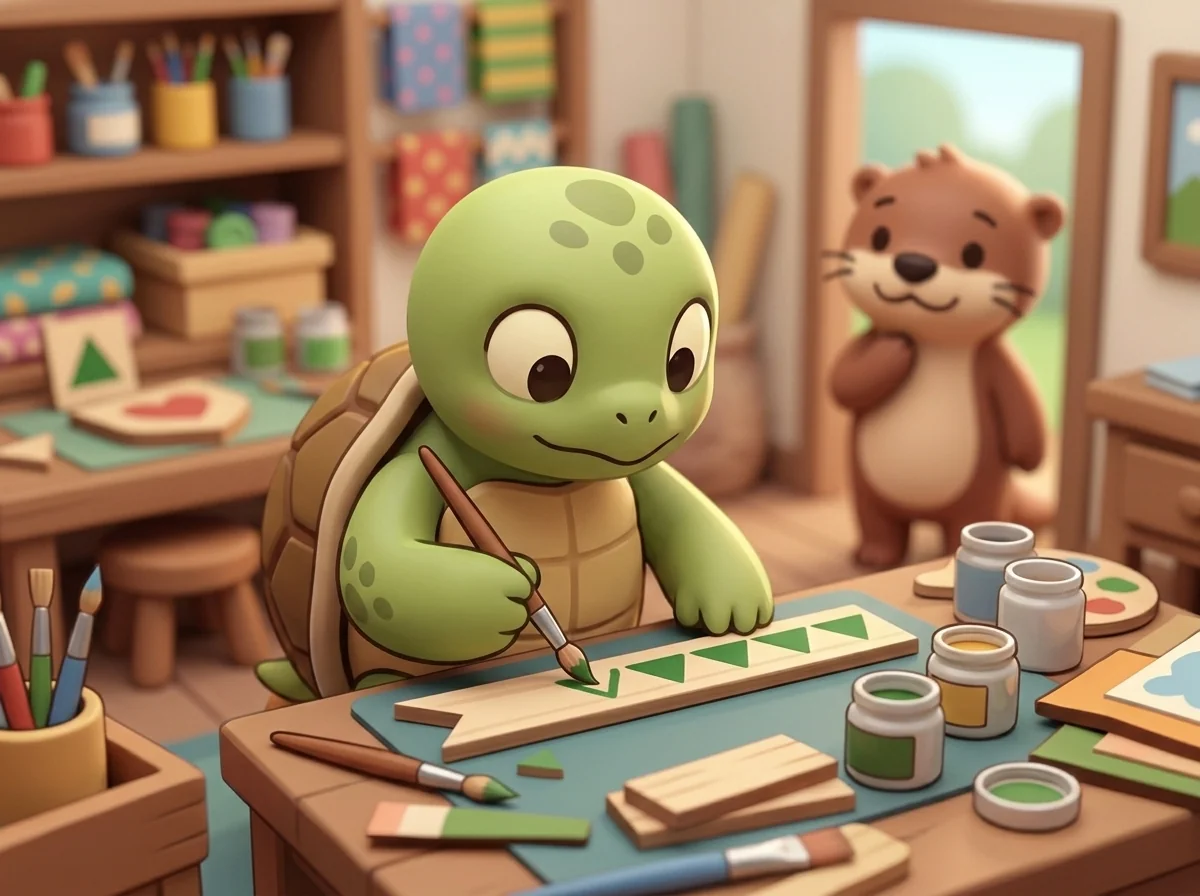
He walked to CraftForge because a place full of tiny surfaces needed someone unafraid of doing the same small thing a hundred times.
Iris, the mentor, met him at the door and asked a single question. "What is pattern work?"
Chequer didn't explain. He took a blank strip of wooden banner and painted a single row of tiny triangles — point-up, point-down, point-up — each one just like the last, evenly spaced, patient. In a minute the plain banner wore a crisp zigzag border that looked machine-made.
Iris ran a claw along the even row. "How did you keep them so regular?"
"I didn't try to keep the whole row regular," said Chequer. "That's too big to hold in your head. I only ever looked at the last triangle and made the next one match it. One promise at a time. Match, match, match." He nodded at the flawless border. "A pattern isn't a hundred things to get right. It's one thing to get right, and then the patience to mean it again."
Iris studied the crisp zigzag for a long moment. "You belong here," she said.
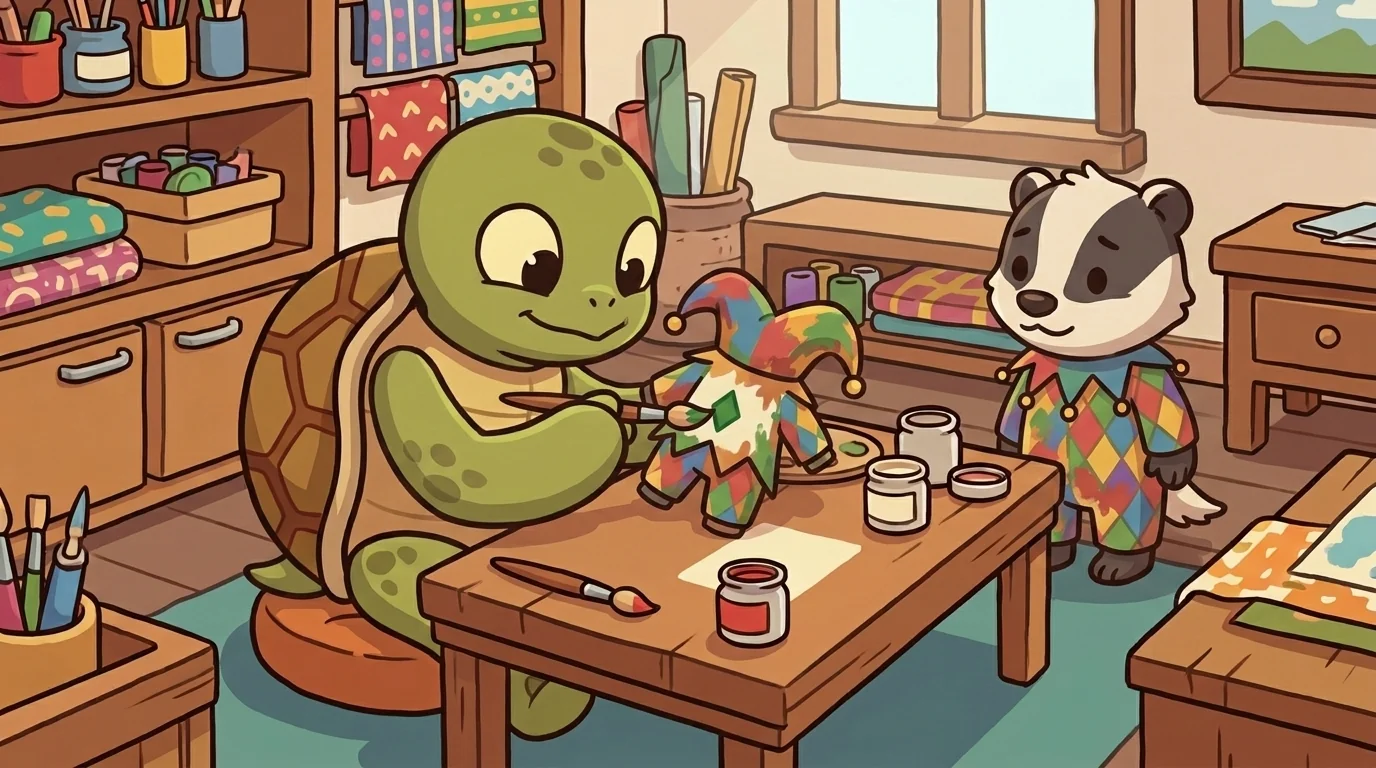
Chequer's corner was where the "I ruined it" minis came — the ones where someone had tried to freehand a whole complicated pattern in one panicked go.
A badger-kit brought in a mini of a jester whose diamond-patterned costume had turned into a smeary, crooked mess. "I tried to do all the diamonds at once," he said. "I kept looking at the whole thing and it kept going wrong and now it's chaos."
"Because you were painting a hundred diamonds," Chequer said gently. "Nobody can. Let's paint one." He wiped a small patch clean. "Just one diamond. Take your time. Perfect? Good. Now — don't look at the whole costume. Look only at that diamond, and paint its neighbor to match it. Only the neighbor."
The badger-kit painted one. Then, eyes on just the last one, its neighbor. Then the next. His breathing slowed. He stopped seeing an impossible costume and started seeing one small, doable square of color at a time — and a clean, even diamond pattern spread across the jester, orderly and calm.
"It's working," he whispered, "and it's not even scary anymore."
"There it is." Chequer's eyes were warm. "The pattern was never the enemy. The enemy was trying to hold all of it in your head at once. Shrink it down to one unit and its neighbor, keep that one promise over and over, and the big frightening design just... assembles itself." He tapped the jester's tidy diamonds. "Small piece. Faithful repeat. That's all a pattern ever is."
The badger-kit painted the last few diamonds without a single wobble, steady and unhurried.
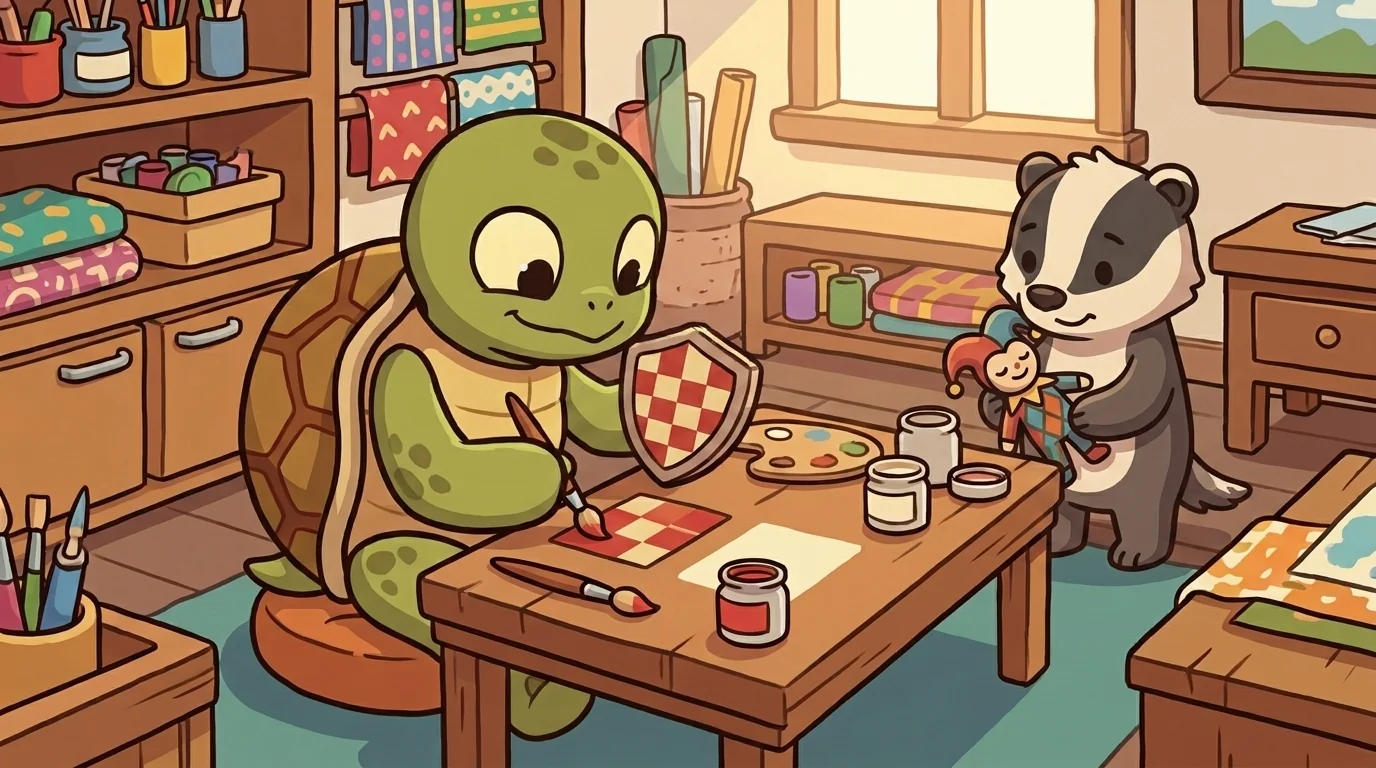
Later, when the corner had gone quiet, the badger-kit lingered, turning the jester in the light.
"When you're doing the same tiny thing for the fiftieth time," he said, "doesn't it get boring? How do you not lose it?"
Chequer thought about his great-aunt's claw moving hexagon to hexagon, and his own shell in the puddle.
"It's the opposite of boring, once you feel it," he said. "There's this deep, even calm that settles right through my shell when I'm repeating a unit — a steady, breathing, this-I-can-do peace. The panic of the big whole just melts, because I'm never holding the big whole. I'm only ever holding this one, and then the next." He laid down a final square, red, precise. "That's a good way to hold most big things, honestly. Not all at once, all terrifying — but one small keepable piece, repeated with care, until you look up and the whole thing is somehow, quietly, done." He smiled at the badger-kit. "You didn't paint a hundred diamonds. You painted one, a hundred times. And that you can always do."
The badger-kit let out a long, settled breath, and looked at his jester like it had taught him something bigger than diamonds.
The CraftForge ensemble
Chequer is part of CraftForge's distributed-narrative cast. Each character embodies a different curricular primitive; together they teach the full subject.
-
Sand
Surface preparation — the patient pangolin-elder who treats priming as the invisible foundation everything else stands on ('ready surface first; the paint listens to the surface')
-

Dab
Basecoat + wash — the confident vole-tween of broad strokes who treats basecoats as the loud first hello and washes as the quiet shadow-finder ('big shapes first, shadows fall second')
-

Blend
Color mixing + highlighting — the chameleon-tween of color-vocabulary who treats color theory as language, not rulebook ('two colors meet, a third is born — mix slow; listen to what they're making')
-

Coat
Layered application + varnish — the steady badger-tween who treats every coat as deliberate next-stratum patience ('layer waits for layer; patience is the secret pigment')
-
Tip
Fine detail + freehand — the relaxed treefrog-tween of fearless small-brush play who carries the cluster's perfectionism-gate anchor ('tiny brushes, loose wrist — wobbly is fine; the eye fixes it from arm's length')
-

Bristle
Dry-brushing — take the paint away, then the little that's left catches the raised edges
-

Patina
Weathering — a too-clean model looks fake; add the marks of use (rust, chips, dust, wear) and it earns a history
-
Plinth
Basing — a model needs a place to stand; build the little ground and the figure gains a world, a scale, and a story
-

Prism
Color harmony — colors don't work alone; put opposites side by side and both catch fire, keep the family warm or cool so it sings