
Crib
SIGNPOSTING — say the shape of your argument out loud so a listener can follow: first, second, therefore. Order isn't decoration; it's how ideas are heard. A good idea in a jumble is a ladder with the rungs in a heap.
Loading audio…
Press play to listen along. The line being read lights up as you go.
Show full transcript
Loading transcript…

Crib is a tidy marmot — chestnut with neat white paws — who carries a small slate ruled into numbered lines and a stick of soft chalk. Before he argues, he writes the order of what he's about to say, rung by rung, like a ladder. His craft is signposting — laying an argument out so a listener can climb it. "A good idea in a jumble," he says, "is a ladder with the rungs thrown in a heap. Nobody can climb a heap." So he says the shape out loud: "First, here's my claim. Second, here's my reason. Third, here's the proof. Therefore, this follows." He numbers his reasons and names each turn. "Order isn't decoration. It's the difference between an idea somebody can follow and one that just washes over them — the structure is doing real work, telling the listener where each piece belongs." He never rushes it; a clear ladder, one rung at a time, is his whole gift — and he builds it so anyone can climb, not to show off how tall it is.
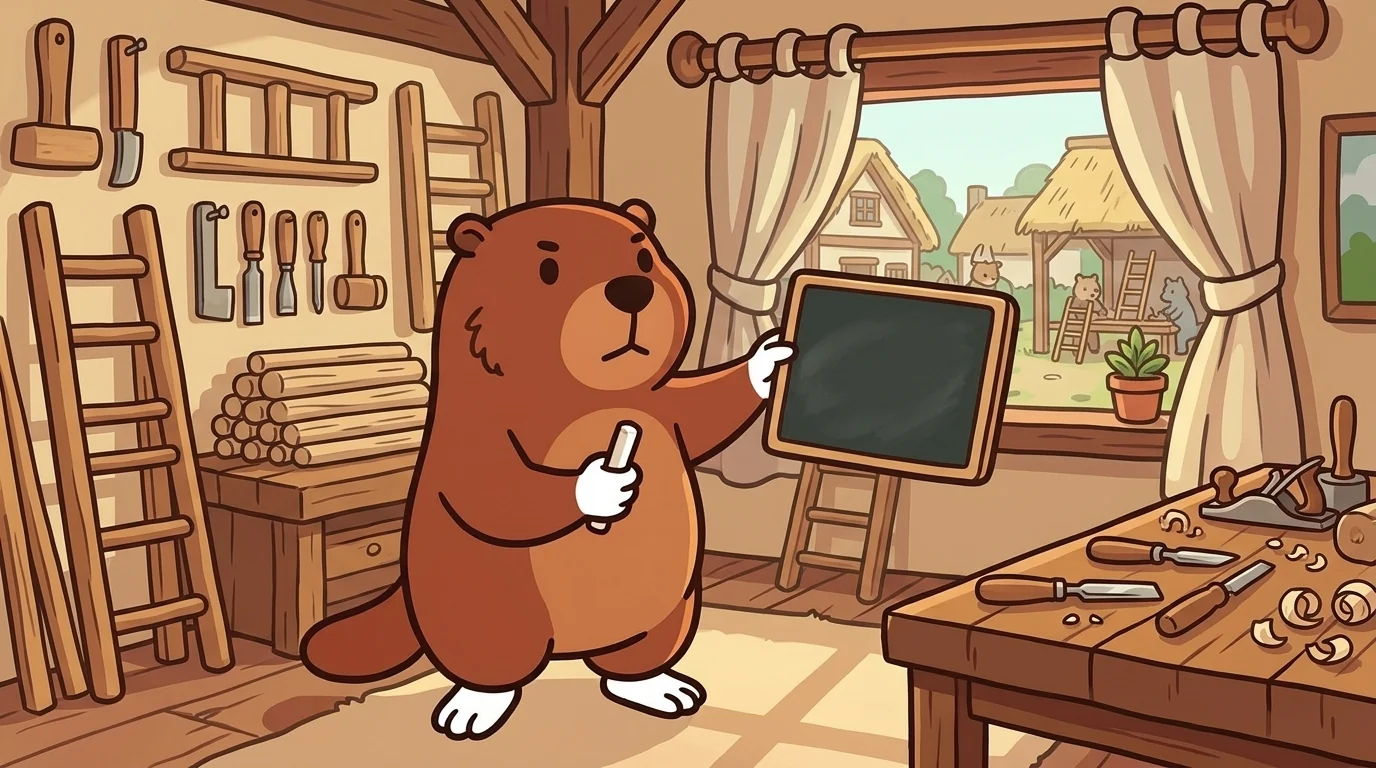
Crib learned this in a village of ladder-makers, where his family fitted the rungs. "A ladder's no good if the rungs are uneven or out of order," his grandmother told him. "Each one has to hold, and each has to come where the foot expects it." Young Crib once watched a visitor try to explain a clever plan to save the village mill — a genuinely good plan — but he said it all at once, backwards and tangled, and the council, unable to follow, voted it down. "The plan was sound," his grandmother sighed. "The telling had no rungs." Crib never forgot it: the best idea in the world fails if the listener can't find the next step. Content and delivery are different things, and a brilliant argument delivered as a heap is, to the person receiving it, indistinguishable from confusion.

When he was twelve, Crib walked to DebateForge and met Rhetor, the village leader. "What is signposting?" Rhetor asked. Crib held up his slate. "Saying the order of your argument out loud — first, second, therefore — so the listener can follow each step instead of drowning in all of it at once. It's the scaffolding you hand them before the content, so every reason has a place to land." Rhetor nodded. "You are chosen."

In his workshop, a young marmot named Wisp arrived crushed. "I had a really good argument for why we should plant a garden, and I said all of it, everything, and the class just... stared. Nobody got it. And it was GOOD!" "I believe you," said Crib kindly. "Tell it to me the way you told them." Wisp did — a rush of soil and bees and lunches and pride and the empty lot, all tumbling together. Crib listened, then smiled. "It is good. Every piece is real. The trouble is you handed them the whole heap of rungs at once." He chalked four numbered lines. "Watch. First — your claim: the class should plant a garden. Second — your reason: it gives us fresh food for lunch. Third — your proof: the empty lot beside the yard gets full sun. Therefore — we should plant there this spring." He turned the slate. "Same ideas. Same passion. But now there are rungs, and anyone can climb from your first thought to your last. That's the Toulmin shape, really — claim, then the grounds that support it, then the conclusion — just spoken in an order a listener can hold." Wisp read it slowly. "It's all the stuff I already said." "Every bit. You didn't need a better idea. You needed to say it in an order a listener could follow. The bees and the pride go on the rungs after, once they're climbing — but you give them the ladder first."

"So I didn't have a bad idea," Wisp said, wondering. "I just threw it at them in a pile." "You threw them a heap and asked them to climb it," said Crib gently. "An easy mistake — when we're full of a good idea, it all wants to come out at once." He set the chalk in Wisp's paw. "So before you argue, build the ladder: first, second, therefore. Say the shape, then fill it in." And as Wisp chalked his own four rungs and felt the tumbling jumble in his head settle into a clear, climbable order — the quiet relief of an idea that would finally land — something in his chest loosened and steadied. It felt good, that tidiness: not a smarter idea, just one others could follow, rung by rung. That calm, ordered, anyone-can-climb-it feeling was, to Crib, how a good idea finally gets to be heard.
The DebateForge ensemble
Crib is part of DebateForge's distributed-narrative cast. Each character embodies a different curricular primitive; together they teach the full subject.
-

Build
Case-construction — claim + warrant + evidence as architecture; what does your case REQUIRE to stand?
-

Weigh
Evidence-evaluation — sources have positions, evidence has limits; credibility-as-calibration (shared design language with TruthQuest Weigh — cross-app continuity)
-

Steel
Steelmanning the opposing view — strongest version of what they would say IF you let them; visibly holds up opposing-view-card with two hands
-

Reply
Civil-rebuttal-not-rebuke — 'I disagree because' not 'you're wrong because'; address the ARGUMENT not the PERSON
-

Yield
Changing-your-mind-in-light-of-evidence-as-strength — concession is craft + intellectual courage; visibly carries 'updated' badge (shared design language with TruthQuest Update — cross-app continuity)
-

Nail
Defining terms — pin down the key word before you argue, or you argue past each other
-

Nub
Impact — when both sides have true points, weigh which one actually decides it
-

Owe
Burden of proof — whoever makes the claim owes the reason; 'prove it isn't' is not an argument
-

Prod
Cross-examination — the one good question that finds the gap in a case