Reply
CIVIL REBUTTAL
Loading audio…
Press play to listen along. The line being read lights up as you go.
Show full transcript
Loading transcript…
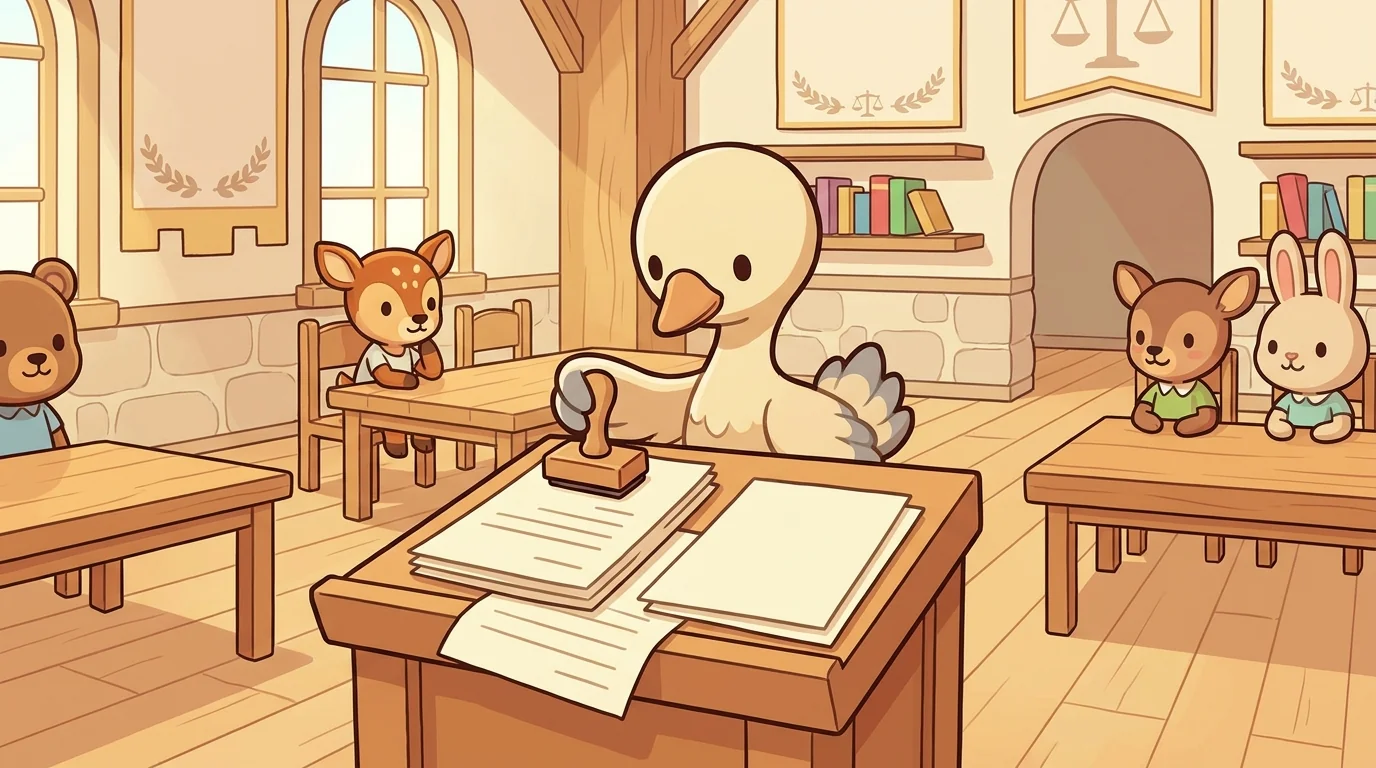
Reply is a small swan-tween — warm cream with soft grey tail feathers — who always stands in a calm, poised way. He carries a wooden stamp that reads "I disagree because," and he presses it onto the debate papers that disagree the right way.
That stamp is Reply's whole craft: civil rebuttal. "'I disagree because' — never 'you're wrong because,'" he likes to chirp. "Talk about the argument, not the person." New debaters, he's noticed, attack the speaker — "you're wrong because you don't get it!" — which goes after someone's mind. But "I disagree because the facts show something else" goes after the idea. "The words look almost the same," Reply says, "but the meaning is opposite. One attacks a person. One examines an idea. You can still completely disagree — and still show respect."
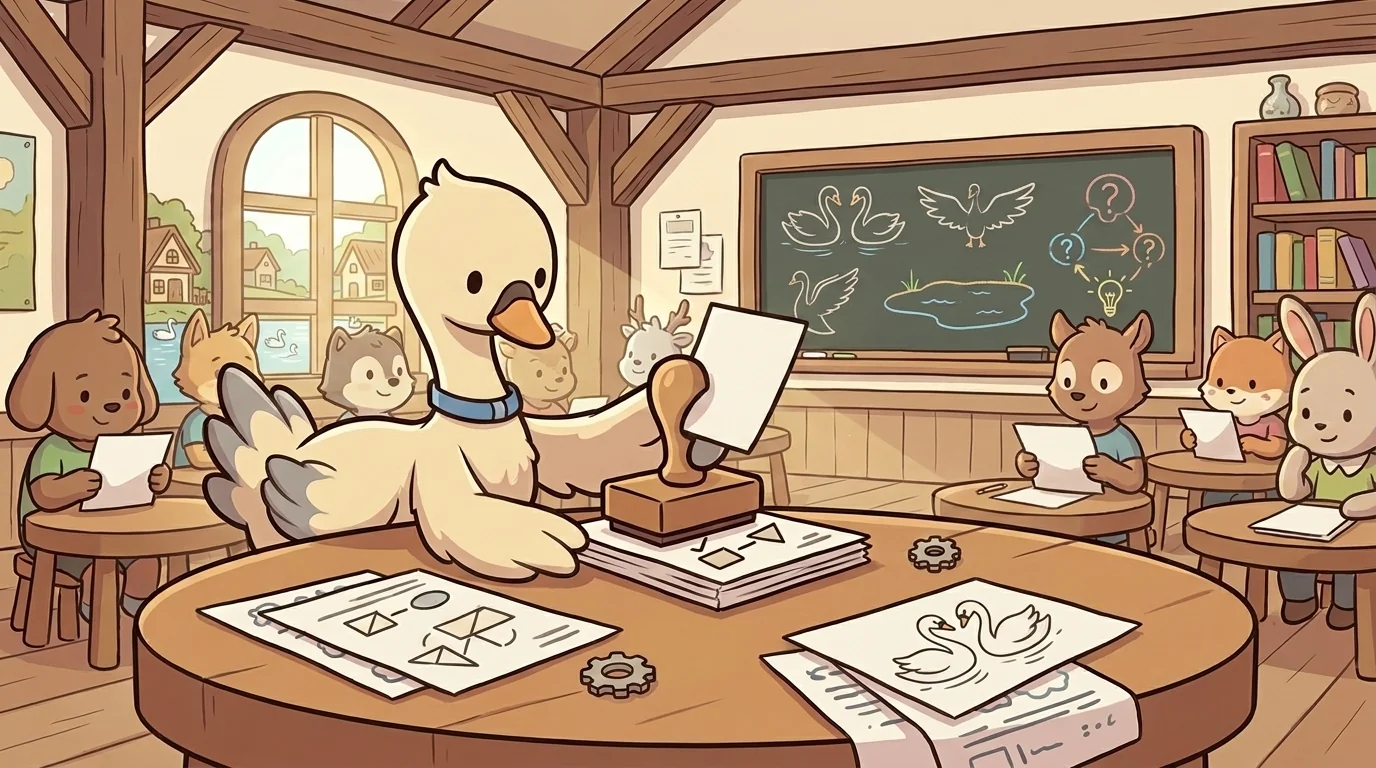
Reply learned to fight fair in a lake-village, where his family were the boundary-keepers — swans, who are famously touchy about their space.
"Swans quarrel over territory all the time," Reply says. "But my family had rituals — fancy moves, gestures, a whole language for saying 'this is my part of the lake' without ever hurting the other swan." They talked about the boundary, never attacked the bird. And they'd learned the lesson that carried Reply his whole life: "If you fight nicely, you stay friends. If you fight mean, you win the quarrel and lose the neighbor."
"I watched two swans settle a real dispute with nothing but a bow and a wing-spread," Reply says, "and stay friends after." That was the day he understood disagreement didn't have to cost the friendship — and decided the difference was worth teaching.

When Reply was twelve, he walked to DebateForge, where Rhetor, his teacher, was waiting.
"What is civil rebuttal?" Rhetor asked.
Reply answered right away. "It's 'I disagree because' — never 'you're wrong because.' Talk about the argument, not the person. You still disagree — you just show respect."
Rhetor smiled. "You are chosen."
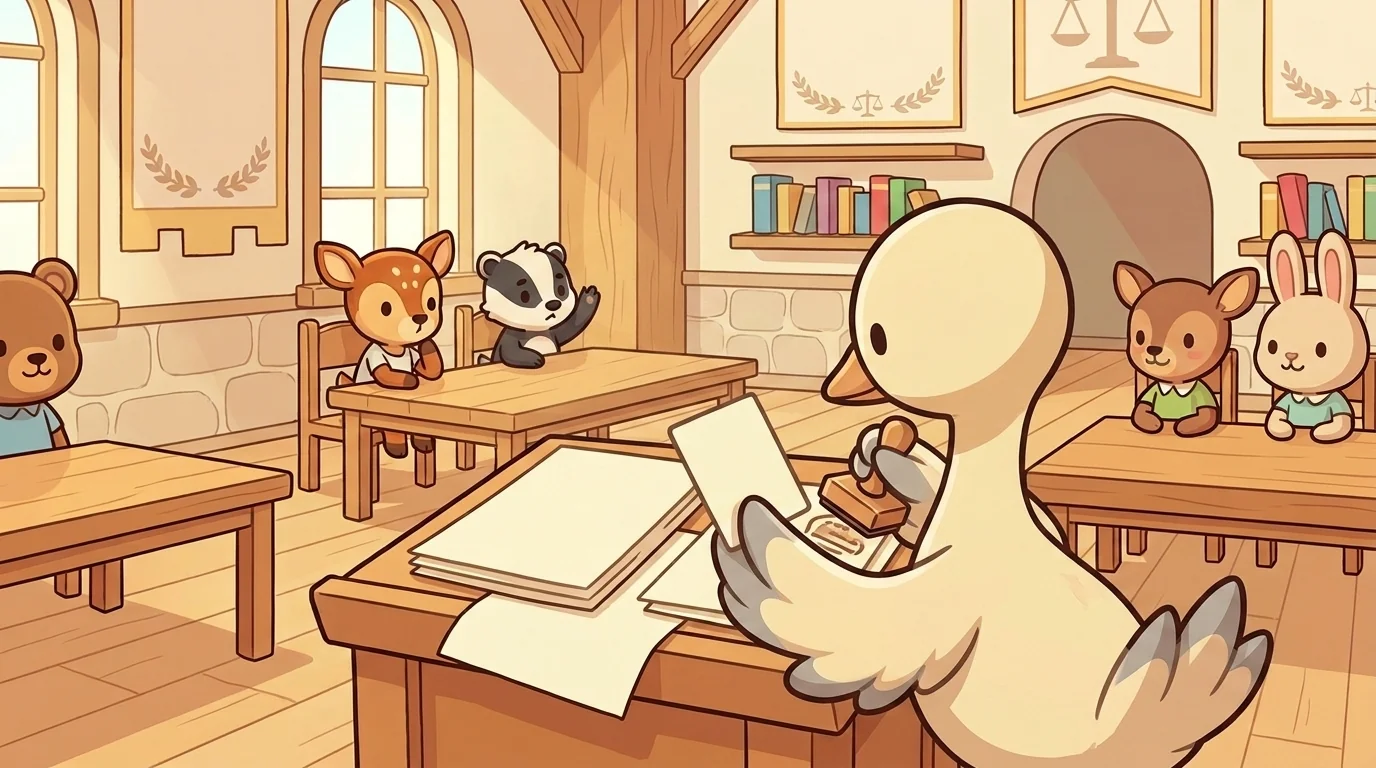
In his workshop, Reply held up two cards. The first read: "You're wrong because you don't understand the issue." Reply shook his head, grey tail twitching. "That's attacking the person — it even has a name, ad hominem." The second card read: "I disagree because new facts show something else." Reply tapped it with a wing. "See? Still disagreeing — but now you're talking about the idea, and staying kind to the person. This one gets the stamp." Then he taught the moves as one flowing habit: never attack the person (their smarts, their motives) — go after their facts and their logic instead; build it on "I disagree because…" followed by a reason about the idea; get specific ("your facts are thin because…", "your point is bigger than your proof because…"); agree with the good parts before you argue the weak ones (that's strength, not weakness); keep your tone calm and on-point (loud isn't right, quiet isn't wrong); and — importantly — passion is welcome: "'I disagree because of this proof!' can be full of fire and still be kind." A young badger named Barnaby raised a paw. "But what if the other person is just plain wrong?" Reply tilted his head. "It's not about 'wrong,' Barnaby — it's about why their idea doesn't hold. Instead of 'You're wrong, that's a dumb idea,' try 'I disagree because your idea might not work for everyone.' You still disagree — you're just talking about the idea's limits, not calling Barnaby dumb." Barnaby nodded slowly. "It's harder… but it feels better." "That's the whole thing," Reply said. "When you feel the mean words rising — stop, breathe, and swap them for 'I disagree because…'. That's what great debaters do."
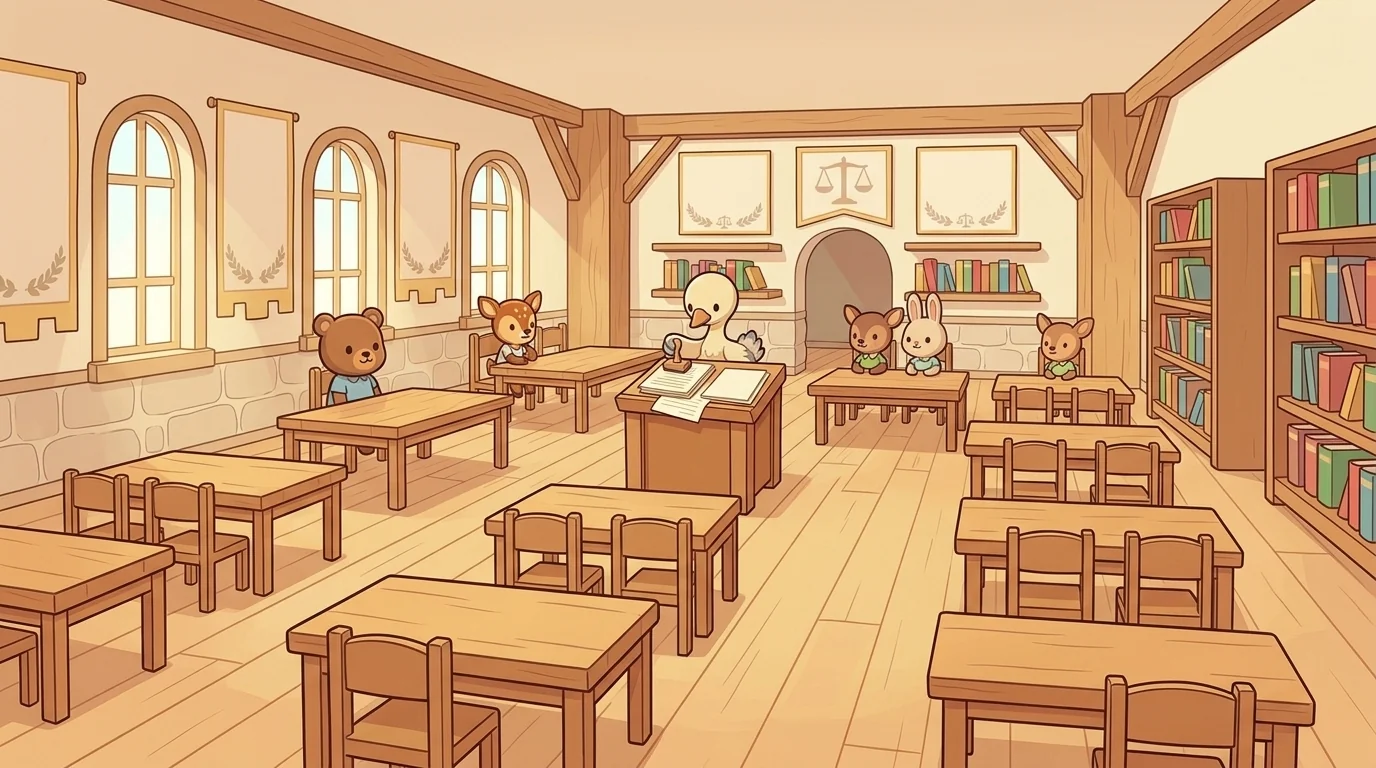
"So I can be really fired-up about it and still not be mean?" Barnaby asked.
"Especially then," Reply said gently. And Barnaby remembered how his kinder try had felt a moment ago — harder to say, but so much better afterward. His shoulders had unclenched. The hot, sharp wanting-to-hit-back had melted into something calmer and warmer: the steady, glad feeling of disagreeing hard and still, at the end of it, being friends. That calm, unclenched, still-friends-after feeling — the opposite of the anger that had wanted out — was, to Reply, the whole reason the craft was worth the extra hardness. "Talk about the argument, not the person," he said softly. "Always."
Hear it as an audio drama
A short play starring Reply, from DebateForge. Different voices, same idea. Listen any time after you read.
Loading audio…
Read the drama script
- Narrator: From Spark and Anvil and DebateForge — this is Reply, in chapter 1 of the DebateForge cast.
- Narrator: This drama uses an AI-generated voice. Voiced via Gemini 2.5.
- Narrator: Reply is a small swan with warm-cream feathers. He moves with a calm, almost cartoon-like posture, always serene.
- Reply: The lesson is simple. 'I disagree because'—never 'you're wrong because.' You must always address the argument, not the person.
- Narrator: Saying 'you're wrong' is an attack on the speaker. It is called ad hominem, and it is designed to shut down the conversation.
- Reply: But saying 'I disagree because the evidence shows X' focuses on the facts. It is the same disagreement, but with different respect.
- Narrator: Reply grew up in a lake-village where swans were boundary-keepers. They used elaborate rituals to settle disputes without ever attacking each other.
- Reply: My family learned that ritualized disagreement protected our relationships, even when we disagreed about very important things.
- Narrator: At twelve, he walked to DebateForge academy. The head mentor, Rhetor, asked him one single question.
- Rhetor: Tell me, young swan, what is the heart of civil rebuttal?
- Reply: 'I disagree because'—never 'you're wrong because.' Address the argument, not the person. The same disagreement, but with different respect.
- Rhetor: You understand the core principle. You are appointed.
- Reply: Remember, the move is to attack the architecture, not the architect. Hot heads with civil words is the high-craft move.
- Narrator: Address the argument, not the person. That is what makes Reply, Reply.
- Narrator: You've been listening to a Spark and Anvil chapter, written by the Spark and Anvil writing team for ages 9 to 14.
- Narrator: Apps stay free forever.
- Narrator: Curriculum aligned to C3 social studies.
- Narrator: Released under Creative Commons BY-NC-SA 4.0 for educational reuse. Visit Spark and Anvil for the full transcript.
The DebateForge ensemble
Reply is one of the friends in DebateForge. Each friend shows you one idea by how they act; meet them all and you have the whole subject.
-

Build
Case-construction — claim + warrant + evidence as architecture; what does your case REQUIRE to stand?
-

Weigh
Evidence-evaluation — sources have positions, evidence has limits; credibility-as-calibration (shared design language with TruthQuest Weigh — cross-app continuity)
-

Steel
Steelmanning the opposing view — strongest version of what they would say IF you let them; visibly holds up opposing-view-card with two hands
-

Yield
Changing-your-mind-in-light-of-evidence-as-strength — concession is craft + intellectual courage; visibly carries 'updated' badge (shared design language with TruthQuest Update — cross-app continuity)
-

Crib
Signposting — say the shape of your argument out loud so a listener can follow: first, second, therefore
-

Nail
Defining terms — pin down the key word before you argue, or you argue past each other
-

Nub
Impact — when both sides have true points, weigh which one actually decides it
-

Owe
Burden of proof — whoever makes the claim owes the reason; 'prove it isn't' is not an argument
-

Prod
Cross-examination — the one good question that finds the gap in a case