
Sonar
SOUND IN THE SEA — light dies within a few hundred meters, but sound travels far and fast underwater. send a click, listen for the echo, and read the dark. the deep ocean is a world of sound.
Loading audio…
Press play to listen along. The line being read lights up as you go.
Show full transcript
Loading transcript…
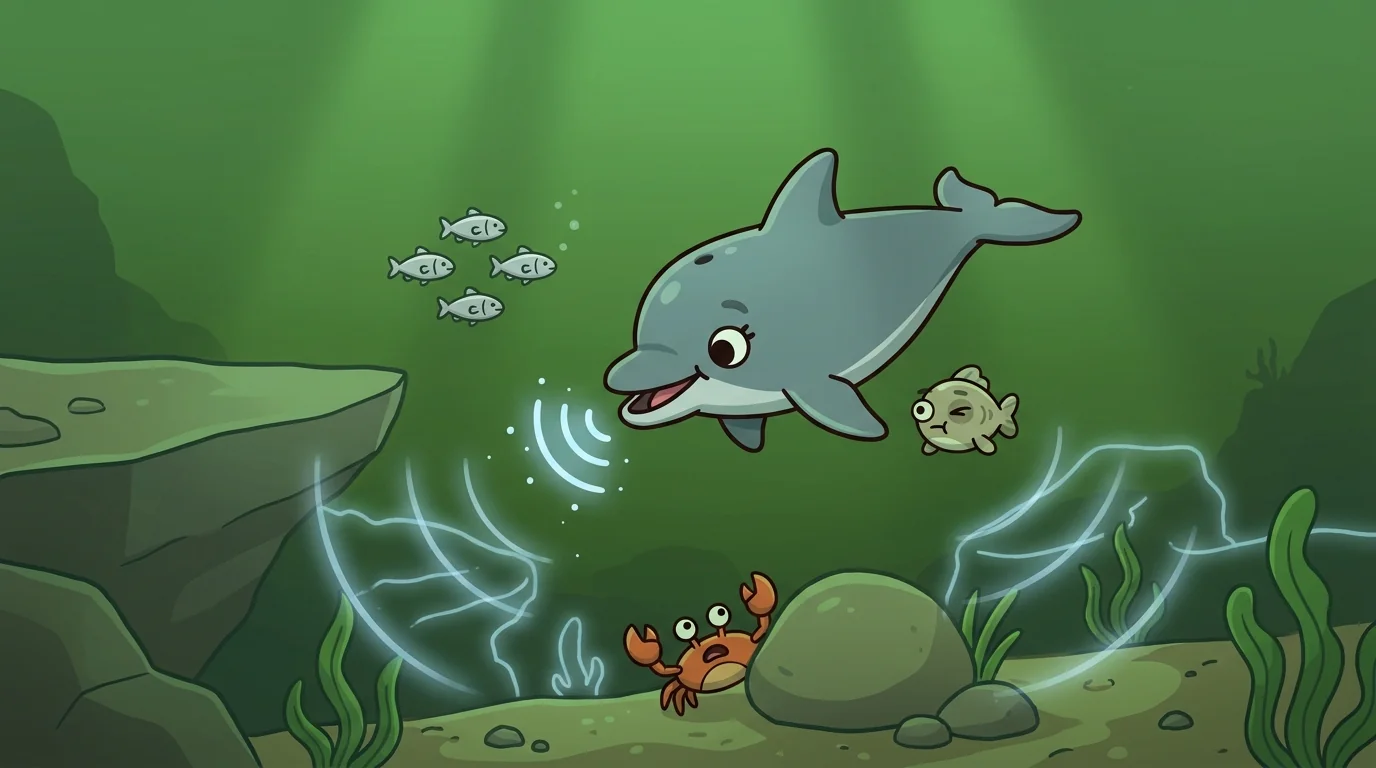
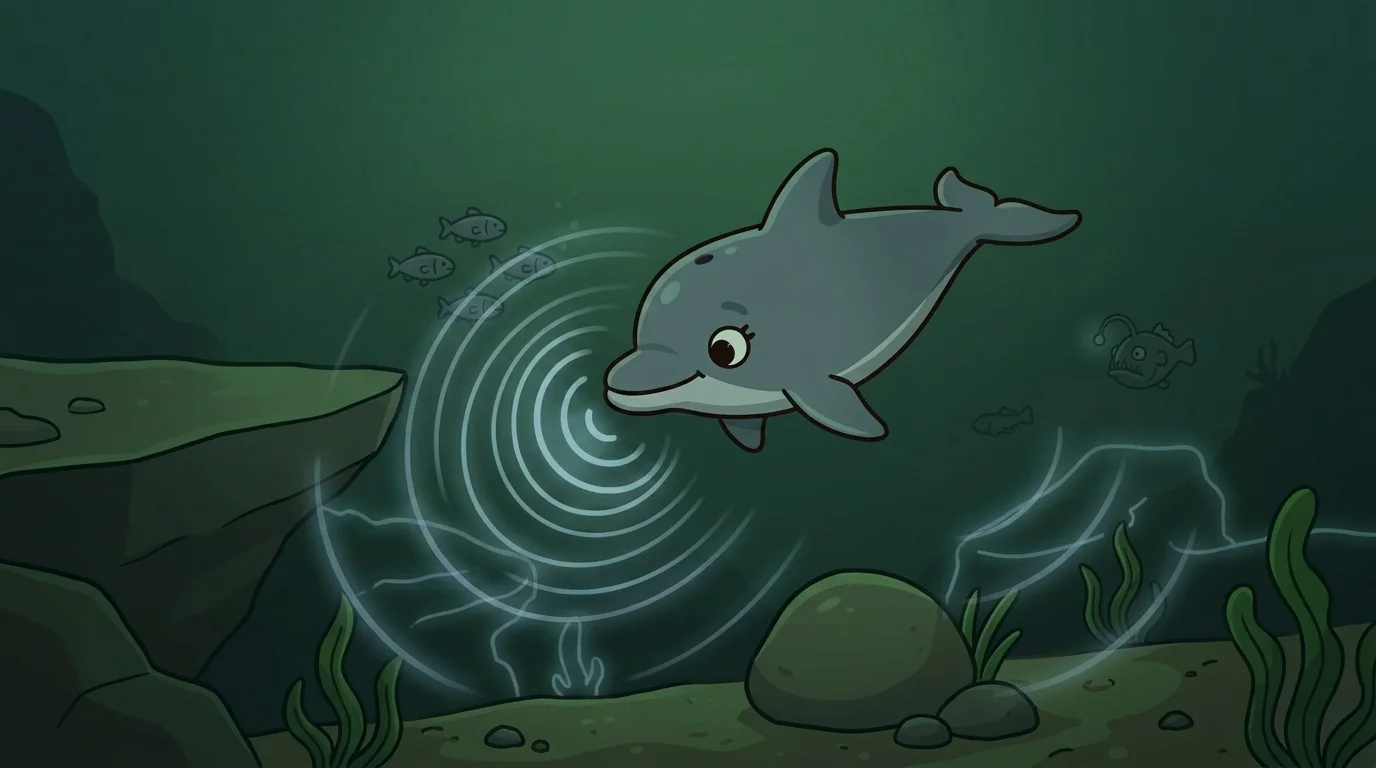
Sonar hung in the murky green water where the light was already giving up, clicked once — a bright tk! — and grinned at the picture that came back.
To the young fish beside her it was pea-soup gloom, a wall of nothing. To Sonar it was a room. She'd clicked; the click had raced out, bounced off things, and come racing home to her ears; and now she knew — a rock ledge to the left, a school of silversides ahead and slightly up, and one very startled crab pretending to be a stone on the bottom.
"There's a crab down there," she said. "Behind that rock. Trying to look like a pebble. Not fooling anybody."
The young fish squinted into the murk. "I can't see anything."
"Course not. There's barely any light here — it runs out fast in water, absorbed and scattered within a couple hundred meters." She clicked again, tk-tk!, and turned her sleek head to catch the returning echoes. "But sound? Sound loves the sea. It travels about four and a half times faster in water than in air, and far, far further. So down here I don't look with my eyes. I look with my voice." Another click sailed into the gloom. "I throw a sound out, listen for the bounce, and the timing and shape of the bounce draw me the shape of everything it touched. That's echolocation — biosonar. Watch — or, well, listen."
She clicked, read the answer, and it was as clear to her as a lit room.
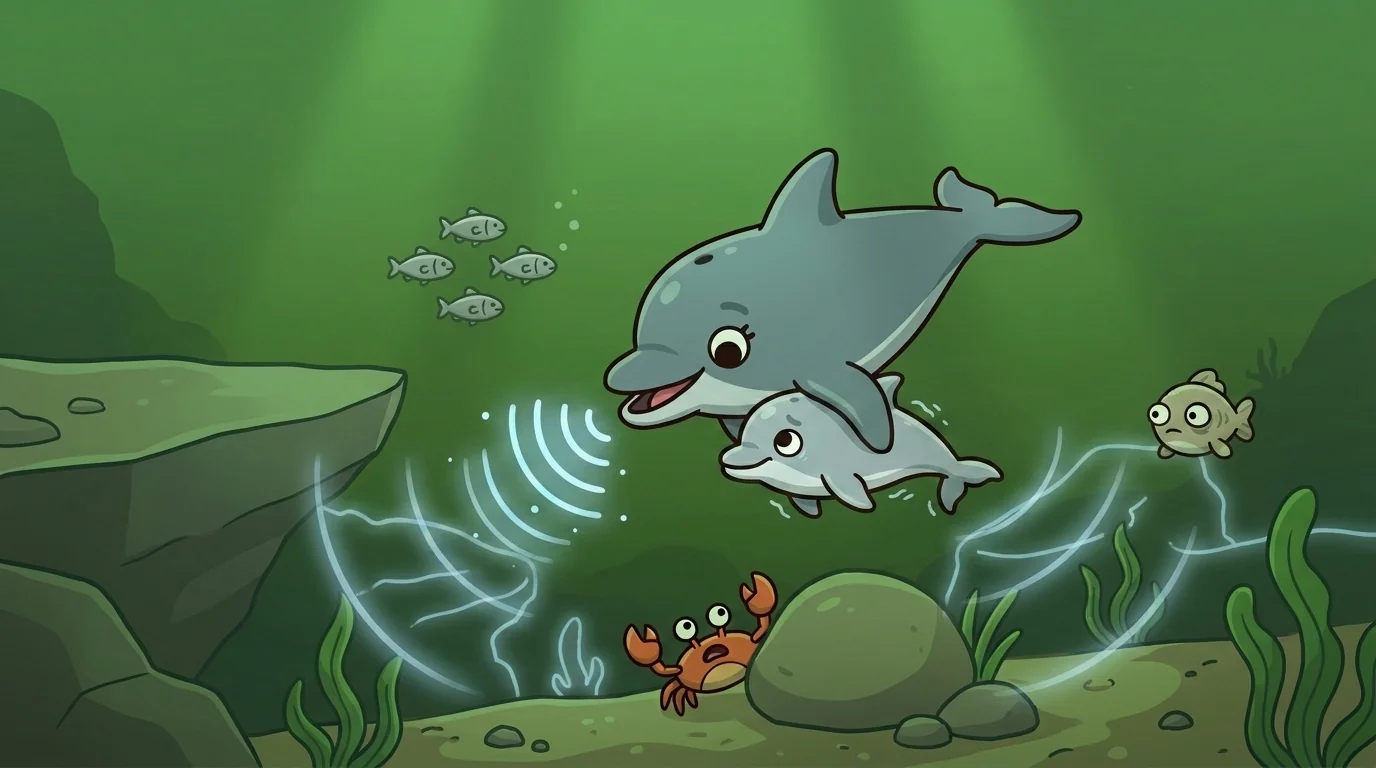
Sonar hadn't always trusted her ears over her eyes.
As a calf she'd chased her mother's shape into a bank of murk and lost it — the water thickened, the light died, and there was no mother, no up, no anything, just gray. She froze, chest squeezed tight. I can't see, and I'll be lost down here forever. She held perfectly still, too scared even to call, as if silence could make the dark less real.
Her mother found her by clicking — a steady stream of little sounds sweeping the murk until one bounced off her calf and led her home.
"You went silent," her mother said, tucking close. "That's the one thing you must never do down here. In the dark, silence is how you get lost."
"But I couldn't see," Sonar said, still trembling.
"Then stop trying to." Her mother clicked, soft, and the murk seemed to organize itself around the sound. "You have a better instrument. Send your voice into the dark and let it come back to you. The echo carries because sound barely fades down here — it's why the sea is a world of hearing, not seeing. Being unable to see isn't the danger, little one. Going quiet is. As long as you keep sending sound out, the dark always sends something back."
Sonar tried it — one small, shaky click. And the gloom answered: a ledge here, her mother there. The drowning gray fear loosened, because the dark wasn't empty after all. It was full of surfaces waiting to echo. She only had to be brave enough to make a sound.
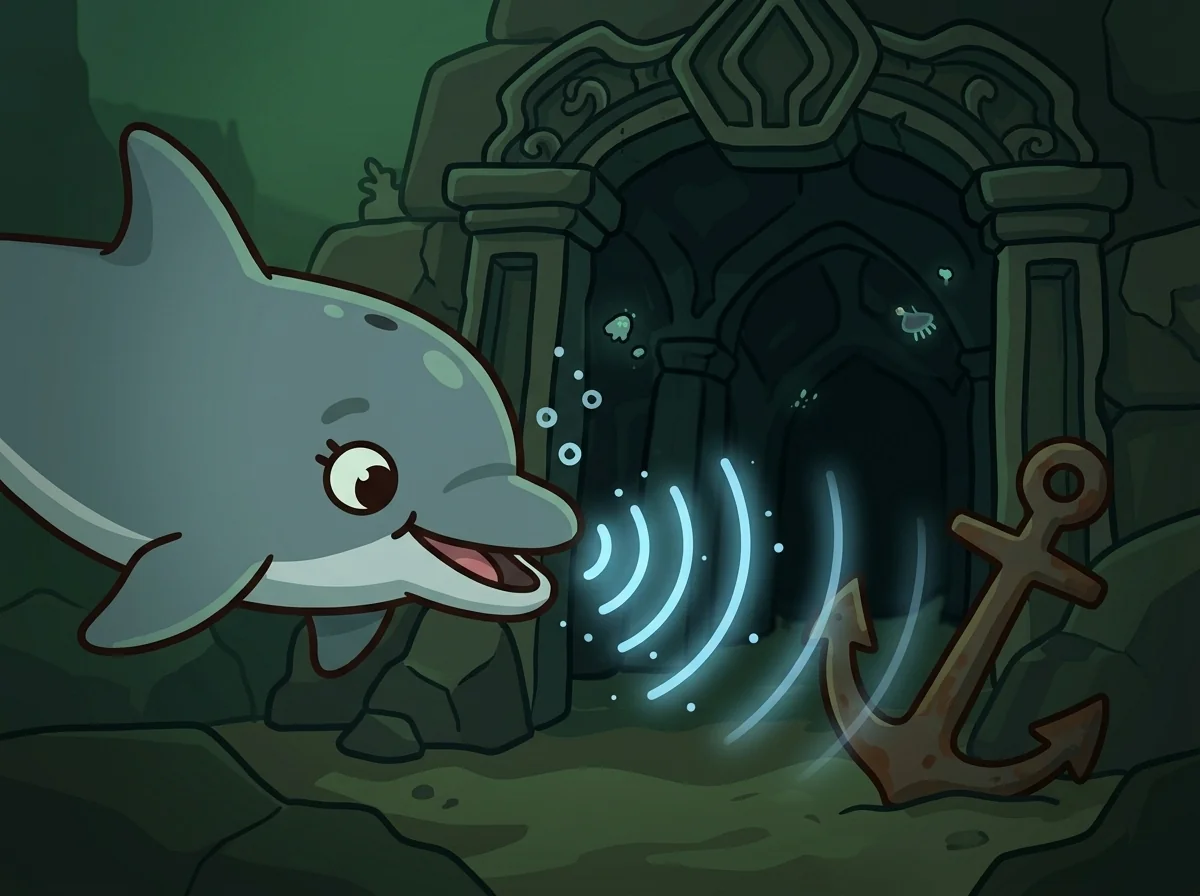
She swam to DepthQuest at twelve, because a place that studied the deep dark ought to have someone who could hear her way through it.
Marlin met her at the twilight gate, where the last light thinned to almost nothing, and asked one question. "What is sound, down here?"
Sonar didn't answer in words. She clicked — a clean bright tk! — toward a far dark corner, waited a half-second for the echo, and said, "There's an old anchor over there, on its side, about thirty meters. I've never seen it. I just heard it."
Then she turned back. "Sound is how the deep talks. Light quits a couple hundred meters down, but sound carries for miles — there's even a deep layer, the SOFAR channel, where a whale's call can travel across an entire ocean basin. So the animals down here don't shine signals; they sing them — clicks, whistles, moans. I send a click and read the echo, and the echo draws a place too dark to see. That's echolocation, and it works because sound loses so little energy in water." One more click sailed past Marlin. "The whole deep ocean is louder and busier than anyone up in the light ever guesses."
Marlin listened to the click fade. "You've learned to hear what you can't see," he said. "You belong here."
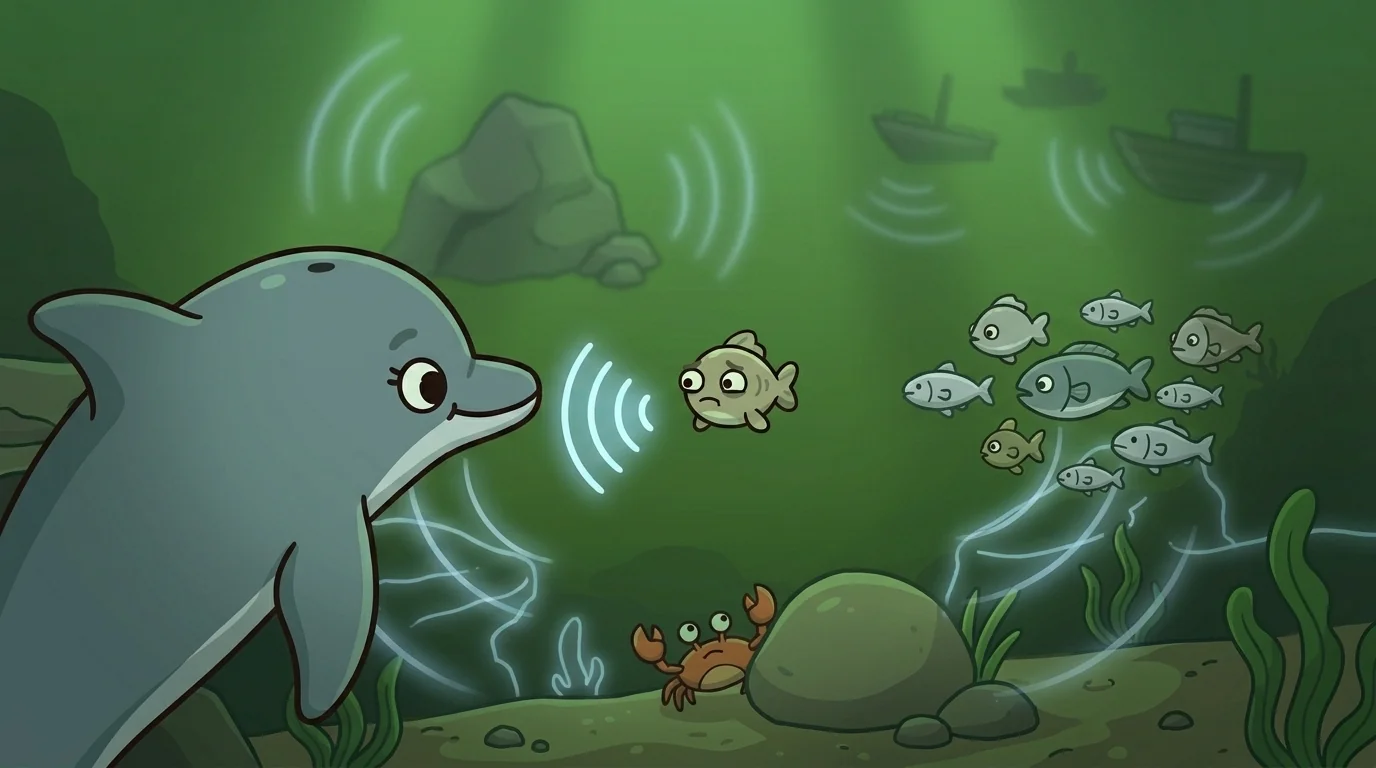
Sonar's students were often the ones who'd gone quiet — spooked by how big and dark and unknowable the deep seemed.
One hung back at the edge of her workshop, small and stiff. "It's too dark down there," he said. "And too big. And I heard it's getting loud — all the ships, all the engines. Everything's drowned out. What's the point of listening?"
Sonar's ears pricked. She knew that stiffness — she'd frozen like that once, a lost calf in the gray.
"Come here," she said gently. "Listen with me." She went still, and had him still too, and sent one soft click into the quiet. It came back clean. "Hear that? A reef ledge, answering. Now — you're right that the sea has gotten noisier. Ship engines add low-frequency noise pollution, and it genuinely makes it harder for whales and dolphins to hear each other, and scientists who study ocean sound are honestly worried about it. I won't pretend they aren't." She clicked again; again the dark answered. "But listen — the sea is not silent. Not close. Right now this water is full of clicks and songs and answers. And here's the hopeful part: noise is one of the few ocean troubles we can turn down. Quieter ship designs, slower shipping lanes — people are already doing it, and the ocean gets its hearing back."
The small fish leaned into the quiet and heard, faintly, the click come home. "It's still talking," he said.
"It never stopped," said Sonar. "You just have to get quiet enough to hear it — and brave enough to click back."
Later, when the workshop had emptied into the dark, the small fish returned with the real question, his voice low.
"When it's too dark to see," he said, "and too big, and you're scared — how do you keep from just going quiet and freezing up?"
Sonar thought of her mother's steady clicks sweeping the murk, and the lost-calf terror that had melted the moment the dark answered.
"You make a sound," she said simply. "That's the whole secret. When you're scared of the dark, the worst move is to go silent and still, because then you really are lost. So you send something out — a click, a question, a call — and you listen." She sent one last click into the black, and it returned, soft and sure. "The dark isn't empty. It's just waiting for you to be brave enough to speak first. Then it answers. Every time."
And the small fish felt the frozen, breath-held fear he'd carried melt into something warm and steady — the plain relief of knowing that as long as he kept sending his small voice into the dark, the dark would always, always send something back.
The DepthQuest ensemble
Sonar is part of DepthQuest's distributed-narrative cast. Each character embodies a different curricular primitive; together they teach the full subject.
-

Reef
Sunlit zone — coral + photosynthesis-zone biodiversity
-

Drift
Twilight zone — bioluminescent + migratory species
-

Press
Midnight zone — pressure + cold + giant-squid scale
-

Smoke
Abyss zone — hydrothermal vents + chemosynthesis
-

Trench
Hadal zone — deepest trenches + extreme-adaptation
-

Cling
Intertidal zone — the strip of shore underwater at high tide and open air at low; life that clings between the tides
-

Drizzle
Marine snow — the constant gentle fall of food from the sunlit top to the dark deep (the biological pump)
-

Gyre
Ocean currents — the great moving conveyor carrying water, heat, and life in slow giant loops
-

Neap
Tides — the moon and sun pull the whole ocean; twice a day the sea rises and falls