
Corral
COMBINING LIKE TERMS — you can only add or subtract terms of the same kind; the x-terms gather with the x-terms and the plain numbers gather with the plain numbers, because a term's variable part names what KIND of quantity it is.
Loading audio…
Press play to listen along. The line being read lights up as you go.
Show full transcript
Loading transcript…
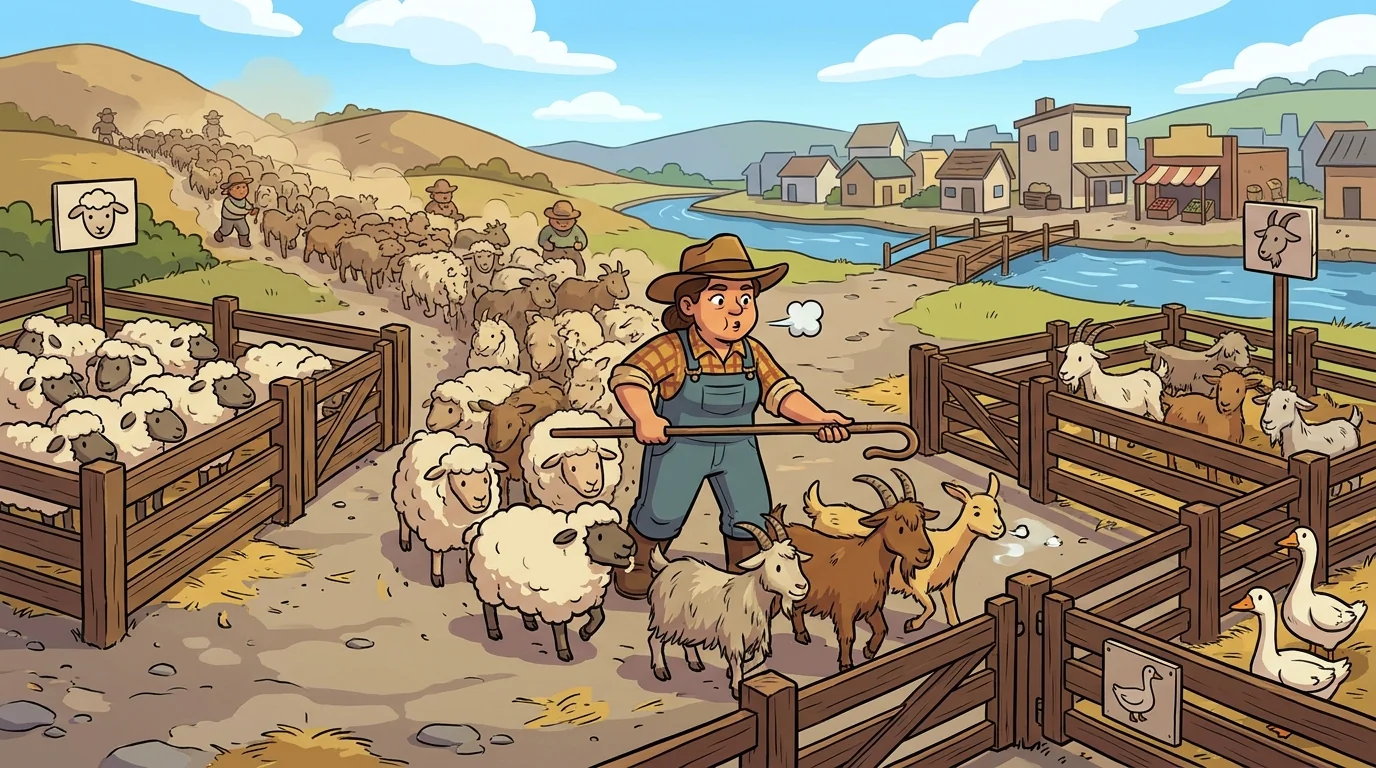
Corral worked, for twelve years, at the great stockyard on the edge of the river town, and the thing she understood better than anyone was that you can only count things by their kind. On market mornings the drovers brought their animals down from the hills — sheep, goats, geese, all mixed into one dusty, complaining drove — and Corral's job was to sort them into pens before anyone counted or traded a single head.
Sheep into the sheep pen. Goats into the goat pen. Geese, honking, into their own fenced corner. She did it with a long crook and a patient whistle, and by the time the buyers arrived every kind stood apart, ready to be tallied.
The reason was one Corral had understood since she was small: three sheep and two sheep make five sheep, but three sheep and two goats make three sheep and two goats — two separate piles, counted separately, because there is no such creature as a "sheepgoat" and never will be. You add the like to the like. What differs in kind stays apart, however you crowd it.
"You add the same to the same," Corral would say, whistling a stray goat back into line. "That's the whole trick of a tidy yard. Force two kinds into one count and the number you get is a lie."
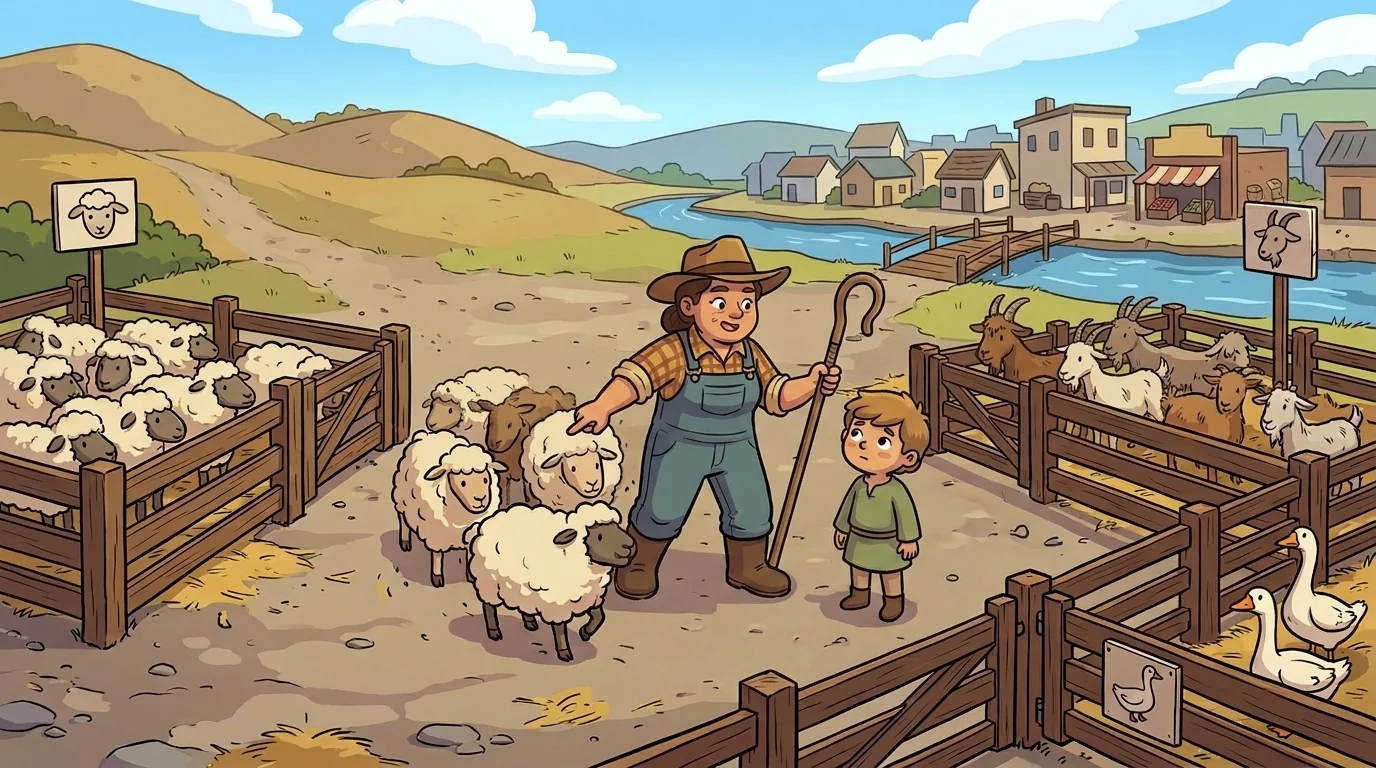
One morning a boy named Rilke, whose father sold geese, watched Corral sort a great mixed drove and asked why she didn't simply count them all at once and be done.
"Because they aren't the same kind," said Corral. "And the kind is what tells you whether two things can join. Watch." She pointed her crook at the pens. "Three sheep here, two more sheep there — five sheep, because 'sheep' is the kind they share. But these four geese don't join the sheep, no matter how I count. They stay four geese. The number in front changes — three, five, four — but the kind behind it decides who's allowed to add to whom."
Rilke thought. "So there's the how-many," he said slowly, "and then there's the what-kind. And you can only add the how-manys when the what-kinds match."
"Where did a goose-boy learn to say a thing so neatly?" said Corral, looking at him with new interest. That evening she scratched on the gatepost: SAME KIND WITH SAME KIND. The number tells you how many; the kind tells you whether they may join. Three-of-a-kind and two-of-a-kind make five-of-a-kind. Everything else waits in its own pen.

After that, Corral saw the whole world wanting sorting-by-kind before counting: coins tallied by their value, beans weighed by their colour. Even a sentence, she thought — you could count its questions and count its answers, but a question and an answer would never sum to "two of a thing," because they weren't one kind.
A year later the EquationQuest academy — always hunting for someone who understood one true thing all the way down — heard of a stockyard hand who "only ever added the same kind to the same kind." The master wrote her a letter. Corral, ready for cleaner air, accepted and brought her long crook.
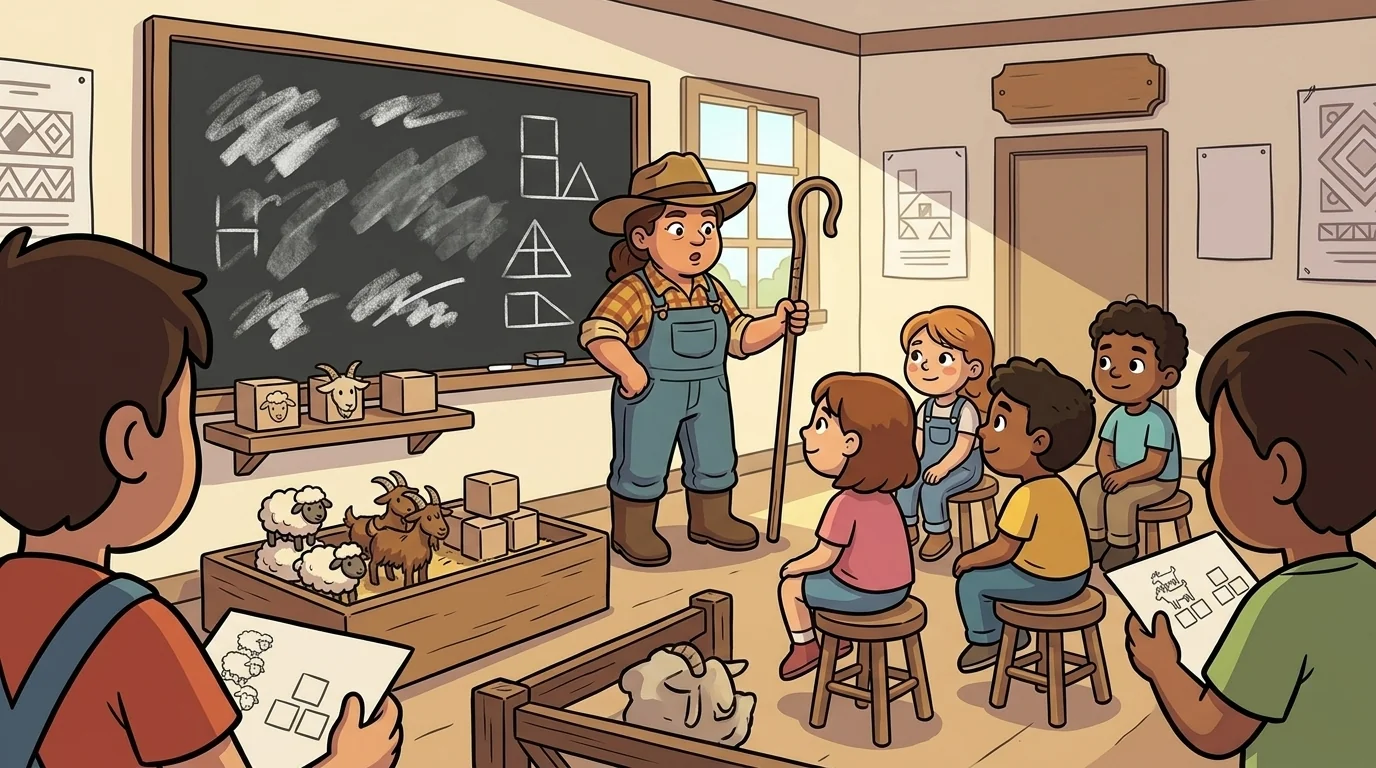
The board at the academy, Corral found, was a stockyard with the animals rubbed out and letters chalked in their place — but it worked exactly the same. She wrote her first line: 3x + 2x + 4 + 5.
"A mixed drove," she said. "It looks like a muddle. It sorts like one too. Now — in algebra we call each of these a term: a number, or a number stuck to a letter. And the letter part is the kind. What kind is 3x?"
"An x-kind," said a girl in front.
"And the 3 riding in front of it — that's called the coefficient; it's just the how-many. Three of the x-kind. And 2x?" "Two of the x-kind." "So they share a pen." Corral looped the two x-terms. "Three of the x-kind and two of the x-kind make five of the x-kind — 5x. The kinds matched, so their coefficients could add. Now the 4 and the 5: are those x's?" "No — just numbers." "Their own pen. A plain number is a term too; its kind is no letter at all, so it can only join other plain numbers. 4 + 5 = 9." She wrote it clean beneath: 3x + 2x + 4 + 5 becomes 5x + 9. "Two tidy pens. And notice what I did not do — I never wrote 5x + 9 = 14x, because 5x and 9 are different kinds. Forcing them together would be counting a sheep as a goose. They stand side by side, finished, unable to combine — and that's not a failure to simplify. That's the answer."
The children copied it. One drew a little fence around the 5x, and Corral thought that was exactly right.
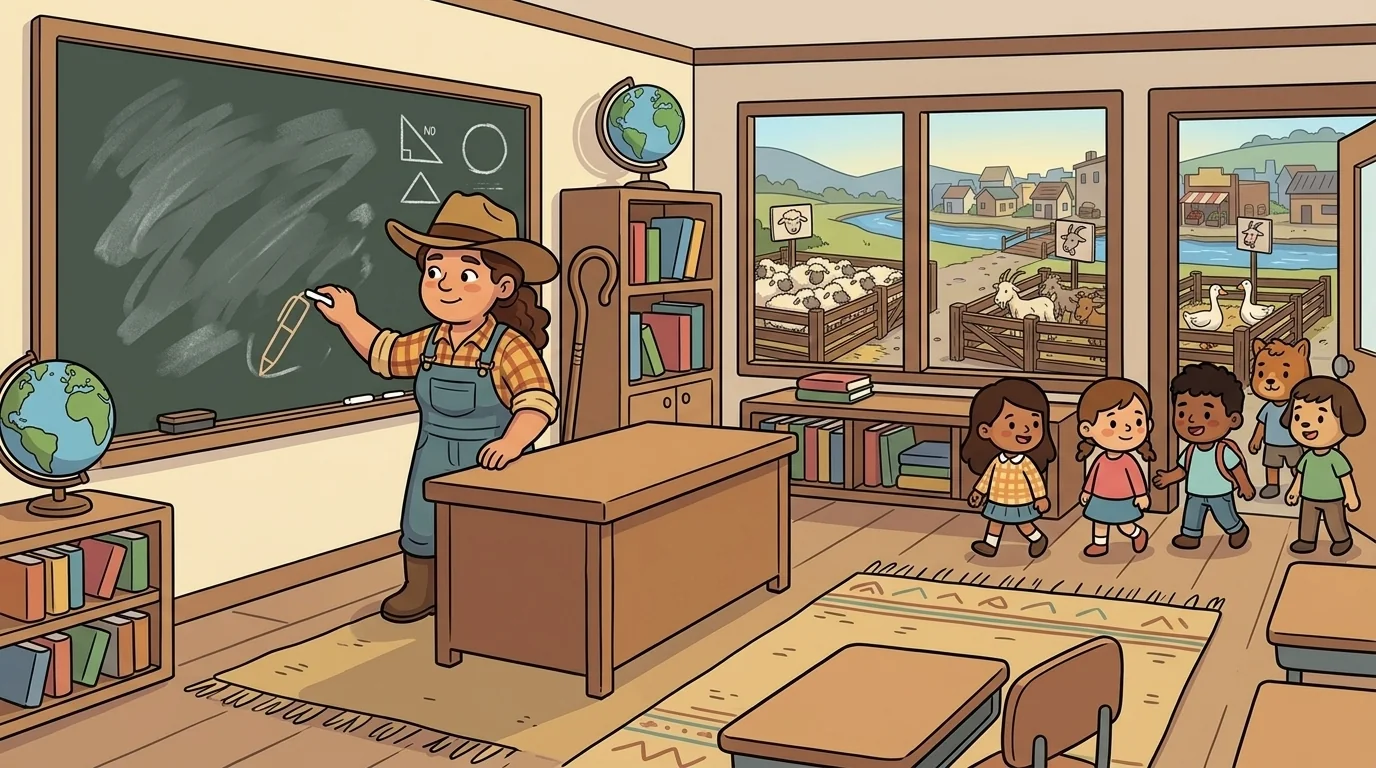
She still visits the old stockyard once a season, and the drovers let her sort a drove for the pleasure of watching it done well.
At the academy she tells the new children, who arrive certain that algebra is a muddle, that it is really only a stockyard — and the first thing you ever do with a muddle is sort it: the x's with the x's, the x-squareds with the x-squareds, the plain numbers with the plain numbers, each kind waiting in its own pen until it is counted. The coefficients out front do the adding; the kinds decide who is allowed to add at all.
"It isn't hard," she says. "It's just tidy. Put the same kind with the same kind, and the count comes easy — and when two kinds won't combine, that's not you failing. That's them telling you the truth."
When the children have gone and the board is wiped, Corral loops one last empty pen in the corner out of long habit, and feels the deep, settled gladness of a yard where everything is finally in its proper place — the same gladness she felt at twelve, at the end of a long market morning, and glad it has never once worn off.
The EquationQuest ensemble
Corral is part of EquationQuest's distributed-narrative cast. Each character embodies a different curricular primitive; together they teach the full subject.
-

Lever
Maintaining balance — do the same thing to both sides
-

Solo
Isolating the variable — moving everything else away from x
-

Undo
Inverse operations — addition ↔ subtraction, multiplication ↔ division
-

Spread
Distribution — multiplying across parentheses
-

Flipper
The sign-flip in inequalities when multiplying/dividing by a negative
-

Leaven
Exponents — repeated multiplication; the small raised number counts how many times
-

Marshal
Order of operations — the agreed sequence for working an expression (PEMDAS)
-

Prise
Factoring — find the part two or more terms share and pull it out front
-

Stead
Substitution — put a known value in place of a variable, then simplify