
Leaven
EXPONENTS — repeated multiplication; the small raised number counts how many times a value is multiplied by itself, so growth BUILDS on itself instead of stacking, and 2 cubed means 2 × 2 × 2, not 2 × 3.
Loading audio…
Press play to listen along. The line being read lights up as you go.
Show full transcript
Loading transcript…
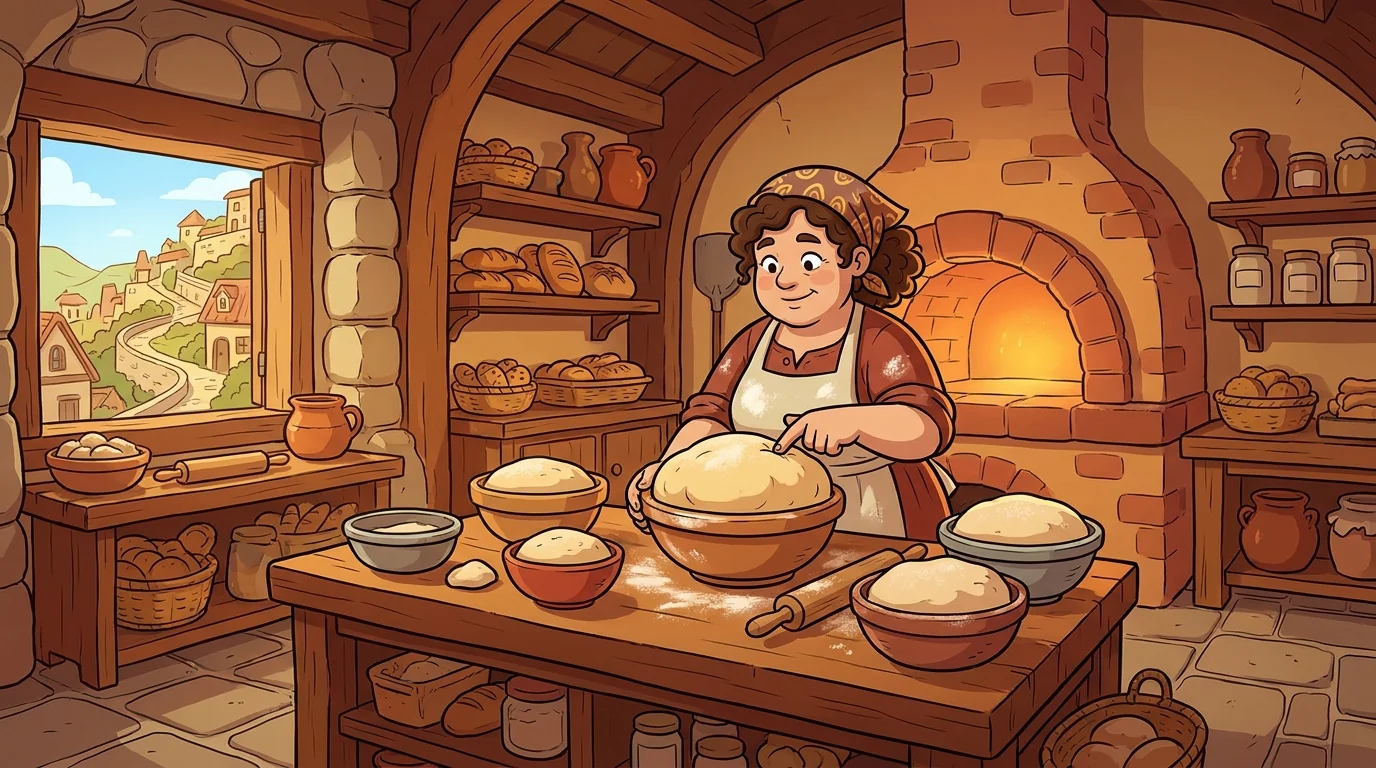
Leaven ran the oldest bakery in a hill town for sixteen years, and the thing she understood better than anyone was rising — and the strange, load-bearing fact that rising does not add; it multiplies.
Bread rises because of leaven, a small patient living thing worked into the dough that feeds and grows and puffs the whole loaf. Leaven the baker was named for it and treated it with respect: you could not hurry it and you could not skip it. You mixed, you let it rise, you folded it down, you let it rise again.
And here was what fascinated her most. A first rise doubled the dough. Folded down and risen again, it doubled the doubled — four times the start, not three. A third rise doubled that — eight times, not four. She had watched it a thousand times, and it still surprised her how fast a small quiet dough could grow when the growth kept feeding on itself. Two rises was not "twice risen" the way two apples is twice one apple. Two rises was doubled, and then doubled again.
"It doesn't stack up. It builds up," she'd say, pressing a fingertip into a swelling loaf. "Each rise takes all of what came before and doubles it. That's why a little leaven fills a whole loaf — and why you must never confuse a few rises with a few extra handfuls."
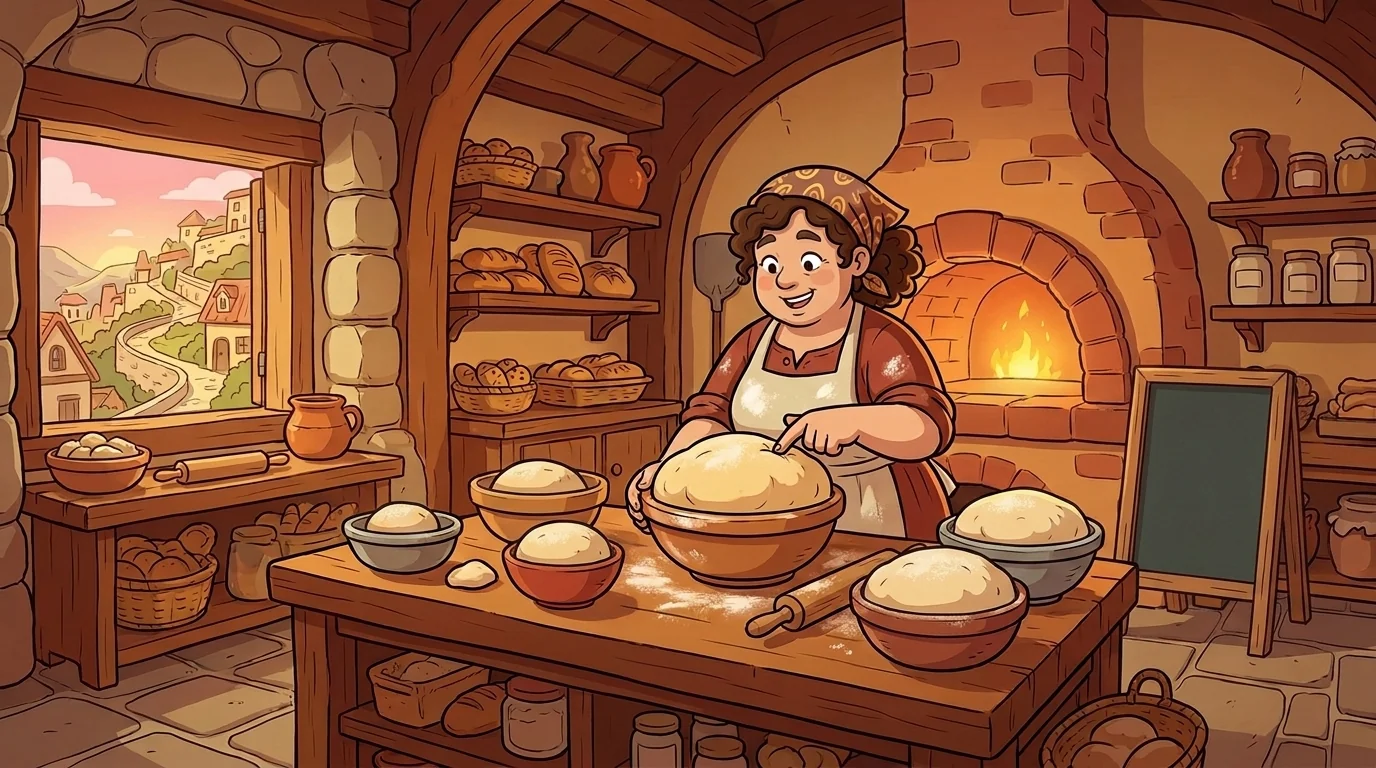
One dawn a girl named Pell, who swept the bakery floor, asked why Leaven didn't simply make the dough big to begin with, instead of all this waiting and folding.
"Because rising isn't adding," said Leaven. "Watch." She held up one handful of dough. "One. Let it rise — two. Fold, rise again — not three. Four. It doubled the two. Rise once more — not five. Eight. Every rise takes everything there is and doubles it." Pell counted on her fingers, then stopped, startled. "So three rises isn't three times bigger. It's doubled, then doubled, then doubled. It's way more than three." "Way more," Leaven agreed warmly. "That's the secret of leaven: small, patient, and it multiplies on itself." That night she wrote on the flour-dusted slate: EACH RISE DOUBLES ALL OF IT. Three rises: 2, then 4, then 8 — the growth compounds. Not 2, 4, 6 — that would be adding.
After that, Pell and Leaven saw self-building growth everywhere — a rumour that doubled with each telling, lily pads covering twice the pond each day, a single coin whose growth was left to grow in turn.
A year later the EquationQuest academy, which wanted someone who could stop children muddling multiplying a value by itself a few times with adding it a few times, heard of a baker who "knew that rising builds on itself." The master wrote to her. Leaven, who had risen enough dough for one lifetime, left it to her apprentice and accepted.
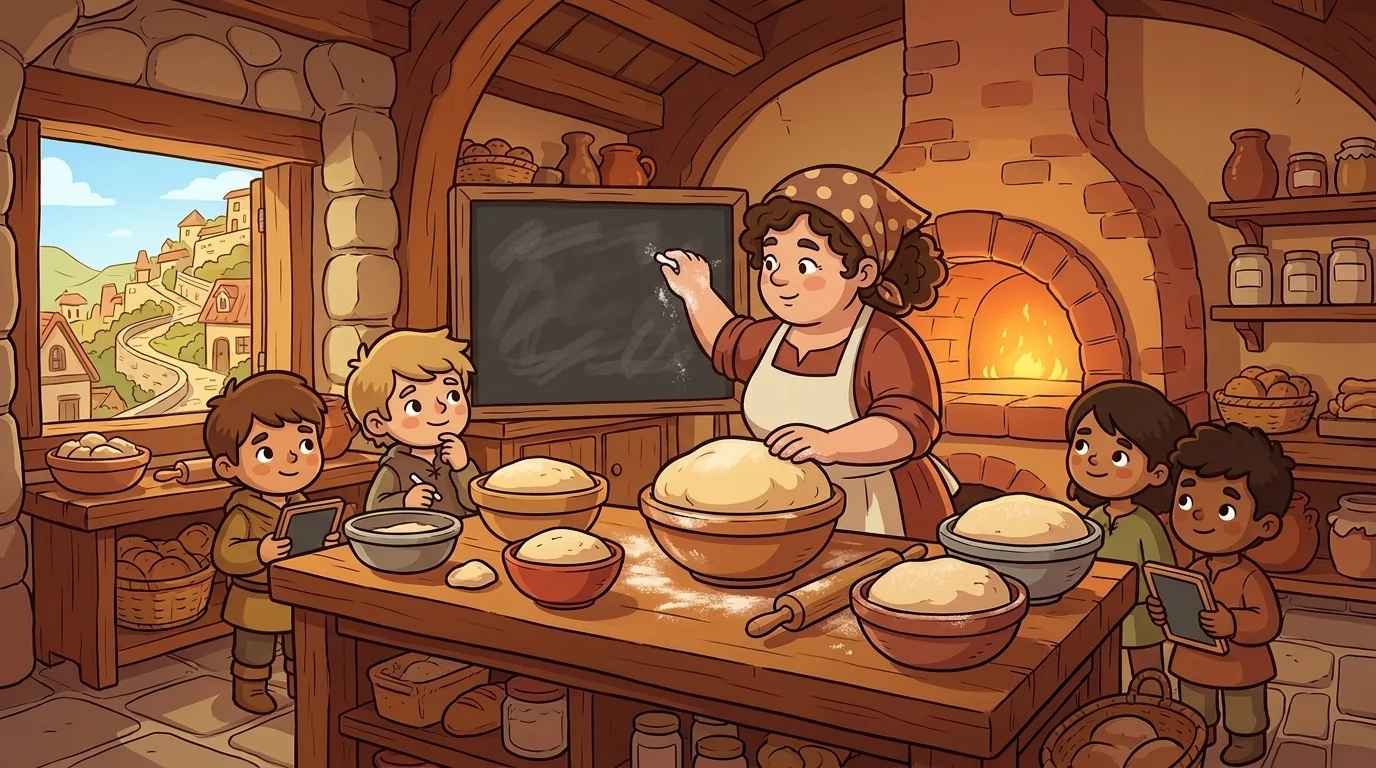
The board, Leaven found, was a bakery with the loaves rubbed out and small raised numbers chalked in their place. She wrote: 2³.
"This little raised three," she said, tapping it, "has a name — the exponent, or the power. And it is not part of a sum. It counts rises. It says: take the base — this 2 down here — and multiply it by itself, three times over." She wrote it long: 2³ = 2 × 2 × 2. "Rise one: 2. Rise two: 2 × 2 = 4. Rise three: 4 × 2 = 8. The answer is 8."
"But two threes is only six," said a boy, wary.
"That is exactly the trap, and I'm glad you walked into it out loud," said Leaven. "2 × 3 = 6 is three lots of two, added up — the base repeated by addition. But 2³ = 8 is two multiplied by itself three times — the base compounding, each step built on the last. The exponent never means 'multiply the base by the little number.' It means 'use the base as a factor that many times.' Adding stacks. This builds. That one difference is why 2¹⁰ is not twenty but one thousand and twenty-four — the rising ran away with itself, exactly the way it does in a loaf."
The children wrote 2³ = 2 × 2 × 2 = 8 and, underneath, warned themselves: the exponent counts the factors — not 2 × 3, not 6.
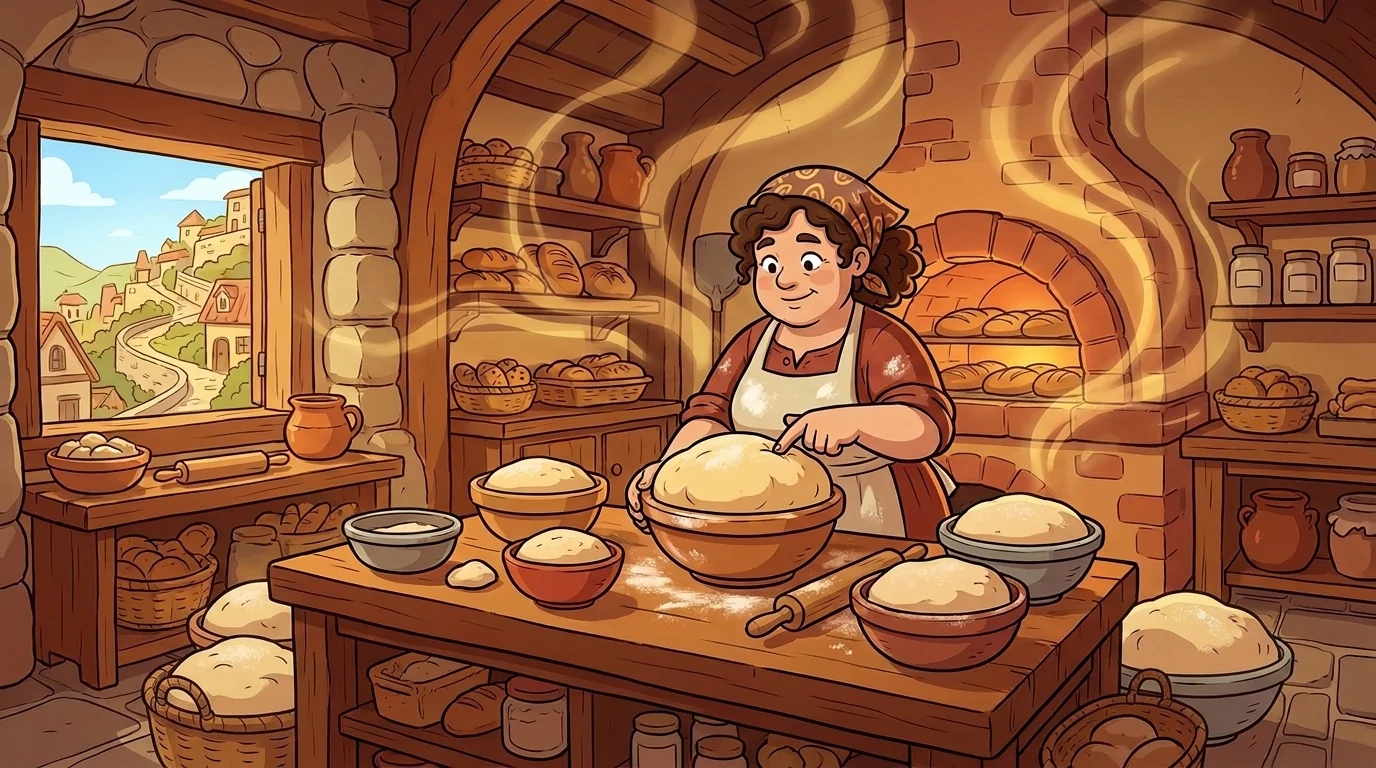
She still bakes for the academy on feast days, and the whole hall knows when Leaven's loaves are rising, because the smell reaches every classroom.
She tells the children that exponents are not a cruel new times-table but only rising — the same patient, surprising, self-building growth that fills a loaf from a fingertip of leaven. The base is the dough; the exponent counts the rises; and because each rise doubles everything before it, exponents grow at a speed that looks almost unfair until you remember you have watched it happen in an oven a thousand times.
"It isn't hard," she says. "It's just rising. The little number counts how many times the base multiplies itself. Build, don't stack."
When the hall empties, Leaven wipes the flour from her hands and feels the warm, rising gladness of a person who has spent her life coaxing small things patiently into something far greater than they began — the gladness of the first good smell at dawn, undimmed by sixteen years of ovens.
The EquationQuest ensemble
Leaven is part of EquationQuest's distributed-narrative cast. Each character embodies a different curricular primitive; together they teach the full subject.
-

Lever
Maintaining balance — do the same thing to both sides
-

Solo
Isolating the variable — moving everything else away from x
-

Undo
Inverse operations — addition ↔ subtraction, multiplication ↔ division
-

Spread
Distribution — multiplying across parentheses
-

Flipper
The sign-flip in inequalities when multiplying/dividing by a negative
-

Corral
Combining like terms — you can only add or subtract terms of the same kind; gather the like ones together
-

Marshal
Order of operations — the agreed sequence for working an expression (PEMDAS)
-

Prise
Factoring — find the part two or more terms share and pull it out front
-

Stead
Substitution — put a known value in place of a variable, then simplify