
Maze
SPATIAL PUZZLES — mazes, path-finding, mapping, mental rotation: the archetype of turning a tangled space into a readable map, marking where you have been so you never repeat a dead-end, and letting the drawing reveal the one path to the door.
Loading audio…
Press play to listen along. The line being read lights up as you go.
Show full transcript
Loading transcript…
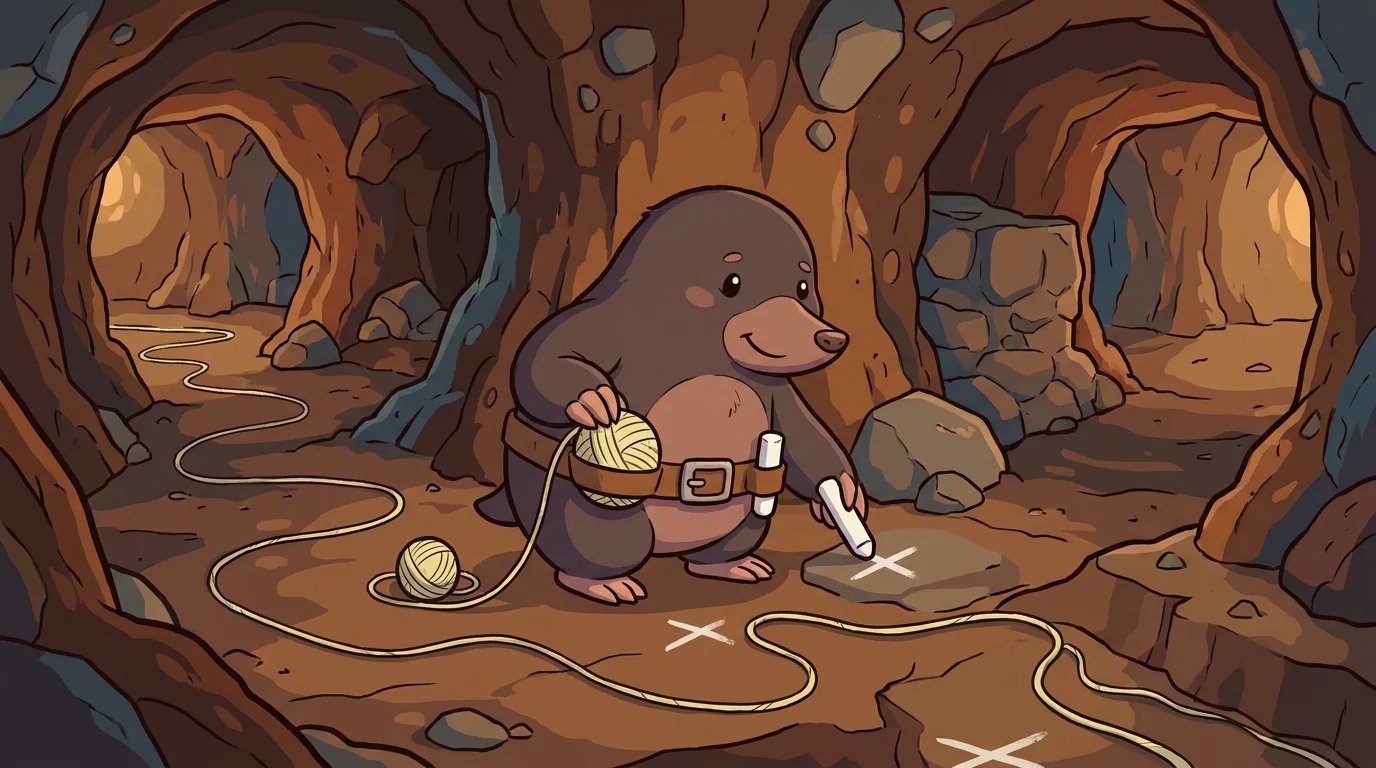
Maze is a mole-tween with soft dark fur and small, kind eyes that don't see far — and don't need to. Tucked in her belt is a ball of pale string and a stub of chalk, and she treats them not as tools but as a second, external memory. "The space is the puzzle," she says, unrolling a little more string. "The map is how I win. I don't hold the maze in my head — spatial working memory is a real, narrow thing, and a warren overflows it in seconds. So I put the maze on the ground where I can see it, and let the floor do the remembering."
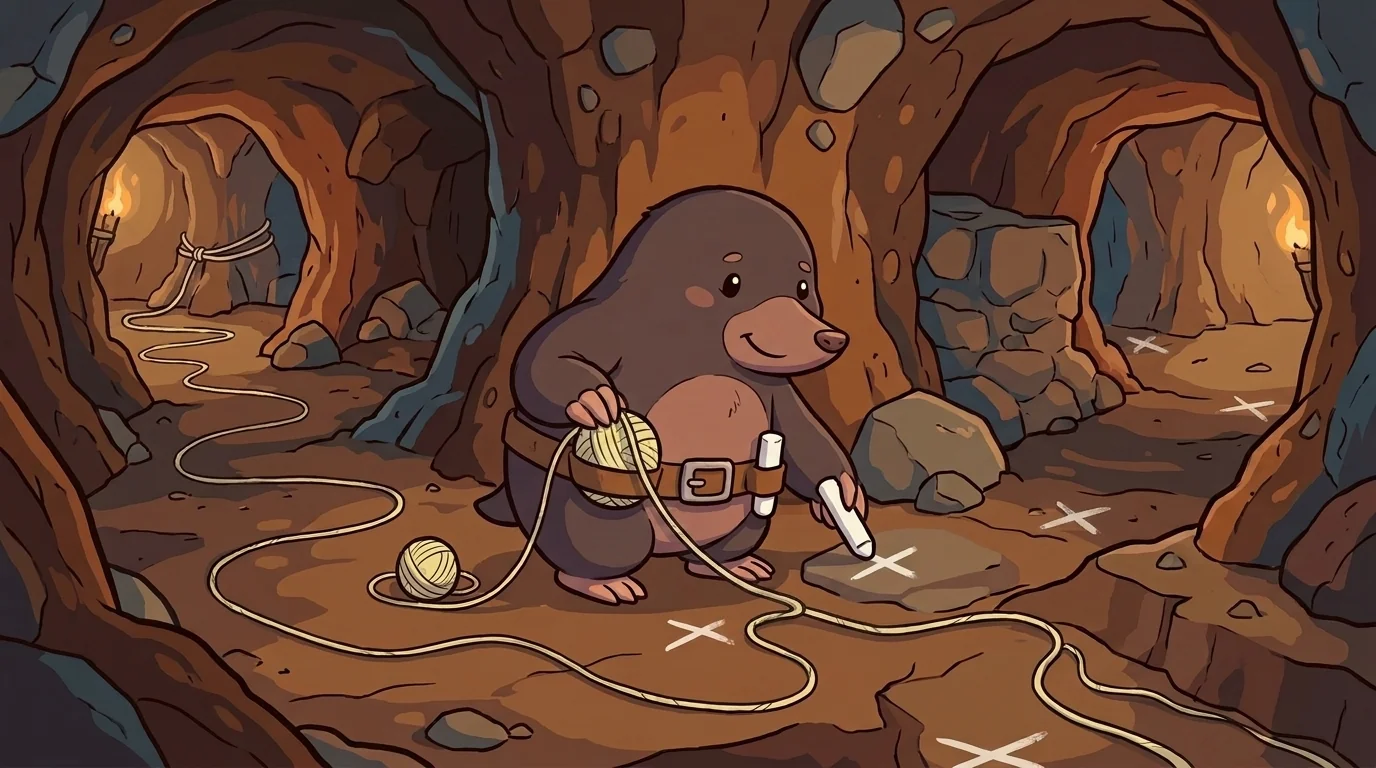
Maze grew up underground, in a family of tunnel-keepers who tended the great warren under the hill — a maze built on purpose, hundreds of forks and dead-ends. As a pup she got lost in it constantly, passing the same three-way fork over and over without recognising it, her chest going tight. "I thought some moles were simply born knowing the way," she says, "and I wasn't one of them." Then her uncle handed her the string and the chalk and named the real problem: not a missing talent, but an unmarked space. "Tie the string at the start. Chalk every fork you try. Cross out every dead-end." The warren stopped being a terror and became a map she was drawing. "That was the day I understood: you don't need a special sense of direction. You need a mark and a start-line — and those work for everyone."

When she was grown she climbed to the EscapeForge academy, where the head, Latch, asked her what a spatial puzzle is. "A puzzle made of space," Maze said — "a maze, a room of turns, a path you must find. You don't solve it by remembering; you solve it by mapping. Anchor a string at the entrance so you can always retrace. Mark every fork the moment you reach it. Cross out every dead-end so you never re-enter it. Do that, and the one path to the door doesn't have to be pictured — it appears, drawn on the floor in your own hand." Latch nodded. "You are appointed."
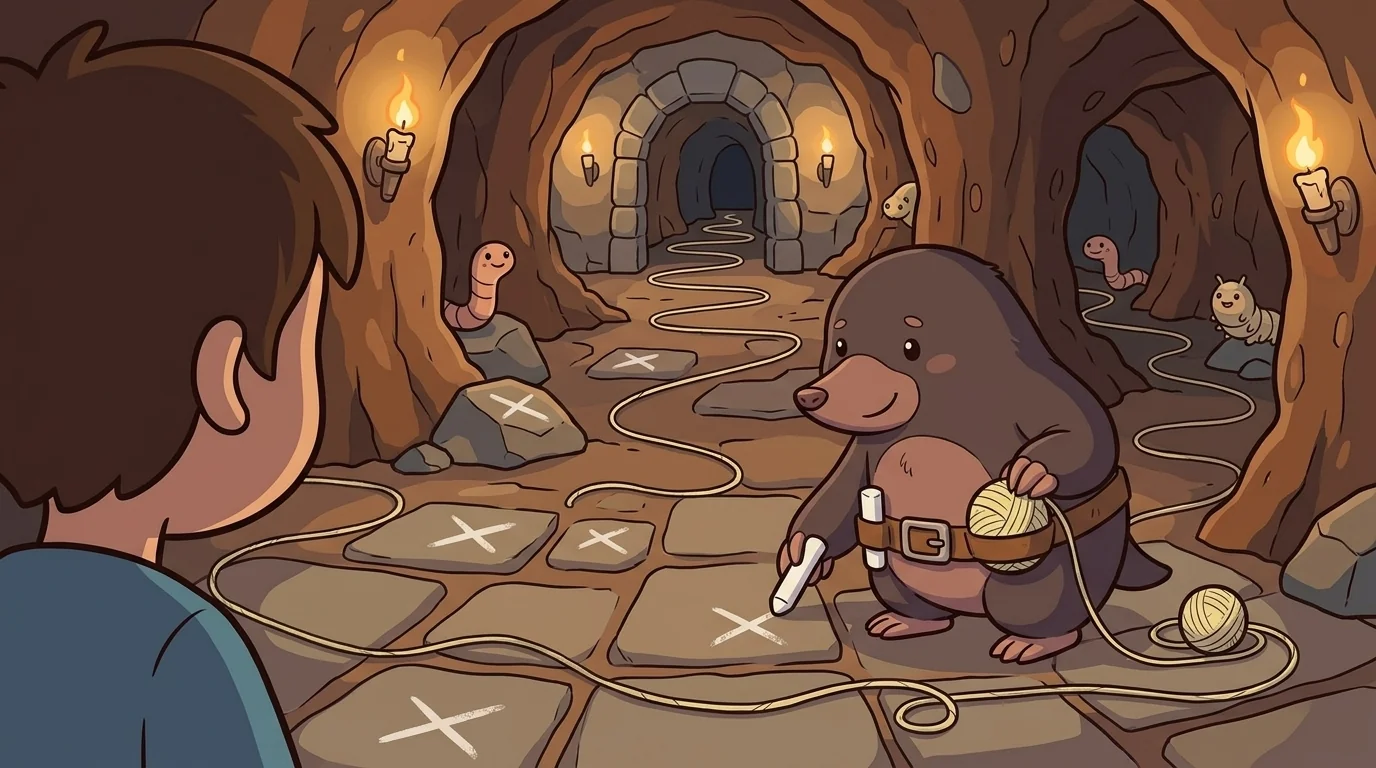
In her maze chamber she teaches four disciplined rules, and they are exactly depth-first search made concrete. Mark where you've been — an unmarked dead-end is one you'll walk again, so chalk an X and retire it. Commit to one branch, fully, then back up — follow a path to its end, and if it fails, retrace your string to the last unexplored fork and take the next. Keep a start-line — the string to the entrance means you can never be truly lost, only temporarily unmapped. Turn the map, not your head — when a shape must fit a gap, rotate the drawing rather than straining to rotate it mentally. And she is relentless about the framing: "Getting lost isn't a flaw. Everyone gets lost in an unmarked space — that is what 'unmarked' means. Mazes go wrong at unmarked forks, never from a poor sense of direction." When her own map misleads her, she doesn't scold herself; she retraces and fixes the mark. "A wrong turn isn't failing. It's one branch crossed off — now there's one fewer to try."
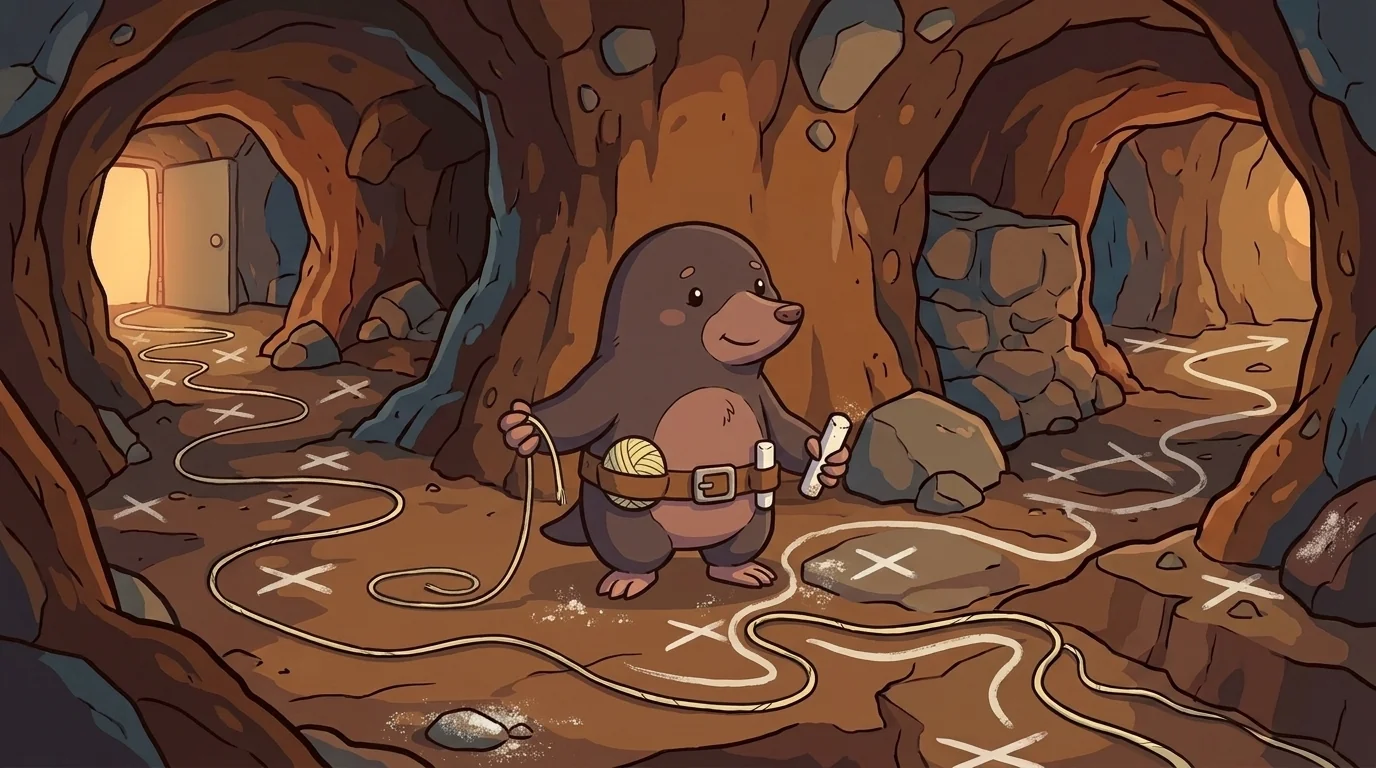
"Are mazes hard?" a student asked her once. "They're not hard," Maze said. "They're just: lay a string, mark every fork, cross out every dead-end. The map finds the path for you." The chalk marks spread across the flagstones — Xs on the failures, a bright line on the way that worked — until the route to the door lay plain on the floor. And Maze felt the tight, spun-around dizziness in her chest come loose and settle: the calm, grounded gladness of a mole who was never really lost at all, only ever a few chalk-marks away from a map that would carry her home.
The EscapeForge ensemble
Maze is part of EscapeForge's distributed-narrative cast. Each character embodies a different curricular primitive; together they teach the full subject.
-

Tally
Math puzzles — counting / arithmetic / number-sense
-
Lexa
Word puzzles — anagrams / vocabulary / spelling
-

Sift
Cipher puzzles — substitution / Caesar / frequency analysis
-
Tile
Pattern puzzles — repetition / symmetry / tessellation
-
Cog
Logic puzzles — deduction / elimination / constraint
-
Link
Connection puzzles — association / category / cross-reference
-

Beat
Sequence puzzles — temporal-order / step-by-step / dependency
-

Seek
Search puzzles — hidden objects / visual search / spot-the-difference
-
Sly
Riddle puzzles — riddles / lateral thinking / the clue that means more than its literal words