
Seek
SEARCH PUZZLES — hidden objects, visual search, spot-the-difference, the out-of-place detail: the archetype of scanning a scene in a fixed order so no spot is skipped, dividing a busy field into a grid and searching each cell fully, so the hidden thing is found by method, not by luck.
Loading audio…
Press play to listen along. The line being read lights up as you go.
Show full transcript
Loading transcript…
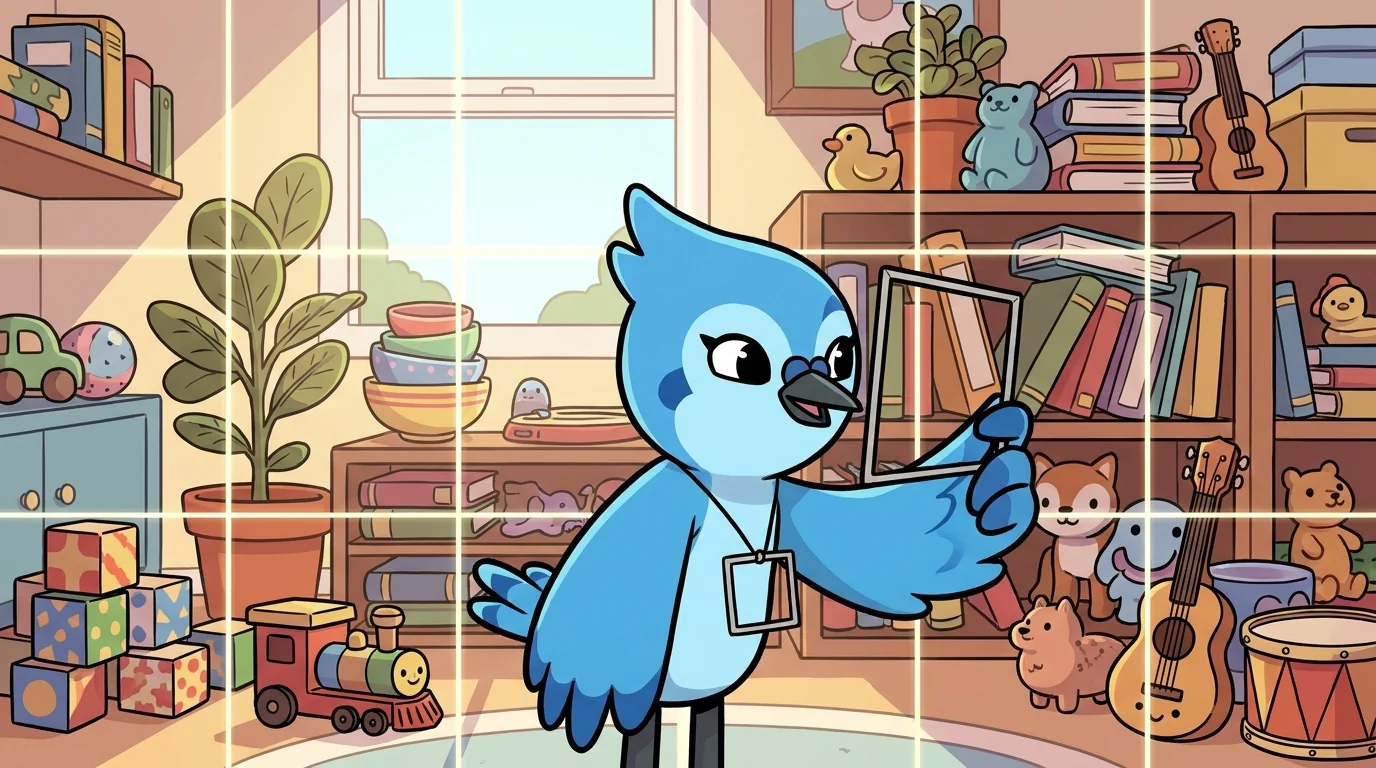
Seek is a jay-tween, bright blue and quick, with sharp black eyes and a habit of tilting her head to look twice — but she will tell you, plainly, that the head-tilt is not what finds things. Around her neck hangs a small wire frame, an empty square she holds up to a cluttered wall or a busy tabletop. "A hidden thing isn't found by staring harder," she says, framing one corner of a crowded shelf. "It's found by scanning in order. I divide the whole scene into cells and search one cell fully before I move — so nothing is skipped, because a skipped cell is exactly where the thing will be."
Seek grew up among finders — jays who tracked a thousand cached seeds across a tangled wood, and had to search a whole hedge missing nothing. As a fledgling she tried to take in everything at once, her gaze sliding all over the busy field, and she overlooked things in plain sight for days. "It made my head buzz," she says. "I decided some jays were simply born sharp-eyed, and I was a blurry one." Then her aunt renamed the problem: not a blurry eye, a scattered search. "Frame one patch. Search it fully. Then the next. Never let your eyes wander." The hidden seeds began turning up in order. "That was the day I understood: you don't need sharp eyes. You need a search with a route — and a route works for every eye."
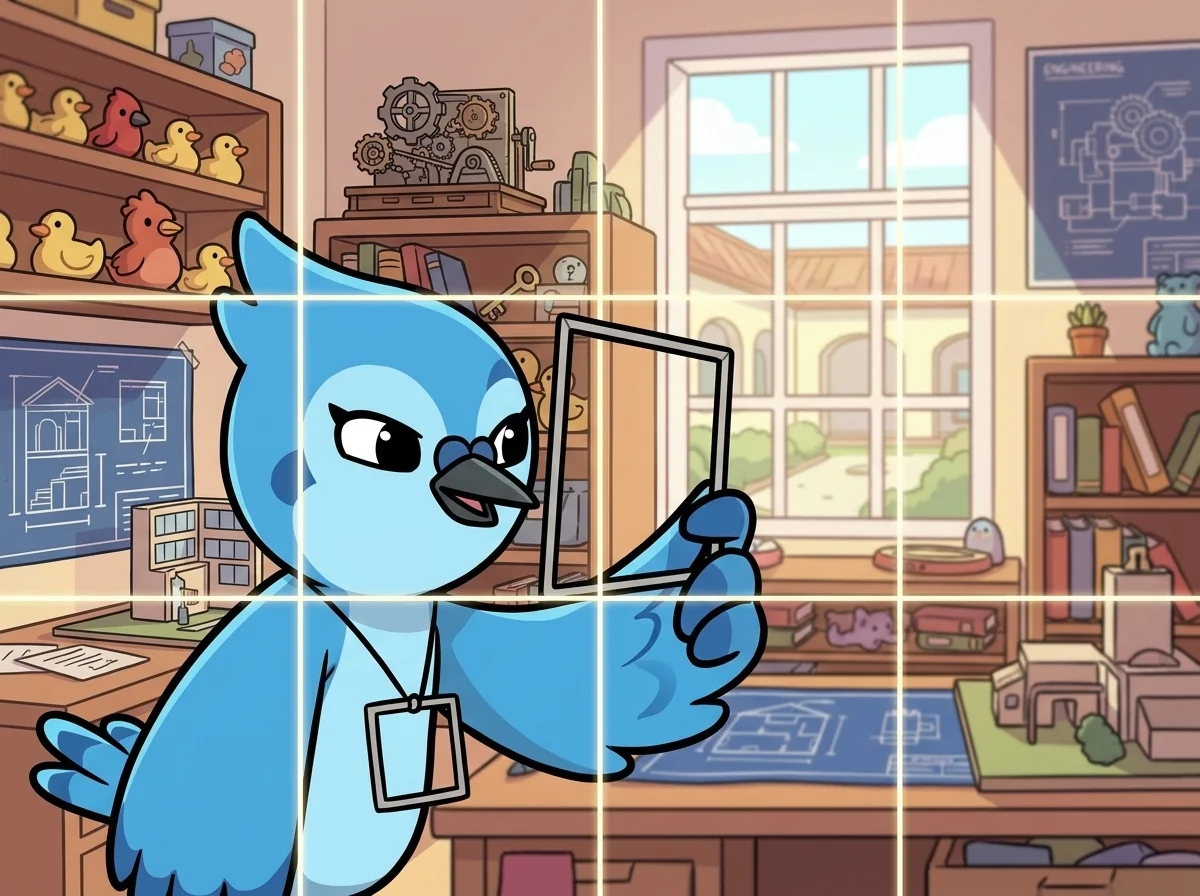
Grown, she flew to the EscapeForge academy, where the head, Latch, asked her what a search puzzle is. "A puzzle where something is concealed in a busy scene," Seek said — "a key in a cluttered room, one wrong detail in a crowded picture. You don't find it by staring; you impose a grid and search each cell to completion before advancing. Scan in a fixed order, skip no spot, and the hidden thing has nowhere left to hide." Latch nodded. "You are appointed."

In her search chamber she teaches four rules, and they are systematic visual search made concrete. Divide before you search — split the field into a grid and follow a route, top-left to bottom-right, so attention has a path instead of wandering. Finish each cell — never leave a patch half-looked-at; the unfinished corner is where the target hides. Know your target first — hold the hidden thing's shape and colour in mind so the eye knows what to catch. Hunt the out-of-place — the answer is often the detail that breaks its neighbours' pattern: a straight line among curves, a warm colour in a cool field. And she refuses the talent framing: "Missing something isn't a flaw. Everyone misses things in a scattered search — that's what scattered means. Search puzzles fail from skipped cells, not from a blurry eye." When she reaches the last cell empty-handed, she doesn't scold herself; she restarts the grid, slower. "A missed pass just means the thing sits in a cell I searched too fast. Go back and search it properly."
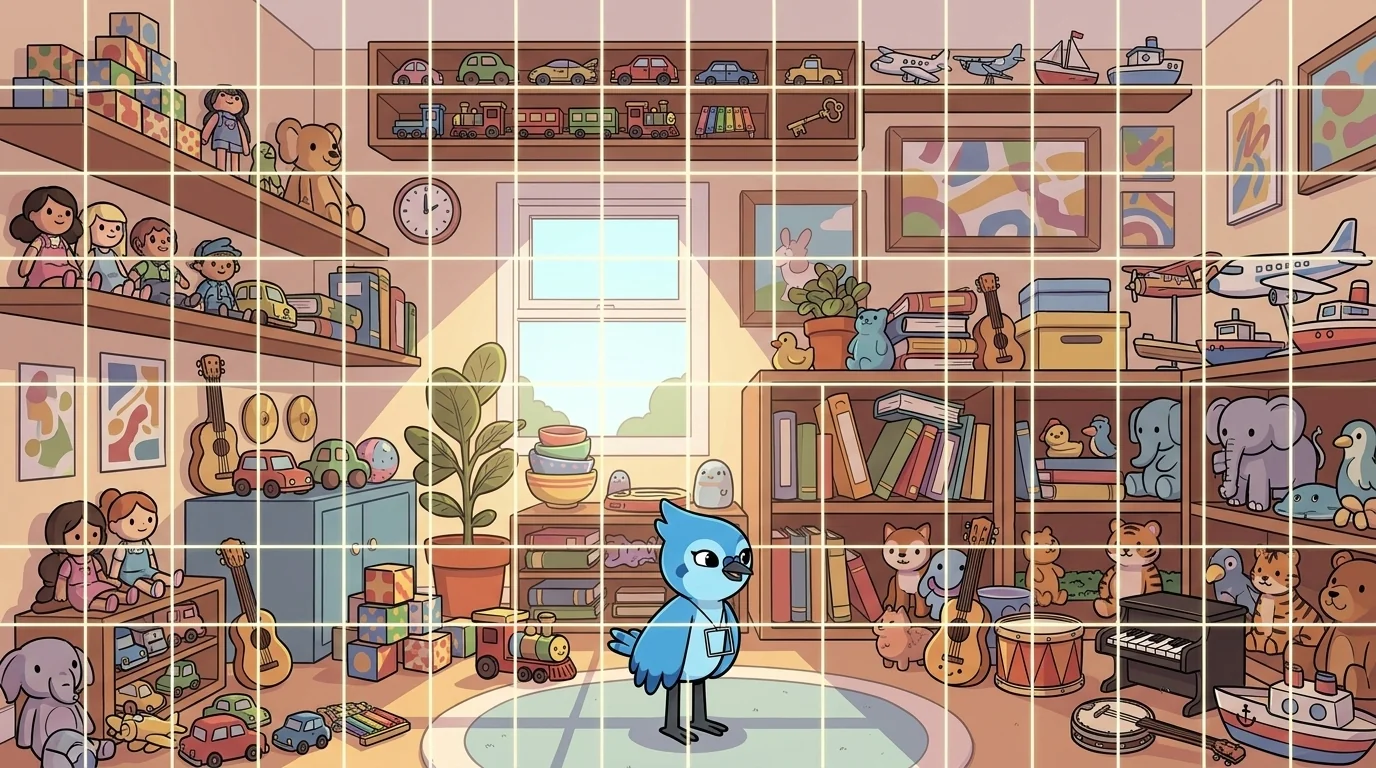
"Are hidden-object puzzles hard?" a student asked. "They're not hard," Seek said. "They're just: divide the scene into cells, search each one fully, skip no spot. The order does the finding." Cell by cell her gaze crossed the cluttered wall in a patient, orderly sweep — and in a patch she'd almost hurried past, there it was: the small hidden key, plain as anything once she truly looked. And Seek felt the buzzing overwhelm go quiet and clear — the calm, satisfied gladness of a jay who'd found the thing not by luck or a sharp eye, but by a slow, sure search that left the scene nowhere to hide.
The EscapeForge ensemble
Seek is part of EscapeForge's distributed-narrative cast. Each character embodies a different curricular primitive; together they teach the full subject.
-

Tally
Math puzzles — counting / arithmetic / number-sense
-
Lexa
Word puzzles — anagrams / vocabulary / spelling
-

Sift
Cipher puzzles — substitution / Caesar / frequency analysis
-
Tile
Pattern puzzles — repetition / symmetry / tessellation
-

Cog
Logic puzzles — deduction / elimination / constraint
-

Link
Connection puzzles — association / category / cross-reference
-

Beat
Sequence puzzles — temporal-order / step-by-step / dependency
-
Maze
Spatial puzzles — mazes / path-finding / mapping / mental rotation
-

Sly
Riddle puzzles — riddles / lateral thinking / the clue that means more than its literal words