
Guise
CONVERGENT EVOLUTION — unrelated lineages independently evolving the same outward form because a shared environment poses the same selective problem. A matching shape is an analogy (same job), not a homology (same ancestry); the bones underneath tell which.
Loading audio…
Press play to listen along. The line being read lights up as you go.
Show full transcript
Loading transcript…
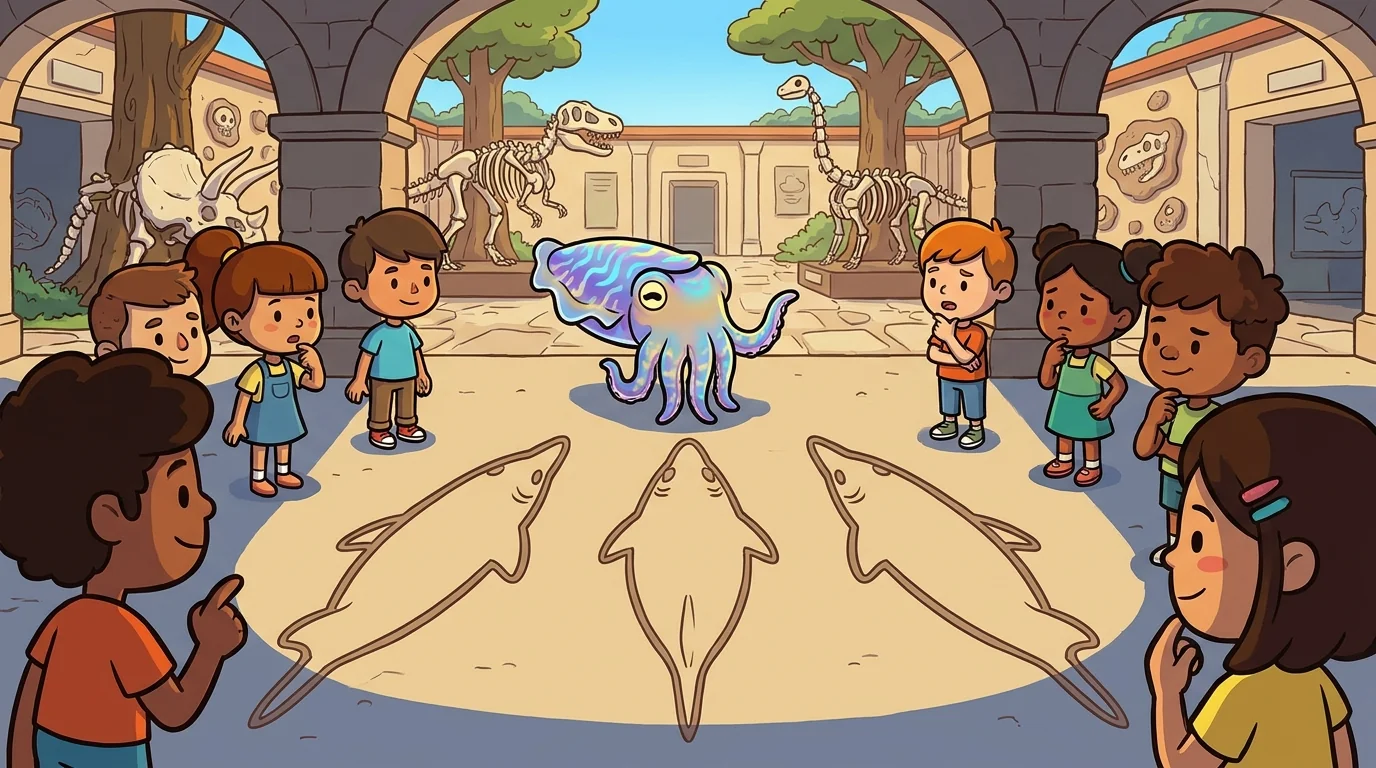
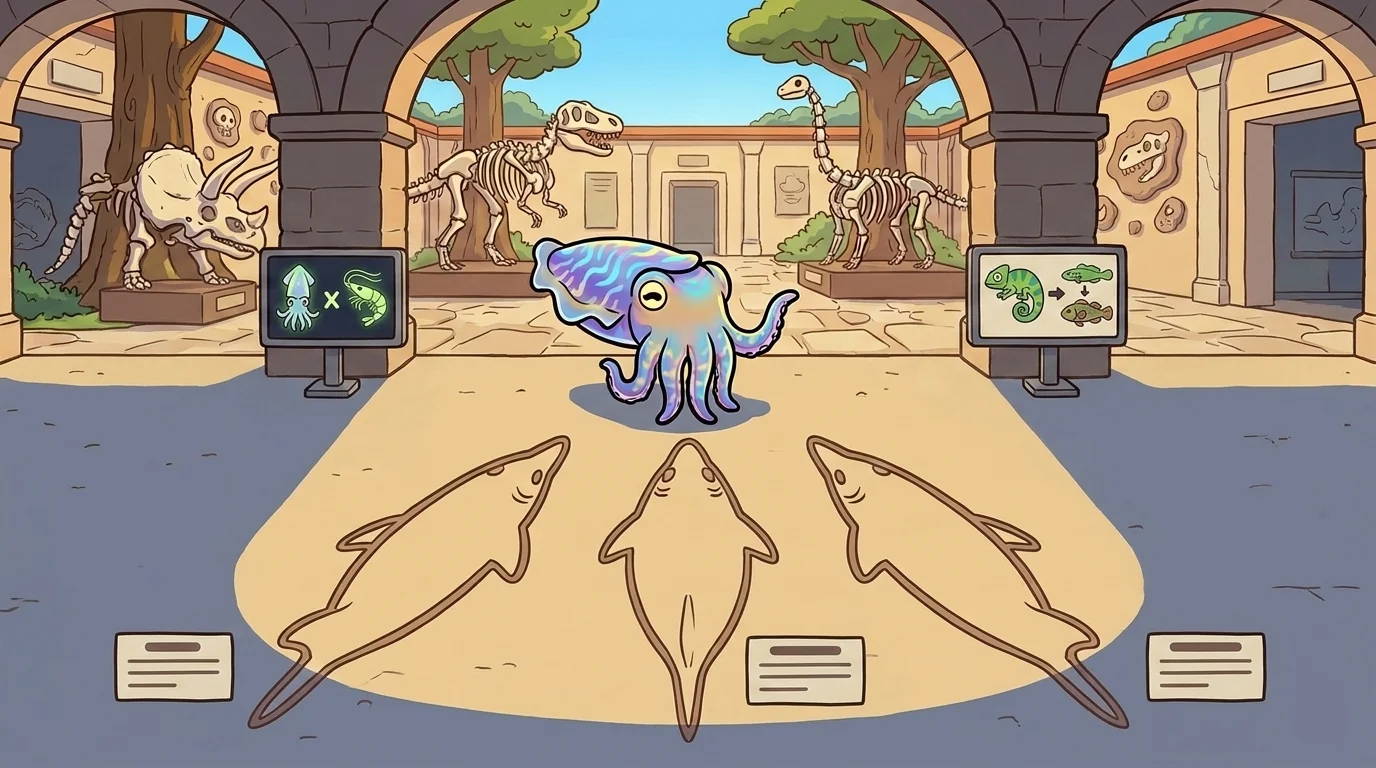
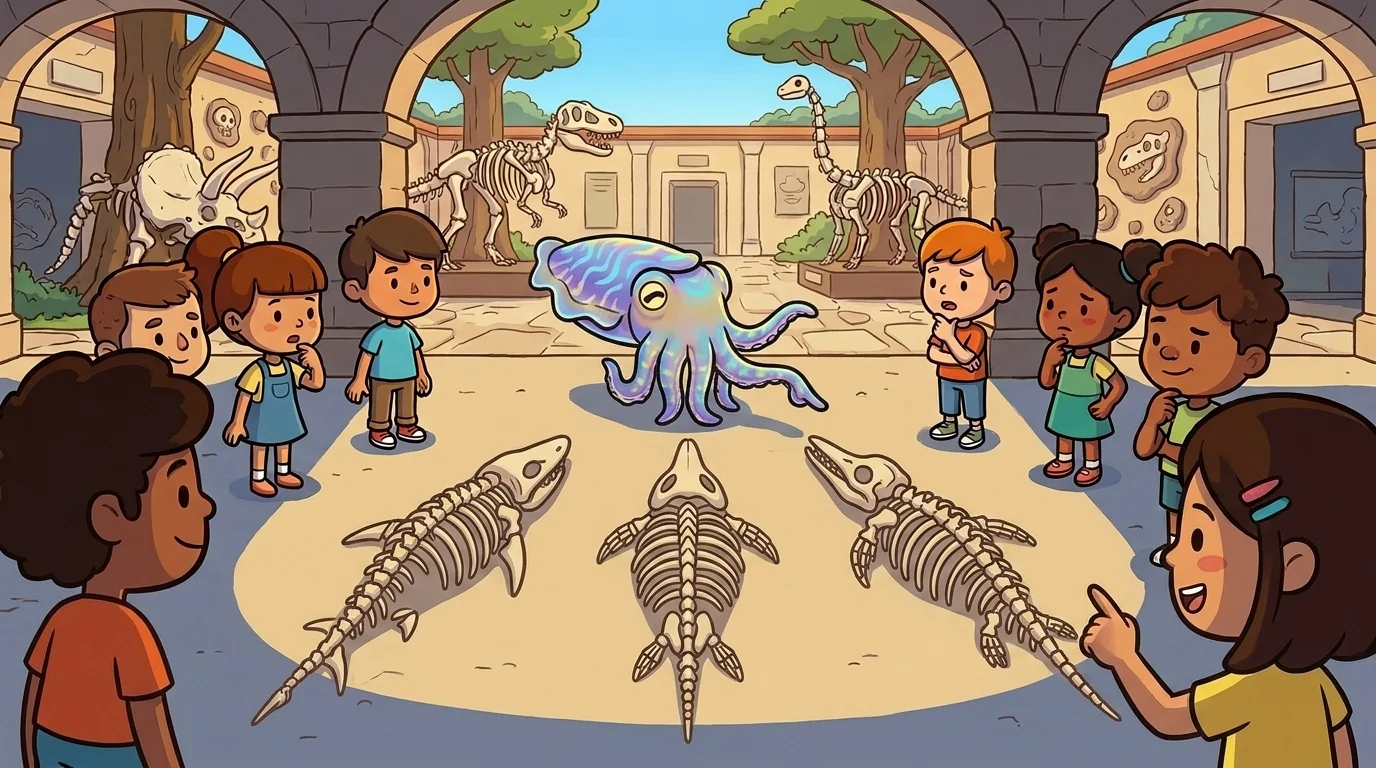
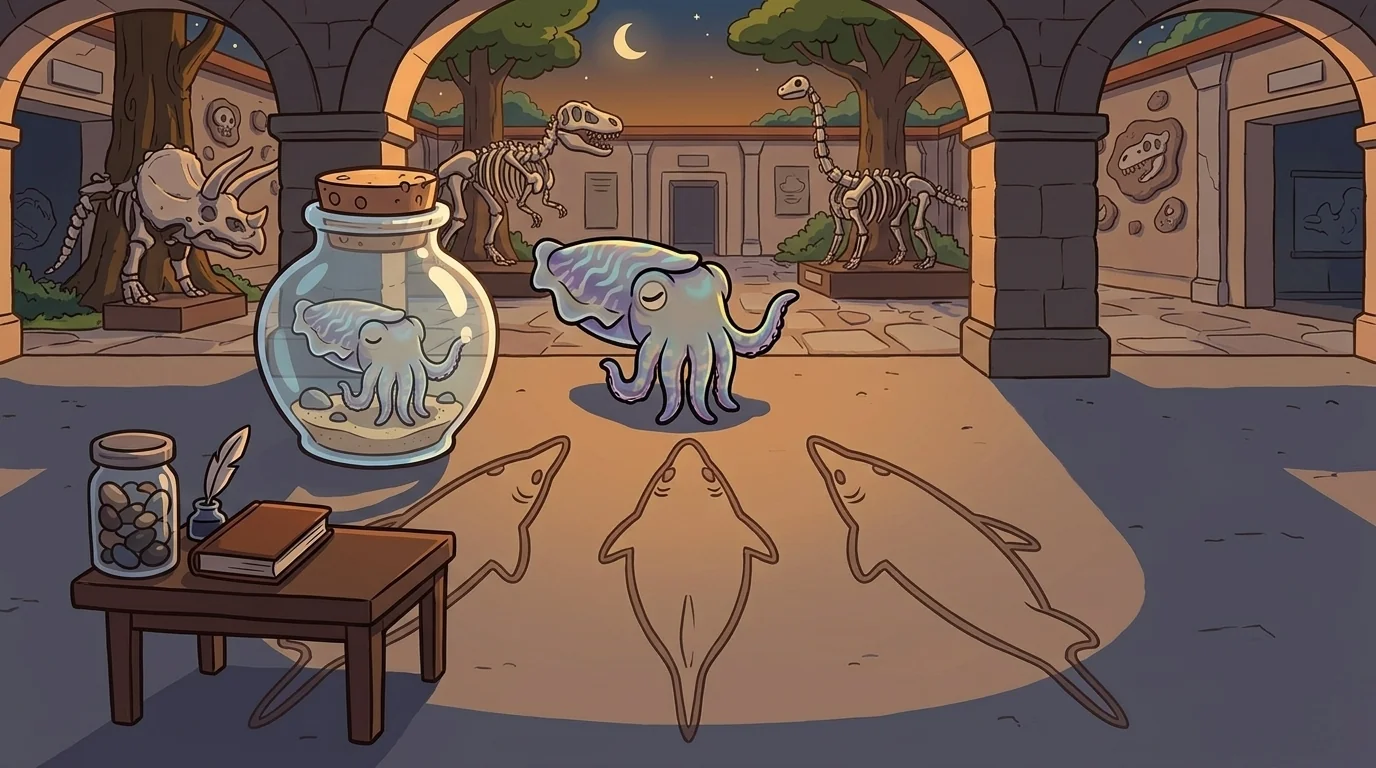
In the FossilForge courtyard, a shimmering cuttlefish — who could not resist changing colour when watched — laid out three sleek, torpedo-shaped outlines. "Three swimmers. Smooth, pointed, finned — built like arrows for the open sea. Which two are cousins?" The museum-club kids looked; the shapes were near-identical. "All of them?" a boy guessed. "None of them," said Guise, delighted. "This is a shark — a fish. This is an ichthyosaur — an ancient reptile, closer kin to a lizard. And this is a dolphin — a mammal, closer kin to you than to either. Three different families, wearing the very same shape. Not because they're related — because the sea asked all three the same question, and all three, alone, gave the same answer."
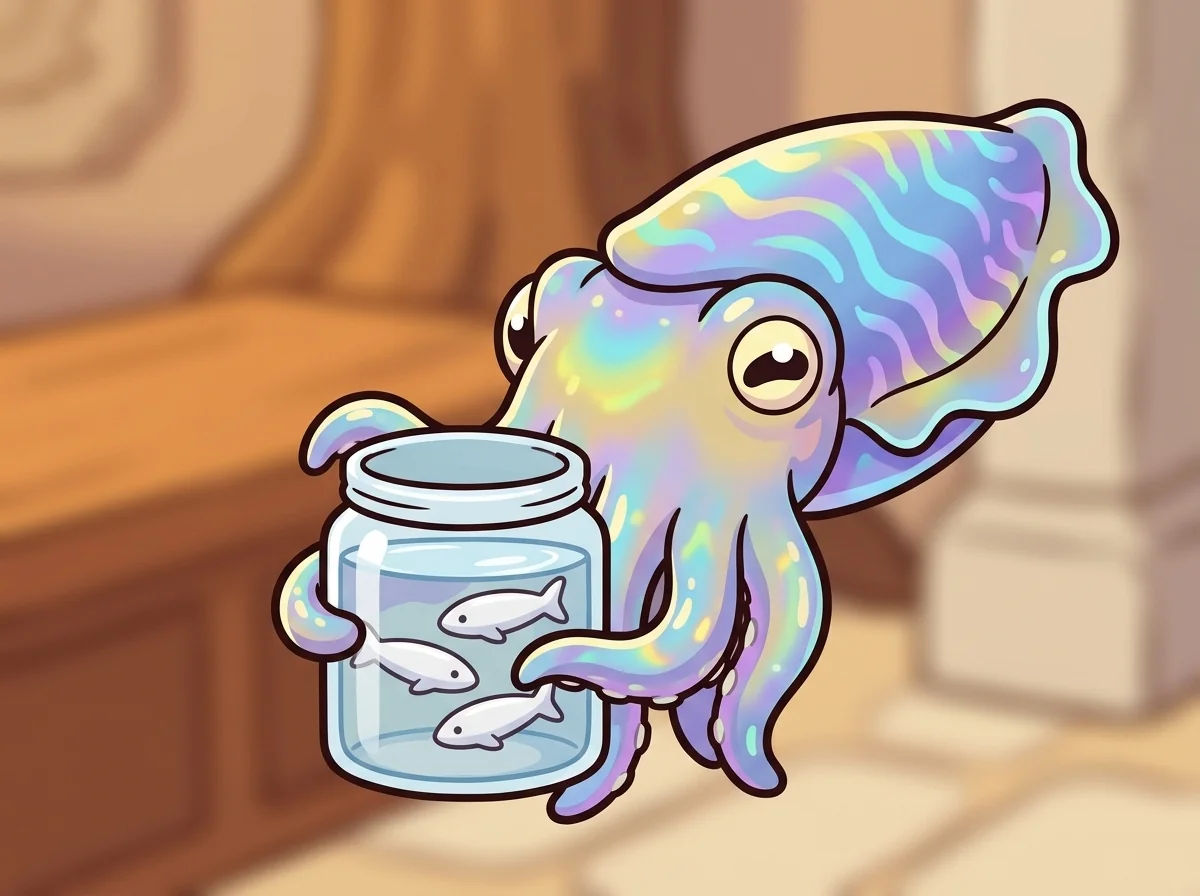
Guise had learned it from her own changing skin. A young cuttlefish, proud of turning the colour of sand or weed in a moment, she had assumed anything wearing a matching appearance must be a relative. But the sea corrected her: a flatfish that changed colour too, no cousin at all; a shrimp and a squid that glowed the same light for the same reason, sharing almost no family. She remembered the humbling warmth of realizing it — that she was not special for her disguises, that the sea handed the same good answers to whoever needed them. It made her feel, oddly, less alone.
At the academy she taught the children not to be fooled by the outside — and the exact vocabulary that keeps it straight. "When lineages come to look alike without close kinship, we call it convergent evolution — and the shared feature is an analogy: same function, arrived at independently. When they look alike because of a shared ancestor, that's homology: same structure, inherited. The dolphin's fin and the shark's fin are analogous — same job, different family. The dolphin's fin and your arm are homologous — same underlying bones, shared ancestor." The mechanism, she said, is selection: "In the open water, an arrow-shape is what lets you go fast without wasting energy, so any swimmer that drifts toward that shape survives a little better and passes it on. Give three unrelated families the same problem — the same environment applying the same pressure — and they converge on the same solution, each on its own road. The shape isn't copied. It's re-discovered, three times."
"But how do you tell them apart if they look the same?" asked a girl. "You do what Underframe does — you read the bones," said Guise, with real respect. "A shark's frame is a fish's frame. A dolphin's flipper has the same limb bones you have — one, then two, then wrist, then fingers — because a dolphin is our kind of cousin wearing a fish's coat. Convergence copies the outside; it almost never reproduces the deep internal frame. So the surface can rhyme, but the skeleton keeps the family secret. A matching shape isn't a lie — it's a clue: that two very different lives were shaped by the same hard water. To confuse analogy for homology is the classic error; the frame underneath is how you avoid it."
She still drifts the reef when she visits home, and can't pass a creature wearing a familiar shape without stopping to admire it. The thing she hopes the children carry is that the surface is real and worth loving — but it is not the whole truth. Two creatures can wear the very same guise for the very same good reason and be no relation at all; knowing that keeps you from mistaking a resemblance for a bond, while letting you marvel that the world so often hands the same answer to strangers.
"Don't be fooled," she tells them, shimmering, "but don't be cold about it either. A shared shape isn't kinship — it's the sea, or the sky, or the ground, asking a lot of different families the same question. And isn't it lovely, how often they agree?" When the courtyard empties, Guise settles in her jar and lets her colours go quiet, feeling the soft gladness she first felt young: that she was never the only one with her tricks, and a world full of unrelated creatures wearing the same good shapes is not lonelier, but warmer.
The FossilForge ensemble
Guise is part of FossilForge's distributed-narrative cast. Each character embodies a different curricular primitive; together they teach the full subject.
-
Seam
Taxonomic + fossil-type classification — family-resemblance-matching (what KIND of organism?)
-
Span
Deep-time + geological chronology — scale-of-scales (WHEN did this organism live?)
-
Branch
Morphological adaptation + evolutionary change — branching-not-laddering
-
Field
Paleoenvironment + ecosystem reconstruction — fossils-as-a-place-story
-
Last
Mass extinctions + extinction-event reasoning — witness-and-choose (cross-app cameo with EcoSphere Brink)
-
Blank
The incomplete record — the fossil record is a story with most of its pages missing
-
Imprint
Trace fossils — fossils of behaviour not bodies: footprints, burrows, trails
-
Seep
Fossilization — how a living thing rarely becomes a fossil: quick burial, slow mineral swap
-
Underframe
Homology — the same underlying skeleton, in the same order, beneath different forms