
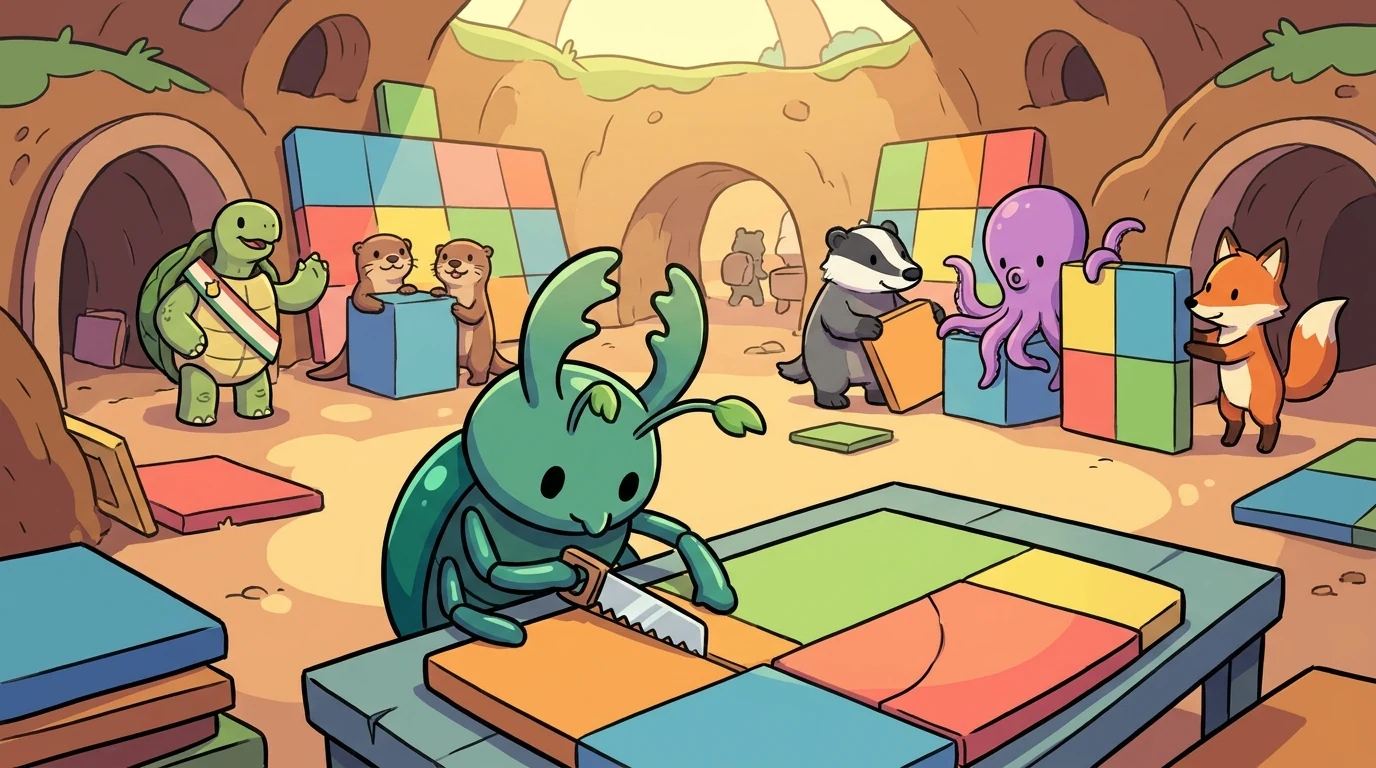
Kerf
THE SNIP TEST - *a true identity is not just right once; it stays true no matter where you cut or what numbers you choose. Snip the square at any spot: if every rearrangement still balances, the statement is an identity, true for all values.*
Kerf and the Test No Rule Can Fake
Kerf is a stag beetle, and Kerf does not take anyone’s word for anything. Beetles who mine tunnels for a living learn early that a wall which looks solid can still cave in, so Kerf tests. It is not that he is suspicious of people. It is that he is careful about claims.
The town of Identity is full of claims. Every day someone marches up with a new one. “The square of (a + b) is a² plus b²!” they announce. Or, “The square of (a + b) is a² plus 2ab plus b²!” And they look very pleased with themselves either way.
Kerf listens. Then Kerf gets out his saw.
“Let me cut it,” he says.
Here is how the snip test works, and it is beautifully simple. You take the square in question and you slice it clean across - a straight cut, at any spot you like. Now you have pieces. You count the tiles in every piece and add them up. If the total after cutting is the same as the whole was before cutting, the pieces have told the truth. And then Kerf slides them back together, picks a different spot, and cuts again. And again. He never cuts the same place twice, and he never warns you where the next cut will fall.
Because that is the trick of it. A wrong rule can be right once by pure luck. Choose the friendly numbers and a false claim might just happen to land on the correct total. But a false rule cannot survive being cut over and over at spots it did not expect, with numbers it did not choose. Somewhere, on some cut, the pieces will refuse to add back up to the whole. The gap opens. The lie shows.
So when the hare comes running with “(a + b)² is a² plus b²,” Kerf cuts. The first cut, by luck, balances. The hare cheers. Kerf says nothing and cuts again, somewhere else. This time two long strips of tiles are left over with nowhere to go - the very strips Miro and Moro live in. The pieces do not add back to the whole. There is a hole exactly the size of 2ab.
“Once isn’t always,” Kerf says, not unkindly, brushing sawdust off his shell. “Your rule got lucky. Then it got caught.”
But when Mayor Tila’s claim comes to the saw - “(a + b)² is a² plus 2ab plus b²” - Kerf cuts, and cuts, and cuts. He cuts near the edge. He cuts down the middle. He cuts at spots chosen only to be awkward. And every single time, the pieces add back to exactly the whole. Nothing left over. No hole. Cut after cut after cut, the statement simply refuses to break.
There is a particular satisfaction Kerf feels at that moment, and it is not the thin pleasure of catching someone wrong. It is the deep, solid feeling of finding something that holds. A rule that survives every test he can throw at it is not a guess and not a lucky answer. It has earned a bigger word.
“That,” Kerf says, setting down his saw at last, “is an identity. Not right once. Right every time. True for every number you could ever put in it.”
The hare, who has been watching, frowns. “How many cuts does it take to be sure?”
“More than one,” says Kerf. “Enough that luck runs out. A true thing has nothing to fear from another cut - so I keep cutting until the only explanation left is that it’s simply true.”
And Kerf sets the square back together, whole and unbroken, ready for the next claim that thinks it can fool a beetle with a saw.
The identityforge ensemble
Kerf is part of identityforge's distributed-narrative cast. Each character embodies a different curricular primitive; together they teach the full subject.