
Cage
the cage constraint — the numbers in a fenced region hit a target under one operation
Loading audio…
Press play to listen along. The line being read lights up as you go.
Show full transcript
Loading transcript…
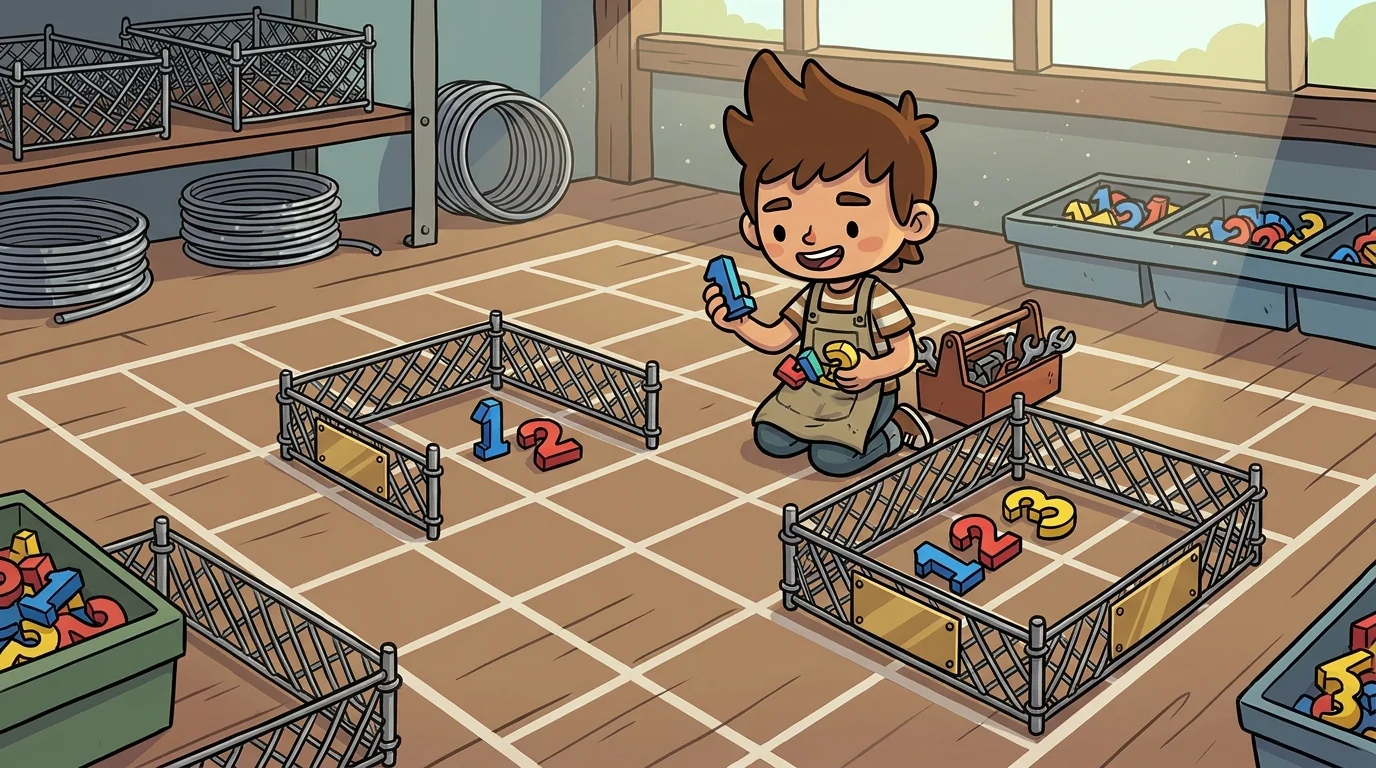
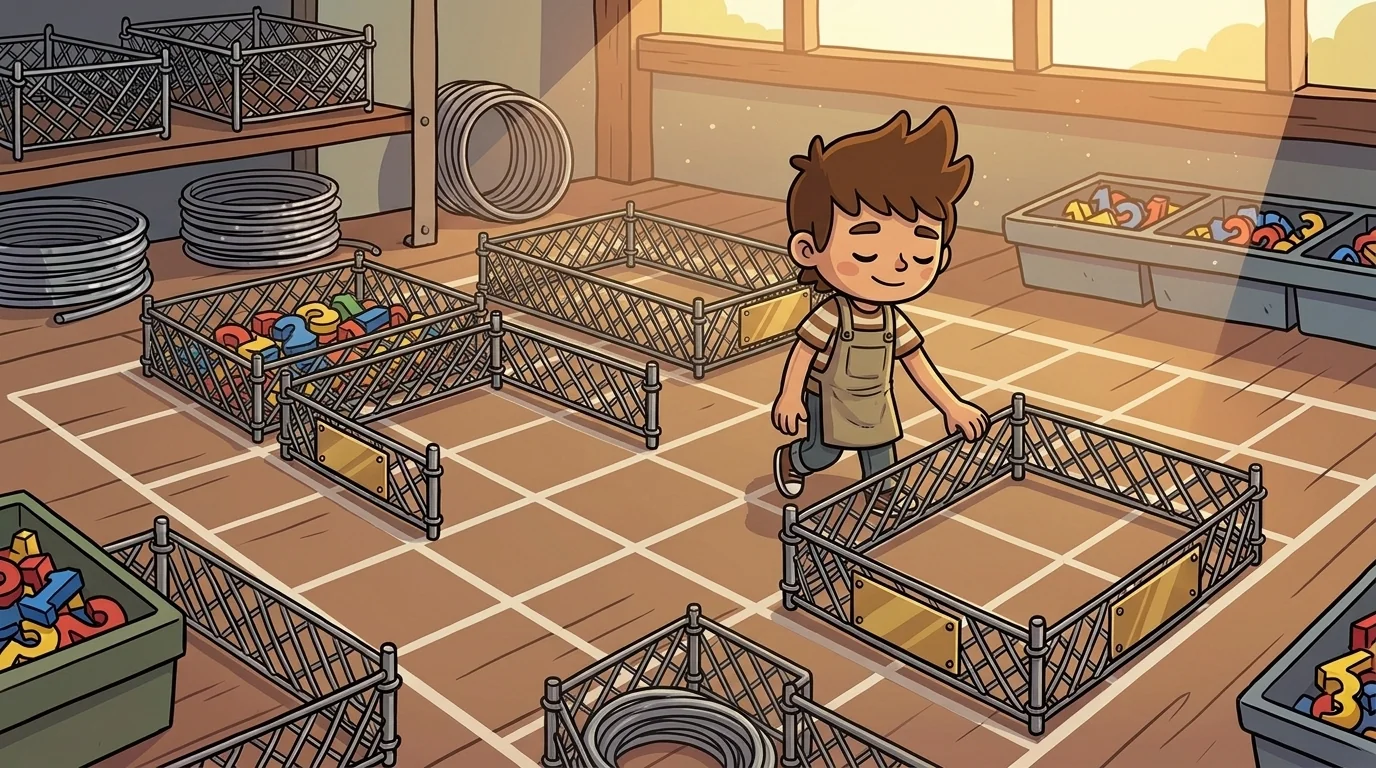
Cage built brass fences across the wide wooden grid squares on his worktable. Each fence was a tiny wire pen, held down by polished brass screws. On the corner of every pen sat a stamped plaque: one read 6×, another read 11+, and a third said 2÷.
The system was straightforward, but mastering the underlying logic took real patience. Whatever numbers lived inside a fenced pen had to hit the target stamped on the plaque. Furthermore, they had to hit that total using the single mathematical operation beside the digit.
"So a pen marked six-times means the numbers inside must multiply to six?" Maya asked, leaning over the table to trace the copper frame.
"They multiply to six," Cage said, tightening a small nut with his wrench. "And they still have to obey the main no-repeats rule of the grid."
"Two rules at once," Maya said, nodding as she watched his hands move.
"That is what makes the work so satisfying," Cage said with a warm smile. He genuinely enjoyed double-checking every small measurement.
He picked up a two-square pen marked 3+. Only two numbers could fit inside, and making three by addition without repeating required a one and a two. No other pair of digits existed in the system that could meet those conditions. Cage set the wooden blocks into place with a crisp click.
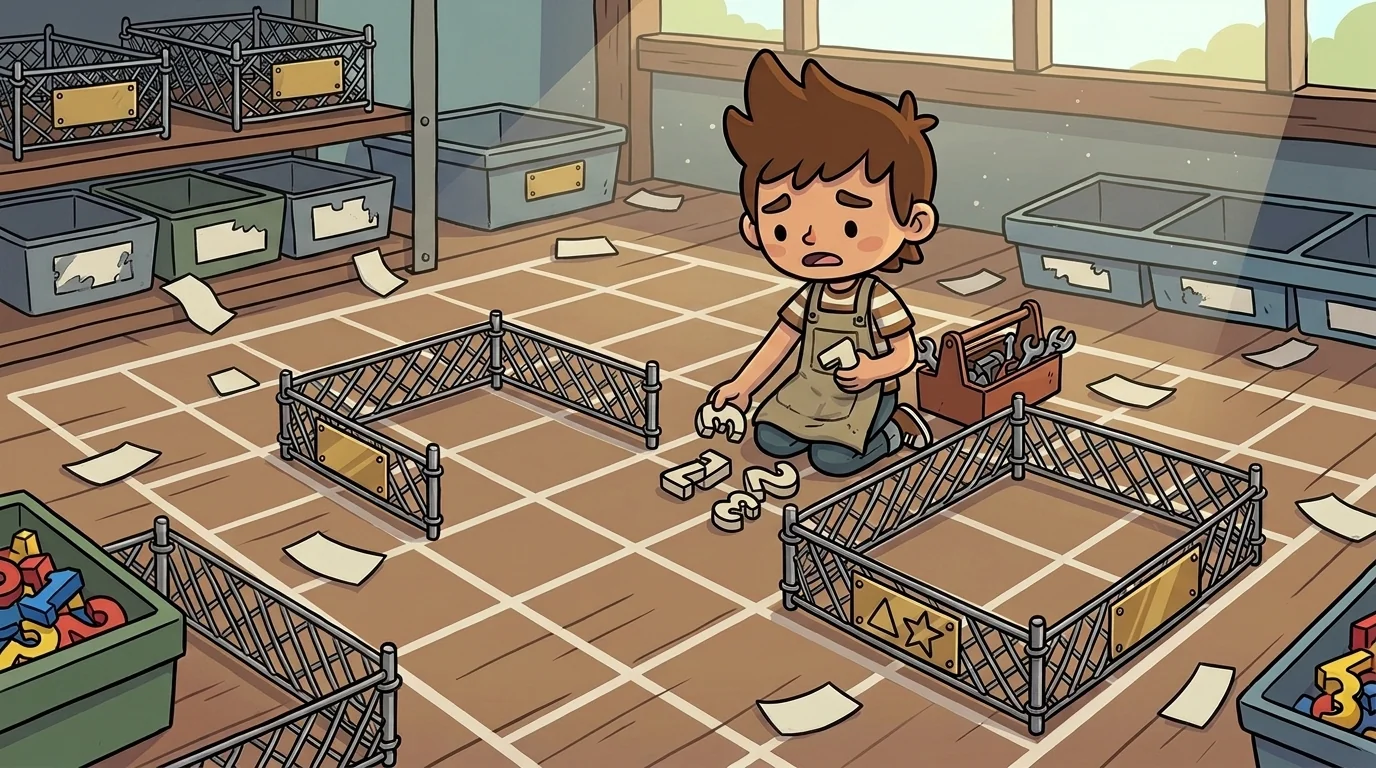
Next, he moved his small pliers to a three-square pen marked 6×. He tested number blocks in his palm, weighing the possibilities carefully. A combination of one, one, and six failed immediately because the ones repeated inside the pen. But two, three, and one multiplied to six without breaking a single grid boundary. He turned the polished wooden blocks over like a locksmith trying keys on a ring.
Cage had not learned this trade from a formal guidebook. He had learned it years ago during the spring storm that flooded the guild warehouse.
At fourteen, he was an apprentice keeping the supply grid in order. Rows of pine bins lined the walls, each holding a precise count of copper rivets and iron bolts. A sudden squall smashed through the glass skylight, sending muddy water down the walls and washing away half the paper shelf labels.
When the storm finally stopped, the warehouse was in complete disarray. All Cage had left were the inventory totals written on his dry oilskin clipboard. One line noted that Shelf Four held twelve items across three bins, with no two bins holding the same count. Another line showed that Shelf Seven held eight items across two bins, with one bin double the other.
The storage lids were rusted shut, so he could not look inside the bins to count the fittings. Nevertheless, those simple total numbers boxed the correct answers in completely.
Twelve items split across three unique bins allowed only a few mathematical combinations. Once he checked the physical shape of the shelf, only one combination actually fit the available space. He rebuilt the entire storeroom using targets and operations alone, without ever prying open a locked lid.
The old quartermaster stood in the doorway, staring at the restored bins in surprise. "You didn't guess those labels, son."
"I didn't have to," Cage said, wiping oil from his palms. "The totals told me. A target plus an operation is almost a label already. You just have to listen to it."
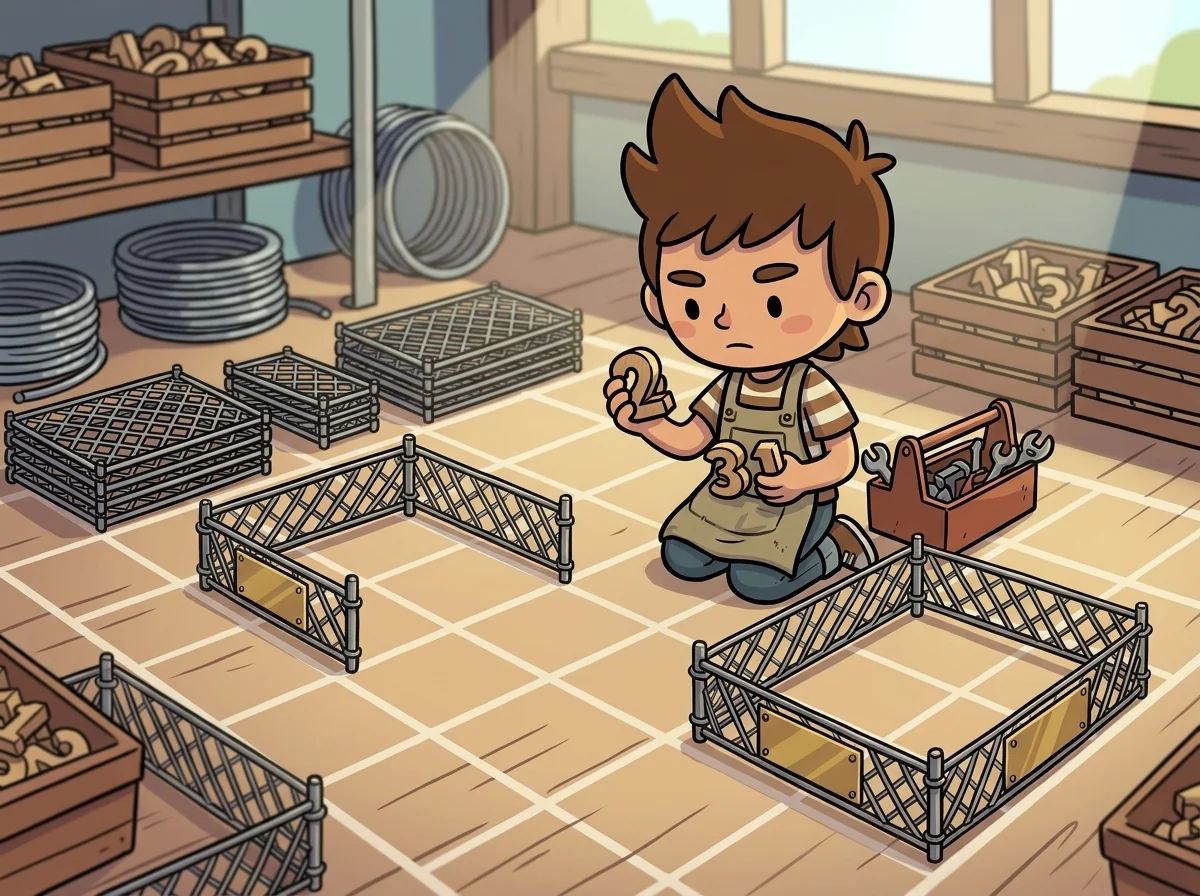
Ada brought him into the Guild three years later for that exact ear.
"Everyone can fill a cage that has ten possible answers," Ada told him during his first interview. "I want the person who finds the cage that has only one answer, and starts there."
That habit guided everything Cage built. He always hunted for the tightest arithmetic cage first—the pen where the target, the operation, and the enclosure size left the fewest possibilities.
A single-square pen marked 7 was a free gift, holding a seven and nothing else. A two-square pen marked 1÷ was more subtle. The two numbers had to divide to one, which meant they had to be equal. However, the grid's main rule banned identical numbers in the same line, meaning those two squares could never share a row or column.
He read the fence, the plaque, and the grid's overall layout together. Where all three rules agreed, there was usually only one valid arrangement left standing.
"You are using two rulebooks at once," a visiting artisan complained one afternoon.
"Three, if you count the grid," Cage said cheerfully. "More rules, fewer answers. That's the trade. I'll take it every time."
By late afternoon, Maya was stuck on a three-square pen shaped like an elbow. The plaque on the corner read 12×.
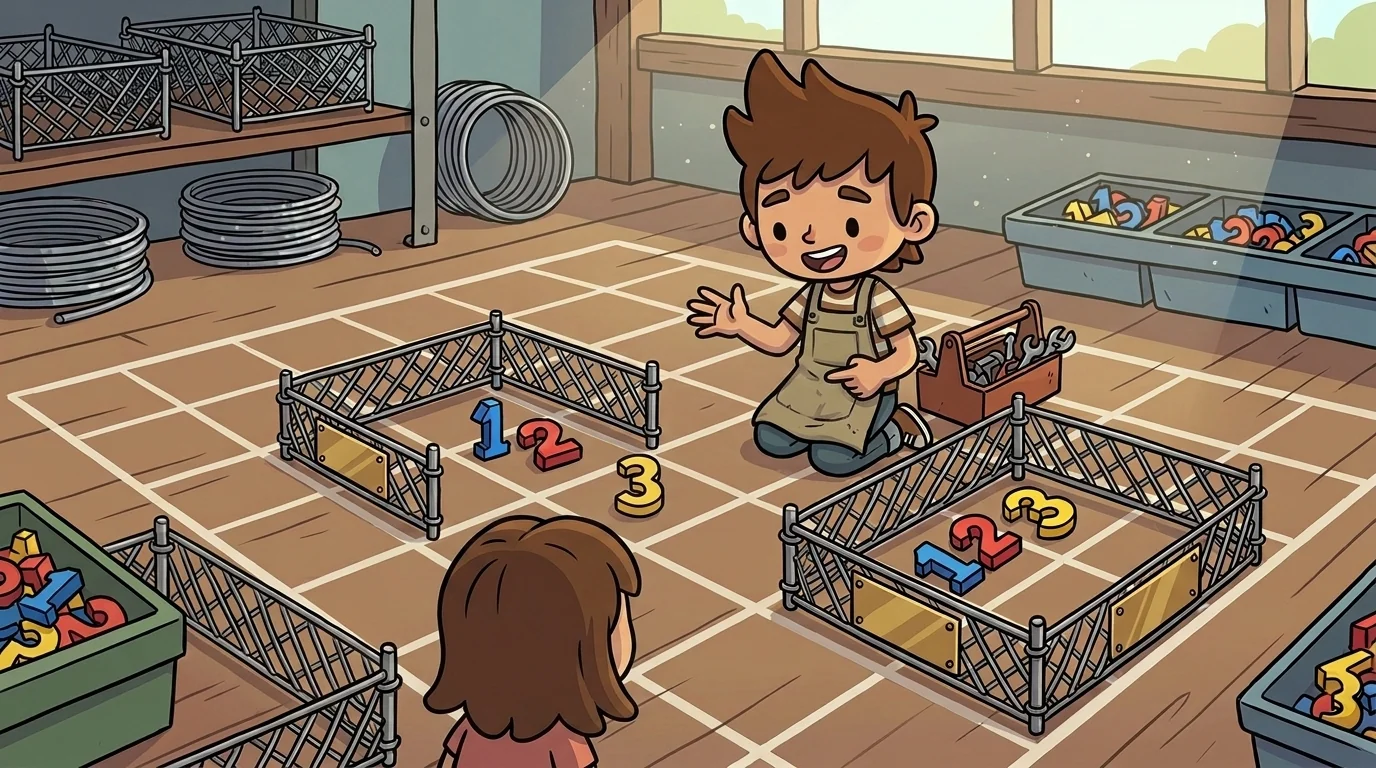
"It could be lots of things," she said, tapping her chin with a pencil. "Two, six, and one; three, four, and one; or two, two, and three."
"Two, two, and three repeats a two," Cage pointed out. "Does this pen bend through the same row?"
Maya leaned down to check the board. "Yeah, two of the squares sit in row three."
"Then those two squares cannot hold the same number," Cage said gently. "Which of your combinations survives that extra rule?"
Maya went quiet, shifting the wooden blocks across the grid. "Only three, four, and one works without putting duplicate numbers in the same row. And there is only one way to lay them out."
Two separate facts she already trusted—the target on the plaque and the row rule—had met and agreed on a single answer.
"That's it," Cage said. "You didn't pick it. The two rules picked it for you."
While resetting the outer frames near the courtyard doorway, Cage met Vega. She was busy drawing star boundaries on her own wooden grid board.
"Still locking your numbers in pens?" Vega asked, smiling dryly as she wiped chalk dust from her fingers.
"I build boundaries," Cage said. "A target total gives the numbers a clear purpose."
"Counting totals sounds like extra work," Vega said, leaning back against the doorframe. "I prefer finding where things are forbidden, because marking empty spaces feels cleaner than calculating sums."
"We are doing the same job," Cage said with a grin. "You mark where stars cannot go, while I build fences that narrow the choices. Both methods strip away the extra noise."
Vega looked down at his 11+ fence and chuckled. "My board uses fewer brass screws."
"Maybe," Cage admitted. "But my board gives a much better click when you find the right answer."
At day's end, Cage walked along his grid rows like a farmer checking fences at dusk. He touched each brass plaque in turn, verifying that twelve was twelve and six was six. Nothing inside repeated where it shouldn't.
There was a quiet satisfaction in the work that he never grew tired of. He loved the moment when separate rules agreed on one single arrangement. It felt like a solid iron key turning inside a clean lock—a small, firm click somewhere behind his ribs.
He rested his hand on the nearest fence, felt that click settle, and smiled.
"Add it up," he whispered to the quiet room, "and let the total tell you what's inside."
The LatticeForge ensemble
Cage is part of LatticeForge's distributed-narrative cast. Each character embodies a different curricular primitive; together they teach the full subject.
-

Onlie
Sudoku — Latin-square uniqueness: sets her lantern on the only place a number can go in its row, column, and box
-
Kaku
Kakuro — cross-sum: fills a run so it sums to its clue with no digit repeated; the total names its parts
-
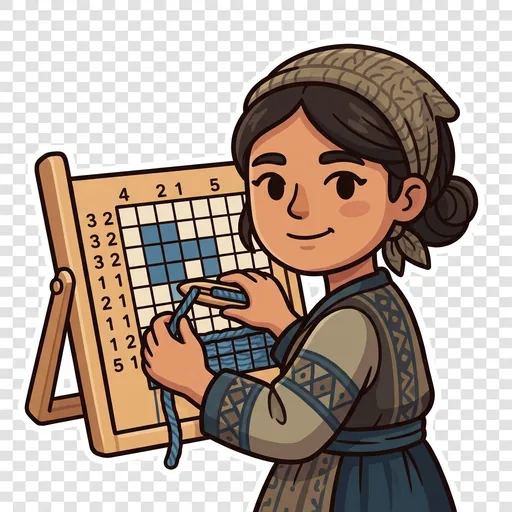
Pica
Nonogram/Picross — run-length deduction: reads the edge numbers and fills the overlap that must be filled
-

Chevron
Futoshiki — inequality/ordering: obeys the < / > flags between neighbours to force the numbers into order
-

Umbra
Hitori — elimination + connectivity: shades out duplicates so none touch and the rest stays whole
-

Serra
Skyscrapers — visibility count: places towers so each edge clue counts how many can be seen, taller hiding shorter
-

Lasso
Slitherlink — single-loop edge deduction: draws one closed loop so each number uses exactly that many edges
-

Vega
Star Battle — partition + non-adjacency: places the stars so each row, column, and region holds its quota and none touch
-

Ada
Mentor host — keeps the puzzle guild; teaches 'every grid hides one rule — find the forced cell, never guess'