
The Family Tree
THE FAMILY TREE (Advanced) — related languages descend from a shared ancestor, and you can prove it. The Advanced version names the machinery: languages are GENETICALLY RELATED when they descend from one PROTO-LANGUAGE; they diverge through REGULAR SOUND CHANGE (sound shifts that apply consistently across the whole vocabulary, not word by word); and the fingerprints left behind are COGNATES — related words in sister languages, distinguished from mere BORROWINGS precisely because the regular sound correspondences match. The comparative method reads the tree backward from those correspondences. No language is the 'original' or 'purest' — all sisters are equally descended.
Loading audio…
Press play to listen along. The line being read lights up as you go.
Show full transcript
Loading transcript…
Bough, Drift, and Bridge worked the same great tree together — Bough among its branches, Drift listening to how it grew, Bridge walking the paths between its limbs — and together they could prove something that sounds impossible: that two languages, spoken oceans apart, are cousins. "Languages have families," said Bough, tracing a branch. "Sisters, cousins, ancestors. And we're not guessing — we can show it." "The trick," said Drift, "is that a language doesn't change all at once, or randomly." "And the proof," said Bridge, "is the words that still rhyme across the gap."
"Start with me," said Bough, high in the branches. "Related languages are genetically related — which just means they descend from a shared ancestor, one older language they all grew out of. We call that ancestor a proto-language. Usually no one alive ever heard it — it was spoken long before writing — so we reconstruct it, working backward from its living descendants, the way you might sketch a grandparent's face from a room full of grandchildren. Every language on one branch of my tree is a descendant of the same proto-language. None of them is the 'original.' They're all equally its children."
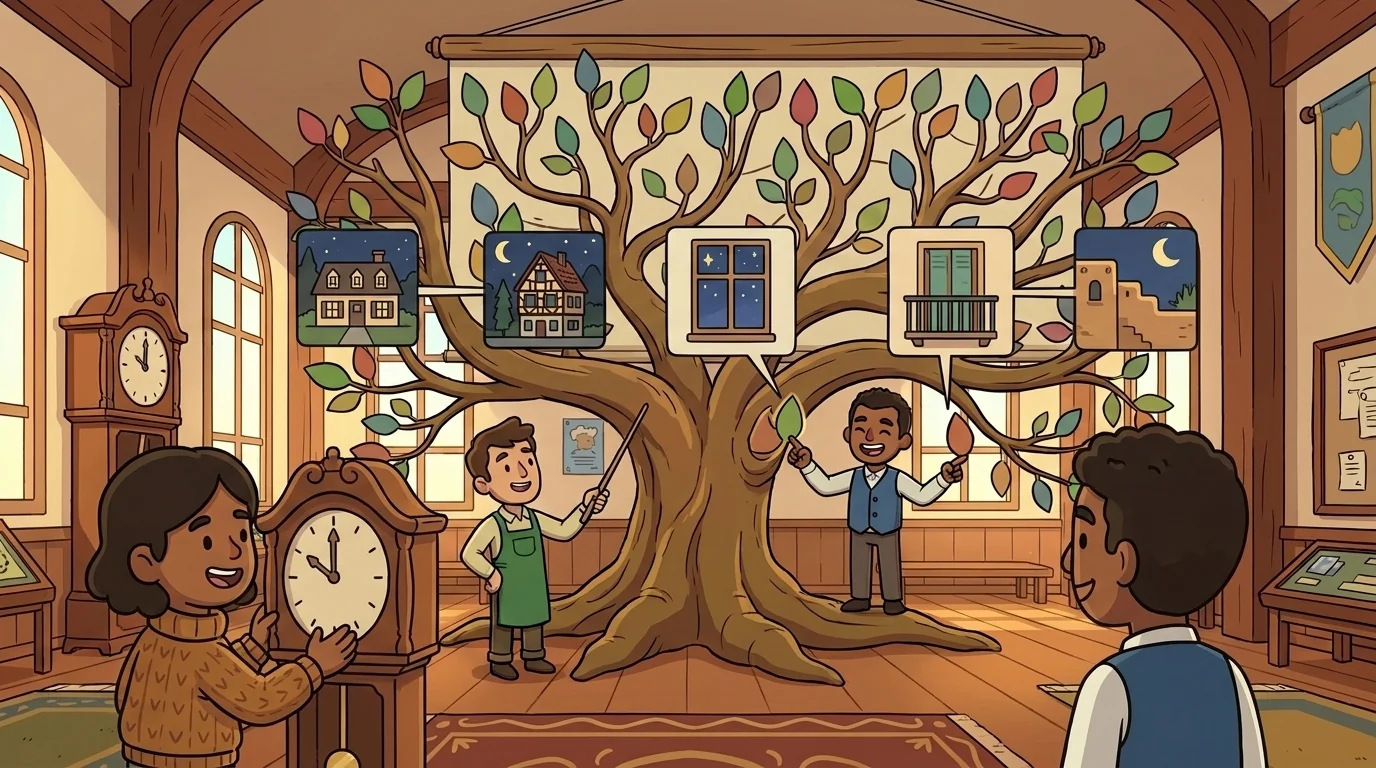
"Now the how," said Drift, who listened to the slow music of change. "Languages drift apart through regular sound change — and regular is the whole secret. When a sound shifts in a language, it doesn't change in one word and skip the next on a whim. It changes consistently — the same sound, in the same setting, shifts the same way across the entire vocabulary, over generations. One community's ancestors start softening a certain sound; their descendants soften it everywhere; meanwhile a sister community, far off, shifts a different sound its own consistent way. Give it centuries, and the two speech-communities can no longer understand each other — not from chaos, but from many small, regular changes piling up in different directions."
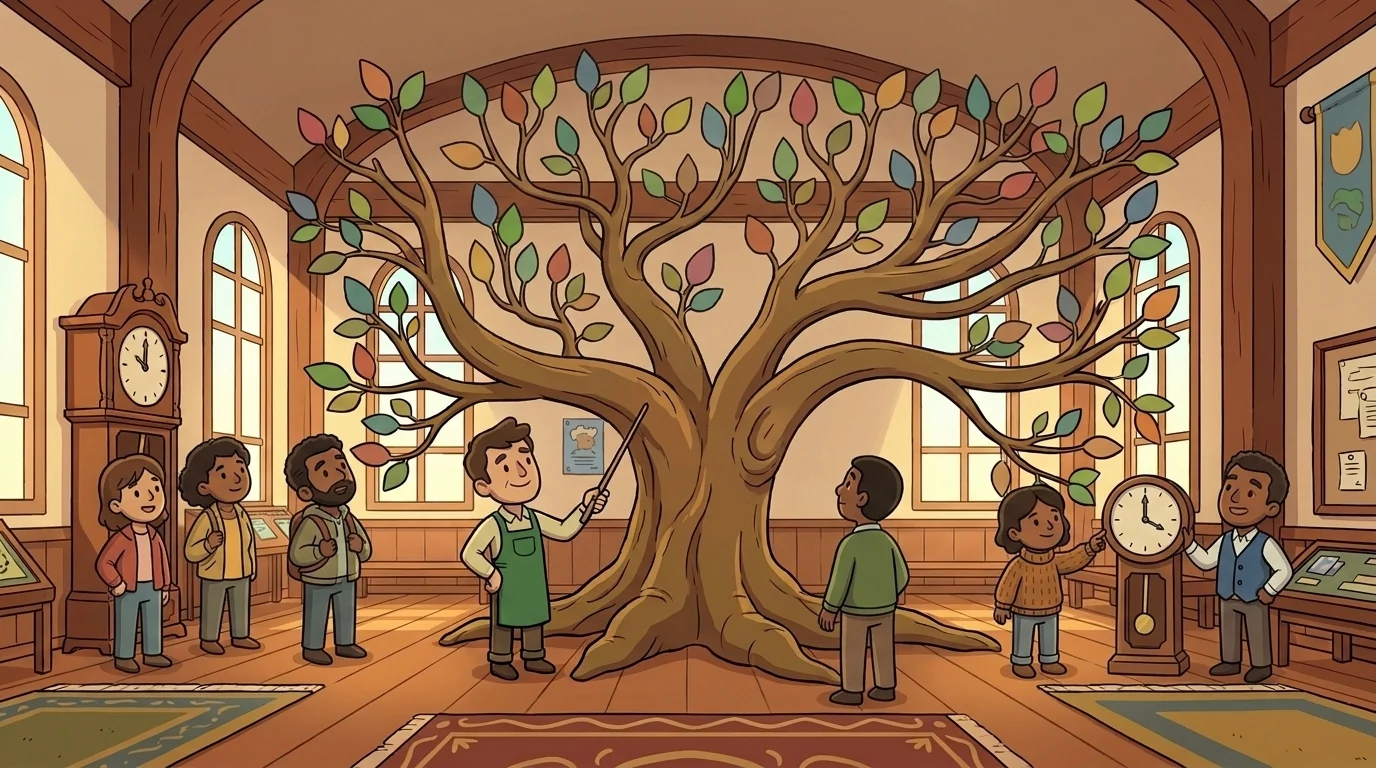
"And that regularity is exactly what lets me catch the family resemblance," said Bridge, walking a path between two limbs. "The fingerprints are cognates — words in two related languages that both descend from the same ancestor word, still echoing it. But here's the sharp part, the part that makes this a science and not a game of look-alikes: a cognate isn't just two words that sound similar. Plenty of similar-sounding words are borrowings — words one language simply took from another, later, like a guest bringing a dish to a party. What tells a true cognate from a borrowing is whether the regular sound correspondences match — whether the differences between the two words follow the same consistent shifts found all across the two languages. If the sound changes line up rule-for-rule, they're cousins by descent. If they don't, one was borrowed. The rules tell blood from guest."
And the three of them stepped back to show the whole tree at once, because each of them was really doing one third of a single method. "This is called the comparative method," said Bough, "and it's how we read the tree backward. Bridge gathers the cognates. Drift reads the regular sound changes hidden inside them. And I use those to reconstruct the proto-language up at the branching point — the ancestor no one recorded, rebuilt from the evidence its children still carry." "Which means," said Drift, "a language is a kind of living history: it carries, in the very shape of its words, the record of everywhere its ancestors have been." "And no branch is 'purer' or 'more original' than another," said Bridge. "Sisters are just sisters. The tree doesn't have a favorite child." Bough smiled among the leaves. "That's the family tree of tongues. Shared ancestors, regular change, and cognates for proof — the past, still whispering, in the words alive today."
The LinguaQuest ensemble
The Family Tree is part of LinguaQuest's distributed-narrative cast. Each character embodies a different curricular primitive; together they teach the full subject.
-

Bough
Language families (genetic descent — Indo-European / Sino-Tibetan / Afro-Asiatic / Niger-Congo / Austronesian)
-

Drift
Sound change (phonological evolution — Grimm's Law, vowel shifts, palatalization)
-

Glyph
Writing systems (alphabetic / abjad / abugida / syllabic / logographic — and how each captures speech)
-
Bridge
Cognates and loanwords (shared roots across languages; trade-route borrowings)
-

Cant
Sociolinguistics — dialect, register, code-switching, formal/informal speech
-
Sign
Signed languages — full natural languages spoken with hands, face, and space; each Deaf community's own, never 'just gestures'
-
Swoop
Tone — pitch that changes a word's meaning (tonal languages); precise and sophisticated, never 'sing-song' or 'exotic'
-
Weft
Word order / syntax — languages arrange words differently (SVO/SOV/verb-first); no order is 'backwards,' each is complete
-

Lex
Untranslatable words — words no other language has in one breath; not a gap in your language but a gift another can offer
-

Nook
Endangered languages + revitalization — keeping fading languages safe; decline is from histories of harm, never the speakers' fault; communities lead the revival