
Flex
SPRING — bend me and I store your push; let go and I give it back. A spring stores elastic potential energy when squeezed, stretched, or bent, and releases it later. Energy is conserved — held, then handed back, none made and none lost.
Loading audio…
Press play to listen along. The line being read lights up as you go.
Show full transcript
Loading transcript…
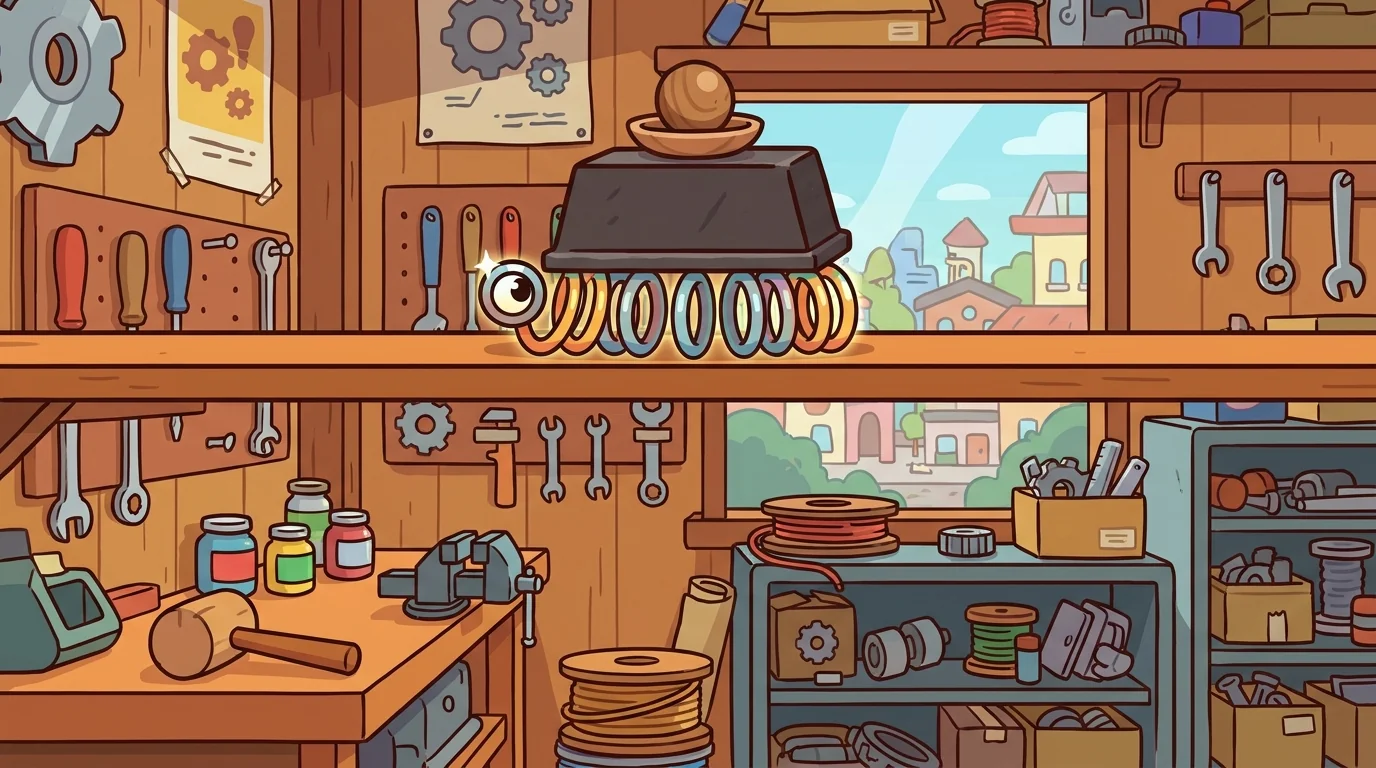
On the highest shelf of the workshop, a coiled steel spring sat squeezed flat under a heavy iron block. It did not strain or complain — it simply held, patient and quiet, its bright loops pressed to almost nothing, a single steady eye glinting at its top coil. A small wooden ball rested in the dish just above it. Flex could have flung that ball to the ceiling in an instant; instead it waited, holding the whole weight of the block, saving the push for a moment that hadn't come yet. "Someone squeezed me this morning," Flex said, its voice a low happy hum, "so now I'm holding their push as elastic potential energy. Bend me and I store it; let go and I give it back — every bit, whenever they're ready." A draft nudged the block; Flex tightened, absorbed the shove, gave nothing away. It liked this feeling most of all: a push received now, kept safe, owed back later, with nothing lost in between — because energy is conserved, only ever moved from one form to another and back.
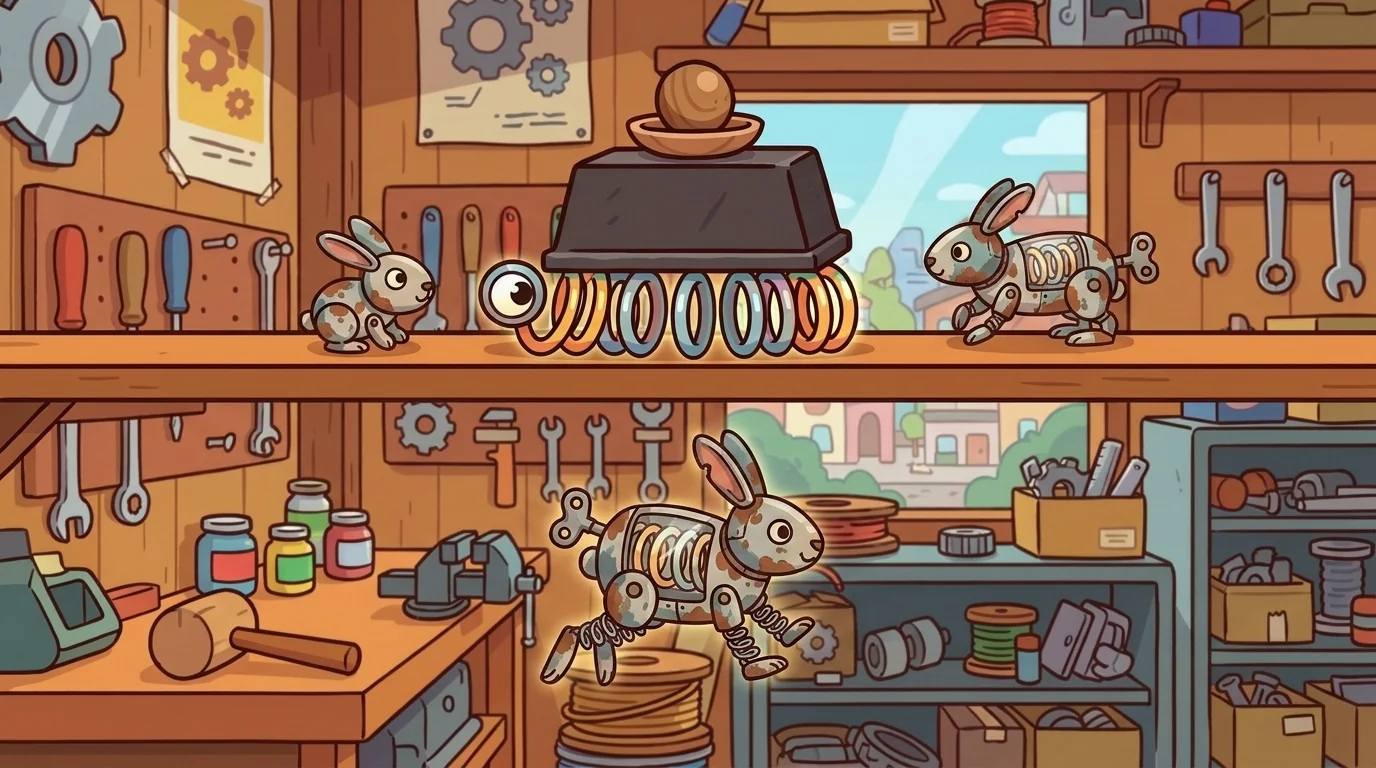
Once, Flex had been part of a wind-up toy — a little tin rabbit that hopped across a nursery floor. A child would twist the rabbit's key, winding Flex tighter and tighter, and Flex would drink up every turn of that winding and hold it, coiled and eager. Then the child would set the rabbit down and let go — and only then would Flex spend what it had saved, handing the stored turns back one at a time, so the rabbit hopped clear across the floorboards on a push given minutes before. That was the moment young Flex fell in love with its own nature: the winding didn't have to become hopping right away. It could catch a push in the morning and carry it faithfully until afternoon, then hand it over exactly as received — work done on the spring, stored, then work done by the spring, equal and opposite. When the tin rabbit finally wore out, the workshop unwound Flex from its rusted case, straightened its loops, and gave the old faithful spring a shelf of its own.
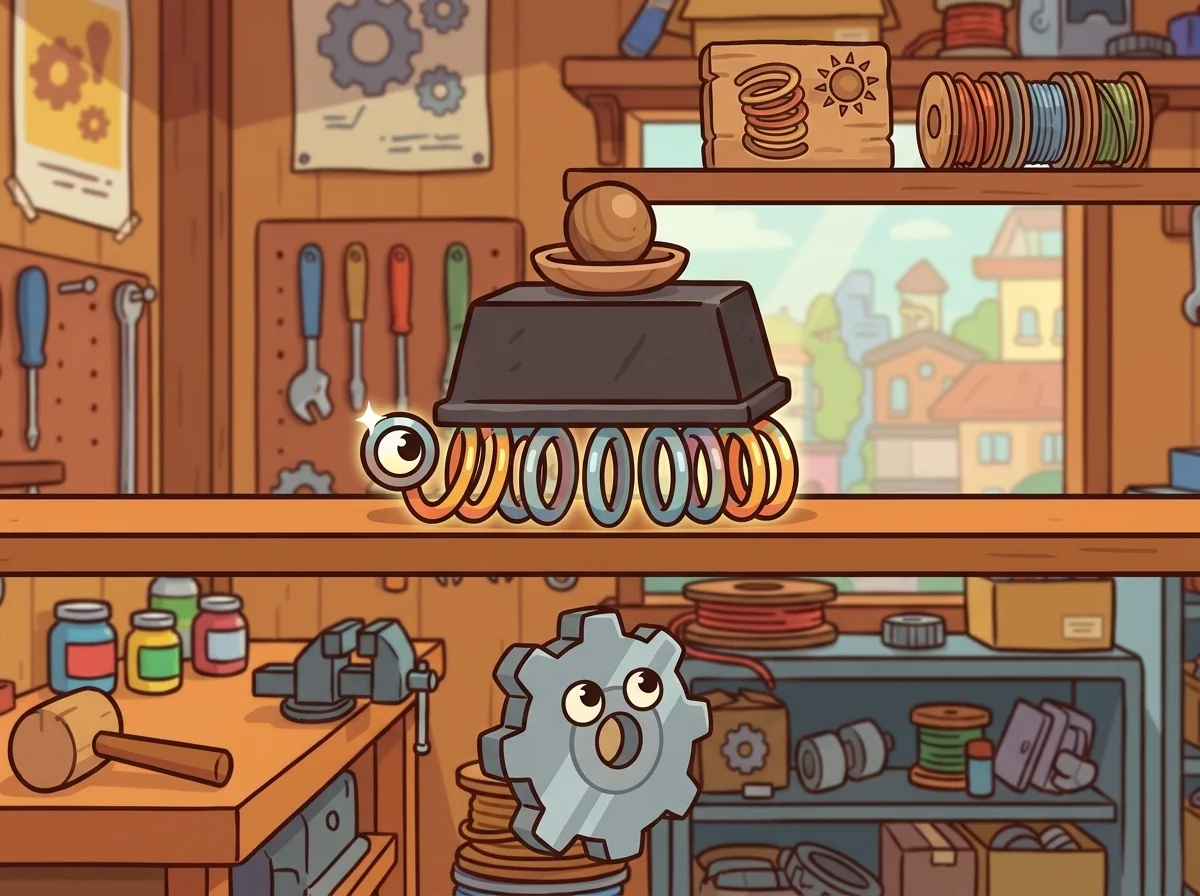
The first day at the workshop, Cog — the wise old gear who watched over every machine — rolled up beneath Flex's shelf and looked at the compressed coils. "Show me what you do." Flex let a sliver of its stored push escape, lifting the iron block a hair's breadth, then caught it and held again. "I take a squeeze and I keep it. Press me down and I hold your energy — still and safe — for as long as you like. Lift your hand, and I hand every bit straight back. I never make more than I was given. I never lose a scrap. I'm a keeper of pushes — and the harder you compress me, the harder I push back. That's a restoring force: the more you bend me from rest, the more I want to return to rest, in proportion." Cog turned slowly, watching the block hover, then settle. "Patient," Cog said, "and honest about it. The shelf by the window is yours."
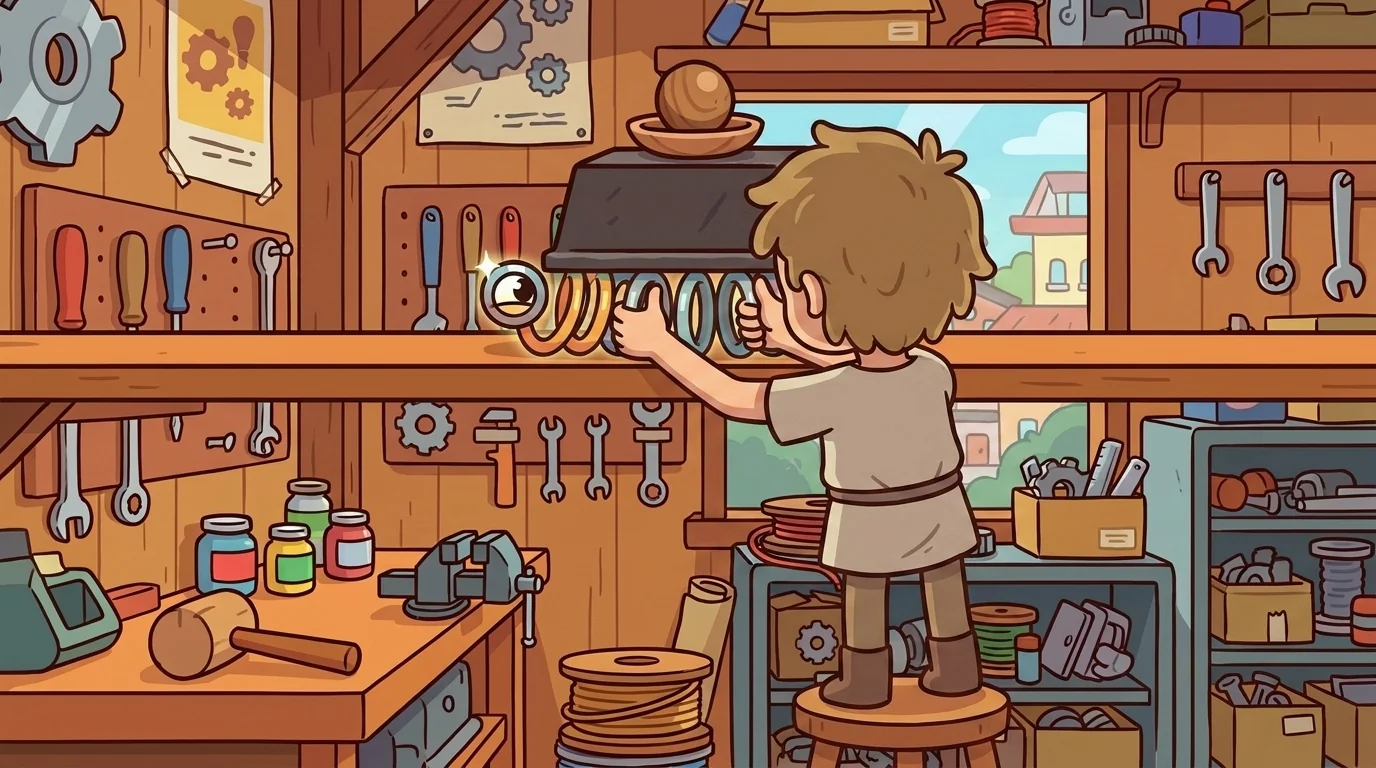
An apprentice named Pip climbed onto a stool, curious about the spring that held a block without groaning. "Press me down against the bench," Flex said. Pip set both thumbs on the top coil and pushed; Flex squashed shorter, its loops crowding, straining upward against his hands. "Feel me push back? That push is yours — I gave it to you this second because you gave it to me. As long as you hold me down, I hold it too." Pip's thumbs began to ache. "How long can you keep it?" "All day. All week. I don't tire. Now — let go, but watch that ball." Pip lifted his hands. Flex sprang tall in a single bright instant and flicked the wooden ball straight up, where it tapped the rafter and dropped back into the dish. "There — your push, handed back whole. Stored energy becomes motion. A clicky pen, a trampoline, a bow bending to shoot an arrow — all of us do the same trick: store your push as potential energy, return it later as kinetic." Pip pressed and released, again and again, laughing at the bright pop each time the ball leapt.
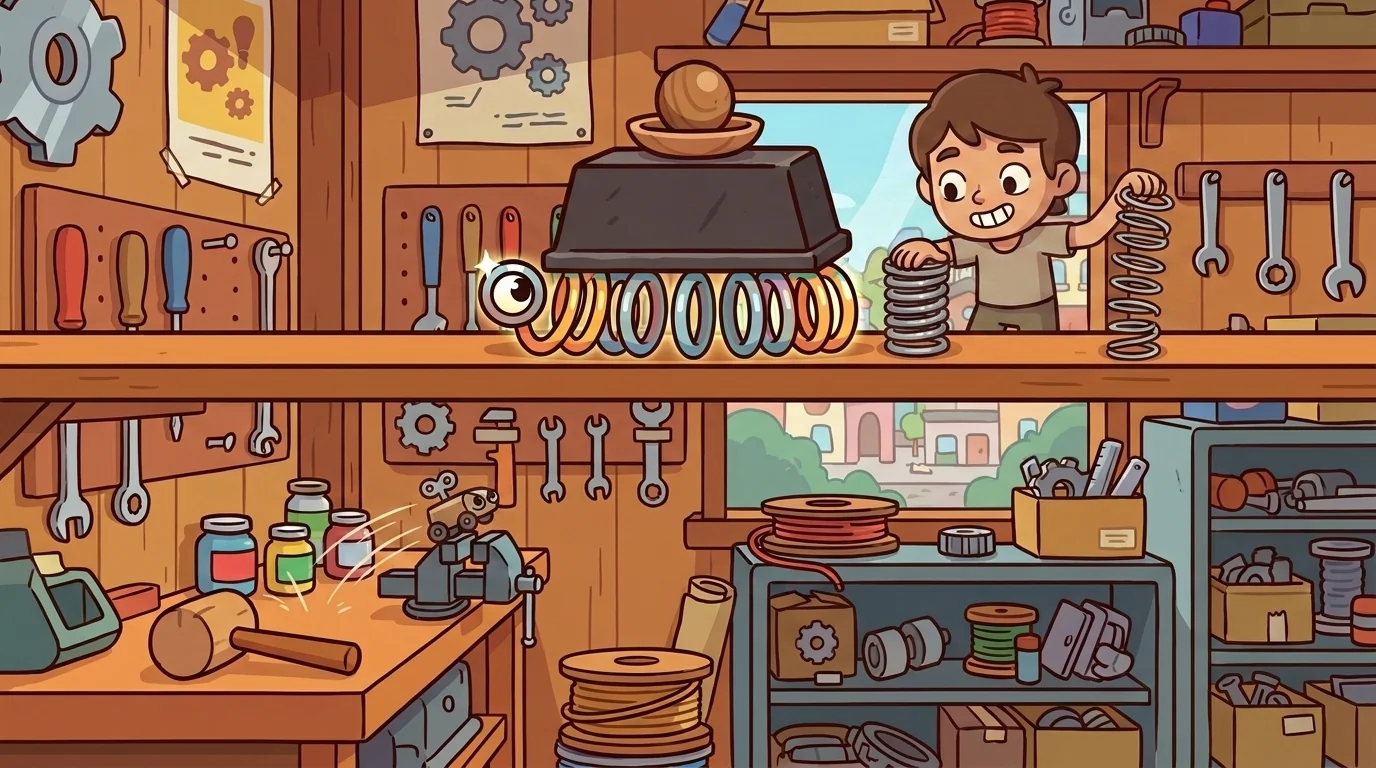
Before he left, Pip lined up a row of springs beside Flex — a stout stiff one, a long soft one — and pressed each in turn, feeling how differently they strained. "The stiff one grabbed my whole push in a tiny squeeze," Pip said. "The soft one needed a long, slow pull." "Different stiffness, same promise," Flex hummed. "The stiff spring stores a lot of energy in very little bend; the soft one needs a long stretch for the same store. But whatever you put in, that's exactly what I give back — not more, not less. I'll carry it as long as you need, and hand it over the moment you ask." It settled its loops. "There's a real joy in that: the held breath, then the bright let-out." Pip wound a little spring-toy, set it on the bench, and lifted his hand; it zipped away across the wood on energy he'd stored a heartbeat before — and something in his chest went loose and light watching it go, like the easy rush after a long-held breath finally lets out. He grinned, feeling the warm satisfaction of a push kept safe and set free at exactly the right time, nothing wasted, all of it returned.
The MachineForge ensemble
Flex is part of MachineForge's distributed-narrative cast. Each character embodies a different curricular primitive; together they teach the full subject.
-
Pry
Lever — push longer to lift heavier; the trade between force and distance
-

Hoist
Pulley — pull down here and watch it go up there; redirecting force
-

Ramp
Inclined plane — climb the long slow way; less force, same work
-
Spoke
Wheel-and-axle — one turn of the hub, many turns of the rim
-

Auger
Screw — round and round becomes step and step; spiral inclined plane
-

Cleave
Wedge — push forward and split it apart; force concentrated to a sharp edge
-
Pinion
A gear train: meshing teeth trade turning-speed for turning-force and pass the motion along, faster or stronger as you choose.
-
Lobe
A cam: a spinning shape with a bump that turns steady spinning into a repeating push, like a music box keeping a beat.
-
Ratchet
A ratchet: lets motion go forward freely but locks when it tries to slip back, holding every bit of progress, click by click.