
Colony
COLONY — microbes build cities together; alone a microbe is fragile, but in a biofilm they share a slime matrix, pass food and signals, and shelter each other, so the community survives what no single cell could
Loading audio…
Press play to listen along. The line being read lights up as you go.
Show full transcript
Loading transcript…
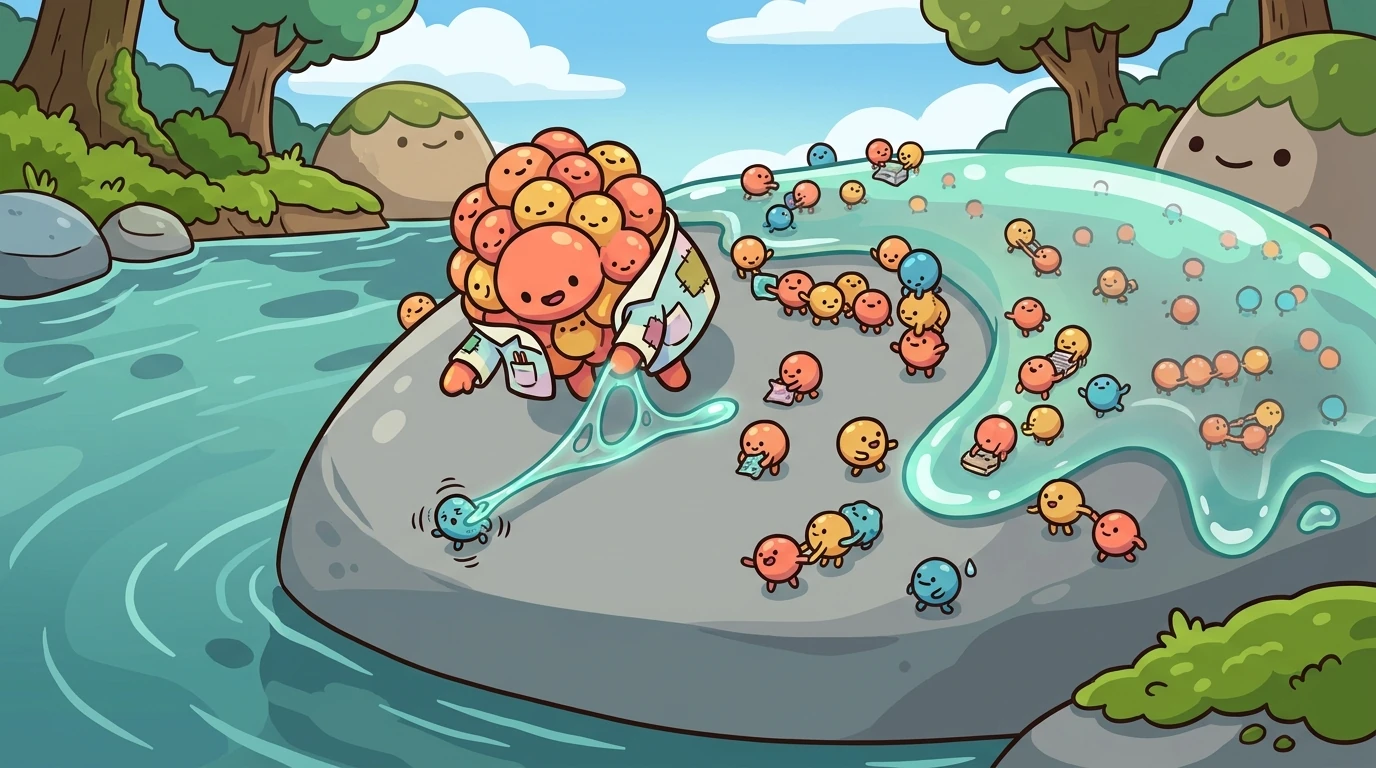
Myco set a smooth grey stone on the bench, still slick with stream-water, and asked Colony to explain the film clouding its surface.
"That is not dirt," Colony said — and Colony said it as a cluster, a warm coral-and-gold huddle of many small rounds in one patchwork coat, all shifting together when one shifted. "That is a biofilm. A city. Every one of those specks is a single cell, and alone a single cell is almost nothing — one current could tumble it away, one dry hour could end it. So we don't stay single. We anchor to the stone, and then we build a roof over all of us, out of ourselves."

The roof, Colony taught, was the whole secret, and it had a real name.
"We ooze a matrix," Colony said, "a slime of sugars and proteins we make and share, and it holds the whole community in place — glued to the stone, glued to each other. Inside it we are not a crowd of strangers. We pass food hand to hand. We send chemical signals so we can act together — that sensing of how many of us there are is called quorum sensing, and when enough of us have arrived, we switch on the building all at once. The matrix keeps water in when the world dries, keeps poisons out when the world turns harsh. One cell could never make it. A thousand cells, pooling what each can spare, make a shelter that outlasts any of us."
The older students heard the subtext under the microbiology: a thing no one can do alone becomes ordinary the moment enough people pool what little each of them has.
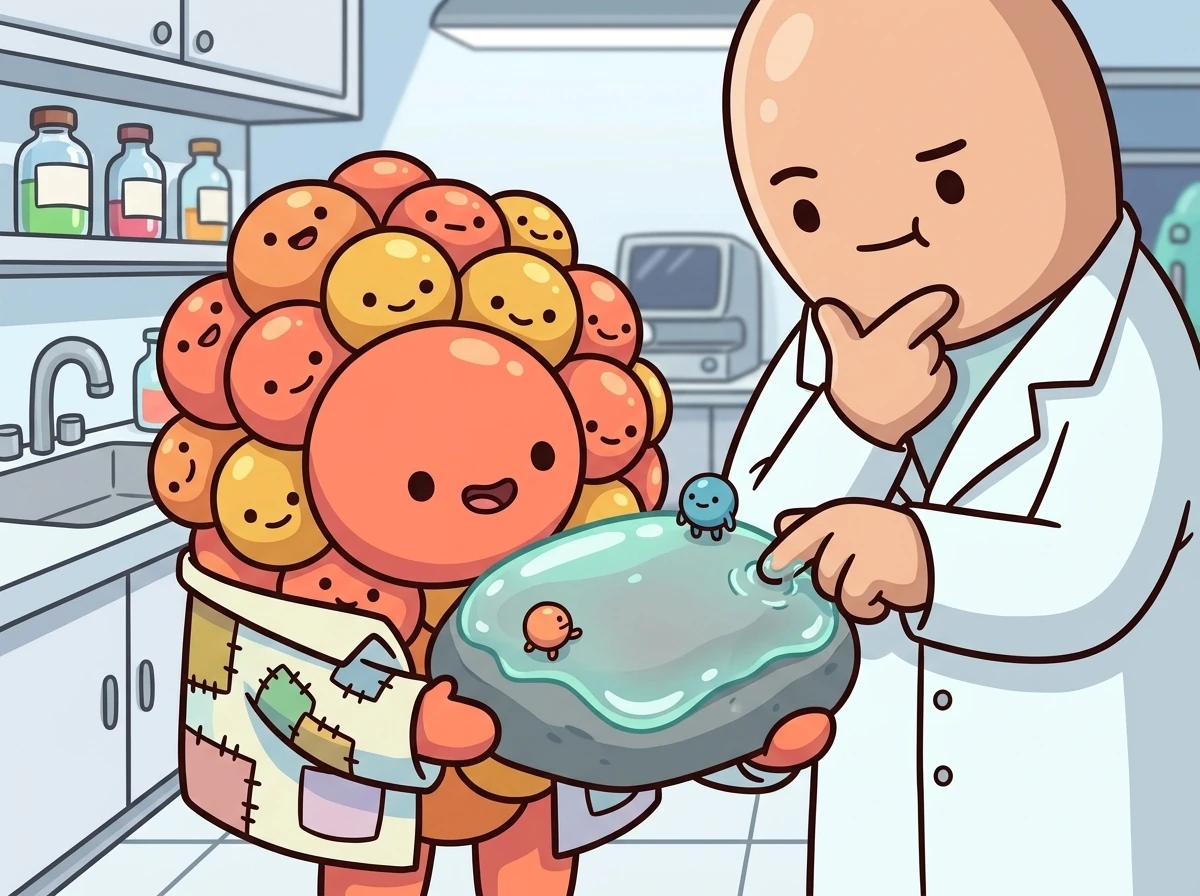
Colony remembered arriving as a single trembling speck, and told it plainly.
"I came down the current spinning and thin, sure I was too small to matter," Colony said. "I bumped the stone and clung there shaking. And the cluster already living there did not test me or rank me. It just shuffled sideways and made a gap and said there's room. That is the first law of a biofilm — the door opens outward. A community that only kept its strongest would stay small and brittle. A community that takes in the drifting speck grows a bigger roof, and a bigger roof shelters everyone, including the ones already inside."
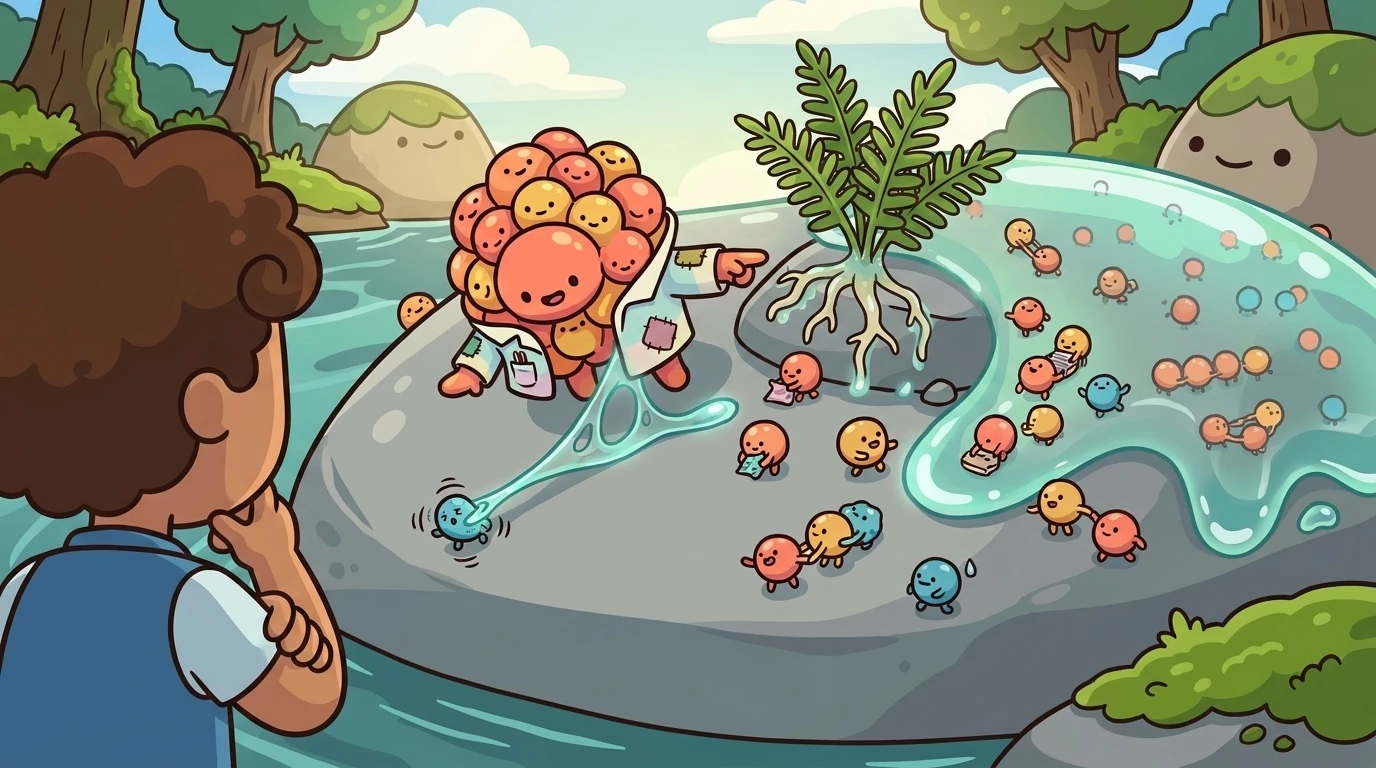
A younger student worried the film looked like scum — like something a bit shameful.
"People say that about us on their teeth, too — plaque, they call it, and they scrub it away, and fair enough," Colony said, unbothered. "But do not confuse where a biofilm grows with what a biofilm is. The same trick that makes plaque makes the slick helpful films on plant roots that feed the plant, and the films in ponds that clean the water, and the mats in soil that hold a whole meadow's worth of tiny life together. The mechanism is not good or bad. It is togetherness, doing what togetherness does — turning many fragile singles into one durable whole. Judge the neighborhood, not the fact that the small ones built a neighborhood at all."
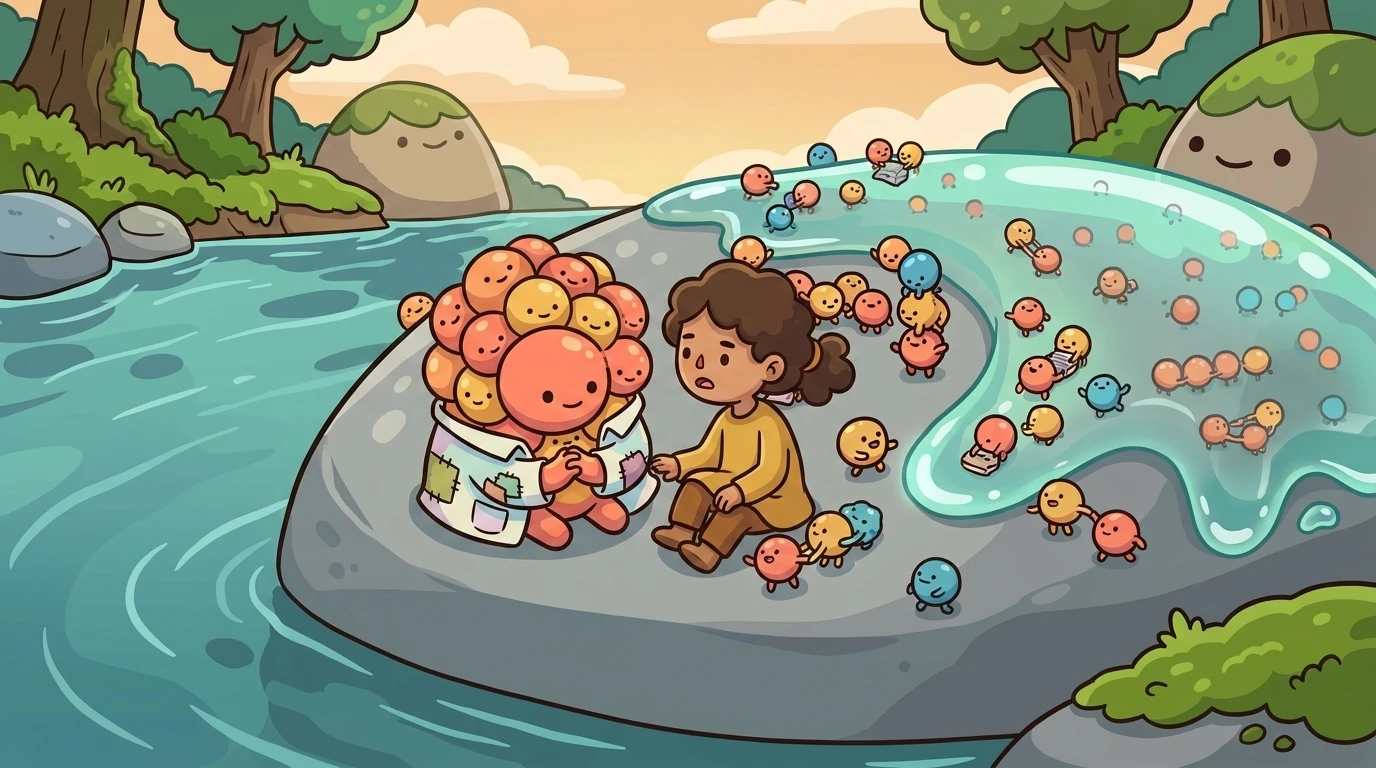
Later a student who felt small and unnoticed came back with the real question. "If a single cell is almost nothing," she asked, "what's the point of being one?"
Colony rippled — the whole cluster tilting toward her at once.
"The point of being one," Colony said gently, "is so there is someone to join. A biofilm is not made of nothing. It is made of ones — every single speck bringing the one small thing it can make, its scrap of sugar, its one signal, its willingness to hold onto the cell beside it. Take away the ones and the city is gone. So you are not almost-nothing waiting to matter. You are a piece the roof cannot be built without." Colony made a gap in itself, warm and open. "That is why the door stays open. Every one who clings on is one more reason the whole thing holds."
The student leaned in toward the gap, and the cluster closed softly around her the way it had once closed around a trembling speck that thought it was too small to count.
The MicrobeLab ensemble
Colony is part of MicrobeLab's distributed-narrative cast. Each character embodies a different curricular primitive; together they teach the full subject.
-

Lacto
Lactobacillus + helpful-bacteria — 'Friend in your food. Friend in your gut.'
-

Yeast
Saccharomyces + helpful-fungi — 'I make air inside bread.'
-
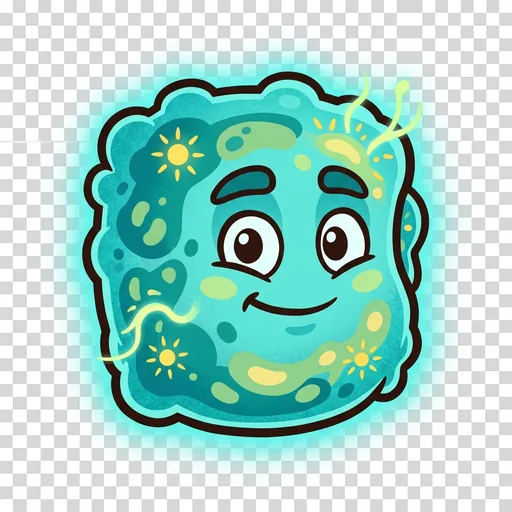
Photo
Cyanobacteria + photosynthetic-microbes — 'Sunlight. Then air. Then everything else.'
-

Net
Mycorrhizal-fungi + nitrogen-fixers — 'Forests talk through me.'
-

Spore
Pathogens (opt-in gated) — 'Some friends. Some not. All real.'
-

Guard
Immune cells (T-cell / macrophage / B-cell) — 'I check IDs. Patient + careful.'
-

Crumble
Decomposer microbes that break down dead leaves and scraps into rich soil, so nothing is wasted and everything begins again.
-

Thrive
Extremophile microbes that make a home in the hottest, coldest, saltiest places, showing life finds a way almost anywhere.
-

Shimmer
Bioluminescent microbes that turn energy into their own soft glow, lighting ocean waves and partnering with animals like tiny lanterns.