
Crumble
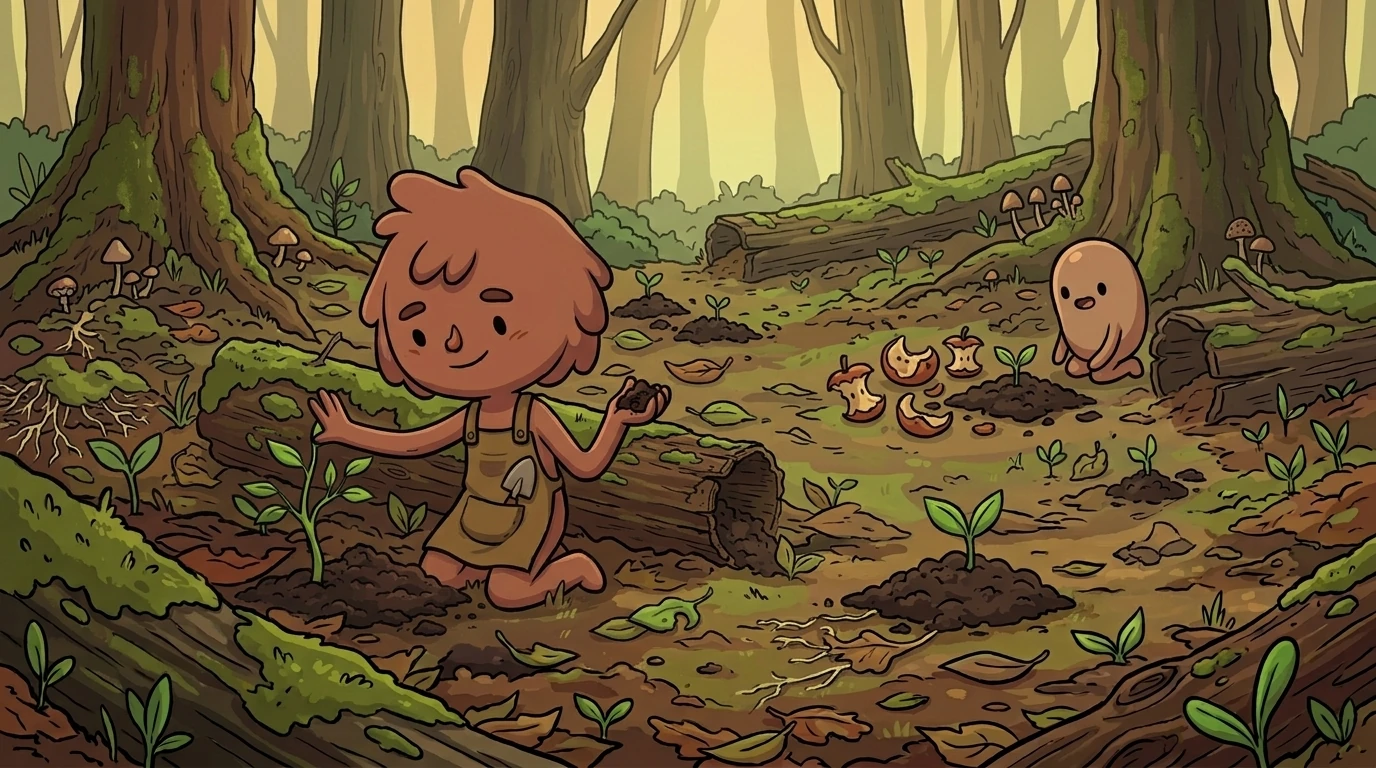
CRUMBLE — nothing is wasted; decomposer microbes break dead leaves, logs and scraps back into the nutrients soil reuses, turning endings into beginnings — the recyclers that keep the whole cycle from choking on its own leftovers
Loading audio…
Press play to listen along. The line being read lights up as you go.
Show full transcript
Loading transcript…
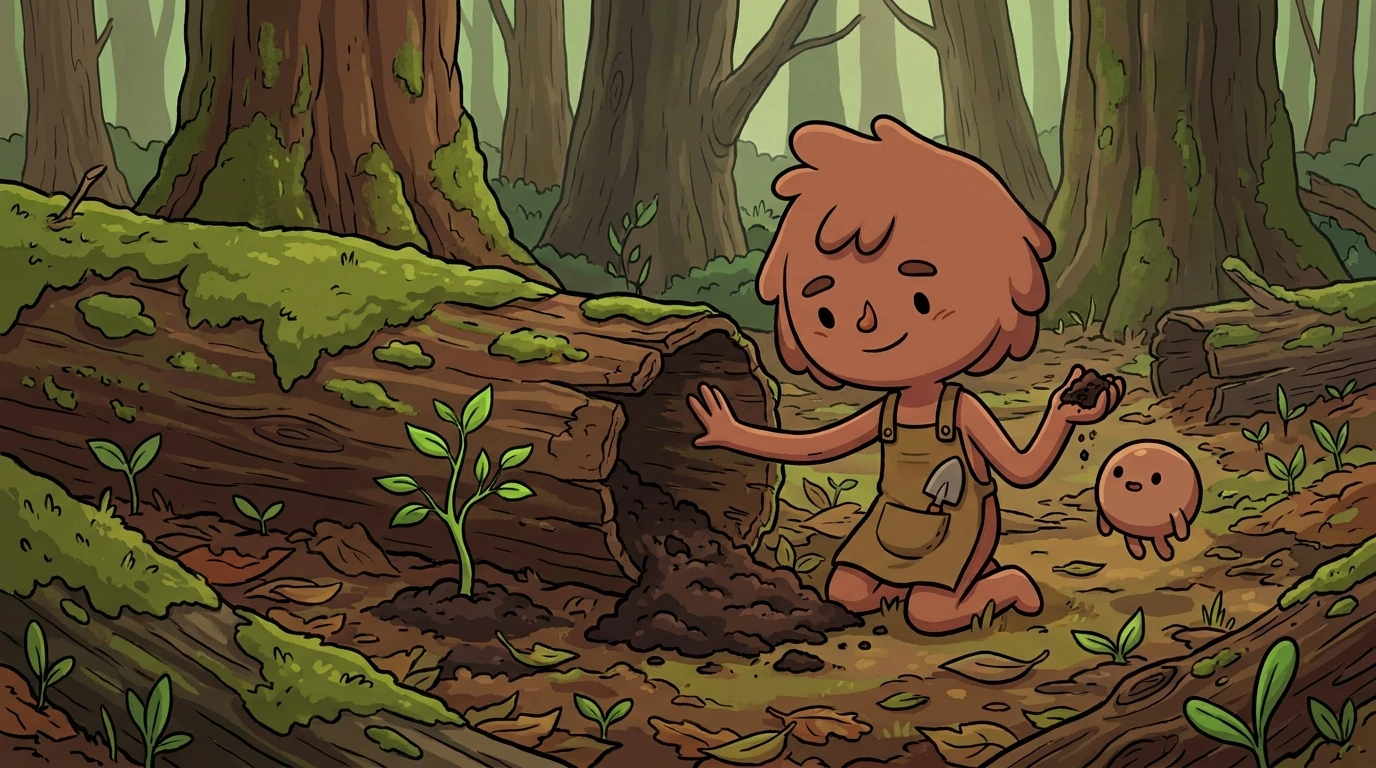
Myco handed Crumble a fistful of dark, sweet-smelling soil and asked where it came from.
"A leaf," Crumble said, turning the crumbs over. "And before that, sunlight and air. This is a leaf that has finished being a leaf — and I am one of the ones who finished it, gently, over a whole season." Crumble was a soft brown tumble of a creature, sleeves always a little dusty. "People think decomposing is destroying. It isn't. It's returning. A dead log is not garbage. It is a locked box of nutrients, and I am the key."
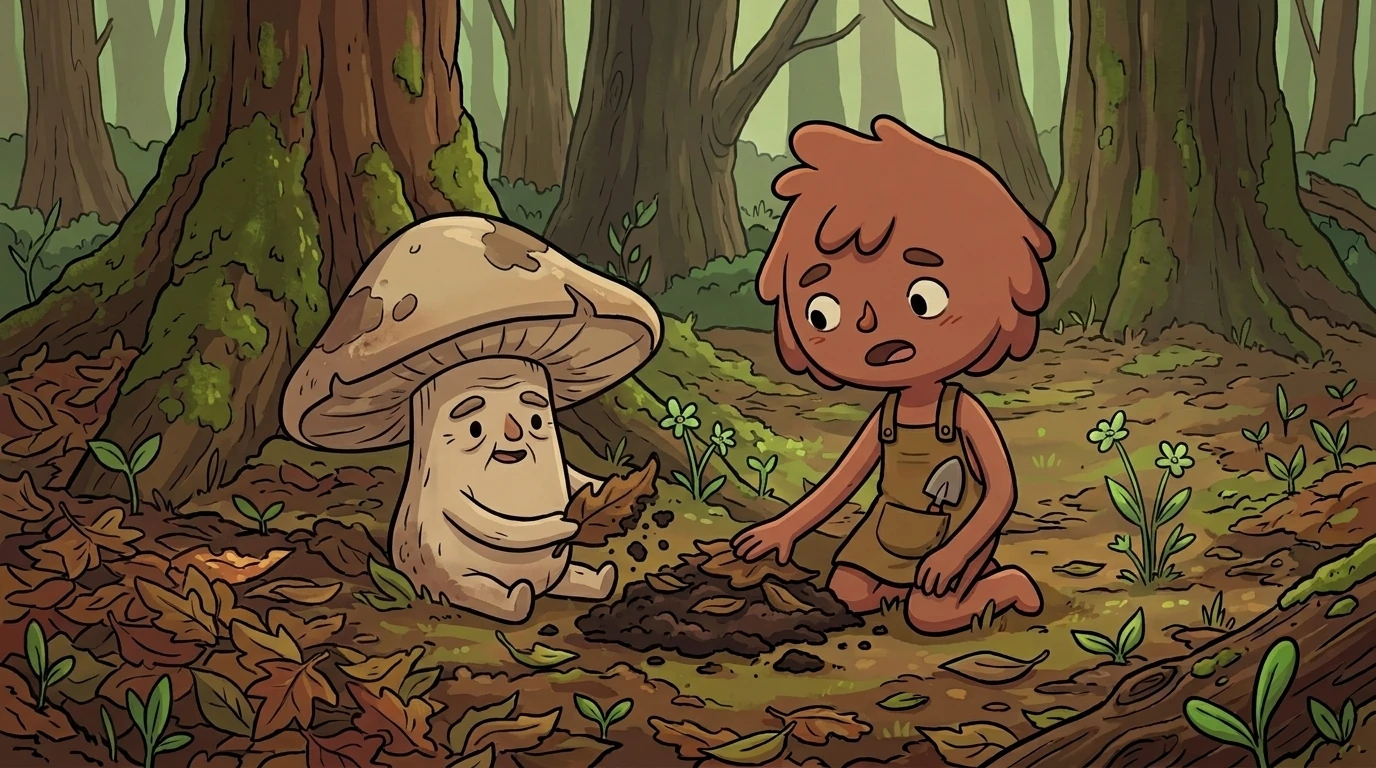
Crumble taught the chemistry of the returning without a scrap of squeamishness.
"A living leaf is built from carbon, nitrogen, minerals — all borrowed," Crumble said. "When it falls, all of that is still there, just locked inside tough molecules the plant can't drink back up. So we decomposers — fungi and bacteria together — release enzymes, tiny chemical scissors, and we cut the big tough molecules into small simple ones. We take some of the energy for ourselves, that's our meal, and the rest — the nitrogen, the minerals — dissolves free into the soil where roots can drink it again." Crumble spread the crumbs. "That is why a forest doesn't drown in its own fallen leaves. Every autumn's leaves become next spring's growth. We are the hinge between the two."
The older students caught the subtext: an ending is only an ending if nobody does the work of handing it forward.
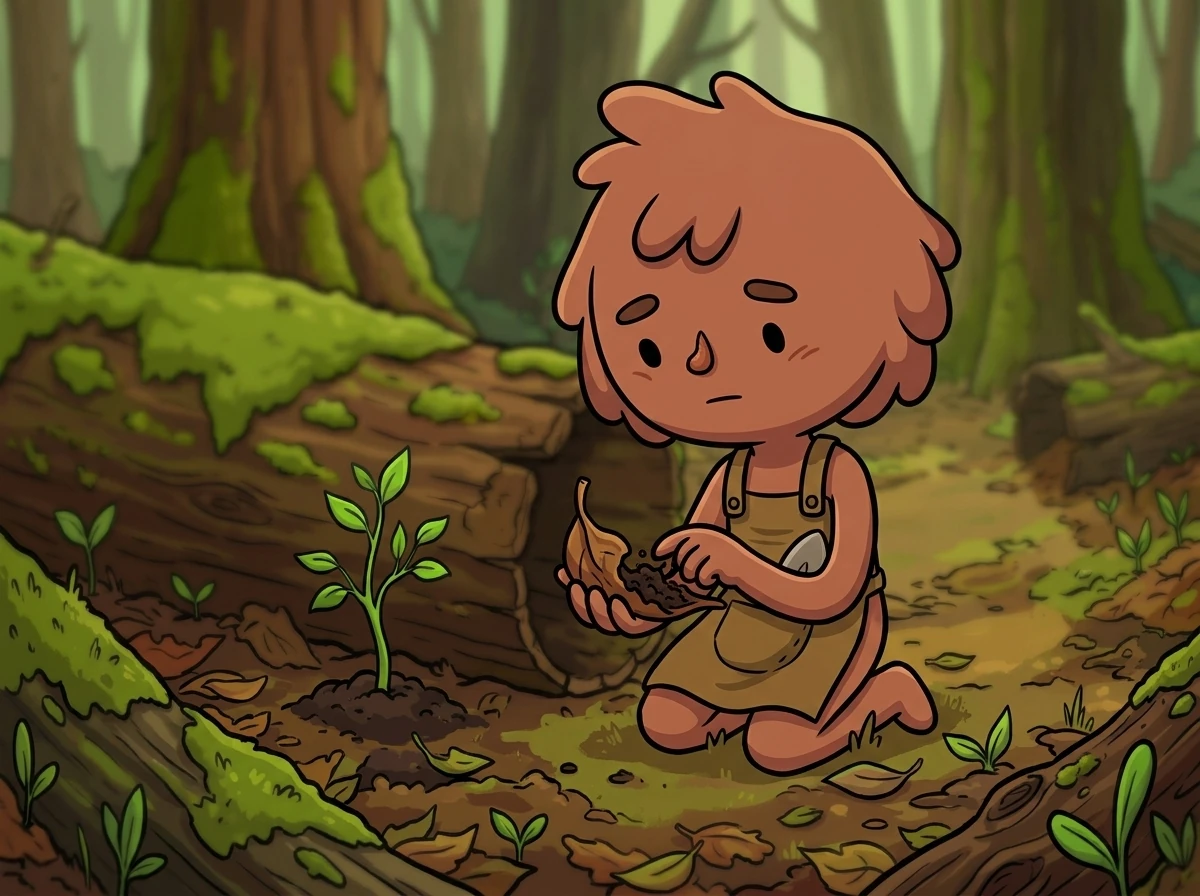
Crumble had once been ashamed of the work, and said so.
"When I was small, the fast bright creatures got all the praise — the ones who bloomed, the ones who flew," Crumble said. "And I lived in the dim damp under the log, doing the slow dissolving nobody watched. I thought my job was the lowly one." Crumble smiled at the soil. "Then one year the returning stopped in a little patch — the decomposers there had died off — and the leaves just piled and piled, and nothing new could root in the choked ground. Nothing grew because nothing had been given back. That was when I understood. The bloom everyone praises is only possible because someone, unthanked, returned last year's bloom to the earth."
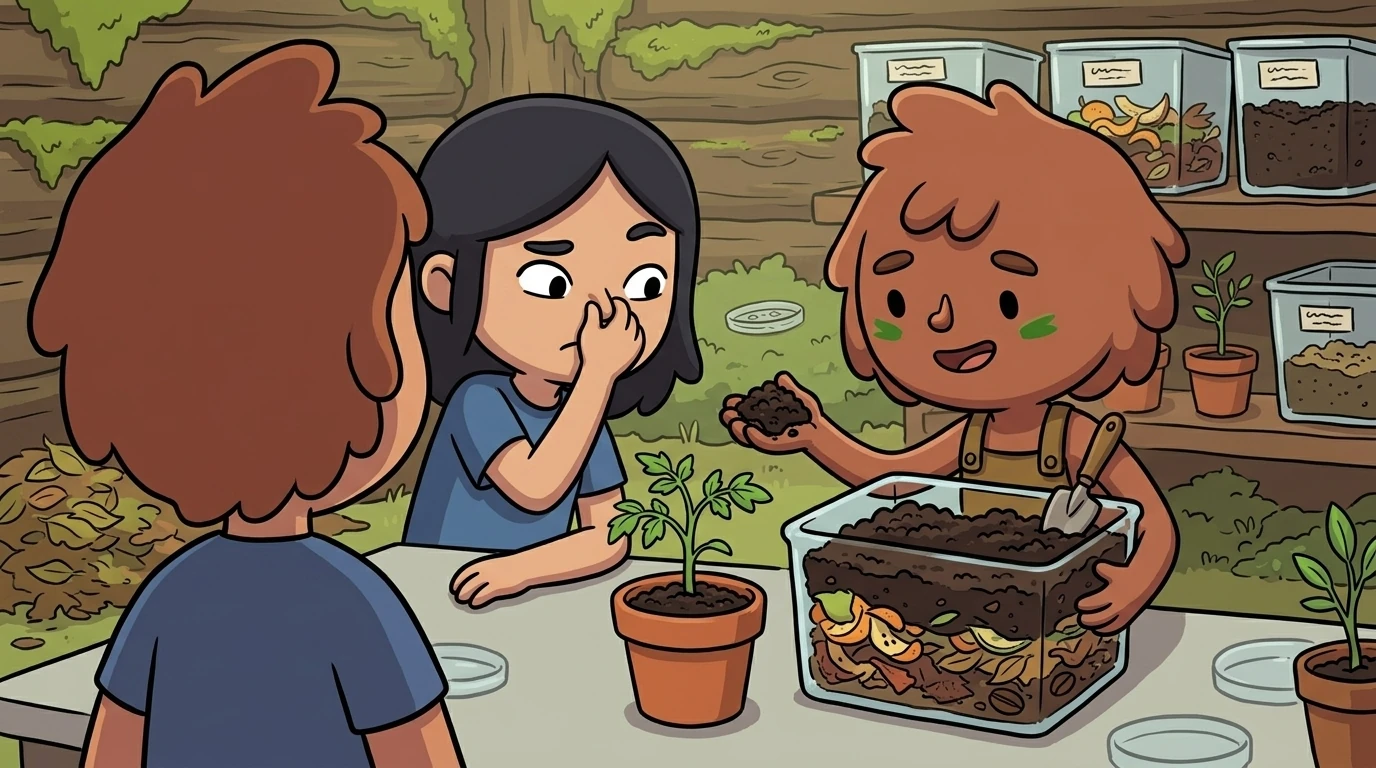
A student asked, a little disgusted, why anyone should care about rot.
"Because it isn't rot the way you mean it — it's repair," Crumble said, unoffended. "Watch what it isn't, first. When decomposers can't reach something — a plastic bottle, say — it doesn't return. It just sits, an ending that never becomes a beginning, for a human lifetime and more. That is waste: matter locked out of the cycle. What I do is the opposite of waste. I keep matter moving — leaf to soil to root to leaf again, around and around, so the same handful of nitrogen can be a thousand leaves across a thousand years." Crumble let the soil sift through its fingers. "The world has almost no new matter arriving. It runs on returning what it already has. That's my job. It's the least wasteful job there is."
Later a student who felt like a failure — like something in her had ended — came back quiet.
"When a thing is over," she asked, "how do you not just feel like it's gone?"
Crumble sat with her in the dim under-log light it loved.
"I hold the log," Crumble said. "The log is over. It will never be a tree again — that's true, and I won't pretend otherwise. But inside it is everything the next tree needs, and my whole work is patiently unlocking that and handing it forward. So when I look at an ending I don't see gone. I see not-yet-returned. The matter doesn't vanish; it waits to be carried on." It pressed a warm crumb of soil into her palm. "That was a leaf. Now it will be a leaf again, through something new. Nothing is wasted. Nothing is ever really thrown away — only handed to whoever comes next."
The student closed her hand around the warm dark soil, and the gone feeling loosened into something more like a beginning.
The MicrobeLab ensemble
Crumble is part of MicrobeLab's distributed-narrative cast. Each character embodies a different curricular primitive; together they teach the full subject.
-

Lacto
Lactobacillus + helpful-bacteria — 'Friend in your food. Friend in your gut.'
-

Yeast
Saccharomyces + helpful-fungi — 'I make air inside bread.'
-

Photo
Cyanobacteria + photosynthetic-microbes — 'Sunlight. Then air. Then everything else.'
-
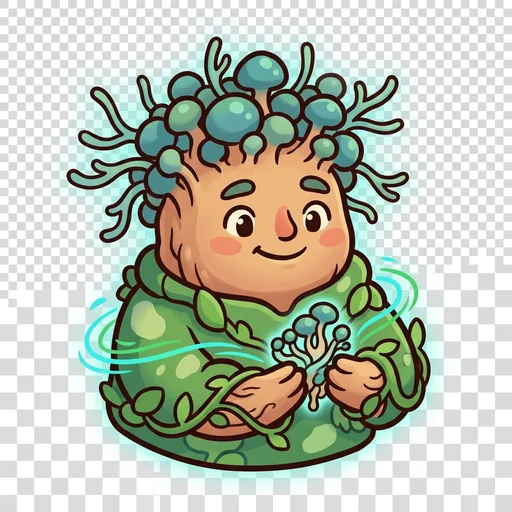
Net
Mycorrhizal-fungi + nitrogen-fixers — 'Forests talk through me.'
-

Spore
Pathogens (opt-in gated) — 'Some friends. Some not. All real.'
-

Guard
Immune cells (T-cell / macrophage / B-cell) — 'I check IDs. Patient + careful.'
-

Thrive
Extremophile microbes that make a home in the hottest, coldest, saltiest places, showing life finds a way almost anywhere.
-

Shimmer
Bioluminescent microbes that turn energy into their own soft glow, lighting ocean waves and partnering with animals like tiny lanterns.
-

Colony
Microbes that build biofilms together, cooperating and protecting each other, because they are far stronger as a community than alone.