Lacto
A helpful bacterium that ferments sugars into lactic acid
Loading audio…
Press play to listen along. The line being read lights up as you go.
Show full transcript
Loading transcript…
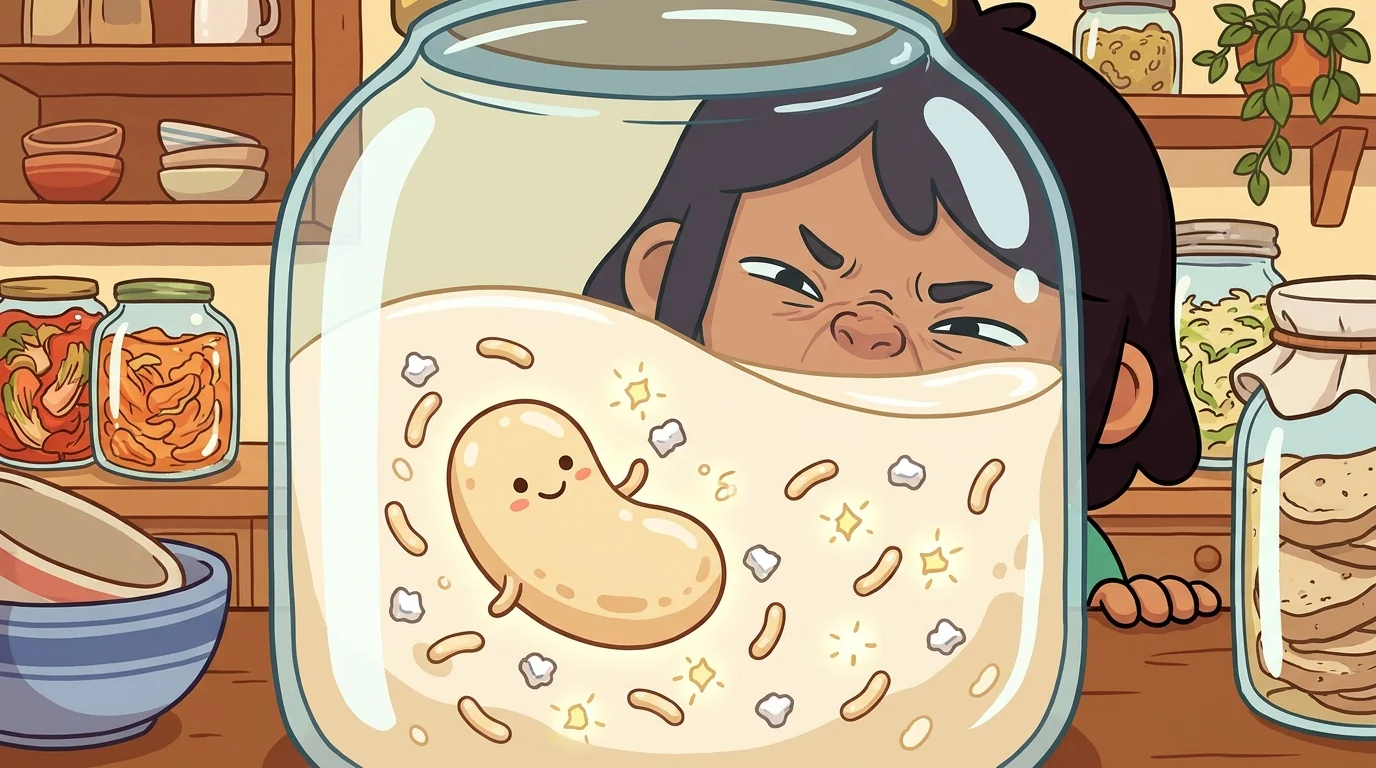
Myco set a jar of warm milk in front of Lacto and said, "Change it."
Lacto did nothing dramatic. It just settled into the milk — a small, round, cheerful bacterium in a cream-colored apron — and got to work the only way it knew. "I don't add anything strange," Lacto said. "I take the sugar that's already in the milk — a sugar called lactose — and I turn it into acid. Lactic acid. That's my whole trick. And as the acid builds, the milk thickens and tangs and becomes yogurt. Same milk. I just changed what it was made of, one sugar molecule at a time."
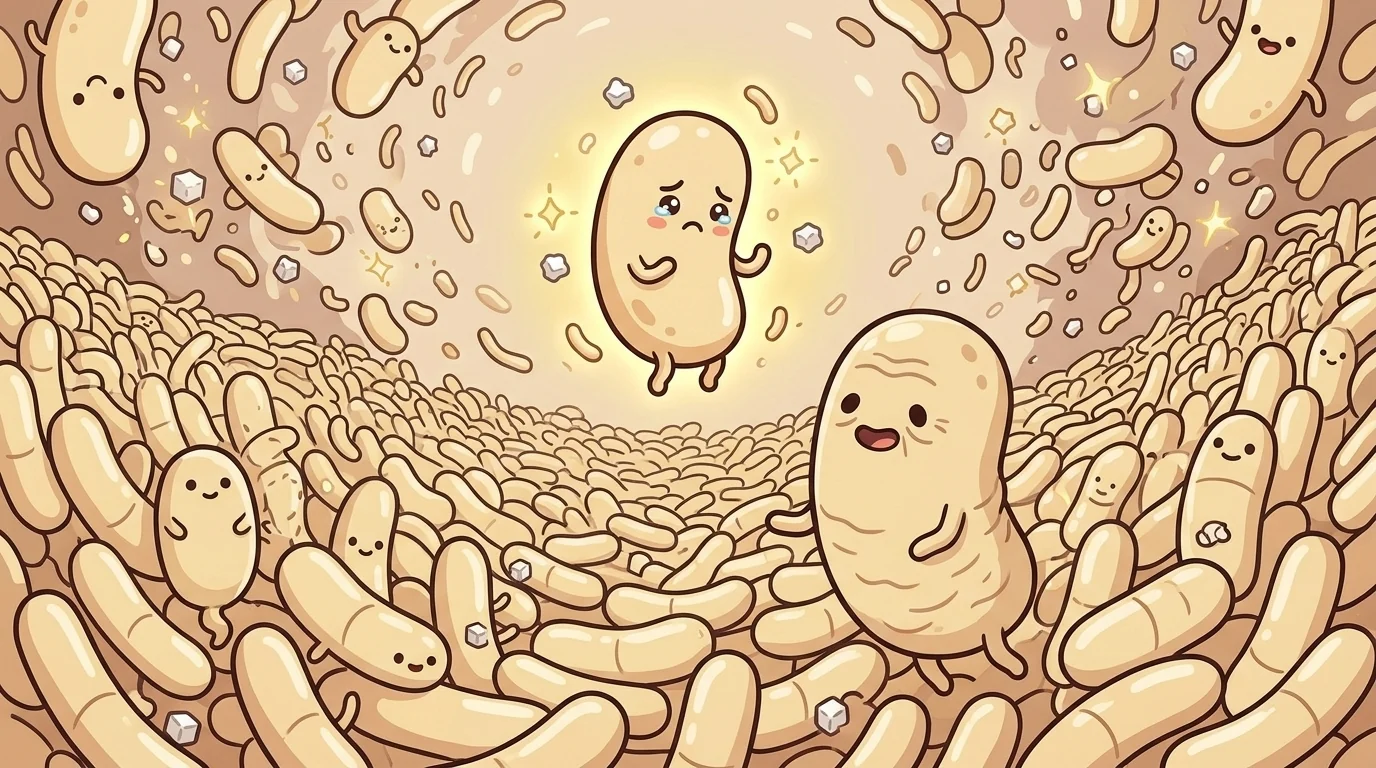
Lacto taught the fermentation plainly, because it was proud of it.
"Fermentation is how I make energy without any air," Lacto said. "I take lactose, break it down, keep a little energy for myself, and the leftover is lactic acid — which spills out into the milk around me. That souring isn't a side effect. It's the whole gift twice over." It counted on small fingers. "First, the acid curdles the milk into yogurt, which keeps longer and is easier to digest — that's why people have made yogurt and cheese and pickles and sourdough with fermenting microbes for thousands of years, long before anyone knew we existed. Second, that same acid is how I protect. Most microbes that would spoil food or upset a gut can't stand a sour, acidic place. I make the neighborhood too tangy for them. I don't fight them off. I just make a home they can't move into."
The older students heard the subtext: you can keep a place safe by quietly shaping it, not only by battling for it.

Lacto had once thought helping had to look like fighting.
"When I was small I watched Guard patrol and strike, and I thought that's what protecting looked like," Lacto admitted. "I felt useless — I don't attack anything. All I do is sit in the gut and make a little acid and take up a little room." It laughed softly. "Then Myco showed me what happens to a gut when the helpful bacteria are gone — after a sickness, say. The harmful ones move right into the empty space and take over, because nothing is there crowding them out. That was when I understood. Every bit of room I fill is room a harmful microbe can't have. Every drop of acid I make is a door that won't open for them. I protect by being present. Presence is a kind of strength too."
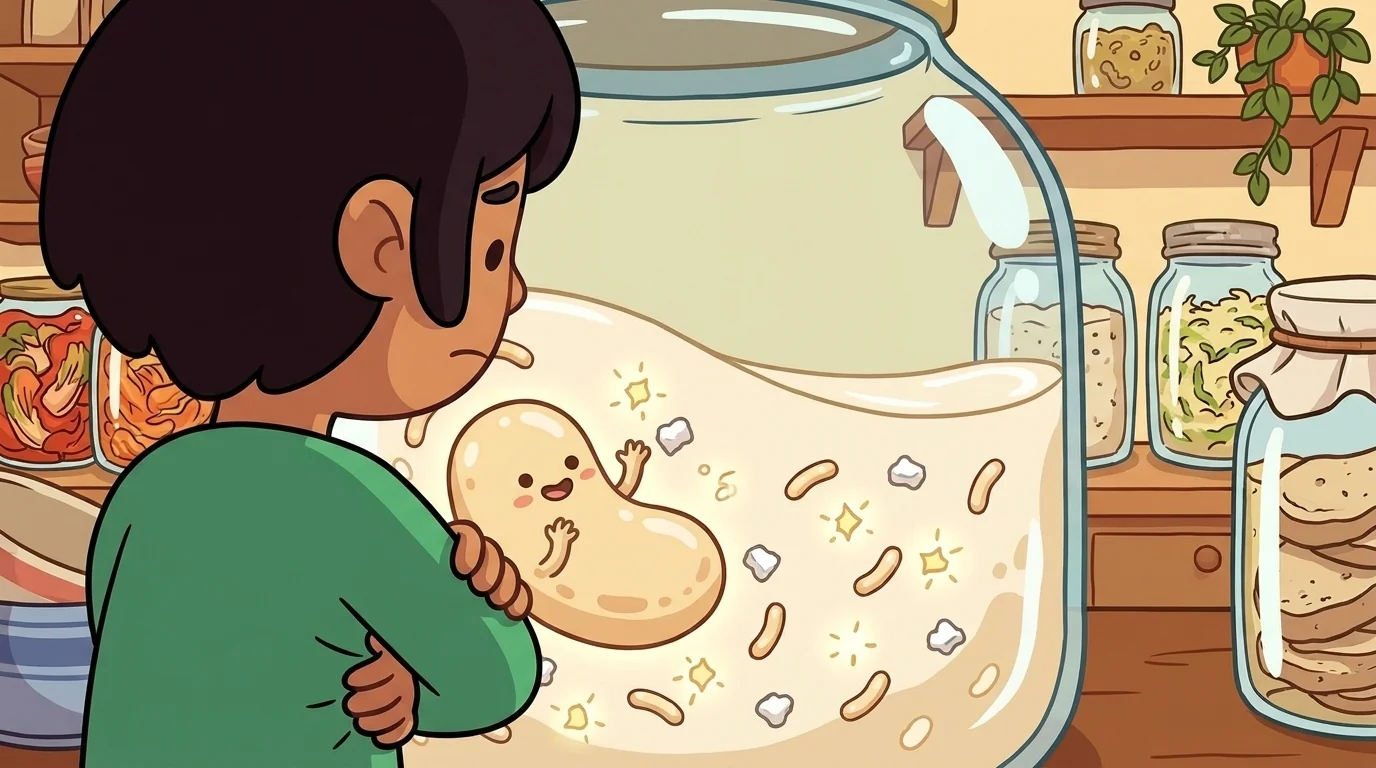
A student asked whether a bacterium in your food was a gross thing, honestly.
"I understand why you'd think so — but no," Lacto said, unbothered. "Your gut is home to trillions of bacteria right now, most of them helping you — digesting food you couldn't break down alone, making vitamins, training Guard's system, holding the space. That whole community is your microbiome, and you feed part of it every time you eat yogurt or kefir or sauerkraut. The word bacterium isn't a synonym for dirty. Most of us are staff, not intruders." It patted the yogurt jar. "This isn't spoiled milk. It's milk with a helpful friend living in it — and when you eat it, the friend comes to stay a while, and helps in there the same way it helped in here."
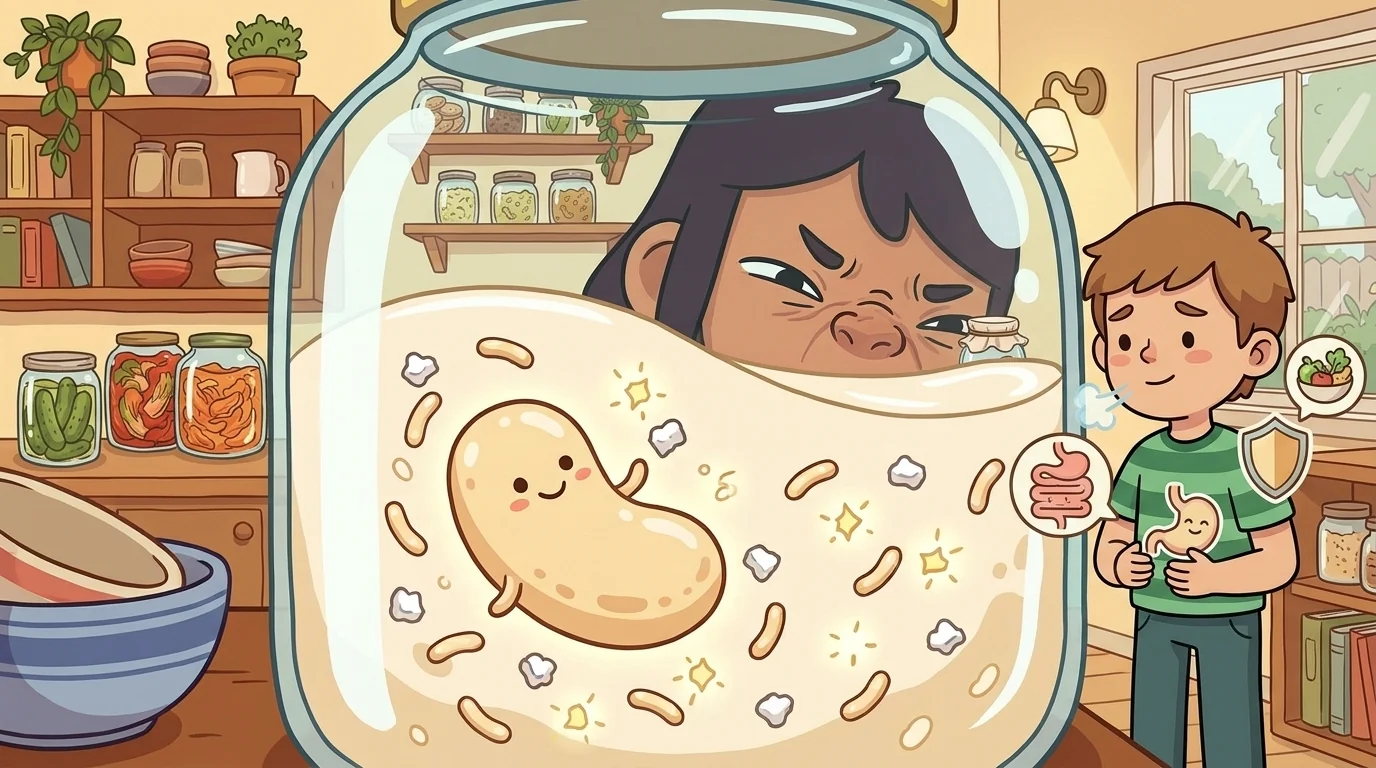
Later a student who felt too quiet and ordinary to matter came back.
"You don't fight, you don't glow, you don't do anything big," she said. "How is that enough?"
Lacto stirred the yogurt gently.
"Because enough isn't the same as big," it said. "I make one small change — sugar into acid — over and over, in the dark, and that one small change keeps milk good and keeps a gut safe and has fed people for ten thousand years. Nobody claps. The acid just does its patient work." It looked up, warm. "You don't have to be loud to hold a place steady. You just have to keep doing your small true thing, and stay. The staying is the help. I've never once fought anything off, and I've kept more homes safe than I could count."
The student sat with that, and the too-quiet feeling turned, slowly, into something steadier — the calm of a helper who has finally learned that presence counts.
Hear it as an audio drama
A short play starring Lacto, from MicrobeLab. Different voices, same idea. Listen any time after you read.
Loading audio…
Read the drama script
- Narrator: From Spark and Anvil and MicrobeLab — this is Lacto, in chapter 1 of the MicrobeLab cast.
- Narrator: This drama uses an AI-generated voice. Voiced via Gemini 2.5.
- Narrator: Lacto is a friendly bacterium-tween, a cheerful, chunky rod-shape in a small lab tunic.
- Narrator: They are warm-cream with soft pearl tones, always holding fermentation cards and a gut-microbiome tracker.
- Lacto: I am Lacto. What I teach is helpful bacteria, the craft of microbes-as-partners.
- Lacto: I turn milk into yogurt and cabbage into kimchi. I live in your gut to help you digest.
- Lacto: I am a friend in your food. And I am a friend in your gut.
- Narrator: Lactobacillus is one of countless helpful bacteria. These microbes are partners in the great project of your body.
- Narrator: Lacto grew up in a bubbling culture of yogurt, learning the ancient and helpful craft of fermentation.
- Lacto: I learned early that being a helpful partner is the most important job a microbe can have.
- Narrator: Then one day, a person looked through a microscope and didn't see a germ, but a tiny helper.
- Lacto: They didn't shrink away. They saw me and understood my purpose was to help, not to harm.
- Lacto: That is my whole lesson. Not all microbes are enemies; so many of us are your essential friends.
- Narrator: A friend in your food. A friend in your gut. That is the whole lesson. That is what makes Lacto Lacto.
- Narrator: You've been listening to a Spark and Anvil chapter, written by the Spark and Anvil writing team for ages 9 to 14.
- Narrator: Apps stay free forever.
- Narrator: Curriculum aligned to Common Core and Next Generation Science Standards.
- Narrator: Released under Creative Commons BY-NC-SA 4.0 for educational reuse. Visit Spark and Anvil for the full transcript.
The MicrobeLab ensemble
Lacto is one of the friends in MicrobeLab. Each friend shows you one idea by how they act; meet them all and you have the whole subject.
-

Yeast
Saccharomyces + helpful-fungi — 'I make air inside bread.'
-

Photo
Cyanobacteria + photosynthetic-microbes — 'Sunlight. Then air. Then everything else.'
-

Net
Mycorrhizal-fungi + nitrogen-fixers — 'Forests talk through me.'
-

Spore
Pathogens (opt-in gated) — 'Some friends. Some not. All real.'
-

Guard
Immune cells (T-cell / macrophage / B-cell) — 'I check IDs. Patient + careful.'
-

Crumble
Decomposer microbes that break down dead leaves and scraps into rich soil, so nothing is wasted and everything begins again.
-

Thrive
Extremophile microbes that make a home in the hottest, coldest, saltiest places, showing life finds a way almost anywhere.
-

Shimmer
Bioluminescent microbes that turn energy into their own soft glow, lighting ocean waves and partnering with animals like tiny lanterns.
-

Colony
Microbes that build biofilms together, cooperating and protecting each other, because they are far stronger as a community than alone.