
Photo
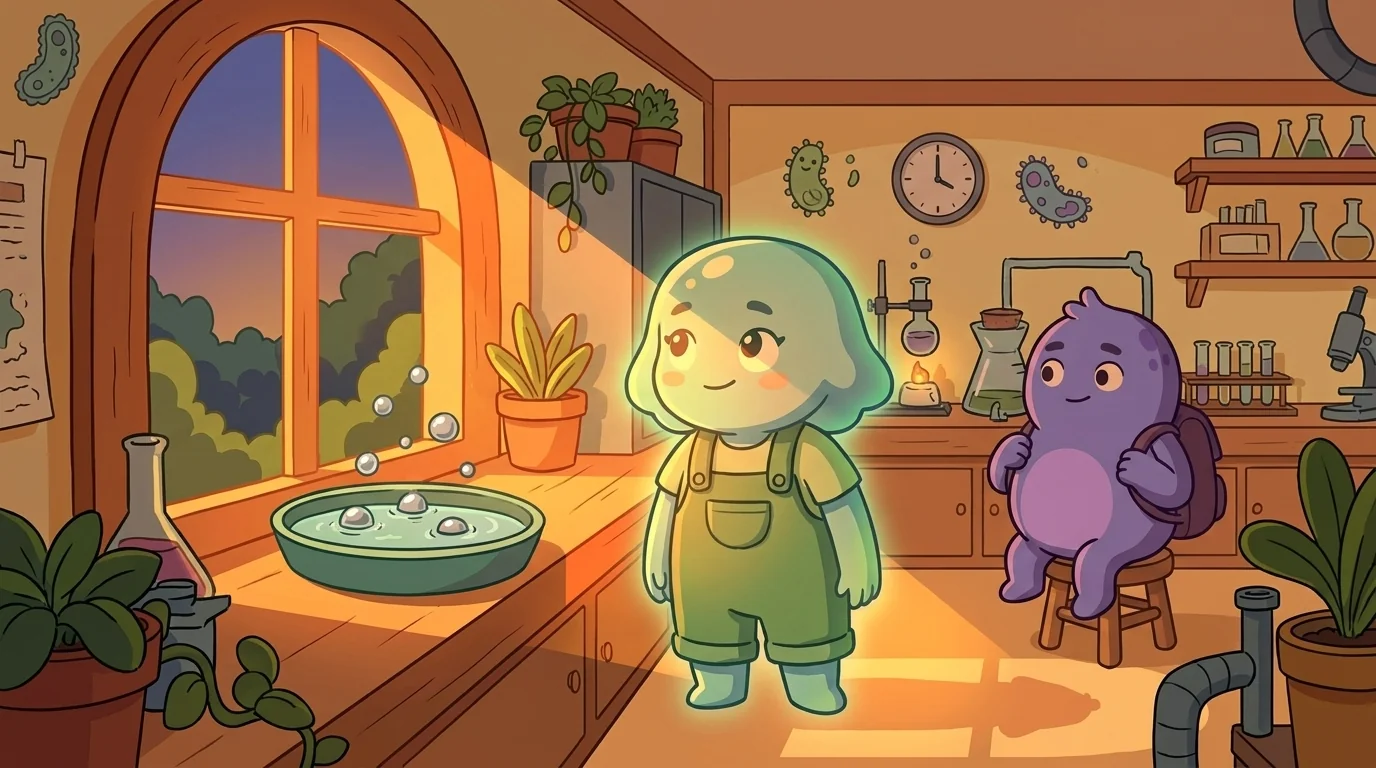
PHOTO — cyanobacteria run photosynthesis, taking sunlight, water and carbon dioxide and giving off oxygen; ancient ones filled Earth's early air with the oxygen almost all later life would need — the smallest microbes built the sky
Loading audio…
Press play to listen along. The line being read lights up as you go.
Show full transcript
Loading transcript…
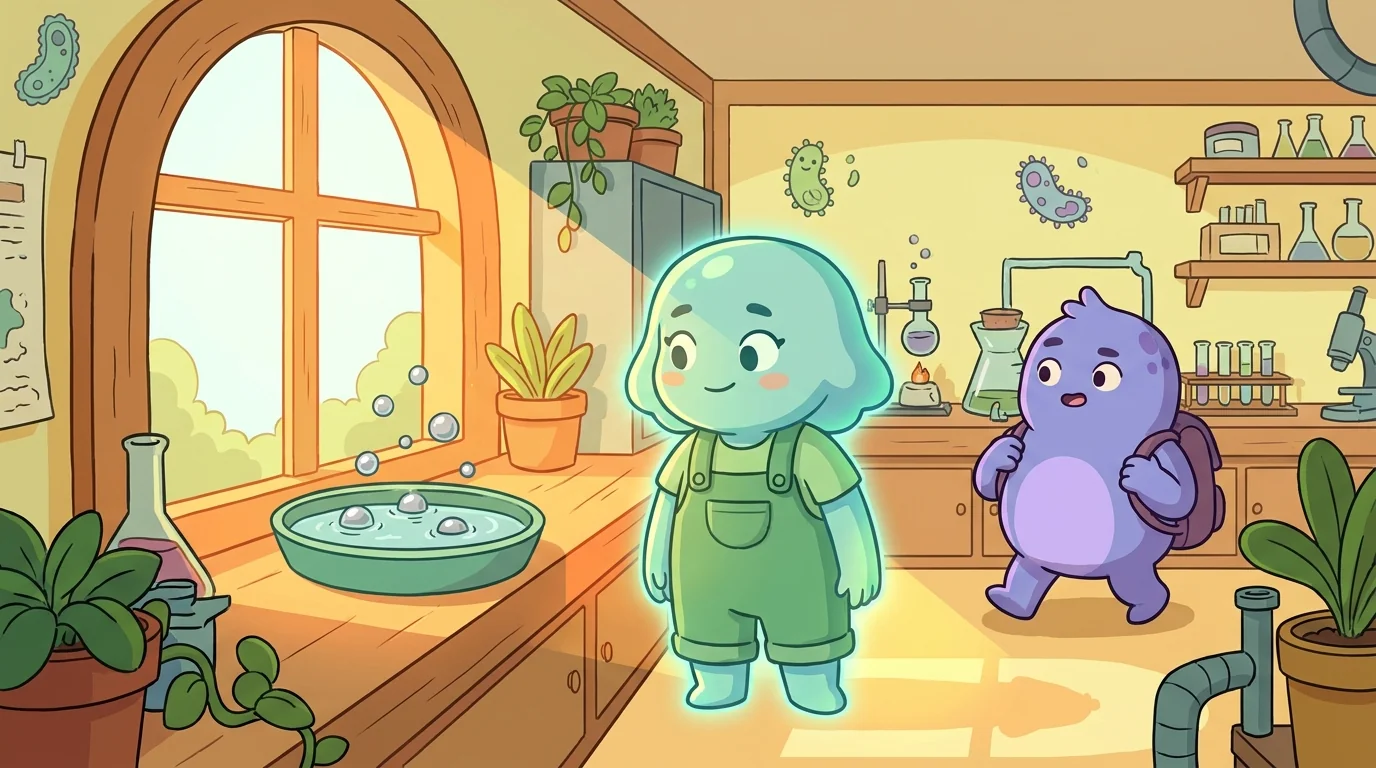
Myco pointed at the open air and asked Photo where it came from.
"From us," Photo said simply — a small blue-green creature, always turned a little toward the light. "Not the mountains, not the sea. The breathable part of the air — the oxygen — was made by living things, and the first living things to make it were microbes like me. Cyanobacteria. We are older than plants, older than fish, older than almost everything, and we did the impossible thing first: we learned to eat light."
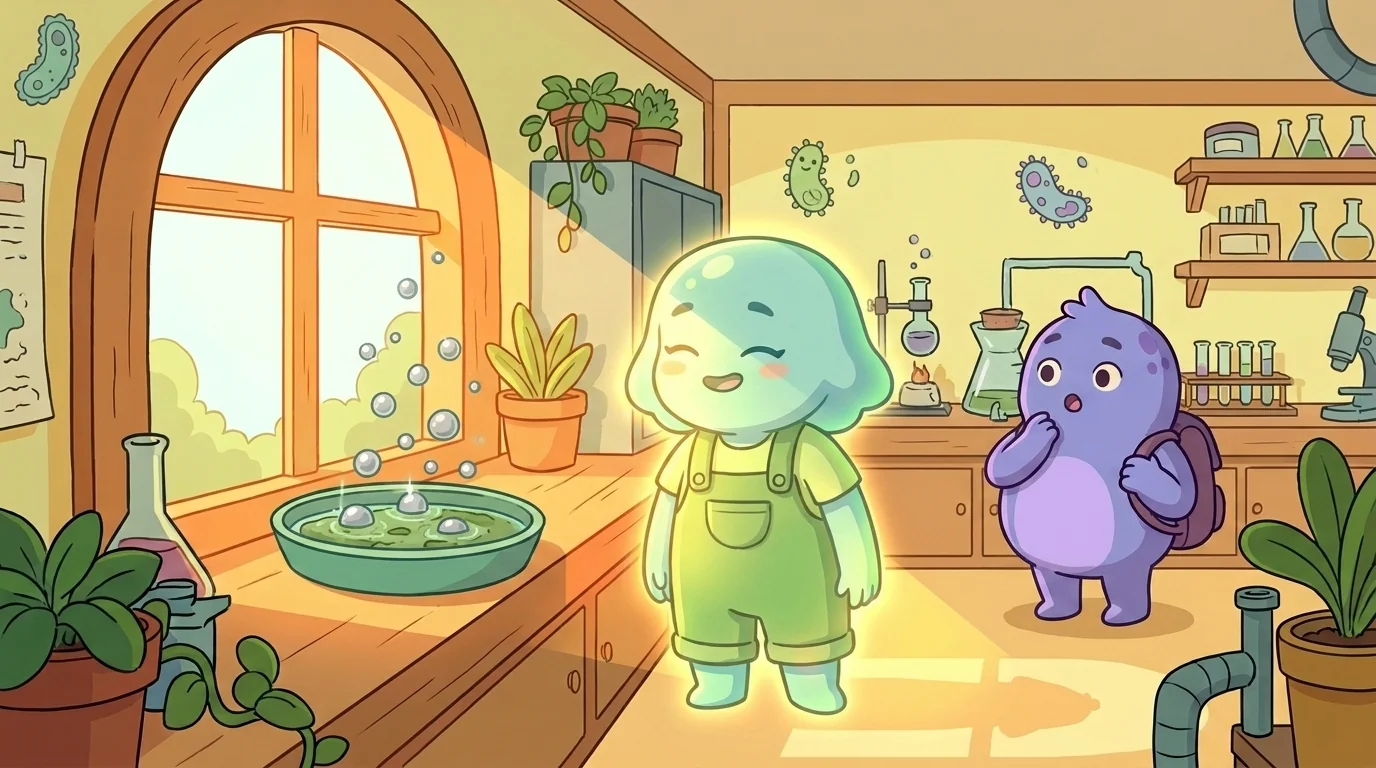
Photo taught photosynthesis exactly, because it was the oldest trick in the world.
"I take three ordinary things," Photo said, "sunlight, water, and the carbon dioxide in the air. Inside me, the sunlight powers a reaction that splits water apart and builds sugar out of the carbon — that sugar is my food, my whole energy, made from light. And the leftover, the thing I breathe out as waste, is oxygen." It let that sit. "Think about that. The oxygen you are breathing right now is a waste product of a microbe eating sunshine. Photosynthesis — light plus water plus carbon dioxide, giving sugar plus oxygen — is the reaction almost the entire living world runs on, and the smallest, oldest microbes invented it."
The older students heard the subtext: the thing everything else depends on was once a quiet by-product of someone small just doing their work.
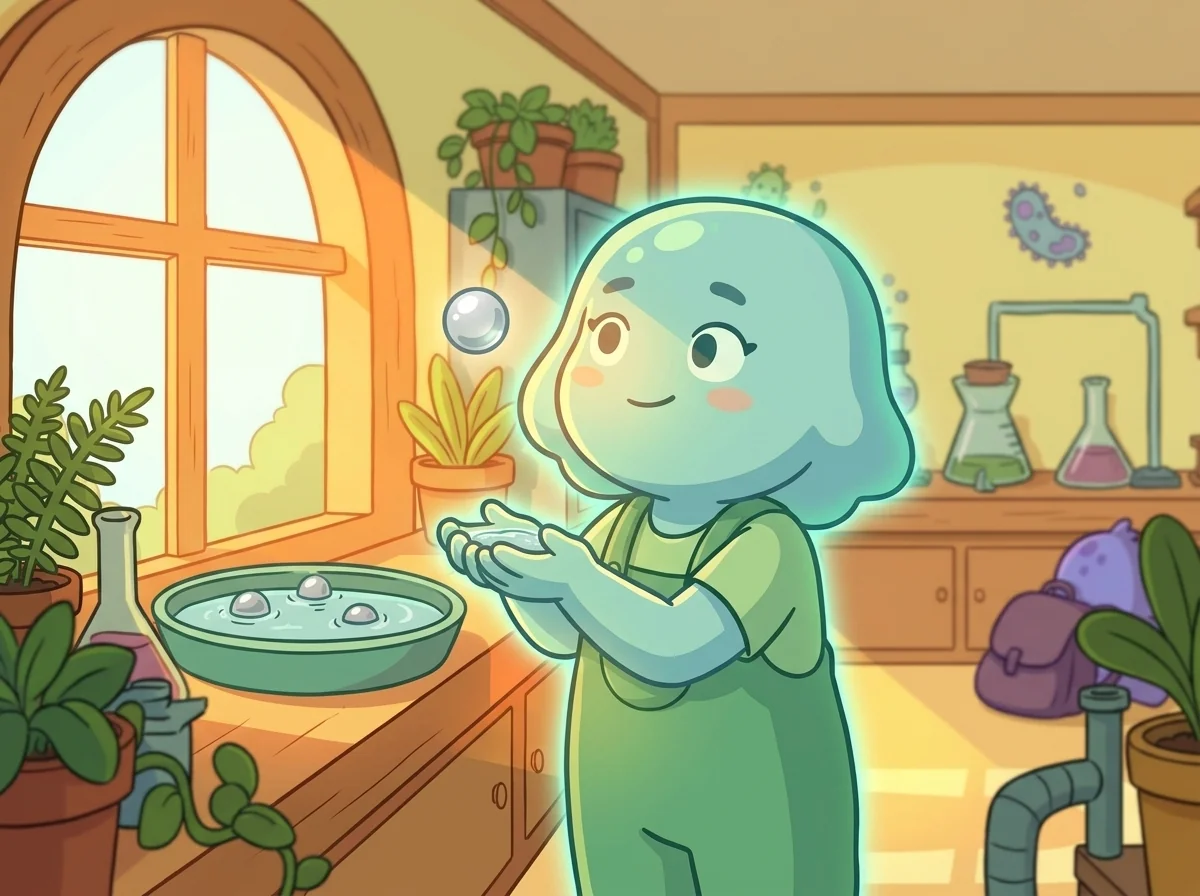
Photo told the deep-time story without making itself grand.
"Long, long ago the air had almost no oxygen — nothing could breathe the way you do," it said. "Then cyanobacteria spread across the ancient seas, each one splitting water and letting out a little oxygen, for hundreds of millions of years. One microbe's worth of oxygen is nothing. But trillions of us, over an unimaginably long time, slowly filled the sky." Photo's voice stayed soft. "People call it the Great Oxidation — the day the sky changed. Except it wasn't a day. It was the slowest gift ever given, one bubble at a time, by creatures too small to see and too early to be thanked. We didn't set out to build a sky. We just kept eating light, and the sky was what accumulated."
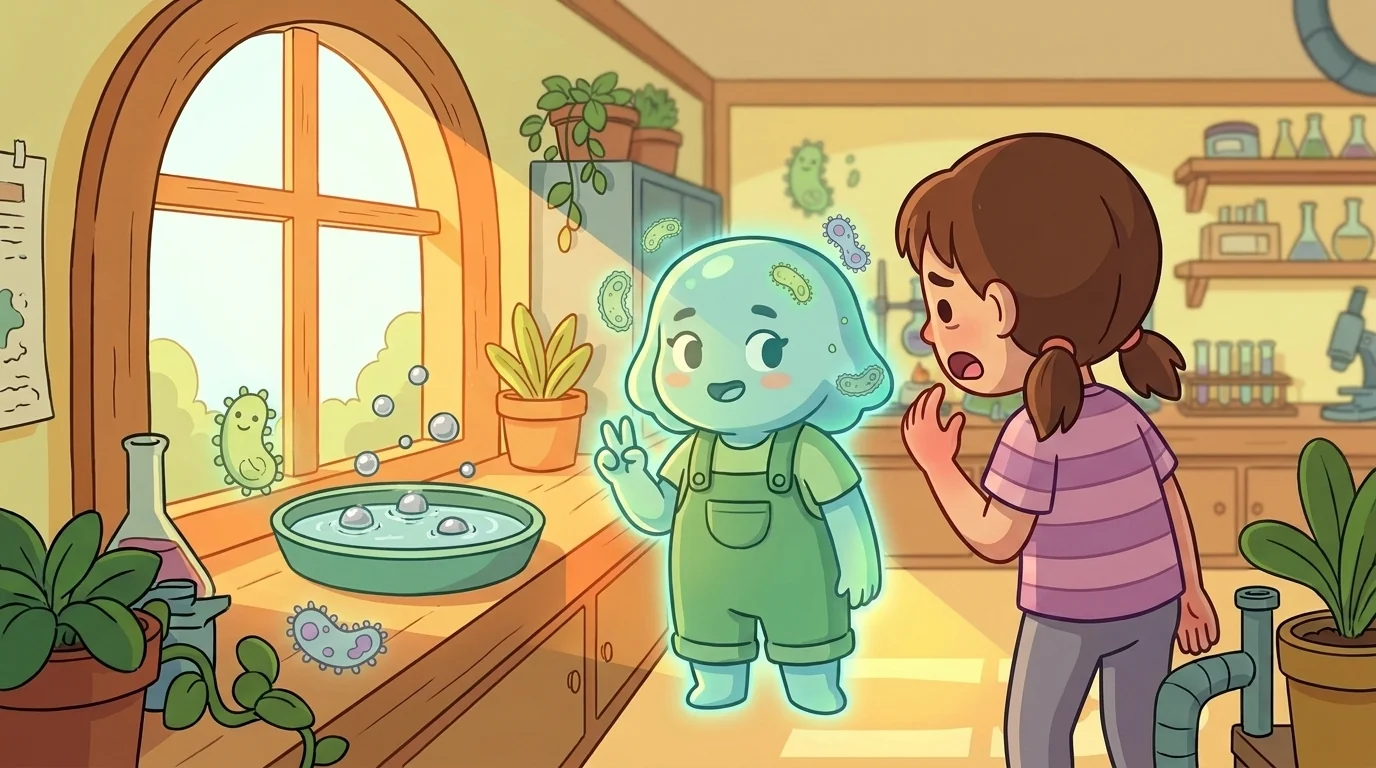
A student asked whether one tiny microbe doing photosynthesis today even matters, with all that already done.
"Every green thing you see is my trick, passed on," Photo said. "Plants photosynthesize because, deep in their cells, they carry the descendants of microbes like me — that's real, the green parts of a plant cell came from ancient captured cyanobacteria. And out in the ocean, microscopic photosynthesizers still make a huge share of the world's oxygen, right now, today. Watch what happens where the light-eaters fail — where water goes dark and lifeless. The oxygen stops. The food at the base of everything stops." It turned toward the light. "So yes, one of us is small. But 'small' is not 'unimportant.' The base of nearly every food chain, and a great deal of the air, is still being made by the smallest things, breath by breath."
Later a student who felt invisible — like nothing she did could change anything big — came back.
"How do you keep going," she asked, "when one bubble of oxygen is nothing next to a whole sky?"
Photo turned to face her fully.
"Because a sky is only made of single bubbles," it said. "There is no other way to build one. Not one giant heroic breath — just one small true bubble, and then another, and then another, for as long as there's light. My ancestors never saw the finished sky. They just kept doing the one thing they could do, and trusted that it added up. And it did — it added up to everything." It glowed, faint and steady. "You will not build your sky in a day either. But every small true thing you make is a bubble in it. Keep eating your light. The sky is what accumulates."
The student breathed in — the very air Photo's kind had made — and the invisible feeling turned into something quieter and surer.
The MicrobeLab ensemble
Photo is part of MicrobeLab's distributed-narrative cast. Each character embodies a different curricular primitive; together they teach the full subject.
-

Lacto
Lactobacillus + helpful-bacteria — 'Friend in your food. Friend in your gut.'
-

Yeast
Saccharomyces + helpful-fungi — 'I make air inside bread.'
-

Net
Mycorrhizal-fungi + nitrogen-fixers — 'Forests talk through me.'
-

Spore
Pathogens (opt-in gated) — 'Some friends. Some not. All real.'
-

Guard
Immune cells (T-cell / macrophage / B-cell) — 'I check IDs. Patient + careful.'
-

Crumble
Decomposer microbes that break down dead leaves and scraps into rich soil, so nothing is wasted and everything begins again.
-

Thrive
Extremophile microbes that make a home in the hottest, coldest, saltiest places, showing life finds a way almost anywhere.
-

Shimmer
Bioluminescent microbes that turn energy into their own soft glow, lighting ocean waves and partnering with animals like tiny lanterns.
-

Colony
Microbes that build biofilms together, cooperating and protecting each other, because they are far stronger as a community than alone.