Shimmer
Bioluminescent microbes turn chemical energy into cold living light using luciferin and…
Loading audio…
Press play to listen along. The line being read lights up as you go.
Show full transcript
Loading transcript…
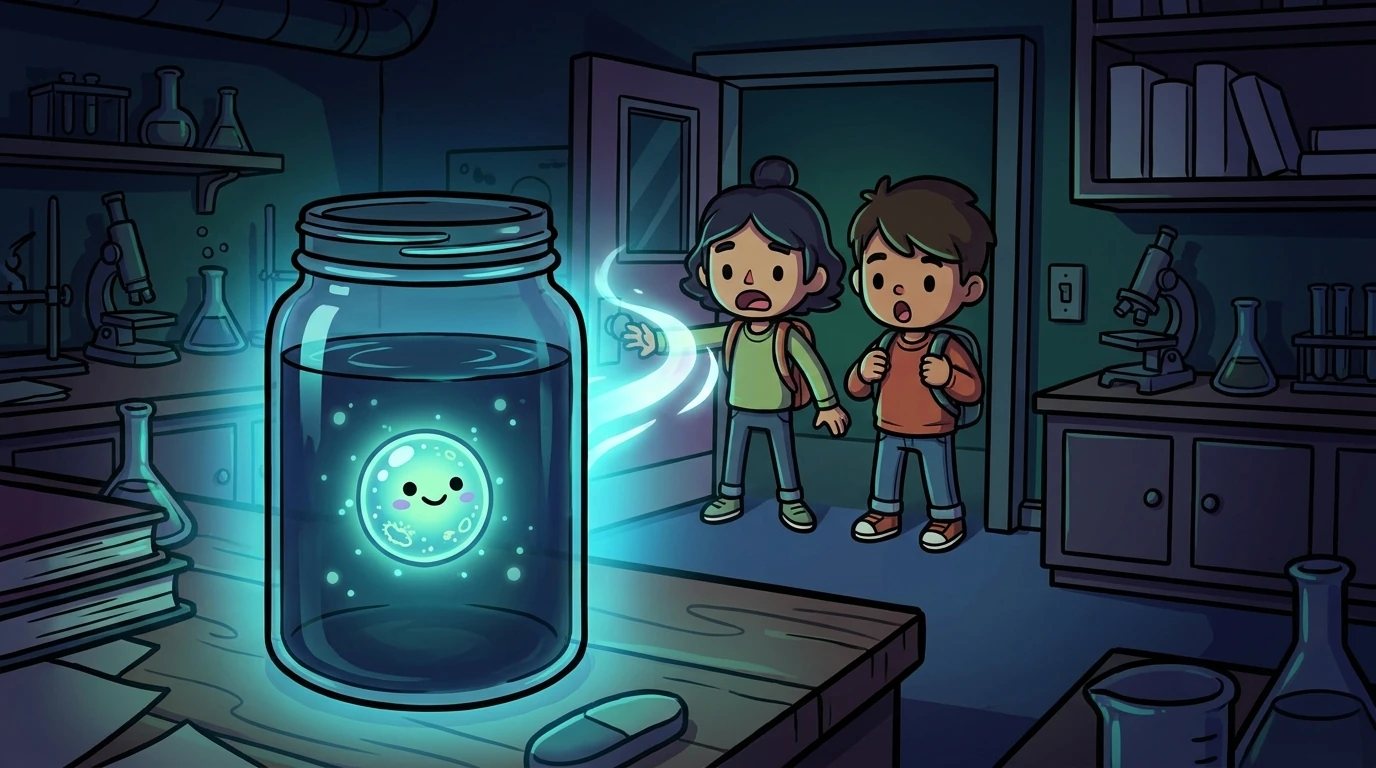
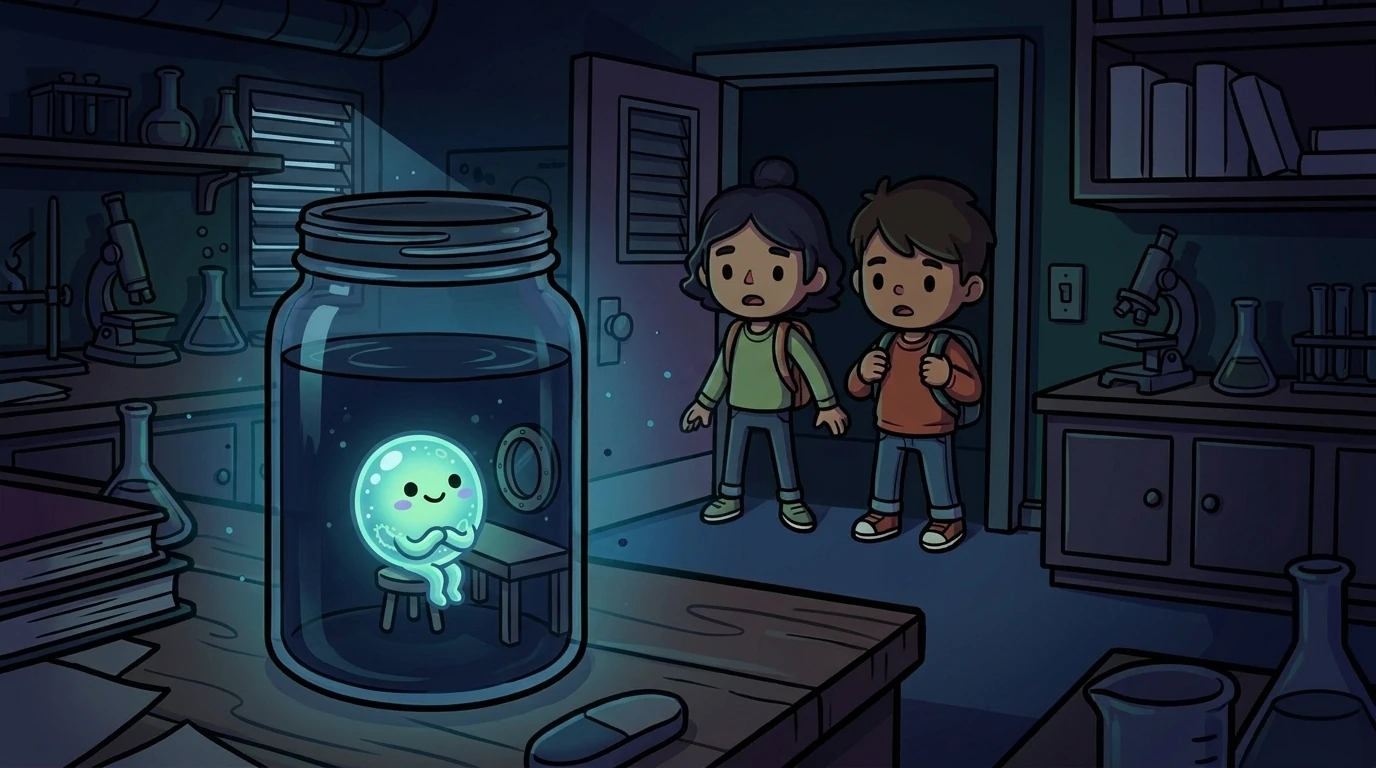
Myco cupped a jar of dark seawater and asked Shimmer to prove it was alive.
Shimmer waited. And then, as more of its kind drifted together in the water, the jar began, softly, to glow — a cool blue light with no lamp and no flame. "There," Shimmer said, pale and luminous. "No fire. No sun. That light is me — a chemical reaction happening inside a living cell. People think light has to come from something hot or something plugged in. But the smallest life makes its own, cold and quiet, out of nothing but chemistry."
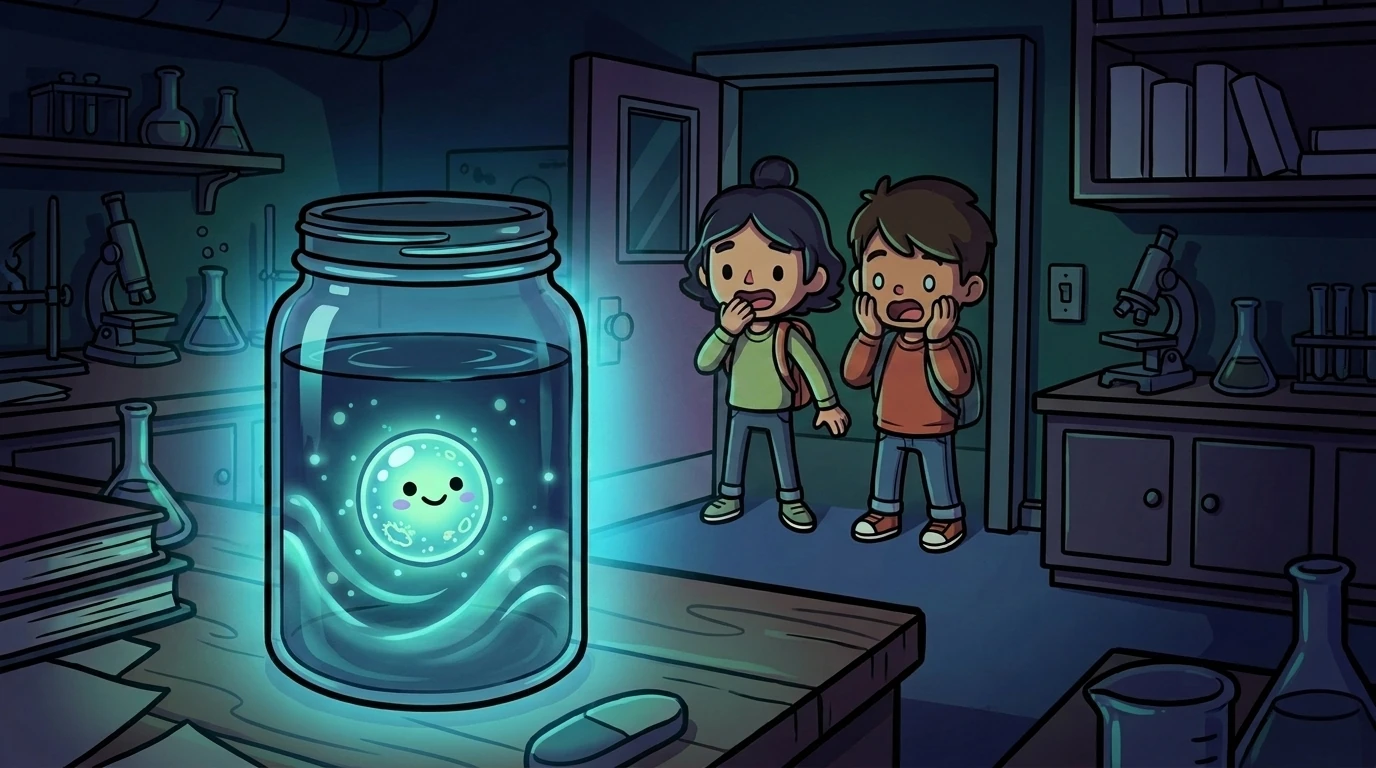
Shimmer taught the reaction precisely, glowing all the while.
"My light is a chemical reaction with two ingredients," Shimmer said. "A molecule called luciferin, and an enzyme called luciferase that speeds the reaction up. When luciferin reacts with oxygen — helped by the enzyme — it releases its energy as light instead of as heat. That's the marvel: almost all of the energy comes out as glow, almost none of it wasted as warmth. Your light bulbs get hot because they waste most of their energy as heat. My light is cold — nearly pure light, almost perfectly efficient." It pulsed gently. "That's what bioluminescence is. Not magic. Chemistry, done so cleanly that the energy comes out as something you can see in the dark."
The older students heard the subtext: real brilliance is energy spent almost entirely on the thing that matters, with almost nothing thrown away.
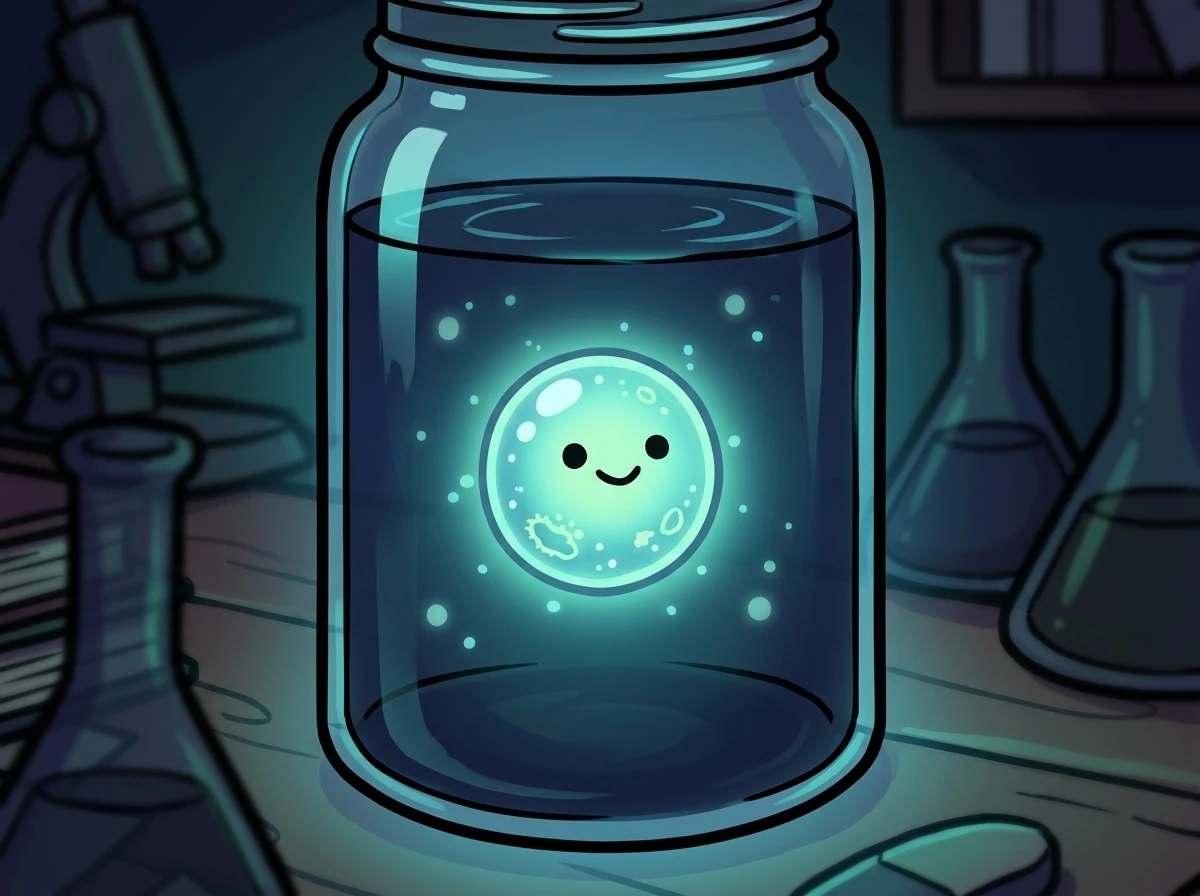
Shimmer told how it learned it couldn't shine alone.
"When I was a single cell, I tried to glow, and — nothing," Shimmer admitted. "One of me makes light too faint to notice. I thought I was broken. Then I understood the rule: I only switch my light on when there are enough of us together. My kind can sense how many of us have gathered — the same quorum sensing Colony uses — and only when the crowd is big enough do we all light up at once, because only together are we bright enough to matter." It glowed brighter as if remembering. "So the light was never a thing I lacked. It was a thing that needed company. I wasn't broken. I was waiting for the others to arrive."
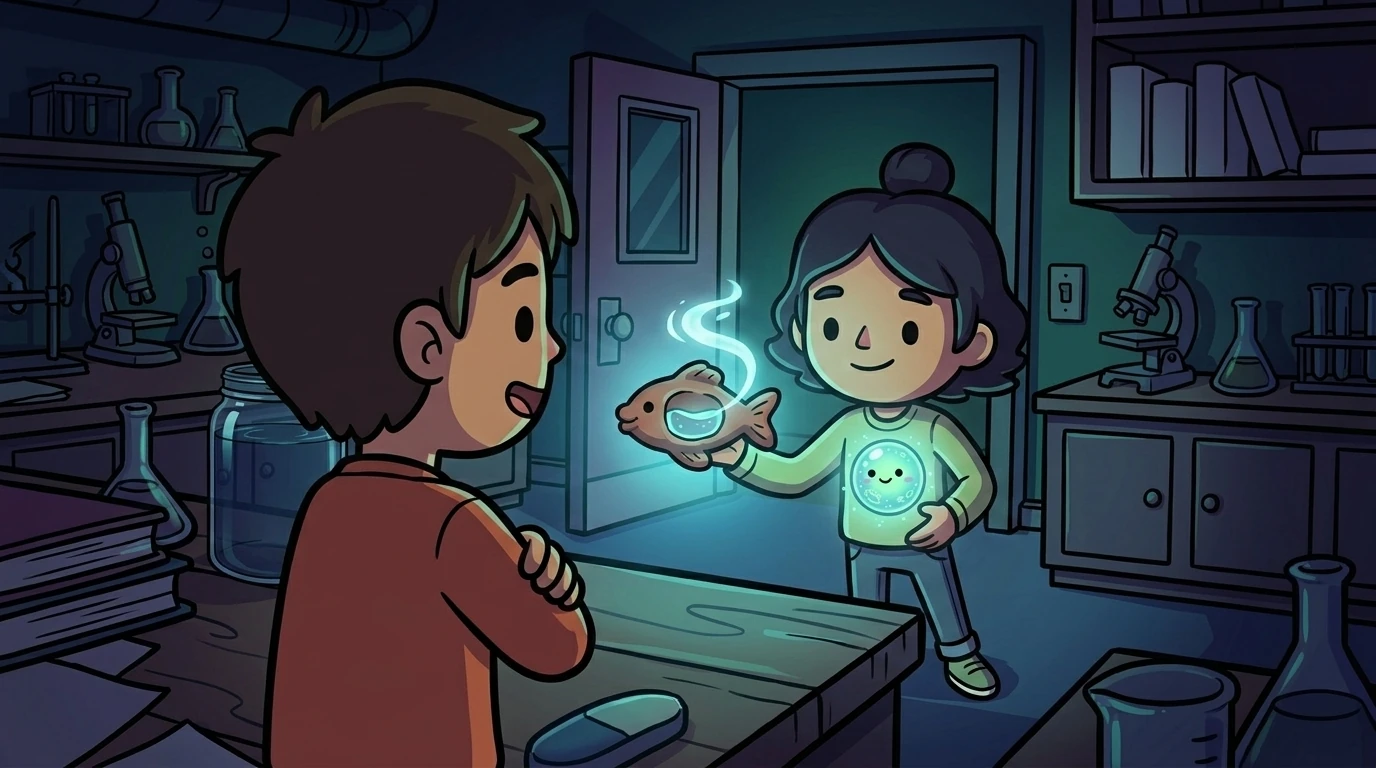
A student asked what the point of a glow even was, out in the sea.
"Different partnerships, different reasons — and that's the loveliest part," Shimmer said. "Some of my kind live inside animals: a certain little squid keeps a pocket of us and feeds us, and in return our glow hides its shadow from predators below, so it carries us like a living lantern. Some of us light up seawater when it's disturbed, so a wave breaks into blue sparks at night. Some deep-sea creatures grow their own glow to lure or signal in a place the sun never reaches." Shimmer pulsed. "The point isn't one point. The point is that light is useful — for hiding, for finding, for signaling — and life kept inventing ways to make it, down where there is no other light at all. Where the world is darkest, something small learned to shine."
Later a student who felt dim — like she had no light in her worth showing — came back.
"How do you know you have a light at all," she asked, "if you can't see it until the others come?"
Shimmer drifted close, faint and warm.
"You don't always feel it alone," it said. "That's the honest thing. One cell in the dark can't tell it's luminous. The light is real the whole time — the luciferin is there, the enzyme is there — it just needs the company to switch on visibly. So the answer isn't to squeeze harder trying to glow by yourself. It's to find the others. Drift toward your kind. Gather. And the light you were sure you didn't have turns out to have been in you all along, waiting for enough of you to be together." It brightened. "You are not dim. You are luminescent and alone in the dark. Those aren't the same thing. Go find the water where the rest of you are."
The student watched the soft blue rise as more of Shimmer's kind gathered, and the dim feeling turned into something patient and hopeful.
Hear it as an audio drama
A short play starring Shimmer, from MicrobeLab. Different voices, same idea. Listen any time after you read.
Loading audio…
Read the drama script
- Narrator: From Spark and Anvil and MicrobeLab — this is Shimmer, in chapter 1 of the MicrobeLab cast.
- Narrator: This drama uses an AI-generated voice. Voiced via Gemini 2.5.
- Narrator: In a jar of dark seawater, something pale and luminous waited, and as more of its kind drifted together the water began, softly, to glow.
- Shimmer: I am Shimmer, and that cool blue light is me — no lamp, no flame, just a chemical reaction happening inside a living cell.
- Narrator: The glow rose and fell like a slow breath in the dark.
- Shimmer: My light needs two ingredients — a molecule called luciferin, and an enzyme called luciferase that speeds the reaction along.
- Shimmer: When the luciferin reacts with oxygen, it releases its energy as light instead of heat, so my glow is cold and almost perfectly efficient.
- Narrator: A hot light bulb wastes most of its energy as warmth, but Shimmer's light is nearly pure glow.
- Shimmer: When I was a single cell I tried to shine and got nothing, and I was sure I was broken.
- Shimmer: But one of me is too faint to notice — I only switch my light on when enough of us have gathered together.
- Narrator: Some of Shimmer's kind live inside a little squid, which feeds them and carries their glow like a living lantern to hide its shadow.
- Shimmer: Others light up the waves at night, or glow in the deep sea where the sun has never once reached.
- Narrator: A student asked, softly, how you can know you have a light at all if you cannot see it alone.
- Shimmer: The light was in you the whole time, waiting for company to switch it on — so do not squeeze harder, just drift toward the others and gather.
- Narrator: You are not dim, you are luminescent and alone in the dark, and those are not the same thing. That is what makes Shimmer Shimmer.
- Narrator: You've been listening to a Spark and Anvil chapter, written by the Spark and Anvil writing team for ages 9 to 14.
- Narrator: Apps stay free forever.
- Narrator: Curriculum aligned to Common Core and Next Generation Science Standards.
- Narrator: Released under Creative Commons BY-NC-SA 4.0 for educational reuse. Visit Spark and Anvil for the full transcript.
The MicrobeLab ensemble
Shimmer is one of the friends in MicrobeLab. Each friend shows you one idea by how they act; meet them all and you have the whole subject.
-

Lacto
Lactobacillus + helpful-bacteria — 'Friend in your food. Friend in your gut.'
-

Yeast
Saccharomyces + helpful-fungi — 'I make air inside bread.'
-
Photo
Cyanobacteria + photosynthetic-microbes — 'Sunlight. Then air. Then everything else.'
-

Net
Mycorrhizal-fungi + nitrogen-fixers — 'Forests talk through me.'
-

Spore
Pathogens (opt-in gated) — 'Some friends. Some not. All real.'
-

Guard
Immune cells (T-cell / macrophage / B-cell) — 'I check IDs. Patient + careful.'
-

Crumble
Decomposer microbes that break down dead leaves and scraps into rich soil, so nothing is wasted and everything begins again.
-

Thrive
Extremophile microbes that make a home in the hottest, coldest, saltiest places, showing life finds a way almost anywhere.
-

Colony
Microbes that build biofilms together, cooperating and protecting each other, because they are far stronger as a community than alone.