
Spore
SPORE — most microbes are neutral or helpful and only some cause harm; the calm, factual work is sorting friend from not-friend by evidence, understanding how a few pathogens spread and how simple habits stop them, without fear and without pretending danger isn't real
Loading audio…
Press play to listen along. The line being read lights up as you go.
Show full transcript
Loading transcript…

Myco set two empty trays in front of Spore and asked her to do the hardest sorting in the lab.
Spore didn't tense. She was a small round tween who worked slowly, and she liked slow work. "Friend, and not-friend," she said, laying a card gently in each tray. "Most microbes go in the friend tray, or a third tray I keep for neither — the ones that just live their lives and never touch us at all. Only a few go in not-friend. And here's how I do it: I look at the evidence on each one, I name it plainly, and I keep my hands calm." She laid both palms flat on the table. "Naming a hard thing out loud, without a flinch, is how you make it something you can hold instead of something that holds you."
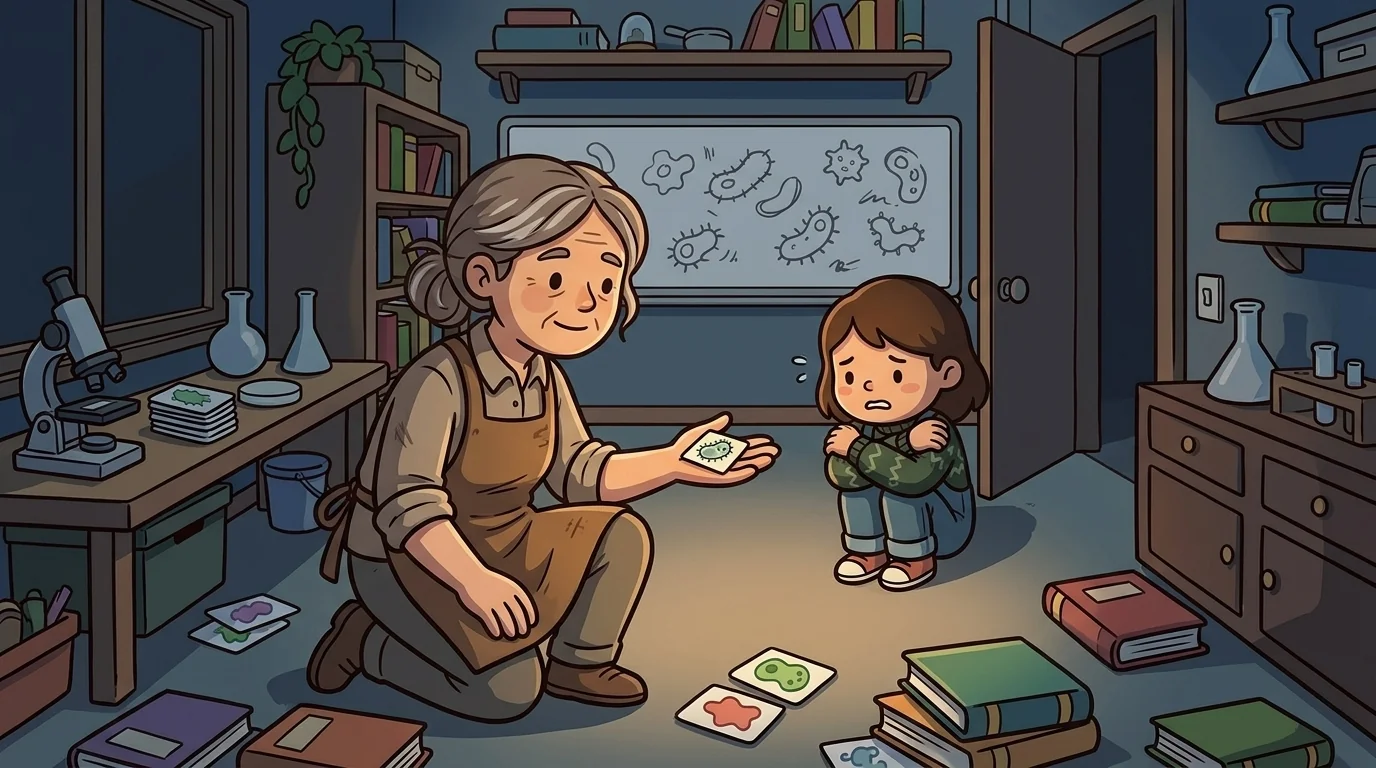
Spore taught what a pathogen actually is, without dread.
"A pathogen is simply a microbe that can harm a host — that's the whole definition, no evil in it," she said. "It's not a monster. It's a living thing making its living in a way that happens to cost us. Some bacteria release substances our bodies react badly to. Some viruses get inside our cells and use them to copy themselves. That's the mechanism — not wickedness, just biology that doesn't happen to be on our side." She turned a card over calmly. "And knowing the mechanism is exactly what takes the fear out. A pathogen spreads in understandable ways — through the air in droplets, through touch, through unclean water. Understandable means interruptible. When you know how something travels, you know where to stand in its way."
The older students heard the subtext: fear shrinks when you replace the vague dark shape with a plain, named, understood thing.
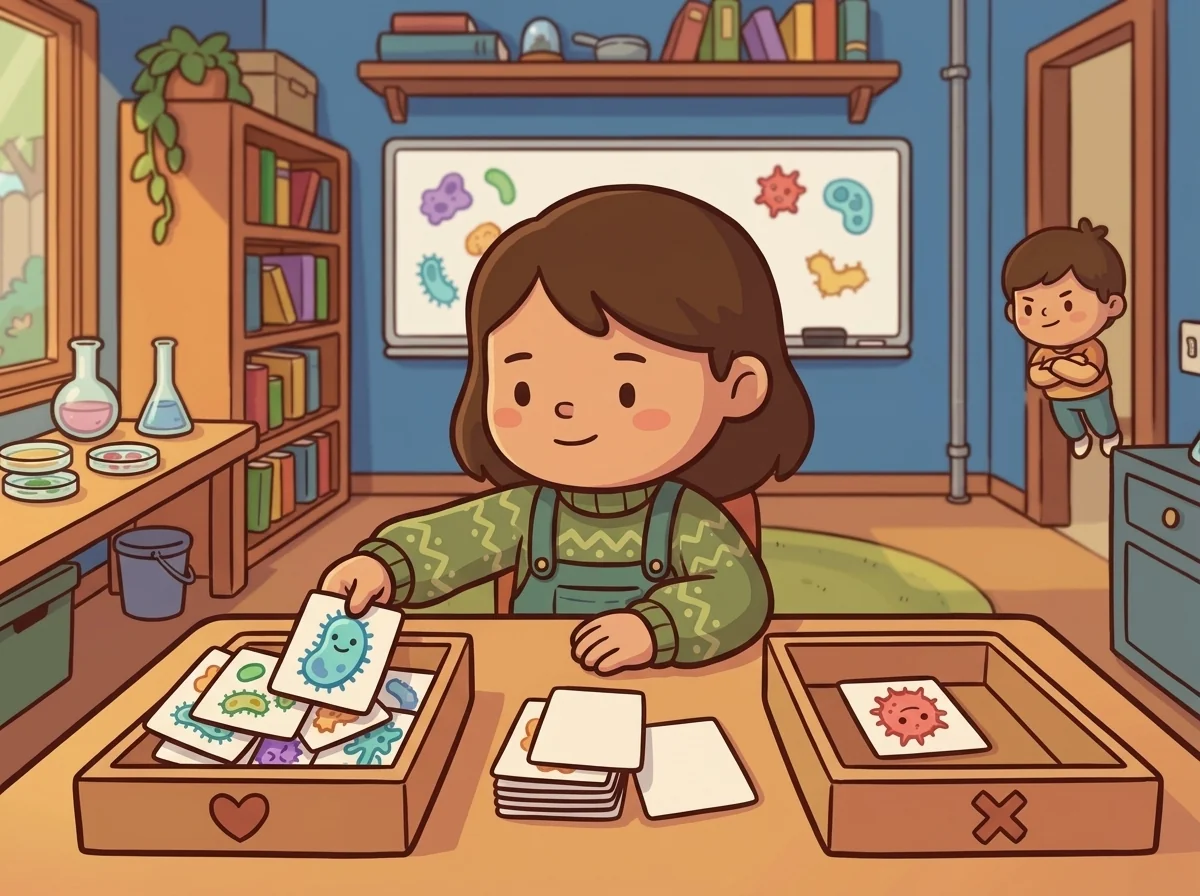
Spore told how she learned to sort without panic.
"When I was small, not-friend felt huge," she said. "I heard the word germ and my whole chest went tight, like the not-friend tray was enormous and coming for me." She smiled, unhurried. "Then I actually counted. Trillions of microbes live on you and in you right now, and the overwhelming majority are helping or ignoring you completely. The not-friend tray is small. It's real — I won't pretend it's empty — but it is a small, sortable, knowable pile, not a flood." She patted the tray. "The fear made it feel infinite. The counting made it finite. And a finite thing you can look at squarely, name, and prepare for. That's the difference between being scared of the dark and turning on the light to see how small the room really is."

A student asked, thin-voiced, how you protect yourself if some microbes really can hurt you.
"With ordinary, powerful habits — and I mean powerful," Spore said, staying calm. "Washing your hands breaks the touch route. Covering a cough breaks the droplet route. Clean water breaks the water route. Vaccines teach Guard's system to recognize a pathogen safely, before it ever arrives, so your body clears it fast. None of these are dramatic. All of them work." She set the last card down gently. "Notice I'm not telling you there's nothing to it — that would be a lie, and lies don't calm anyone for long. I'm telling you the true thing, which is better than nothing-to-worry-about: the harmful few are known, the ways they spread are known, and the habits that stop them are simple and in your own hands. Truth plus a plan. That's what steady is made of."

Later a student who felt frightened of a big unnamed worry — not just germs — came back.
"When something scary is real," she asked, "and you can't just pretend it away — how do you not let it swallow you?"
Spore slid a blank card across, and a pen.
"You do what I do with the not-friend tray," she said. "You name it — out loud, plainly, no whisper and no drama. You look at how big it actually is instead of how big it feels. You learn how it works, because how-it-works is where the handles are. And then you make your small true plan and keep your hands calm and keep breathing." She laid her palms flat again, and waited until the girl's breath slowed to match. "Steady isn't pretending nothing's wrong. Steady is telling the exact truth in a calm voice, and then doing the next small useful thing. You can be a little afraid and completely steady at the same time. I am, every day, and I sort the hardest tray in the lab."
The girl wrote a word on the card, looked at it, and let her shoulders come down — the fear not gone, but named, and small enough now to hold.
The MicrobeLab ensemble
Spore is part of MicrobeLab's distributed-narrative cast. Each character embodies a different curricular primitive; together they teach the full subject.
-

Lacto
Lactobacillus + helpful-bacteria — 'Friend in your food. Friend in your gut.'
-

Yeast
Saccharomyces + helpful-fungi — 'I make air inside bread.'
-

Photo
Cyanobacteria + photosynthetic-microbes — 'Sunlight. Then air. Then everything else.'
-

Net
Mycorrhizal-fungi + nitrogen-fixers — 'Forests talk through me.'
-

Guard
Immune cells (T-cell / macrophage / B-cell) — 'I check IDs. Patient + careful.'
-

Crumble
Decomposer microbes that break down dead leaves and scraps into rich soil, so nothing is wasted and everything begins again.
-

Thrive
Extremophile microbes that make a home in the hottest, coldest, saltiest places, showing life finds a way almost anywhere.
-

Shimmer
Bioluminescent microbes that turn energy into their own soft glow, lighting ocean waves and partnering with animals like tiny lanterns.
-

Colony
Microbes that build biofilms together, cooperating and protecting each other, because they are far stronger as a community than alone.