
Nudge Nora and Gap Gus
TWO ROADS TO ONE ANSWER — a subtraction can be made friendly two different ways: nudge one number to a round one and give back the difference (compensation), OR slide both numbers the same amount so the gap is unchanged (constant difference). Both reach the exact same answer.
A story read by Nudge Nora and Gap Gus
Loading audio…
Press play to listen along. The line being read lights up as you go.
Show full transcript
Loading transcript…
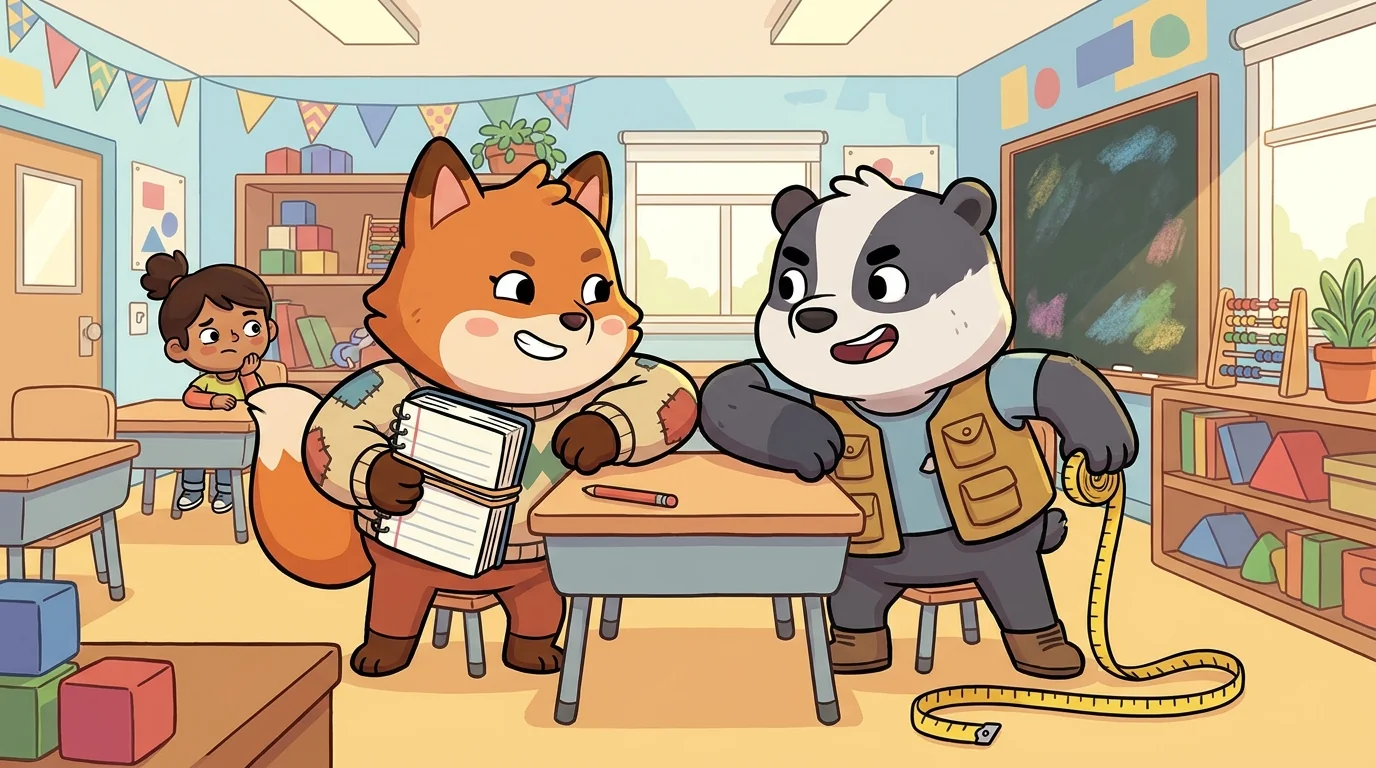
The kitchen clock clicked toward five, and the late afternoon light hit Wren’s math worksheet at a sharp angle. On the screen of her tablet, problem number fourteen sat in bold black type: 72 − 38.
Wren tapped her pencil against her chin and let out a long, heavy breath. Before she could even reach for her scratch paper, two figures tumbled onto the desk, shoulder to shoulder.
"Out of the way, Gus," said Nudge Nora. She straightened the thick rubber band around her pocket notebook. "This is clearly a job for clean bookkeeping."
"Not a chance," said Gap Gus. He unclipped a small steel tape measure from his belt loop. "Thirty-eight is practically begging for a slide. It’s my turn."
Wren lowered her pencil. She looked at Nora’s crisp white index cards, then at Gus’s scratched yellow tape.
"Are you two seriously arguing over my homework?" Wren asked.
"Friendly competition," Nora said, adjusting her glasses.
"The healthiest kind," Gus added with a grin. "Look at the problem, Wren. Thirty-eight is an awkward, prickly number to take away from seventy-two. You have to borrow across columns, cross things out, and leave messy little marks. Nora and I both fix the problem before we touch it."
Nora nodded firmly. "We just disagree on who does the fixing with more dignity."
"Right," Gus said. "So we race. One problem. Two methods. You judge who gets you to the finish line with fewer headaches."
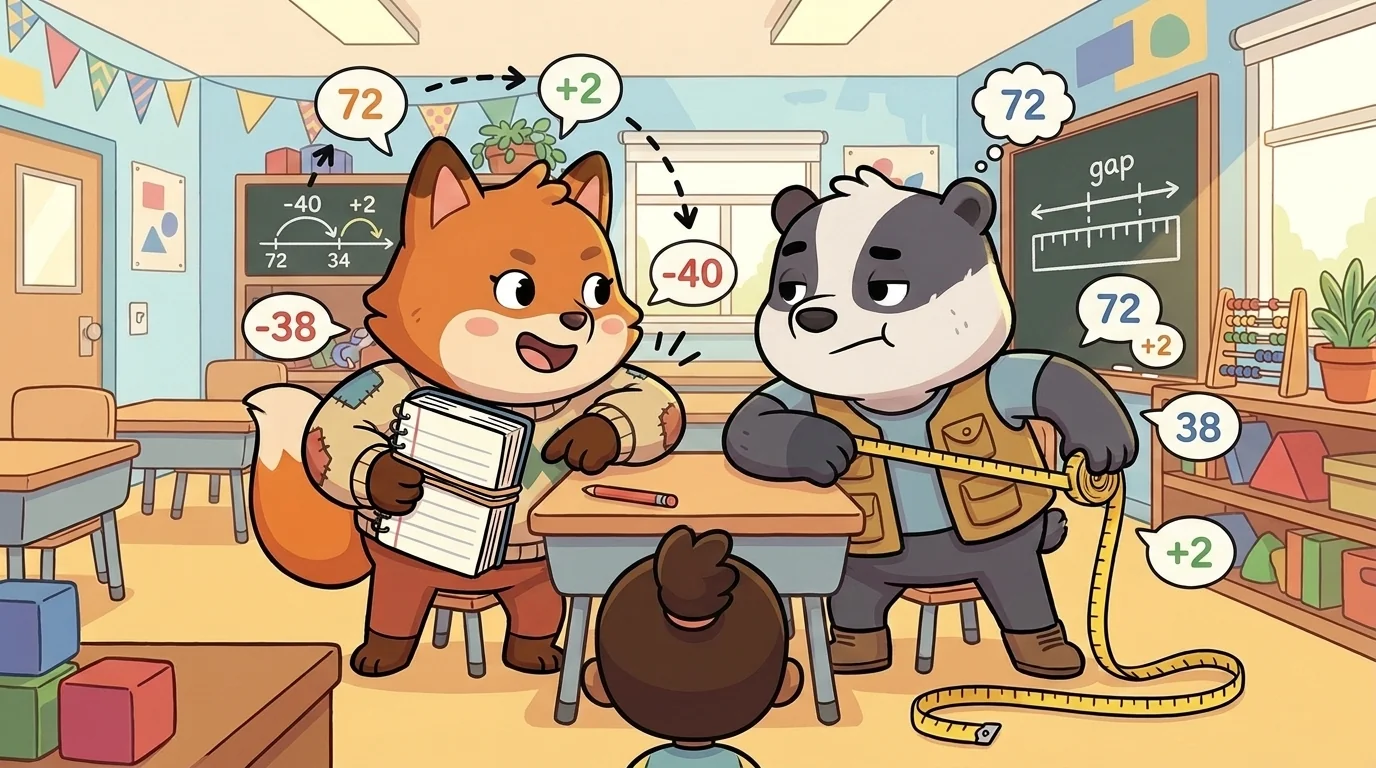
Nora stepped forward first. She set her notebook down with a neat tap against the wood.
"My method uses compensation," Nora explained. "I call it nudging. Thirty-eight is clumsy, but it is only two units away from forty. Forty is a friendly, polite number."
She drew a clean bracket on the paper.
"So I nudge thirty-eight up by two," she continued. "Now the problem becomes seventy-two minus forty. That is simple mental math. Seventy-two minus forty leaves thirty-two."
Wren nodded slowly. "Right. Thirty-two."
"Except I took away forty instead of thirty-eight," Nora said, raising one finger. "I took away two too many. To keep things honest, I must return what I borrowed. Thirty-two plus two gives thirty-four."
She snapped her notebook shut. "Two clean steps. Nudge the number to make it friendly, then give back the difference. Honest, orderly, done."
Gus leaned against the desk edge and shook his head with a slow smile. "Very neat, Nora. Very polite. But you still had to hold a debt in your head. Watch what happens when you never owe anything at all."
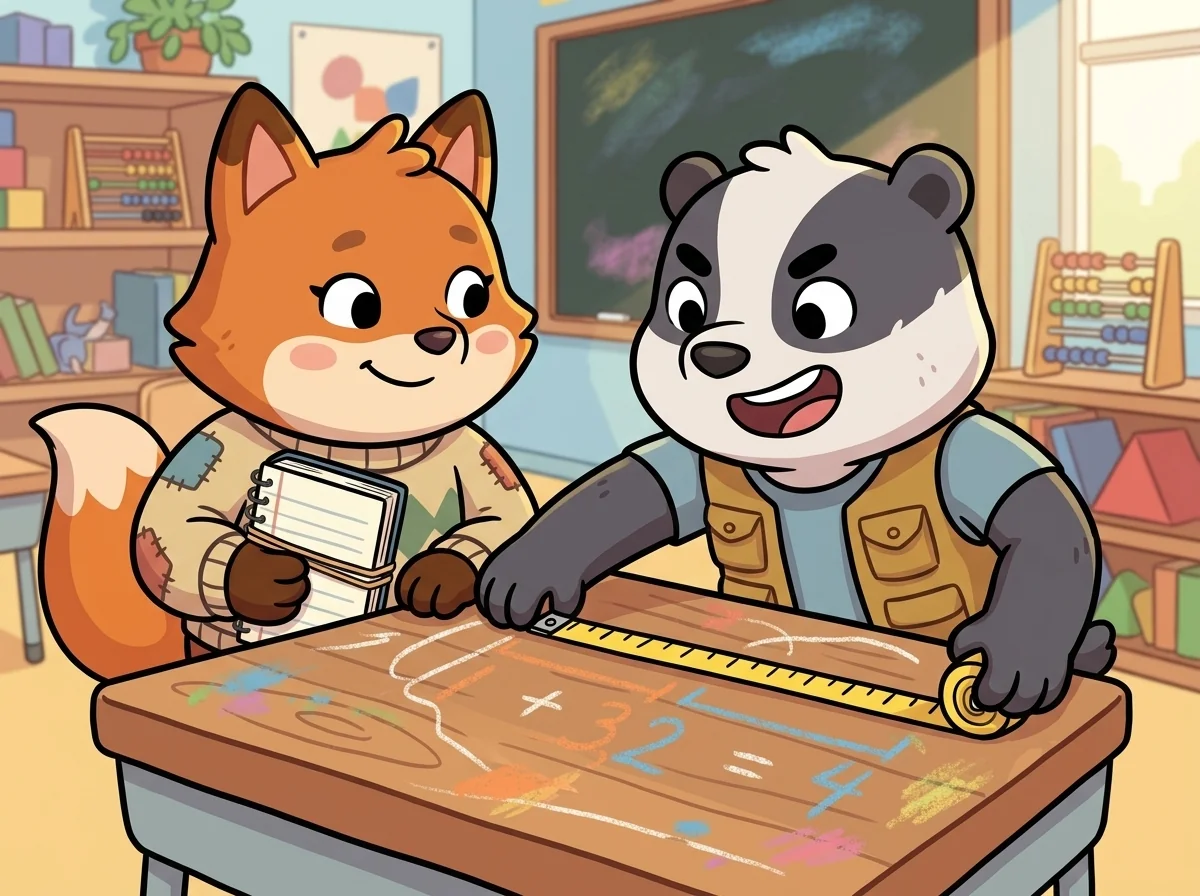
Gus pulled the end of his tape measure, and the thin yellow metal hissed across the wood.
"My trick relies on constant difference," Gus said. "I call it keeping the gap. I don't look at subtraction as taking something away from a pile. I look at it as the physical distance between two numbers."
He pinned the tape at thirty-eight with his thumb and held seventy-two with his forefinger.
"The space between thirty-eight and seventy-two is the answer you want," Gus said. "Now, if we pick up that whole distance and slide it down the desk, does the space between my fingers change?"
Wren watched his hands shift together. "No. The gap stays the same size."
"Exactly," Gus said. "Thirty-eight wants to be forty. So I slide thirty-eight up by two. To keep the gap identical, I slide seventy-two up by two as well. Now the problem is seventy-four minus forty."
He looked up, letting the tape hum softly between his fingers. "Seventy-four minus forty is thirty-four. No borrowing across columns. No give-back step at the end. I simply moved the entire problem onto smoother ground."
Wren stared down at the scratch paper. On the left side, Nora’s notes ended in thirty-four. On the right side, Gus’s numbers ended in thirty-four.
"Wait," Wren said, pointing her pencil back and forth. "You both landed on thirty-four."
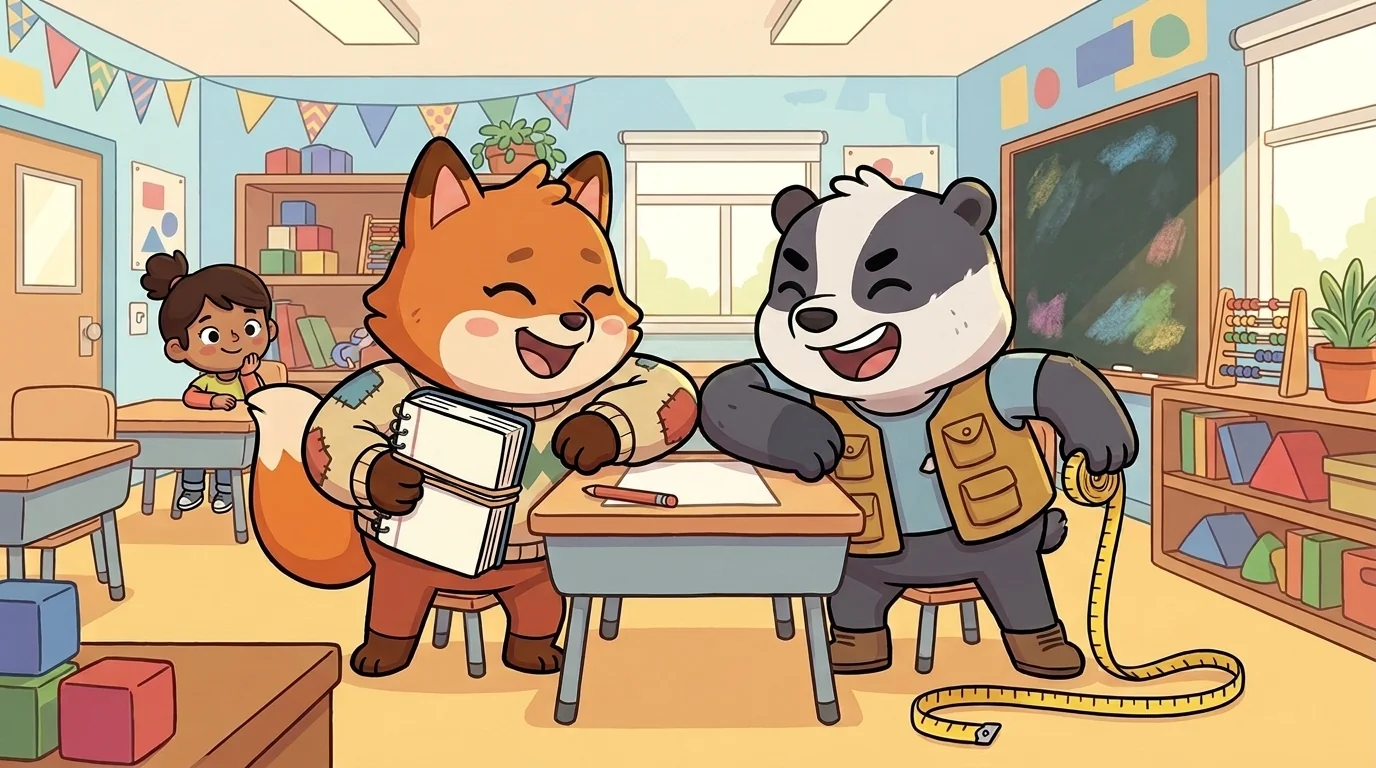
A brief silence hung over the desk. Then Gus chuckled, and Nora let out a quiet, satisfied laugh.
"Of course we did," Nora said. "A true mathematical distance does not change just because you took a different path to measure it."
"People always think we are fighting to the death," Gus said, letting the yellow tape snap smoothly back into its case. "Really, we are doing the exact same work. We make an ugly subtraction easy without breaking the truth of the numbers. Nora fixes the total at the end. I shift the whole frame at the start."
Wren looked at the next problem on her screen: 83 − 49.
"So if I have forty-nine," Wren said, tapping the glass, "I could nudge it up to fifty, subtract, and add one back at the end."
"You certainly could," Nora said, beaming.
"Or," Wren continued, looking at Gus, "I could slide both numbers up by one, turning it into eighty-four minus fifty."
"And both roads take you straight to thirty-four," Gus said, giving a small mock bow. "Pick whichever road feels lighter in your hands."
Wren scribbled the answer into the box. It took her less than five seconds. The green checkmark flashed on the screen with a cheerful chime.
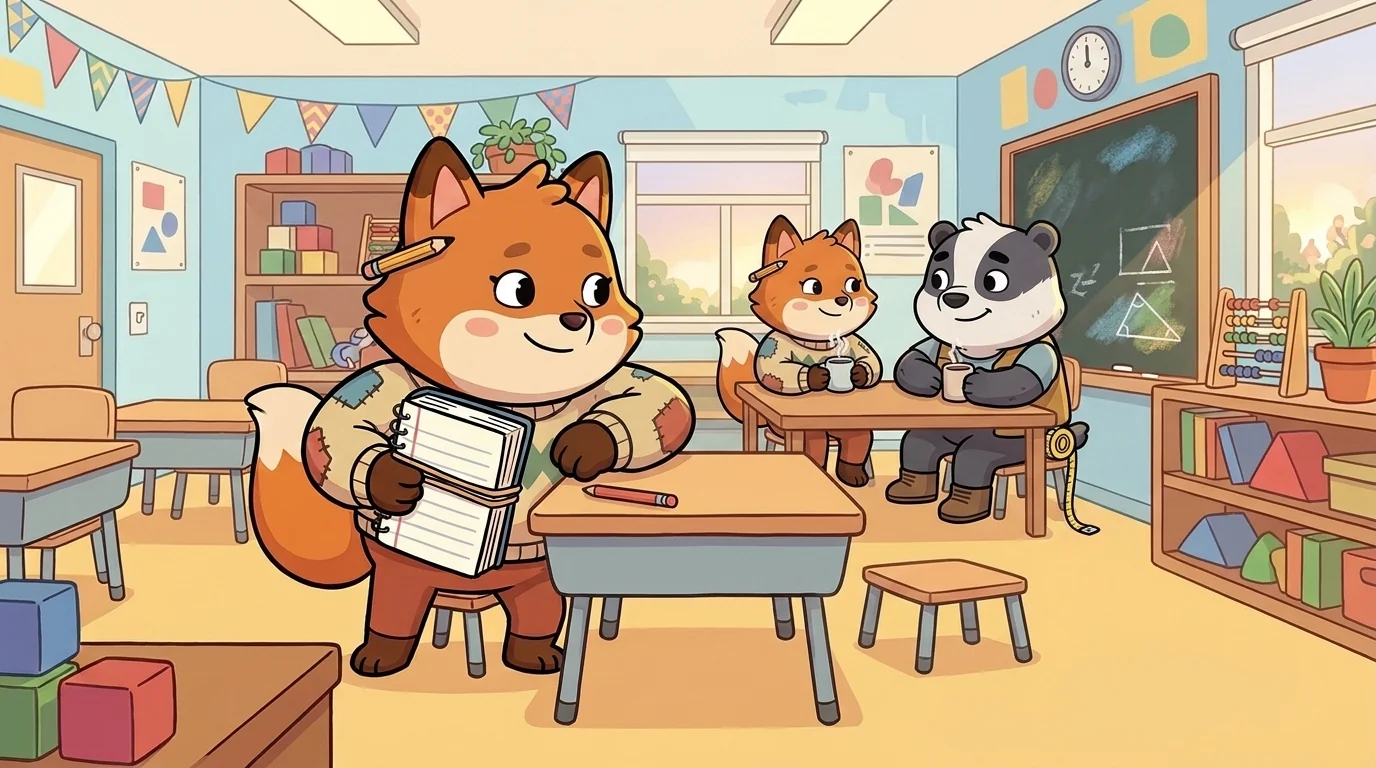
By six o’clock, the kitchen table was clear again. The dinner pot simmered on the stove, and the evening breeze stirred the curtains.
Nora secured her notebook with its fat elastic band. Gus clipped his tape measure to his belt, resting his heels on the table leg.
"You know," Gus murmured, "your give-back step is surprisingly efficient when the subtrahend ends in nine."
Nora smiled into her teacup. "And your constant difference slide is remarkably elegant when working with large numbers."
"Don't tell Sasha I said that," Gus warned.
"Your secret is safe with me," Nora replied softly.
Upstairs in her bedroom, Wren leaned against her pillows with her library book open. She wasn't thinking about subtraction anymore. She was thinking about how two completely different methods had reached the exact same truth without either one being wrong. It was a comforting thought, she decided as she turned the page, to know that the world offered more than one good road home.
The NumberSense ensemble
Nudge Nora and Gap Gus is part of NumberSense's distributed-narrative cast. Each character embodies a different curricular primitive; together they teach the full subject.
-

Estimator Ernie
Confidently approximate; the first-guess advocate
-

Pivot Pia
Deceptively casual question-flipper; reframes the prompt
-

Ratio Rio
Per-something specialist; rate thinker
-

Splitter Sasha
Make-10 and place-value specialist; benchmark builder
-

Nudge Nora
Compensation — nudge a number to a friendly round one, do the easy math, then give back exactly what you borrowed.
-

Doubler Della
Doubling and halving — to multiply, double one number and halve the other; the product stays the same while one side gets friendlier.
-

Landmark Lena
Benchmark numbers — judge any number by how it sits next to friendly landmarks like 0, a half, 10, 50, and 100.
-

Factor Fiona
Factors and multiples — every number is built from smaller numbers multiplied together, and seeing the building blocks makes hard arithmetic come apart.
-

Gap Gus
Constant difference — subtraction is the gap between two numbers; slide both the same amount and the gap stays the same, so you can land on friendly numbers.
-

Bridge Bao
Derived facts — reach a fact you don't know by taking one short step out from a fact you do.