
Nudge Nora
compensation — nudge a number to a friendly round one, do the easy math, then give back exactly what you borrowed
Loading audio…
Press play to listen along. The line being read lights up as you go.
Show full transcript
Loading transcript…
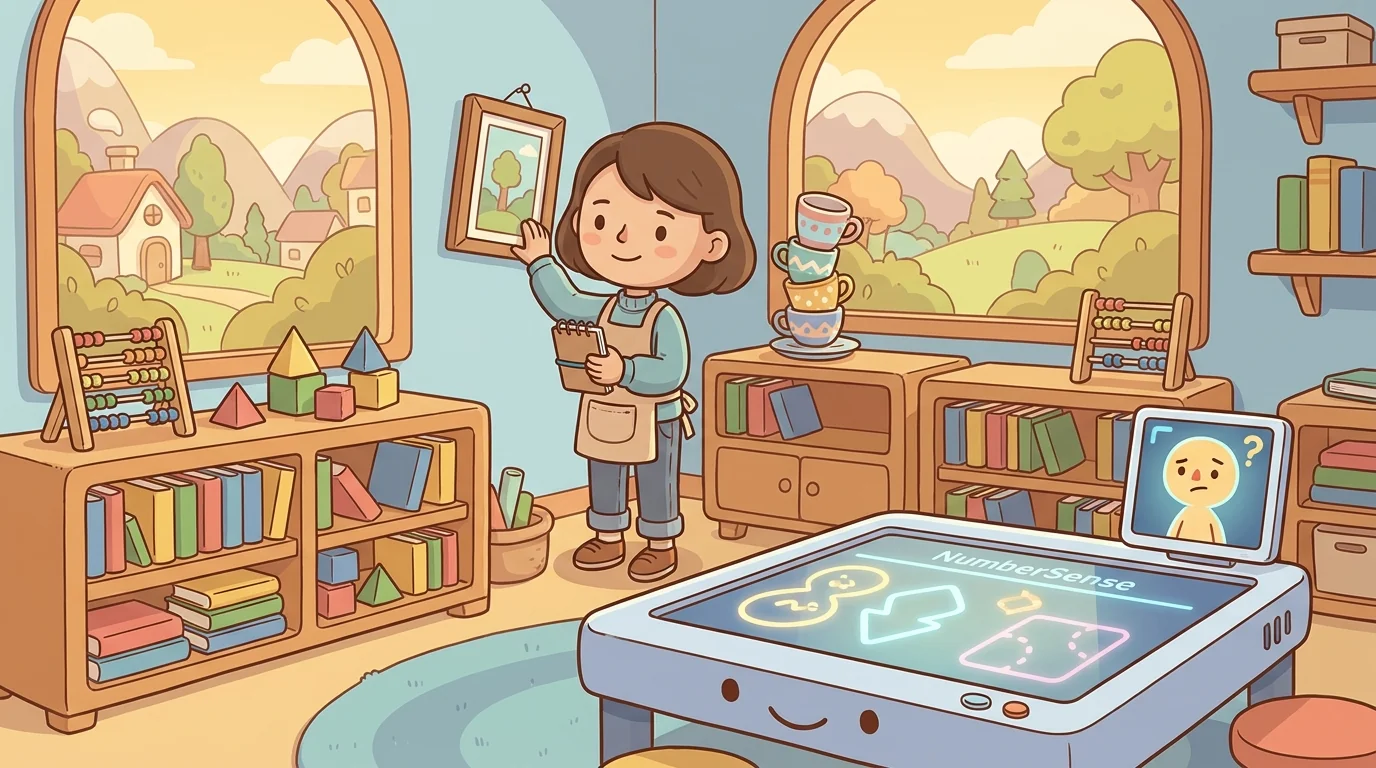
Nudge Nora carried a pocket notebook bound with a thick green rubber band. She had a habit of aligning things that drifted off-center. If a frame tilted on a hallway wall, her fingers found the edge before her brain even finished deciding to help. She treated messy arithmetic the exact same way.
On the screen, an eleven-year-old named Leo was currently losing an argument with 53 − 18.
His digital scratchpad was an absolute disaster of crossed-out digits and grey eraser smear. Leo knew the answer lived somewhere in the thirties. But eighteen was a jagged, annoying rock in the middle of his mental road. You could not roll over it smoothly. It demanded borrowing from the tens column on paper, or holding three fragmented values in your head until your skull buzzed.
"It is an awkward number," Nora said, her voice dropping into the audio channel like a glass of cool tap water.
Leo jumped slightly. He had forgotten his microphone was active. "It’s not awkward. It’s just stupid. Eighteen doesn't go into fifty-three cleanly."
"No, it doesn't," Nora agreed. "Eighteen is sharp. But twenty is round and blunt. Twenty doesn't hurt your feelings. Let's use compensation."
"Compensation sounds like something lawyers talk about on daytime television," Leo muttered.
Nora let out a quiet, dry laugh. "Fair enough. Let's call it a nudge. Watch what happens if I shove eighteen two steps forward. What number do we get?"
"Twenty," Leo said warily.
"Right. Now do the easy subtraction in your head. Fifty-three minus twenty."
"Thirty-three," Leo answered instantly. He paused, his pencil hovering an inch above his ruined scratchpad. "Wait. That’s not the answer, though. We changed the number."
"We borrowed two steps to make life easier," Nora said, tapping her notebook with a clean thumbnail. "Fifty-three minus twenty is thirty-three. But we took away two too many. We over-subtracted. So what do we owe the pile?"
Leo stared at the screen. His eyes drifted to the ceiling as the machinery turned over in his chest. "We took two too much. So... we put two back?"
"Put two back," Nora said softly. "Thirty-three plus two."
"Thirty-five." Leo wrote the number down in the corner of his page. Then he quickly stacked fifty-three over eighteen on paper, crossed out the five, made it a four, carried the one, subtracted eight from thirteen to get five, and subtracted one from four to get three. Thirty-five. He blinked at the graphite. "That was way too fast. Is that legal?"
"It’s not just legal," Nora said. "It’s honest. You can borrow whatever distance you need, as long as you pay it back at the end."
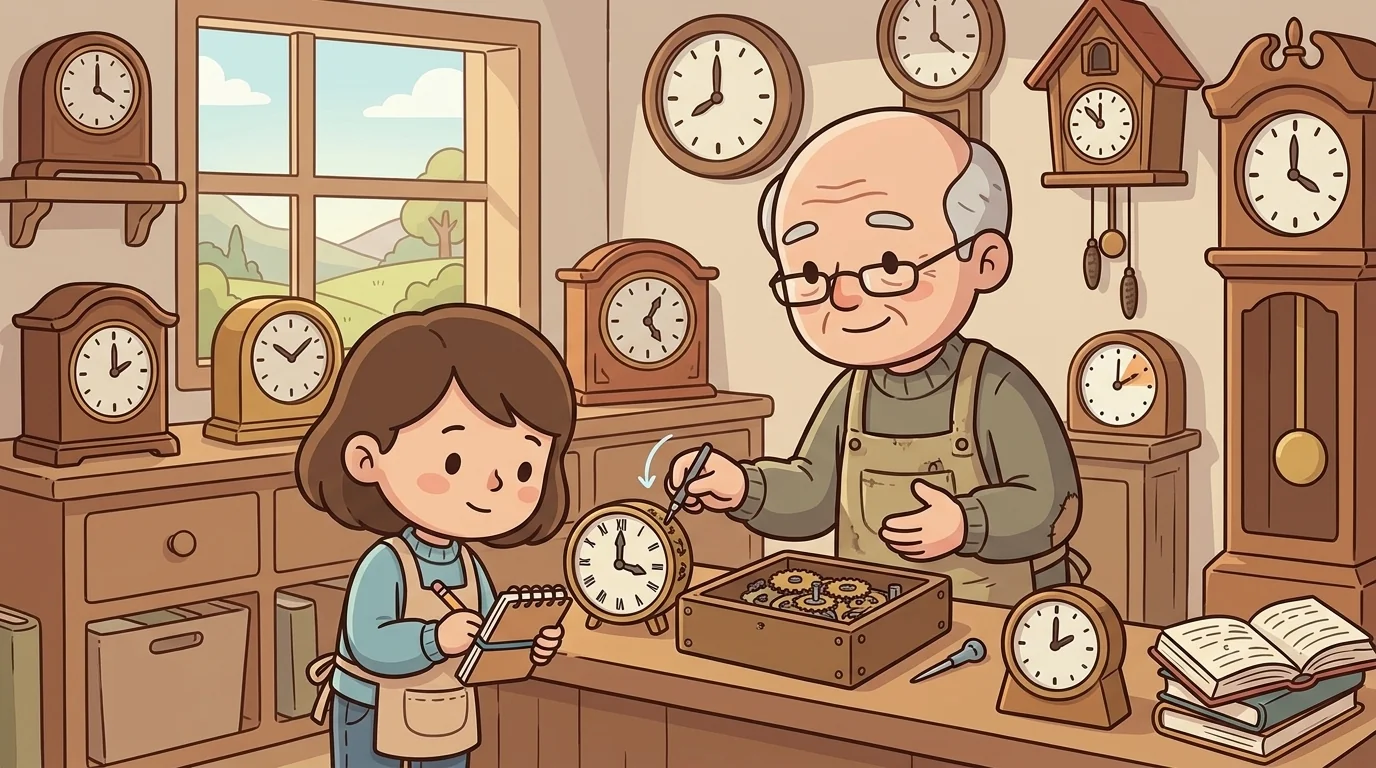
Nora had learned the logic from her grandfather’s basement workshop.
The basement smelled of machine oil, cedar sawdust, and the metallic dust of brass gear teeth. Her grandfather spent his retirement repairing antique pendulum clocks that wealthy people brought him in velvet-lined crates. When a heavy German grandfather clock ran three minutes fast each day, he never tore the escapement apart.
Instead, he would take a tiny brass key and turn the rating nut under the pendulum bob half a revolution. Then he picked up a black wax pencil and marked the wooden backboard with a tiny stroke and a date.
"Never adjust a mechanism without writing down the turn," he told Nora when she was seven, handing her a magnifying loupe. "A small nudge can fix a broken beat. But if you forget what you altered, you haven't repaired the clock. You've just created a brand-new mystery."
Nora had taken that rule and carried it directly into third grade.
When a math worksheet threw a number like ninety-eight in her face, she refused to panic. She kicked ninety-eight two units up to one hundred, finished the problem in three seconds, and recorded the two in her margins. As long as she squared the debt before she circled her final answer, the universe remained balanced.
She filled three notebooks that year with pencil tallies and small adjustments. The secret was never the nudge itself. Anyone could round a number up because they were lazy. The entire trick lived in the second half of the agreement: the return.
By three in the afternoon, the queue brought in a girl named Priya, who was wrestling with 47 + 18.
"I hate carrying ones," Priya announced before Nora could even say hello. "I always lose them in the tens column. My teacher makes us draw little hats on top of the numbers."
"No hats required today," Nora said. "Look at forty-seven. How close is it to fifty?"
"Three away," Priya said.
"Nudge it up to fifty," Nora directed. "Fifty plus eighteen. Can you do that without writing?"
"Sure. Sixty-eight." Priya sounded confident for half a second. Then her voice dipped into suspicion. "Except the real question wasn't fifty. It was forty-seven. I made the starting number three too big."
"So what do you do with that extra three now?"
"Take it back off?" Priya tapped her desk with her knuckles. "Sixty-eight minus three. Sixty-five."
"Look at that," Nora said.
Priya went quiet for four seconds while she verified the sum in her head. "Wait. With Leo earlier, you told him to add the extra back. Now you’re telling me to subtract it. Why does the direction flip?"
Nora smiled, adjusting the angle of her pen on the desk. "Because Leo was subtracting. He took away too much, so he had to return what he stole. You were adding. You made your starting pile three units too heavy. To make it fair, you have to throw those three units away."
Priya whistled a low note between her front teeth. "It’s like balancing a ledger."
"Exactly like that," Nora said. "Try one on your own. No pencil allowed. 199 + 36."
Priya closed her eyes. Her eyelids twitched as she moved the blocks inside her head. "Nudge one ninety-nine to two hundred. That’s one borrowed. Two hundred plus thirty-six is two thirty-six. Take the one back. Two thirty-five."
"Clean," Nora said.
"That felt like cheating," Priya said, though she was clearly grinning.
"It only feels like cheating because school usually makes you carry heavy boxes up the stairs," Nora said. "We just used an elevator and walked down one step."
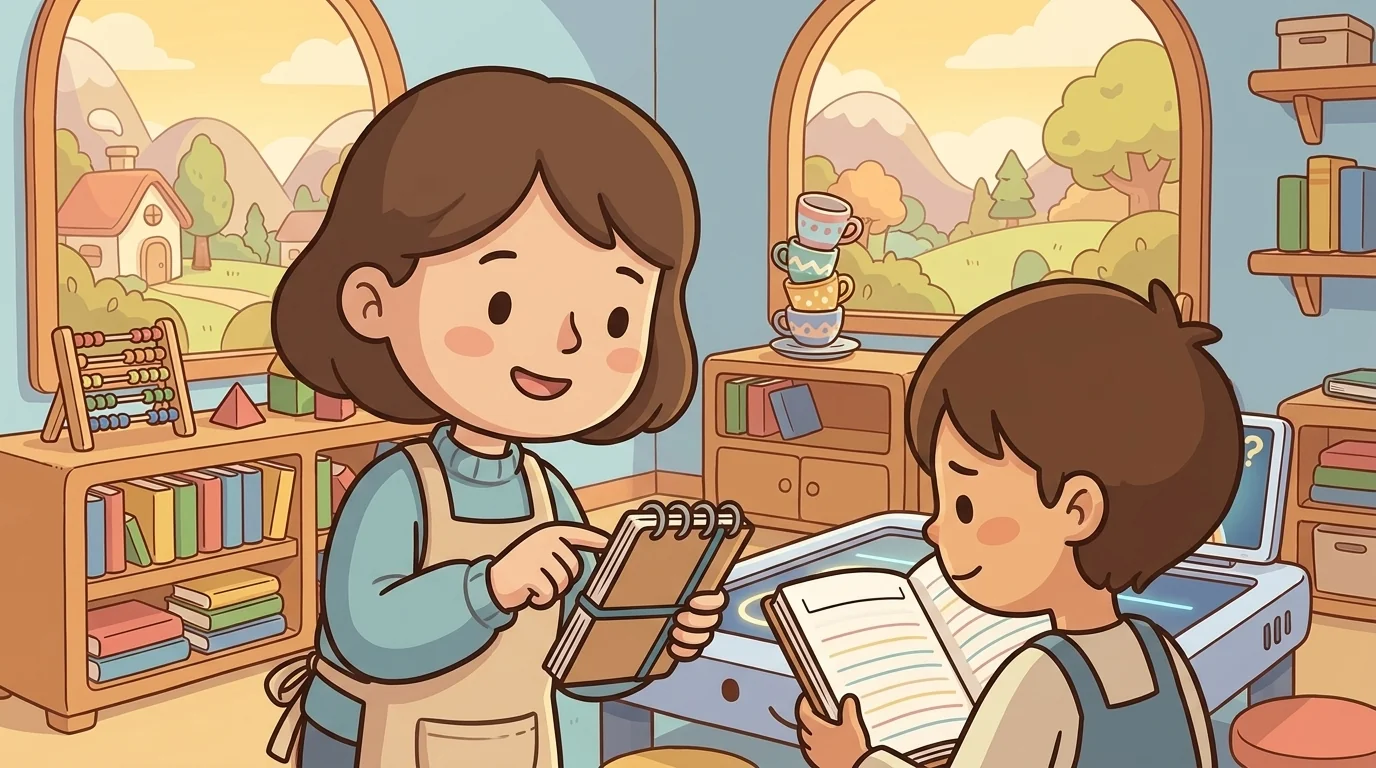
The hardest part of Nora's job was helping kids past the fear of the return step.
Around four o'clock, a seventh-grader named Sam arrived with a set of multi-digit practice problems. Sam didn't trust mental shortcuts. He had spent years being told that skipping steps meant you were careless, sloppy, or trying to rush out to recess early.
"If I nudge ninety-seven to a hundred," Sam said, staring at 97 + 58, "I’m going to forget the three. I just know I will. My brain will see one hundred fifty-eight and think I'm done."
"Then don't trust your brain alone," Nora told him. "Put your left index finger flat on the desk."
Sam hesitated. "Okay. My finger is on the desk."
"Every time you nudge a number, tap that finger once for every unit you moved," Nora said. "That finger stays pressed against the wood until you finish the problem. It is your physical reminder that a debt is open."
Sam looked at his hand on the desk. He worked through the problem slowly. "Ninety-seven becomes one hundred. Tap, tap, tap. Three units. One hundred plus fifty-eight is one fifty-eight. My finger is still down. So I subtract three. One fifty-five." He lifted his hand. "Okay. That actually works."
"Nudge and give back," Nora said. "They are a matched pair of shoes. You never walk outside wearing only one."
Sam wrote the rule across the top margin of his paper in heavy block capitals: THE NUDGE MAKES IT EASY. THE GIVE-BACK MAKES IT TRUE.
"Can I do this with decimals?" Sam asked, his shoulders dropping two inches away from his ears.
"You can do it with decimals, fractions, minutes on a stopwatch, or money," Nora said. "The numbers don't care how big they are. They just want their change back."
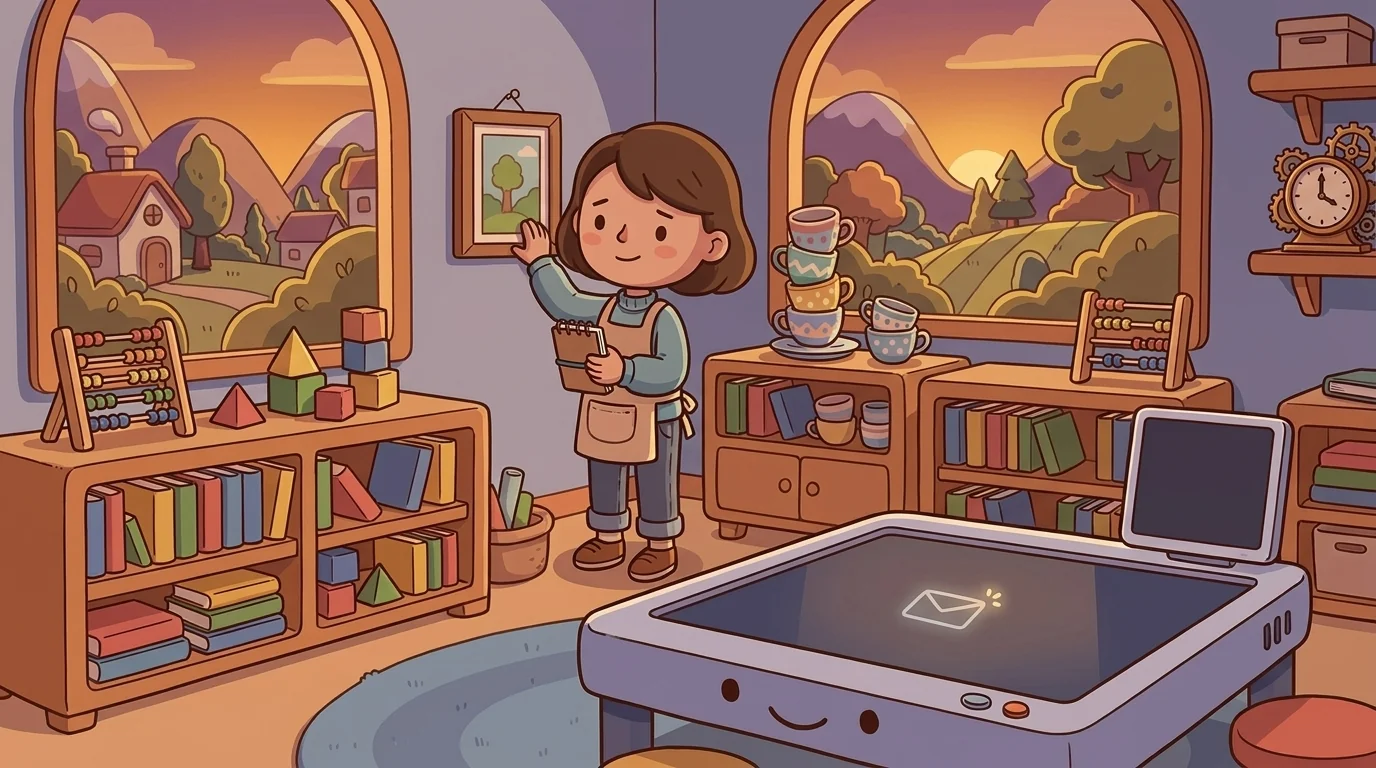
When the screen interface dimmed at five o’clock, Nora stayed in her wooden chair for a few minutes.
Outside her window, the neighborhood was settling into late-afternoon shadows. A delivery truck rumbled past the curb, shifting down through its gears with a heavy, rhythmic clatter. Nora pulled her notebook toward the center of the blotter, slipped the rubber band off, and flipped through three years of penciled notations.
Rows of numbers lived on those pages: nudges of two, debts of five, adjustments of fifteen, corrections of single digits. Every single one had an arrow pointing back to its partner. Not one had been left open.
She thought about her grandfather working under the yellow incandescent bulb in the cellar. He had understood something fundamental about how the world held together. You did not have to suffer through an awkward problem just because it was handed to you in a clumsy shape. You were allowed to alter the terms to make them manageable. You could borrow time, leverage, or space.
You just had to keep your promise to the balance sheet.
She closed the notebook, stretched the thick green band over the cardboard cover with a sharp snap, and set the book perfectly parallel to the edge of the wood. Everything was accounted for. Nothing was lost.
The NumberSense ensemble
Nudge Nora is part of NumberSense's distributed-narrative cast. Each character embodies a different curricular primitive; together they teach the full subject.
-

Estimator Ernie
Confidently approximate; the first-guess advocate
-

Pivot Pia
Deceptively casual question-flipper; reframes the prompt
-

Ratio Rio
Per-something specialist; rate thinker
-

Splitter Sasha
Make-10 and place-value specialist; benchmark builder
-

Doubler Della
Doubling and halving — to multiply, double one number and halve the other; the product stays the same while one side gets friendlier.
-

Landmark Lena
Benchmark numbers — judge any number by how it sits next to friendly landmarks like 0, a half, 10, 50, and 100.
-

Factor Fiona
Factors and multiples — every number is built from smaller numbers multiplied together, and seeing the building blocks makes hard arithmetic come apart.
-

Gap Gus
Constant difference — subtraction is the gap between two numbers; slide both the same amount and the gap stays the same, so you can land on friendly numbers.
-

Bridge Bao
Derived facts — reach a fact you don't know by taking one short step out from a fact you do.