
Shade
PALETTE RAMP — *a small set of colors arranged darkest to lightest. limited palette = stronger form.*
Loading audio…
Press play to listen along. The line being read lights up as you go.
Show full transcript
Loading transcript…
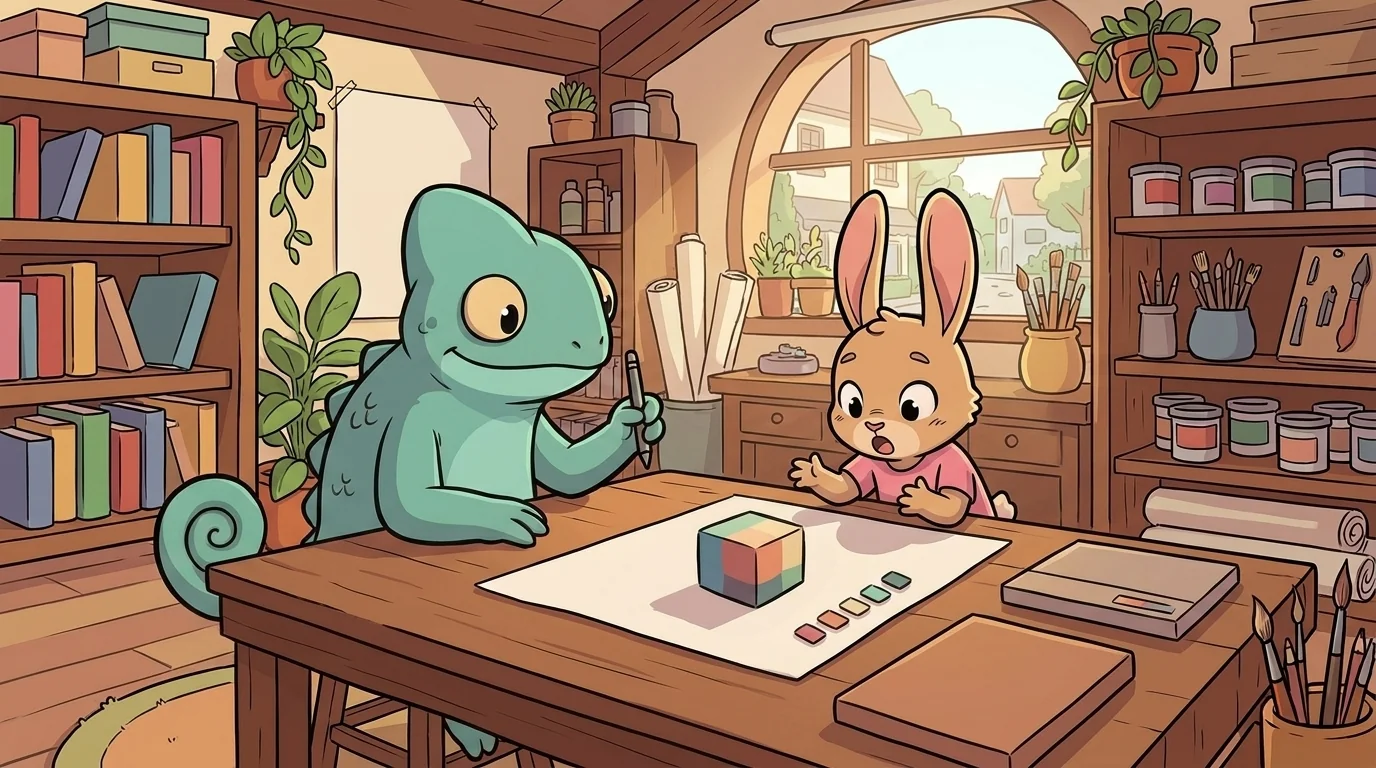
In the corner of the PixelForge workshop, a small chameleon sat very still in front of a screen, choosing his colors one at a time.
He was not spiky. His scales were soft and rounded, and right now they had gone a calm teal, the color he turned when he was concentrating. On the screen he was building a face — an ordinary face, nothing fancy — and he was building it out of exactly five colors. He would set one down, lean back, look, and only then reach for the next. A dark brown for the deep shadows. A dimmer tone for the shaded cheek. A base. A soft highlight. One bright touch at the tip of the nose. Five colors, arranged darkest to lightest, and a whole face rising up out of them as if it had been there the whole time.
Around his neck hung a little chain of color swatches, running dark to light, and he touched it without noticing, the way some people worry a coin in their pocket. Five colors, chosen and kept. That was the thing he believed in more than anything: fewer colors, stronger form.
Shade had not always trusted limits. When he was young he had wanted all of them.
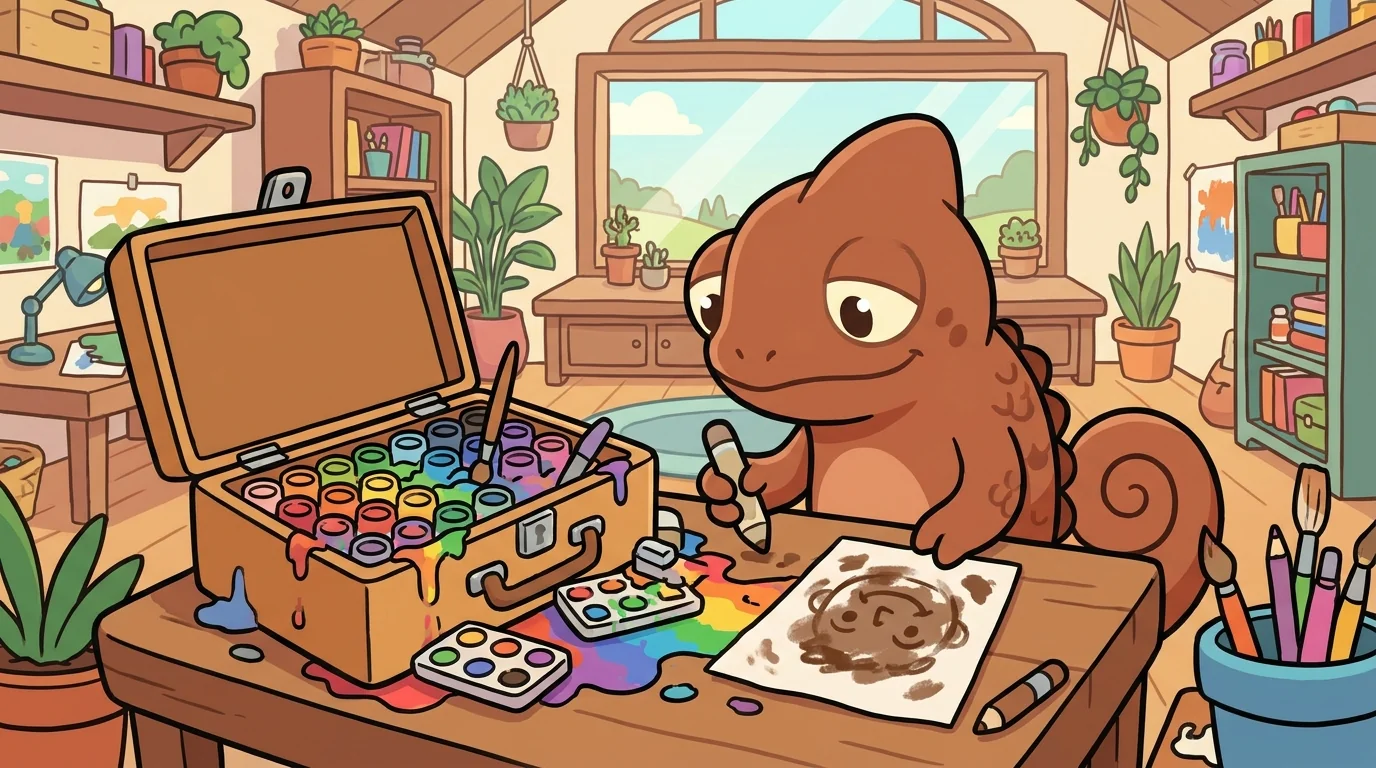
He came from a village of chameleons, and chameleons cannot help what they do — a chameleon's skin shifts with every feeling that crosses it. As a small child Shade had thought this was the best thing about being alive. He would work himself into a frenzy of moods just to watch his own scales riot: joy-gold sliding into surprise-violet sliding into a dozen shades that had no names, all of them at once, until he was a smeared blur of everything.
His grandmother, an old teal-and-slate chameleon who ran the village dye-house, watched him do this one afternoon and shook her head.
"Look at yourself," she said, not unkindly. "You've turned every color you have. And what are you now?"
Shade looked down at his own churning scales. "...Nothing," he admitted. "Just muddy."
"Just muddy," she agreed. She held up a strip of dyed cloth — five bands of blue, deep to pale. "When you show one feeling clearly, everyone can read it. When you show all of them, you disappear." She pressed the strip into his hands. "The colors you don't use are what let the ones you keep be seen."
He held that cloth for a long time. It was the first time a limit had ever felt like a gift instead of a fence.
He walked to PixelForge when he was twelve, because a workshop full of artists drowning in color was exactly where a palette-discipliner belonged.
His mentor, an ancient chameleon named Palette, met him at the workshop door and asked one question, the way the mentors there always did. "What is the palette ramp?"
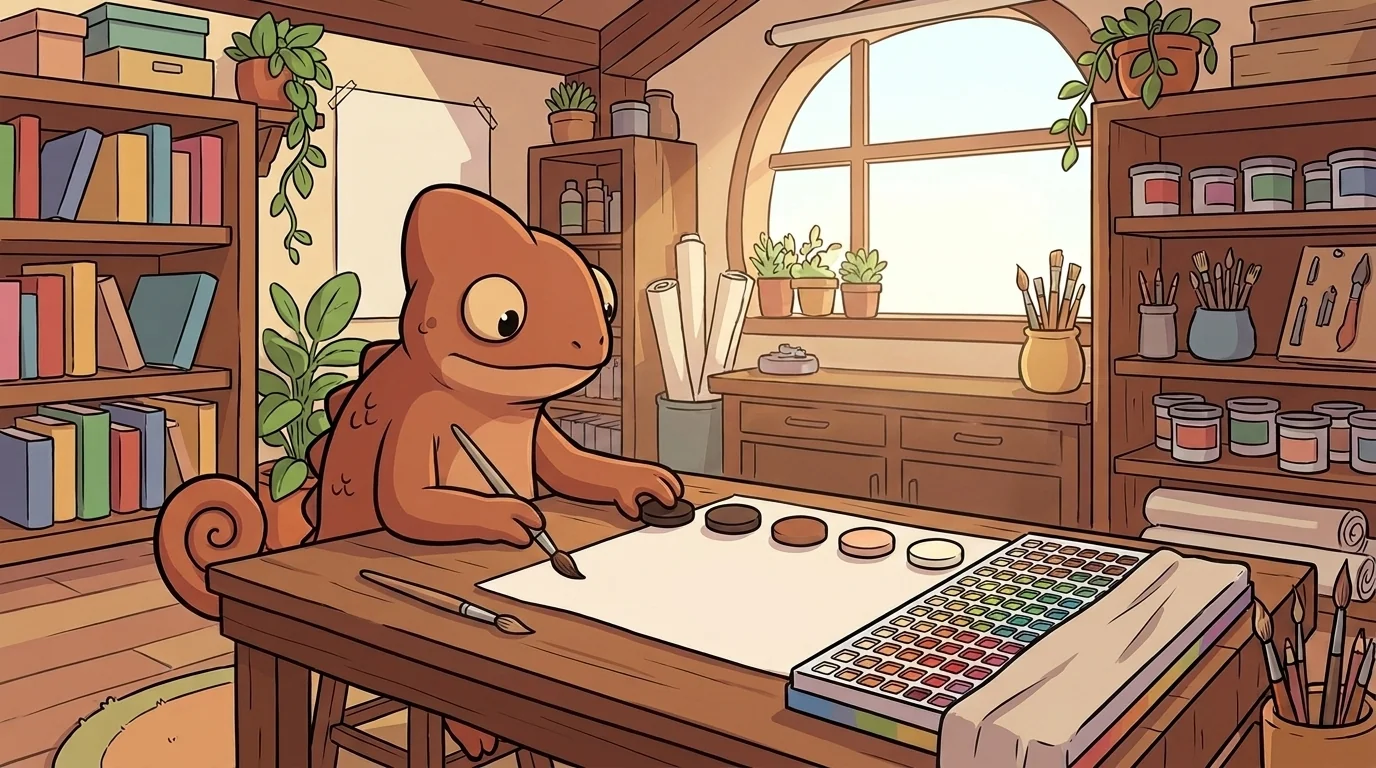
Shade didn't reach for a definition. He unhooked the swatch-chain from his neck and laid it flat on Palette's workbench, dark end to light end. "It's this," he said. "A few colors, arranged in order from shadow to highlight. You put the dark ones where the light doesn't reach and the bright ones where it does, and the flat thing stops being flat." He set his hand over the strip. "My grandmother taught me that a chameleon who shows every color shows nothing. A picture's the same. Pick a few. Make them count."
Palette studied the little chain for a long moment, then looked at the young chameleon standing so seriously beside it.
"Most of them arrive here wanting more colors," she said. "You arrived wanting fewer. That's rarer than it sounds." She nodded once. "You are appointed."
Shade's corner of the workshop filled, over the years, with students who came to him stuck.
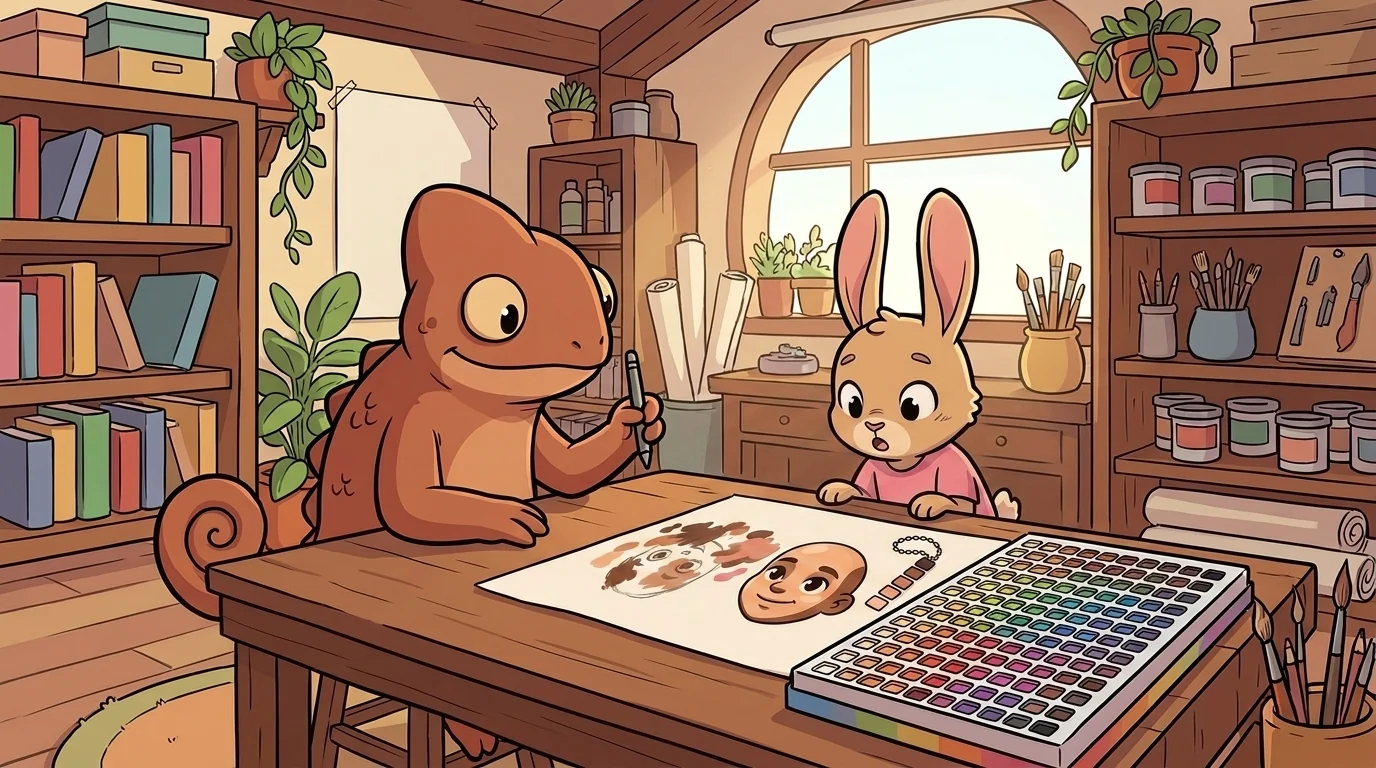
One afternoon a boy named Pip dropped onto the stool beside him and turned his screen around in frustration. He'd been trying to give a face depth, and he'd reached for color after color to do it — fifty of them, maybe more — and the face had dissolved into a soft grey-brown smear. "I wanted it to look real," Pip said. "It just looks like a puddle."
Shade's scales warmed toward gold. He knew that smear. He'd worn it, once, on his own skin.
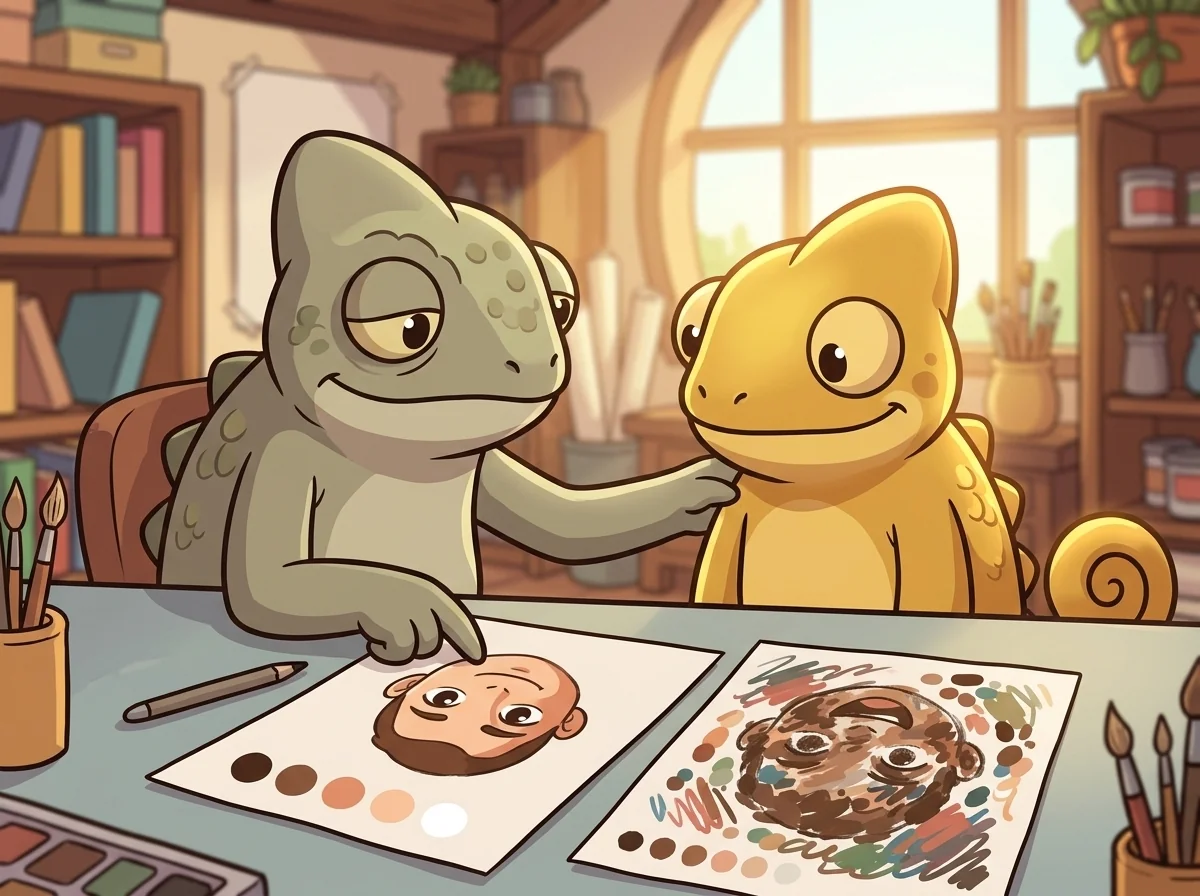
"You reached for more colors to get more depth," he said. "Everybody does. But watch." On a clean patch of screen he drew the same simple face, and this time he opened a fresh palette and took only five colors from it. Deep brown. Mid-shadow. Base. Highlight. One bright point. He set them down slowly, one at a time — dark in the eye sockets and under the chin, base across the lit cheek, the bright touch where the nose caught the light.
The face lifted off the flat screen and turned solid.
"Five," Shade said quietly. "Not fifty. Five, in order, placed by where the light falls."
Pip stared between his muddy face and Shade's clean one. "But if I need more shades? If five isn't enough?"
"Then you cheat, gently." Shade nudged two neighboring colors into a tiny checkerboard between them. "Mix two that sit side by side on the ramp. Your eye blends them and sees a shade that isn't even there. The old machines did it all the time — the little Game Boys with four colors, the game systems that gave each character only a handful. Every one of them was boxed in. Every one of them made pictures people still remember." He tapped his pendant. "The box is why. Not despite."
That evening, when the workshop had emptied and gone amber, Pip lingered at the door with a last quiet question.
"When I threw out the fifty-color version," he said, "it felt like giving up. Like I was settling for less." He frowned, working it out. "But the five-color one's better. So why did letting go of all those colors feel like losing?"
Shade thought about his grandmother's strip of cloth, and the smeared, no-color child he had once been.
"Because nobody tells you it's the opposite," he said. "Every color you set down and don't use — that's not a color you lost. That's a decision you made for the picture. You spent it on clarity instead of on more." He looked at the boy for a moment. "You didn't settle for less, Pip. You chose what mattered and let the rest go. That's the whole craft. It only feels like loss until you see what the loss buys you."
Pip glanced back at his clean five-color face, glowing on the dim screen, and something in his shoulders came loose. The tight, grabbing, need-more feeling that had knotted him up all afternoon went soft and quiet, and in its place rose a small, steady gladness — the calm of a person who has finally stopped reaching for everything and found that the few things left in his hands were exactly enough.
The PixelForge ensemble
Shade is part of PixelForge's distributed-narrative cast. Each character embodies a different curricular primitive; together they teach the full subject.
-

Speck
The single pixel — the atomic unit of pixel art; every image is a grid of these
-
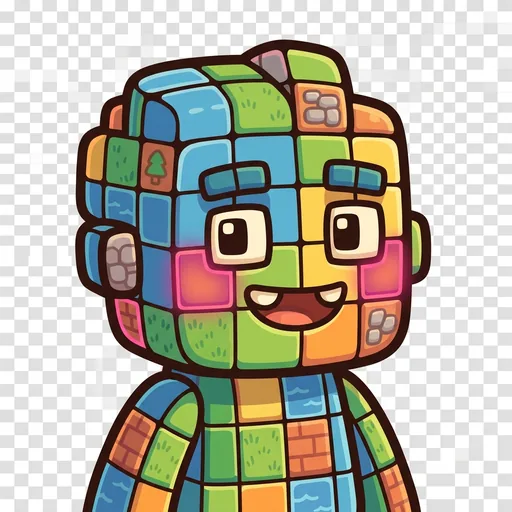
Grid
The tilemap grid — pixels snapped to repeating units that form tiles, tilesets, and game maps
-
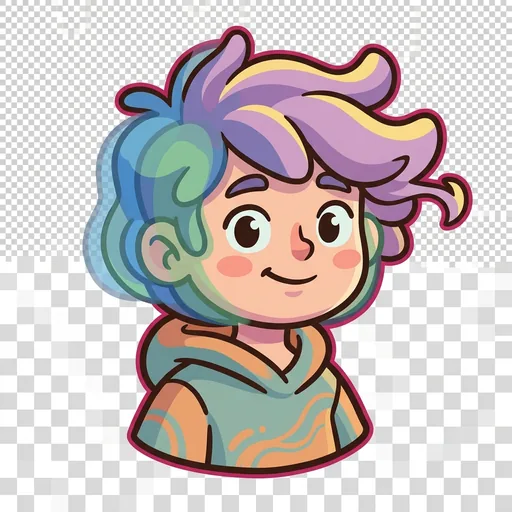
Tween
The in-between frame — the animation frame that sits between two keyframes, giving motion its smoothness
-

Banner
The impact pose — the heroic / dramatic silhouette that reads instantly at thumbnail size (the principle that good character art is recognizable from its outline alone)
-
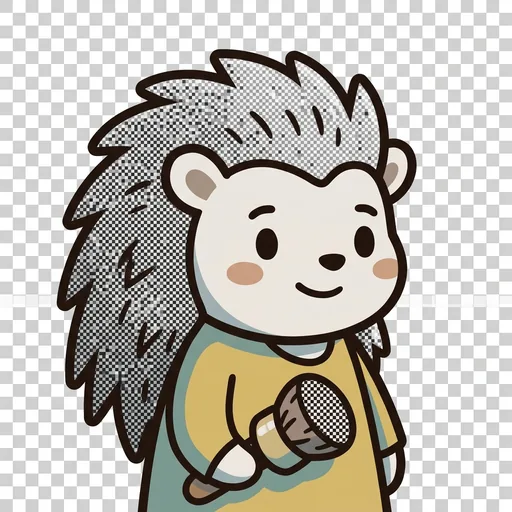
Stipple
Dithering — scattering two colors in a checker pattern so your eye blends them into a third; how pixel artists fake a smooth gradient with a tiny palette
-
Feather
Anti-aliasing — tucking a few in-between pixels along a jagged edge so a curve reads smooth instead of like a staircase
-

Sheen
Light source and form shading — choosing where the light comes from, then placing highlights and shadows so a flat shape turns round
-
Rim
Selective outlining — drawing the edge only where a sprite would get lost, so it pops from the background without looking boxed-in
-

Cycle
Color-cycling animation — making water and fire flow by shifting which colors sit in the palette slots, without moving a single pixel
-

The Sprite
A finished character sprite coming to life — how placed pixels, a color ramp, chosen light, a clean outline, and smoothed edges layer together into one whole little hero