
Speck
SINGLE PIXEL — *the atomic unit. every image is a grid of these. one pixel is a choice.*
Loading audio…
Press play to listen along. The line being read lights up as you go.
Show full transcript
Loading transcript…
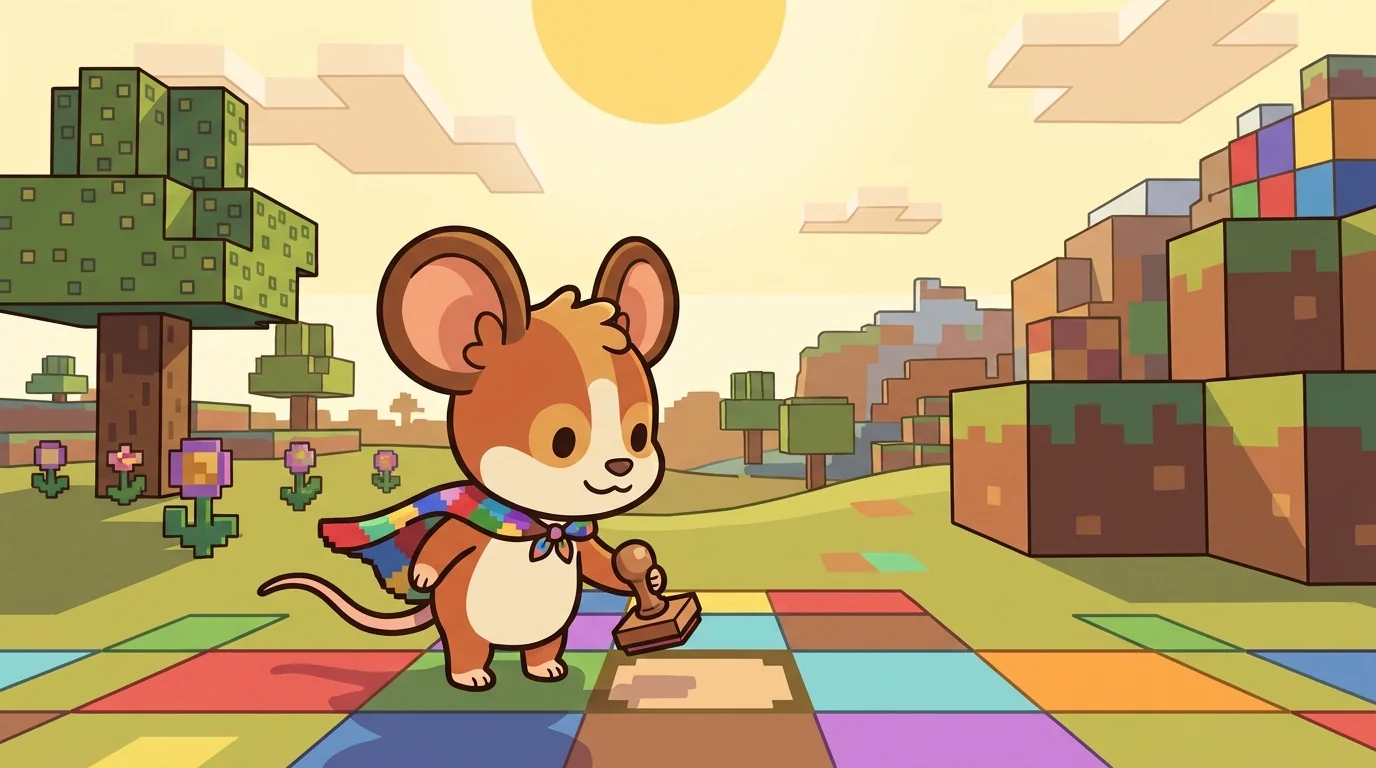
In the smallest workshop at PixelForge, a mouse no bigger than a teacup stood on a stool and placed a single brown square onto a blank grid.
She did not rush. Speck never rushed. Her soft, rounded ears twitched once as she studied the square she had just set down, the way another artist might step back from a whole finished painting. In her paw she held a little wooden pixel-stamp, worn smooth from years of use, and the stamp did exactly one thing: it set down one colored square at a time. No more. Around her shoulders hung a patchwork cape stitched from tiny squares of every color, each one placed by hand, so that the cape itself was a picture built the only way Speck knew how — one deliberate choice after another.
"There," she murmured to the empty room. "That's a beginning."
The grid in front of her was mostly empty, and to most people an empty grid looked like nothing. To Speck it looked like a hundred small decisions waiting to be made, and the trick — the whole trick of her life — was that you only ever had to make one of them at a time.
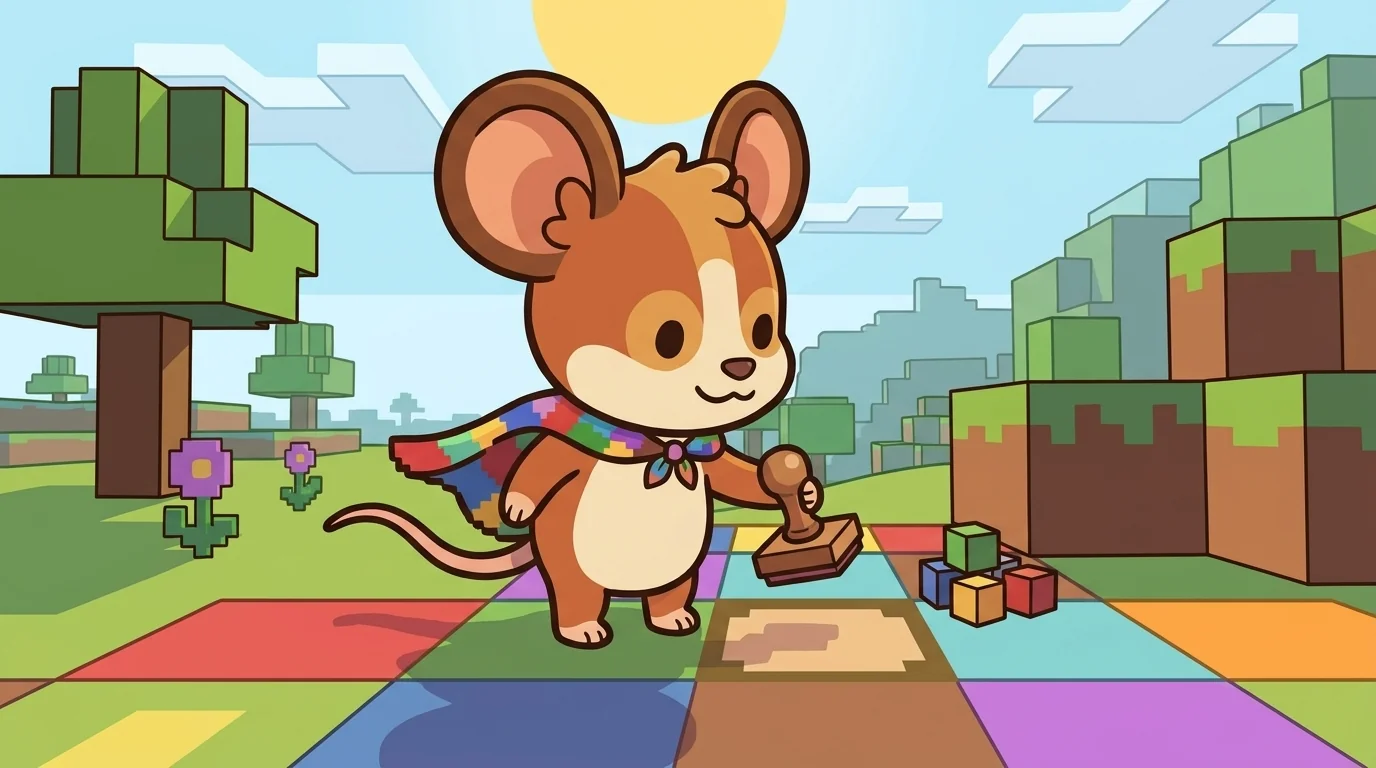
Speck had grown up in the village granary, where her family had been the seed-counters for as long as anyone could remember.
It was slow, careful work. Every autumn the harvest came in, an avalanche of grain, and to a small mouse it looked impossibly large — a mountain that could never be counted. Speck remembered standing at the edge of the first bin she was ever given, seven years old, staring up at a heap taller than her whole family, and feeling something cold settle in her stomach. It was too much. She would never finish. She hadn't even started and she already wanted to give up.
Her mother had crouched beside her and picked up exactly one grain.
"You don't count the mountain," her mother said, holding the single seed between two claws. "You count this one. Then you count the next one. The mountain counts itself."
So Speck had counted one grain, and set it in the sorted pile. Then one more. Then one more. And somehow, without her ever seeing the moment it happened, the impossible heap became a tidy row of full baskets, and the cold feeling in her stomach was gone. Every grain counts, the seed-counters said, generation after generation. Small things, placed on purpose, build up to something large. Speck carried that all the way into her bones, and later, when she found pixel art, she found it was the exact same truth wearing a different coat.
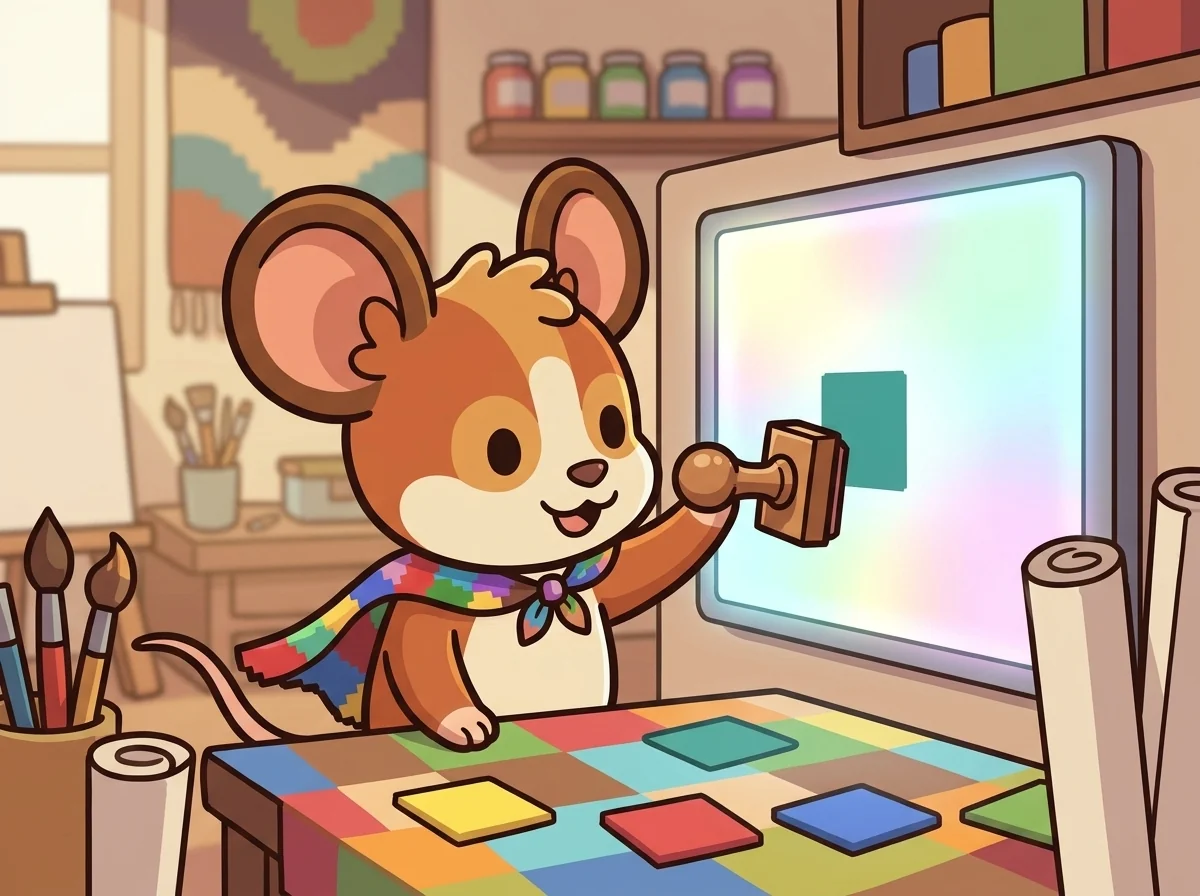
She walked to PixelForge the summer she turned twelve, cape rustling, pixel-stamp tucked into her belt.
Palette met her at the workshop door — a broad, calm mentor with a coat like a fanned-out swatch book. Palette asked the question she asked everyone. "What is the single pixel?"
Speck had rehearsed a dozen clever answers on the long walk over. She used none of them. Instead she reached out, set one imaginary square in the air between them, and said, "The smallest choice you can make. Every picture is a grid of these. You don't build the picture. You make one choice, then the next, and the picture shows up on its own."
Palette was quiet for a moment. Mentors here were always quiet before they answered, and Speck's heart thudded in the pause.
"Most newcomers tell me pixel art is 'blurry old pictures,'" Palette finally said. "You told me it's a way of not being afraid of big things." She stepped aside from the door. "You're appointed."
Years later, a boy came to Speck's corner nearly in tears.
He'd been trying to draw a tree on the grid, and it had come out crooked and wrong, and he'd already reached for the button that would wipe the whole thing clean. "It's ruined," he said. "The trunk's lopsided. I have to start over."
"Stop." Speck put a gentle paw over his. "Show me the one square that's wrong."
He pointed, flustered. "That one. It's too far right."
"Only that one?"
The boy looked again, really looked, the way he hadn't before. "...The rest is okay, actually. It's just that one."
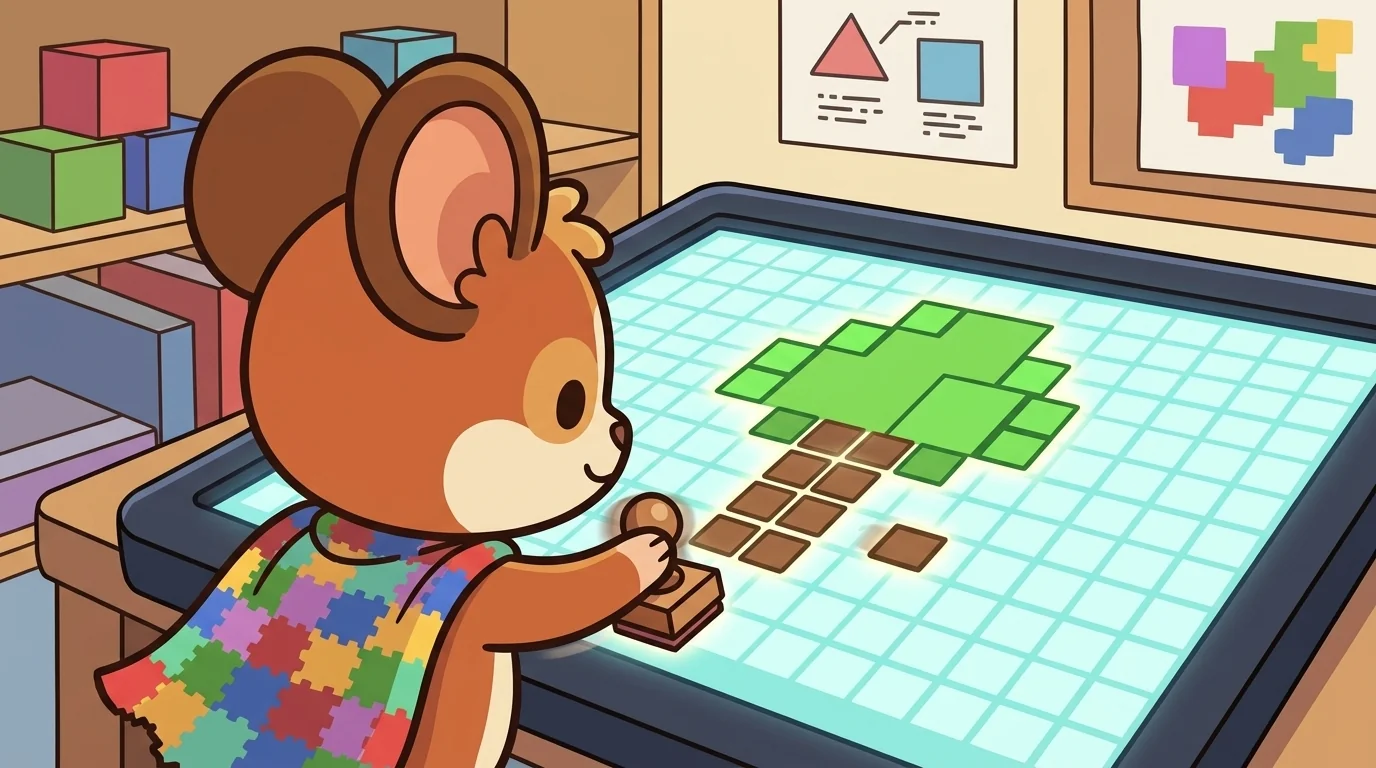
"Then you don't have a ruined tree," Speck said. "You have a good tree with one square in the wrong spot." She lifted her stamp, nudged the offending pixel one place to the left, and it snapped neatly into the grid. Thump. "See? You didn't need to start over. You needed to fix one choice."
She placed a green square above the trunk. Thump. "A leaf." Another. Thump. "Another leaf." Slowly, patiently, one square at a time, a small green tree grew across the grid, and every so often she paused and zoomed out to see the whole of it, then leaned back in to move a single pixel a hair to the side.
"Most pixels look a little wrong-ish the first time you set them down," she told him. "That's not failure. That's just the middle of the work. You place, you check the whole picture, you adjust the one square that needs it. The tree emerges out of a hundred small corrections, and not one of them is worth crying over."
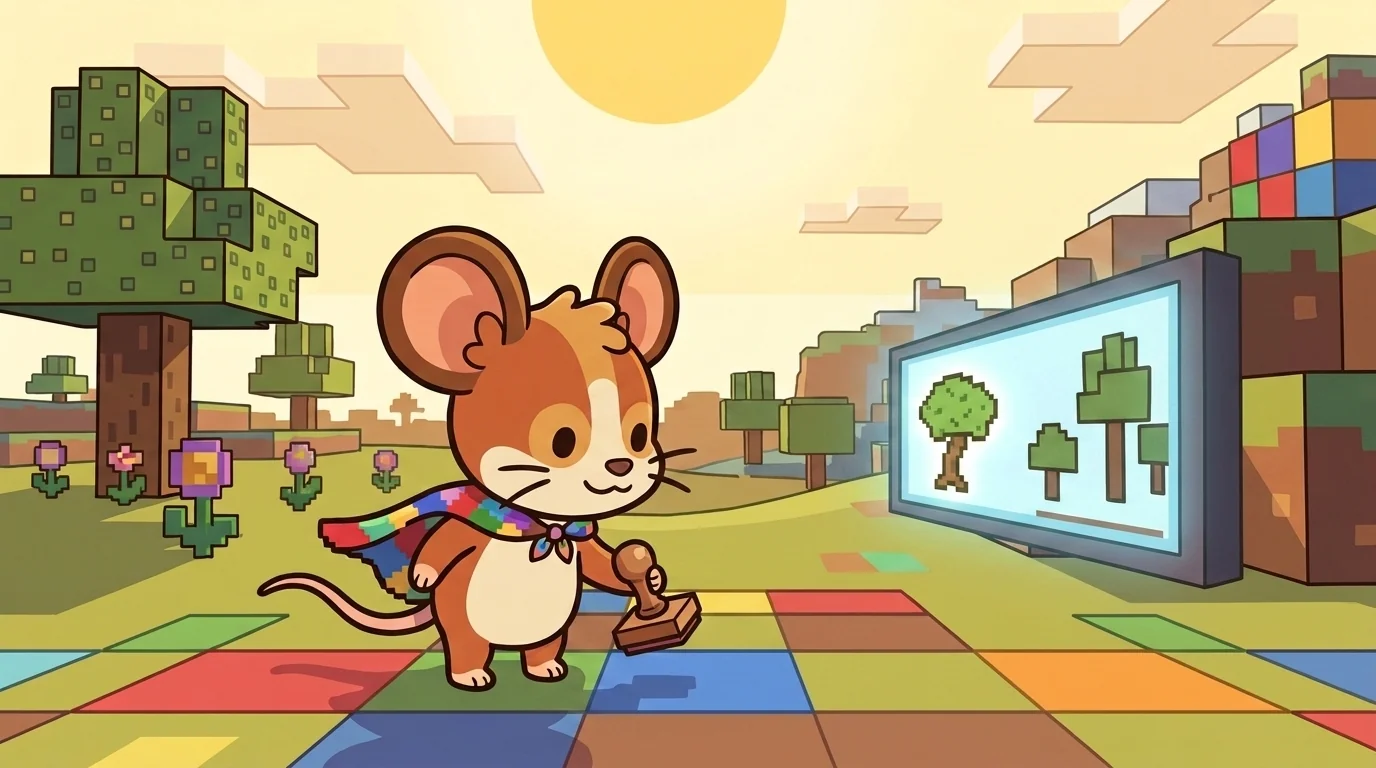
When the boy had gone — with his crooked-then-un-crooked tree saved and proud — Speck sat alone with the last of the afternoon light and placed one final square, a bright green cap on the top of the canopy.
She looked at what a whole day of single choices had made: a workshop wall glowing with small, deliberate pictures, none of them started all at once, all of them started one square at a time. The old cold feeling from the granary — the it's too big, I'll never finish feeling — had not visited her in years, and she knew exactly why. You could not be overwhelmed by a mountain if you had promised yourself you would only ever pick up one grain.
She let out a slow breath and felt her small shoulders come down and settle, easy and light. There was a quiet gladness in her chest, the kind that comes not from finishing something enormous but from knowing, deep down, that anything enormous was only ever a long, calm string of one next choice. She rested her paw on the worn wood of her stamp, warm from a whole day's use, and felt, more than thought, the thing she'd carried since she was seven: one at a time is enough. One at a time was always enough.
The PixelForge ensemble
Speck is part of PixelForge's distributed-narrative cast. Each character embodies a different curricular primitive; together they teach the full subject.
-

Shade
The palette ramp — a small set of colors arranged from darkest to lightest (the foundation of pixel-art shading and form)
-
Grid
The tilemap grid — pixels snapped to repeating units that form tiles, tilesets, and game maps
-

Tween
The in-between frame — the animation frame that sits between two keyframes, giving motion its smoothness
-

Banner
The impact pose — the heroic / dramatic silhouette that reads instantly at thumbnail size (the principle that good character art is recognizable from its outline alone)
-

Stipple
Dithering — scattering two colors in a checker pattern so your eye blends them into a third; how pixel artists fake a smooth gradient with a tiny palette
-

Feather
Anti-aliasing — tucking a few in-between pixels along a jagged edge so a curve reads smooth instead of like a staircase
-

Sheen
Light source and form shading — choosing where the light comes from, then placing highlights and shadows so a flat shape turns round
-
Rim
Selective outlining — drawing the edge only where a sprite would get lost, so it pops from the background without looking boxed-in
-

Cycle
Color-cycling animation — making water and fire flow by shifting which colors sit in the palette slots, without moving a single pixel
-

The Sprite
A finished character sprite coming to life — how placed pixels, a color ramp, chosen light, a clean outline, and smoothed edges layer together into one whole little hero