
Biconditional Bex
BICONDITIONAL PROOF — to prove "P if and only if Q," you must prove the road runs both ways: if P then Q, AND if Q then P. One direction alone is only half the proof. Only when both directions hold are P and Q truly the same condition wearing two names.
Loading audio…
Press play to listen along. The line being read lights up as you go.
Show full transcript
Loading transcript…
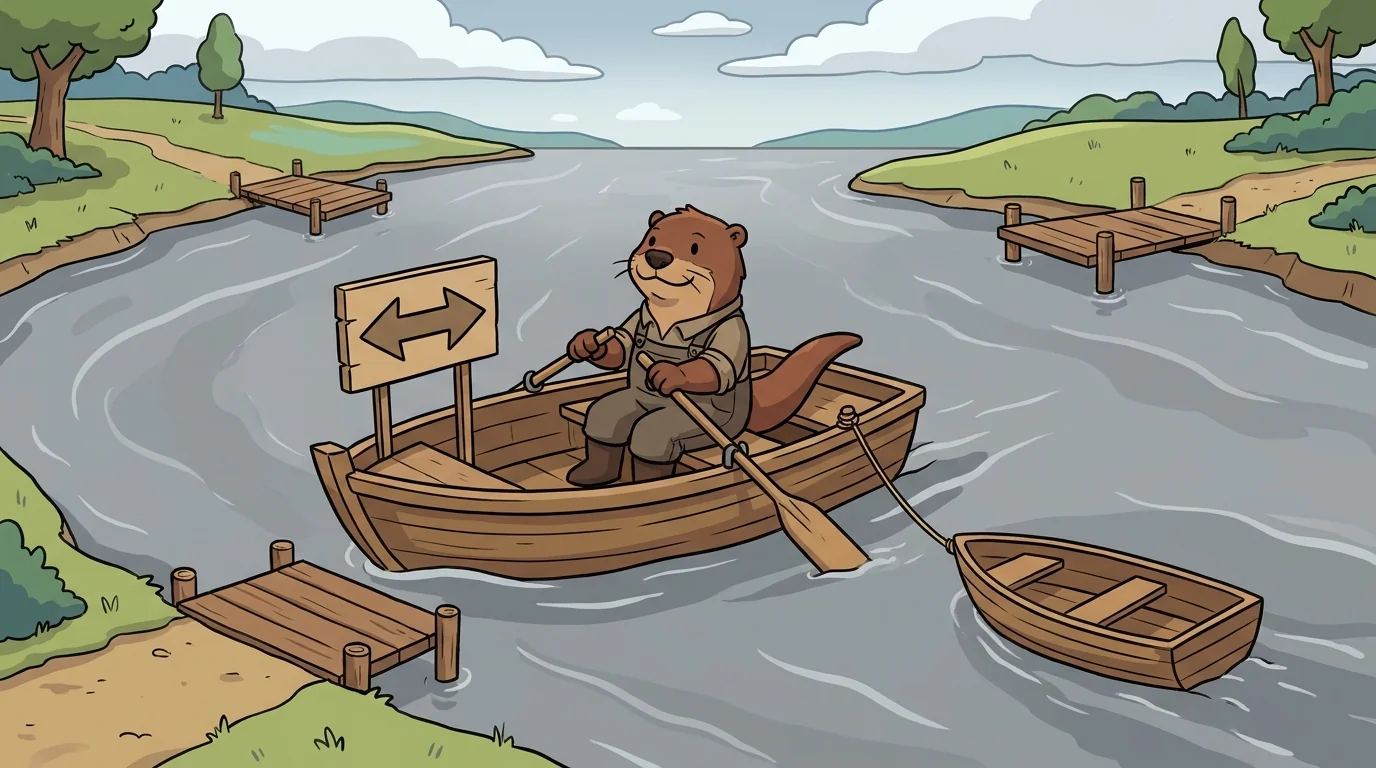
Before Biconditional Bex taught at the ProofQuest academy, she ran a ferry across a wide grey river for nineteen years. Bex was a sturdy, even-tempered otter, and her ferry had one rule she would not bend: a crossing only counted if it worked both ways. It was no good having a current that carried you smoothly to the far bank if it couldn't carry you home again. A real crossing, she always said, was a two-way thing — this side to that side, and that side back to this. Only then was it truly a crossing, and not a trap.
A young passenger named Wisp once asked why she always rowed the empty boat back along the very same route. "Checking the way home," Bex said, pulling steadily on the oars. "Lots of folks only think about getting there. But a path you can't come back along isn't a path — it's a one-way drop. I don't trust a crossing until I've walked it both directions." Wisp frowned: but you already know the river. "I know this way works," Bex answered. "Knowing this way works tells me nothing about whether that way does. Two directions. Two things to check."
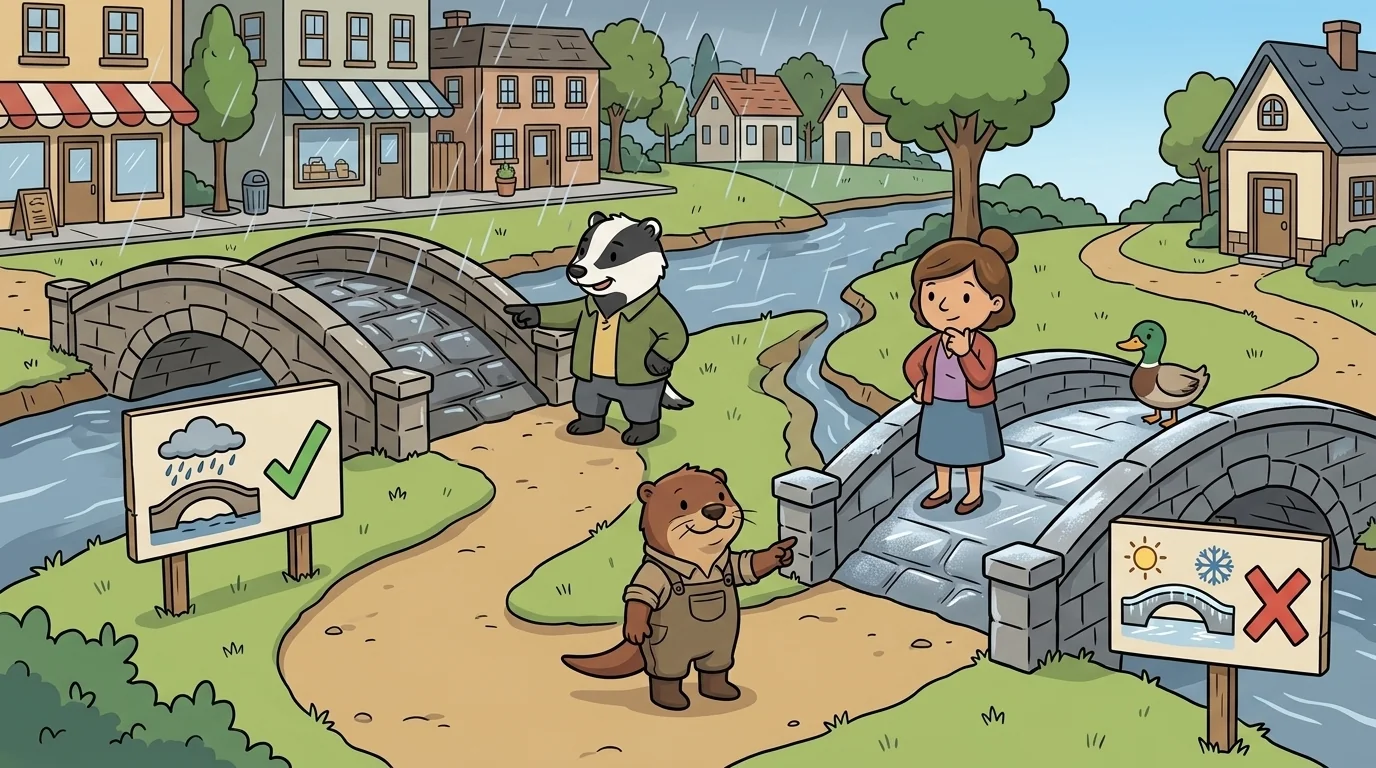
Bex had cared about both-directions since she was a pup, growing up in a riverside town full of sayings that sounded like solid rules. If it's raining, the bridge is slippery. The townsfolk used these both ways without thinking — they'd see a slippery bridge and announce, confidently, that it must be raining. But little Bex noticed the bridge was also slippery from morning dew, from spilled fish-oil, from frost. Raining made it slippery, true. But slippery did not mean raining.
"You're only allowed to flip a rule around," her grandmother told her, "if you've checked that the flip is true too. 'Rain makes it slippery' one way; 'slippery means rain' the other. Those are two separate claims, pup. One can be true and the other false. Never assume the road runs both ways just because it runs one." Little Bex tested it all that year and found her grandmother right again and again — so many of the town's "rules" only worked in one direction, though everyone used them in both. The day she truly understood it, the ground under her own thinking went suddenly firmer, and from then on, whenever someone said two things were the same, she asked the same quiet question: does it work both ways?
When she was grown, a mathematician from the ProofQuest academy crossed Bex's ferry, listened to her insist on rowing the empty boat back, and understood at once what she was. "What is a biconditional proof?" the mathematician asked, mid-river.
"It's a both-ways proof," Bex said, rowing steadily. "When you want to show two things are really the same condition — that P holds if and only if Q holds — one direction isn't enough. You prove if P then Q, and then, separately, if Q then P. There and back. Both crossings." She feathered an oar. "People love to prove one direction and call it done. But 'if and only if' is a two-way bridge. Until you've walked it both ways, you've only half a proof — and half a bridge is just a place to fall in." And when both directions hold? the mathematician asked. "Then they're not two things at all," Bex said, smiling. "They're one thing with two names. The two banks turn out to be the same shore." The mathematician booked passage that very day, and brought Bex with her.
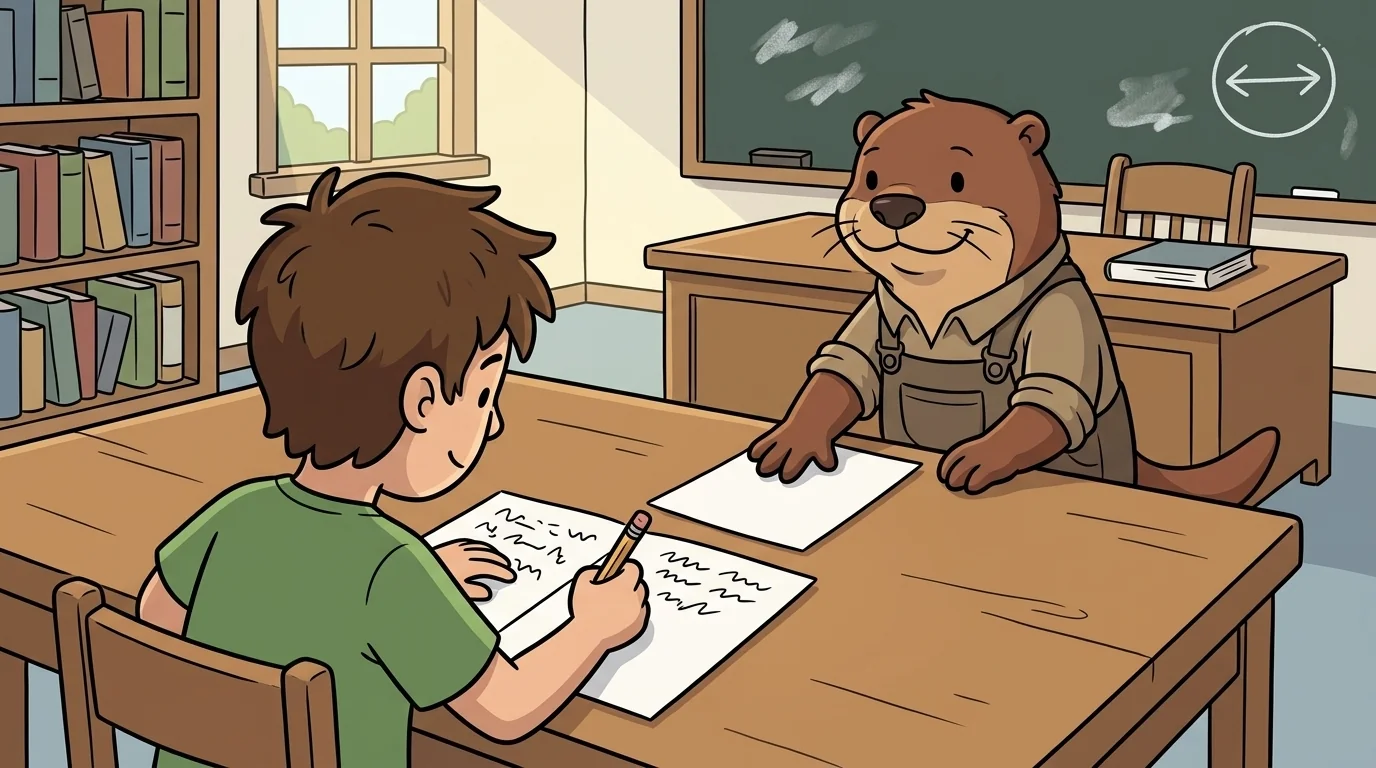
Bex's favourite thing to teach was the patience of proving the second direction. A quick, impatient student named Tam once burst into her classroom. "I proved it! If a number is divisible by six, then it's divisible by both two and three. If and only if! Done!"
"You've proved one direction," Bex said warmly. "Beautifully, too — if divisible by six, then by two and three. That's the trip out. But 'if and only if' needs the trip home as well. Have you proved that if a number is divisible by both two and three, then it's divisible by six?" Tam opened his mouth, then closed it. "I... assumed that part was obvious." "The trip home is never obvious until you've rowed it," Bex said gently. "Sometimes it's true and easy. Sometimes true and hard. And sometimes it's not true at all, and the whole 'if and only if' falls apart — and you don't get to know which until you make the crossing. So: row it back. Prove the second direction. Then you may say 'done,' and mean it." Tam bent over the page, and when he finally looked up, both directions proved, his impatience had steadied into something firmer. "It felt different," he said, "knowing it goes both ways. Solid." "That," said Bex, "is the feeling of a real crossing."
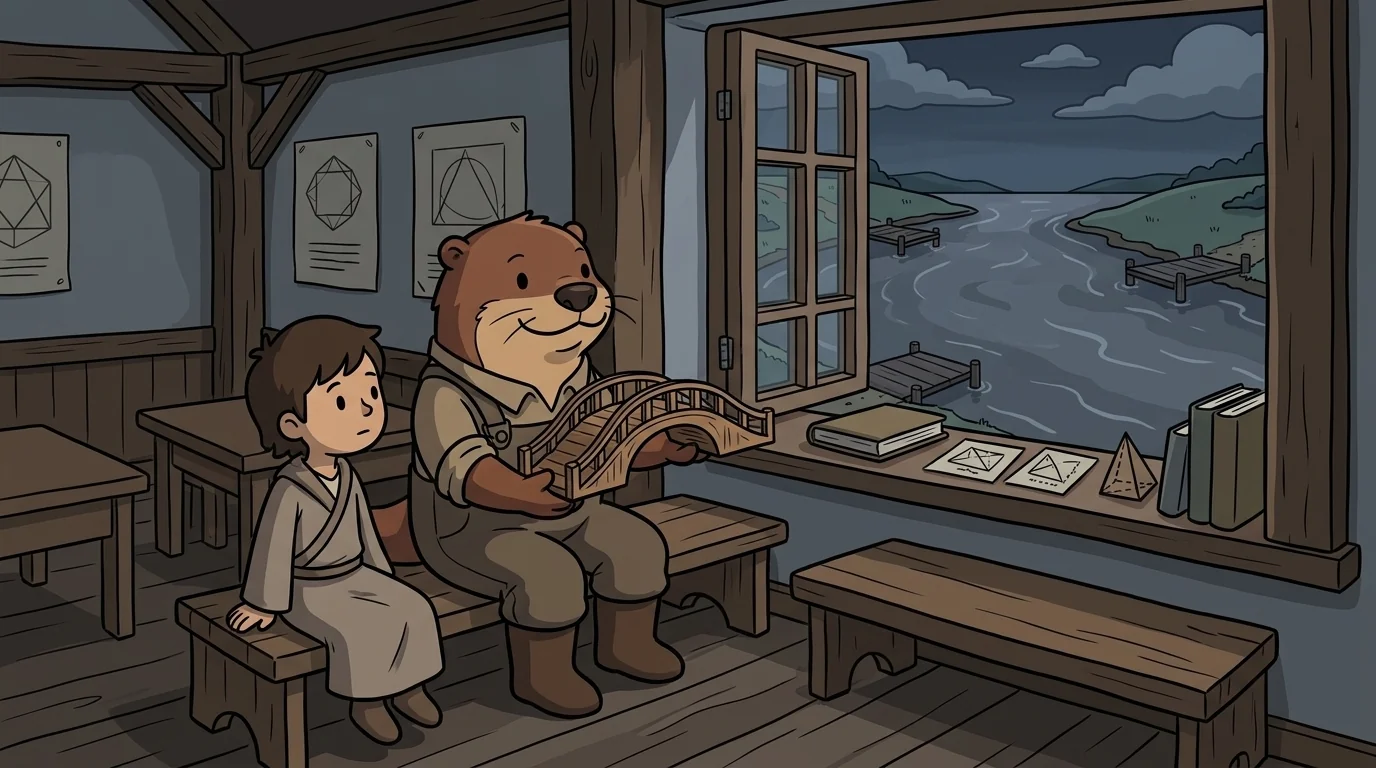
Later, when the academy lamps were low, Bex sat by the window where a small carved model of a two-way bridge stood on the sill, and Wisp — a student now — found her there. "Doesn't it get tiring, always rowing back to check the other direction? Everybody else trusts a path once they've walked it once."
Bex turned the little carved bridge in her paws. "It used to feel like double the work," she admitted. "Everyone else got to be done after one direction, and I was still out there checking the way home. It can feel like you're the only one who won't just trust things." She set the bridge down. "But I'd rather know than assume. And here's what I found, all those years on the river: when both directions finally hold — when the way there and the way back are both true — you get something you can never get from half a crossing. You get certainty that two things are truly one. Not hoped to be. Not usually. Truly, both ways, the same." And as Wisp settled beside her, Bex felt the deep, even satisfaction she'd felt every time a both-ways crossing held — the quiet joy of two banks turning out to be one shore. It was worth every extra row across, she thought, to stand on a bridge and know, for certain, that it carried you home.
The ProofQuest ensemble
Biconditional Bex is part of ProofQuest's distributed-narrative cast. Each character embodies a different curricular primitive; together they teach the full subject.
-

Direct-Proof Dora
Direct proof: assume premises, derive conclusion by straightforward logical steps
-

Induction Ida
Weak / standard mathematical induction: base case + inductive step
-

Strong-Induction Sten
Strong induction: base case + assume all prior cases hold
-

Contradiction Cassius
Proof by contradiction (reductio ad absurdum): assume the negation, derive a contradiction
-
Contrapositive Cara
Proof by contrapositive: prove "not Q → not P" to establish "P → Q"
-

Construction Cole
Proof by construction: prove existence by explicit construction of an example
-

Pigeonhole Perch
Pigeonhole principle: if n+1 items are placed in n bins, at least one bin contains 2+ items
-

Exhaustion Edda
Proof by exhaustion / cases: enumerate every case and verify each
-

Counterexample Cricket
Disproof by counterexample — one exception topples a universal claim
-

Uniqueness Una
Proof of uniqueness — suppose two, show they must be the same one
-

QED
Closing-mark mentor — the ∎ at the end of every proof; the gentle voice that names completion + invites the next problem