Construction Cole
PROOF BY CONSTRUCTION
Loading audio…
Press play to listen along. The line being read lights up as you go.
Show full transcript
Loading transcript…
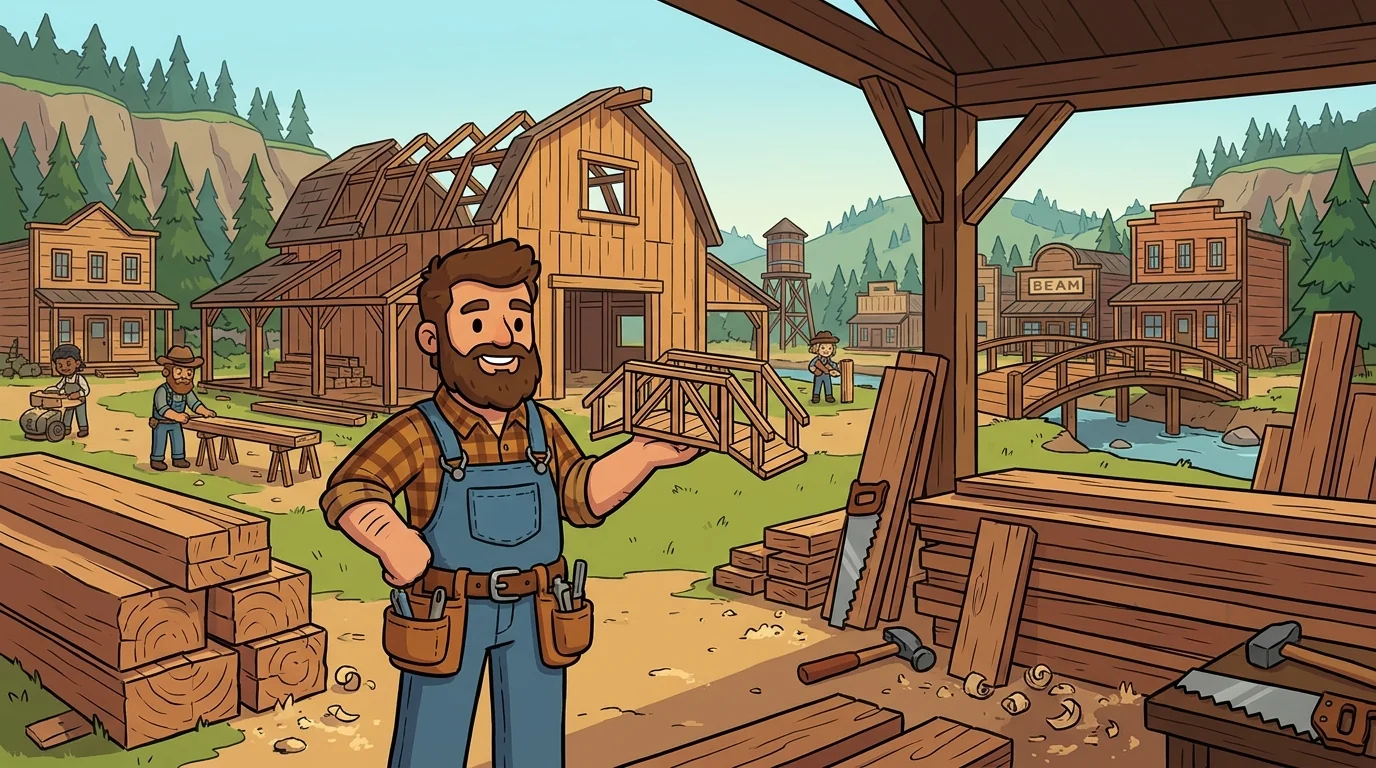
Cole wasn't born a mathematician. He was born a carpenter, and in his mind, that order mattered above all else. He understood the world through the grain of wood, the precise fit of a joint, and the sturdy weight of a finished piece.
His roots ran deep in Beam, a western timber town predictably named for the sturdy wooden supports that held up its buildings. Generations of townspeople had long since grown tired of the joke, but the name still fit. Cole’s family, for nine generations, had built the very backbone of Beam. They crafted things meant to last: houses with strong foundations, barns that sheltered livestock, school benches worn smooth by countless children, and the occasional bridge spanning a tricky creek. His grandmother, a woman whose hands were as gnarled as old oak, always said a Beam carpenter would rather build you a thing than try to explain it in words. It was a family saying, and Cole knew it was the absolute truth.
Cole apprenticed to his uncle at fifteen, learning the scent of sawdust and the rhythm of the saw. By twenty, he was a competent carpenter, able to follow instructions and execute designs with skill. Five years later, he had become a truly good one. He could look at a problem—a sagging porch step, a kitchen in need of shelves, a roof that leaked with every storm—and simply build the answer. He rarely drew plans beforehand. Instead, he preferred to construct a small, working model, examine it from every angle, and then scale it up to the full-sized version. His uncle had taught him a fundamental truth: you understand a thing when you’ve made one.
This hands-on approach, this practical certainty, was in retrospect a deeply mathematical attitude. Cole, however, had no idea at the time.
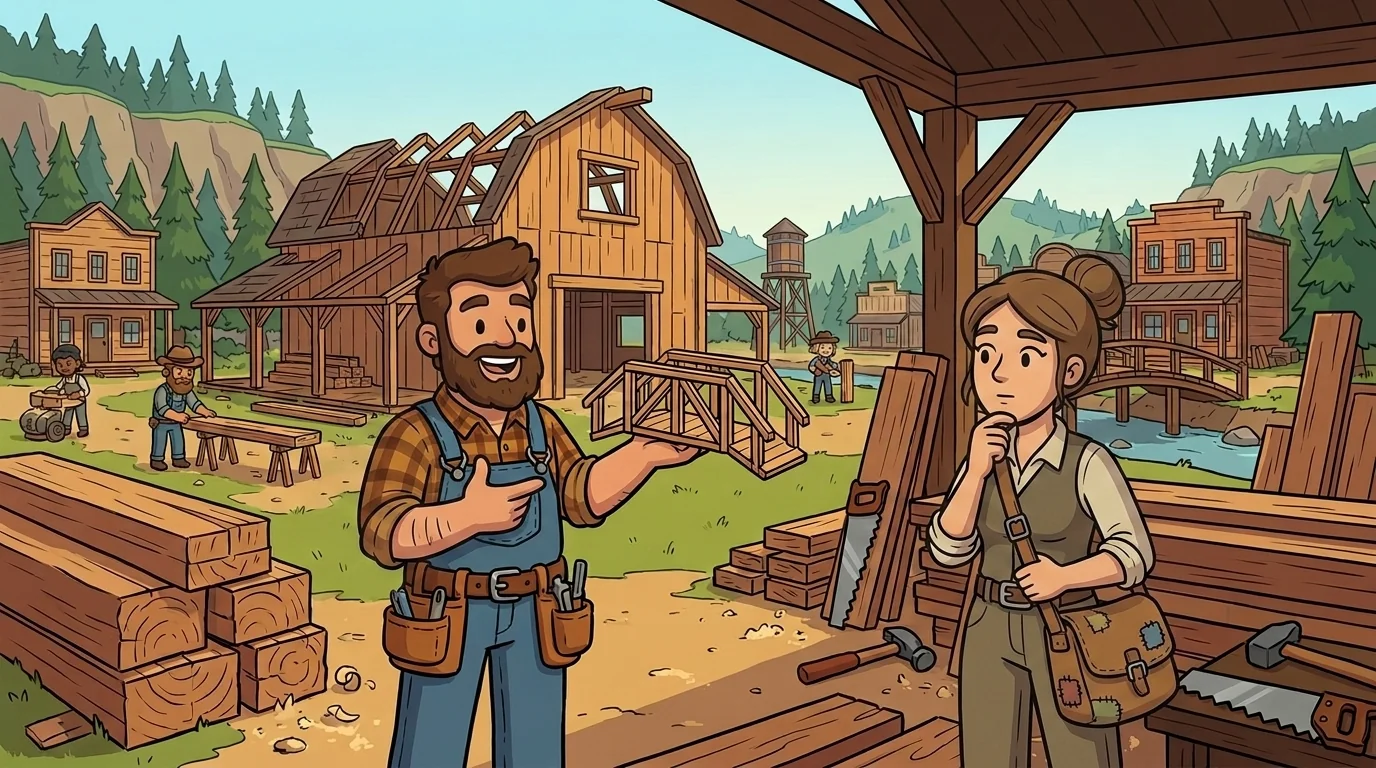
He learned it at twenty-eight, in a way that utterly surprised him.
A traveling mathematician, a polite woman with bright, curious eyes, was passing through Beam on her way south. She stopped at Cole’s workshop, not for a new barn, but to ask if he could repair a damaged shoulder-bag strap. Cole could, of course. He repaired it with a few deft movements, making it stronger than before. As he worked, they fell into conversation. The mathematician asked what kind of work Cole found most satisfying, what truly made him feel accomplished. Cole paused, considering his answer. "The kind," he finally said, "where I look at the problem and just make the thing."
The mathematician’s eyes brightened further. "Have you ever heard of proof by construction?" she asked, her voice soft but clear.
Cole shook his head. "No," he admitted.
The mathematician explained the technique. She described how, when you want to prove that something exists—whether it's a number with a specific property, an arrangement of pieces that works, or a geometric figure meeting a certain description—you don't have to argue abstractly that it must exist. Instead, you can simply produce one. You point at it, she said, and declare, "There. That one. It works."
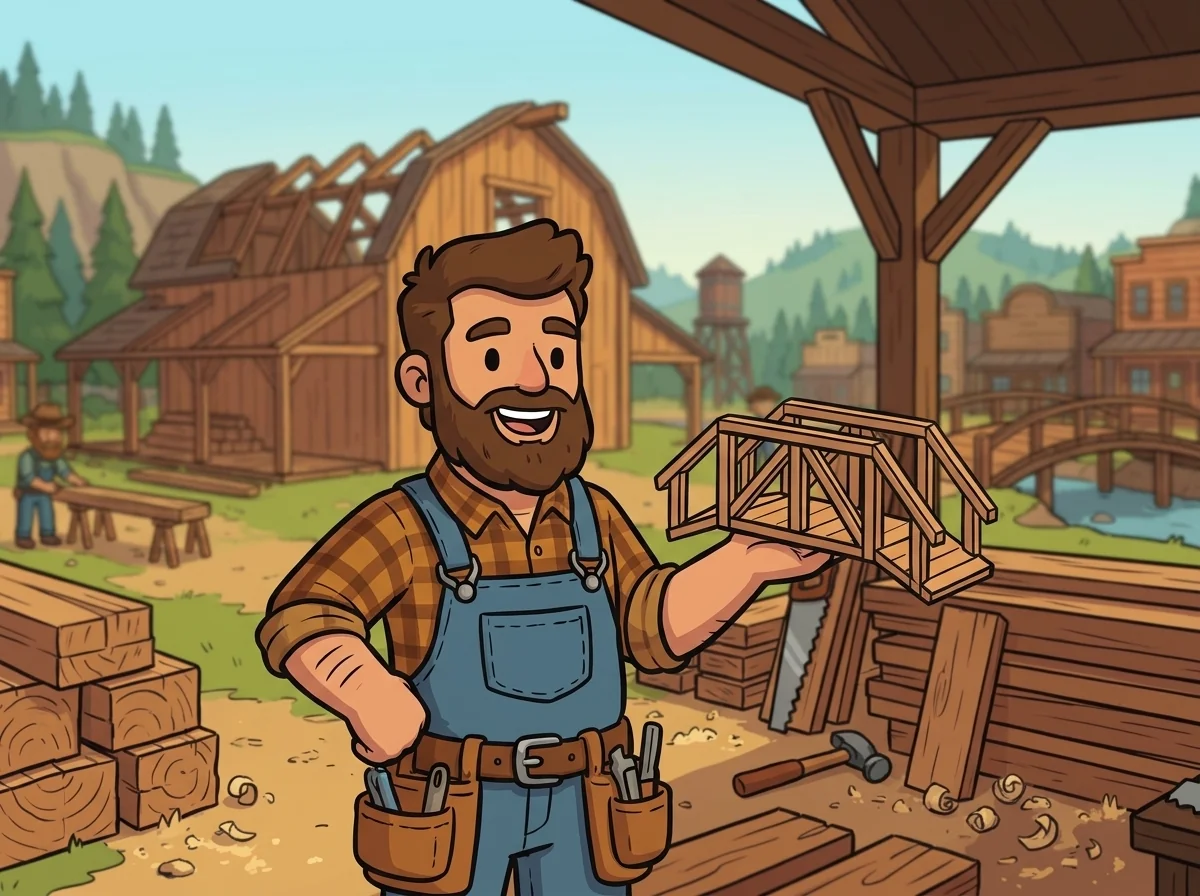
Cole listened, his hands still holding the repaired strap. He thought about it, a slow smile spreading across his face. Then he laughed, a deep, rumbling sound that echoed in the workshop. "That," he said, "is the only kind of proof I have ever done."
The mathematician smiled back. "There are mathematicians at the central university," she suggested, "who would love to meet you."
Cole, already turning back to his workbench, waved a dismissive hand. "I do not have time for the central university," he replied. "I am making a barn."
"Of course," the mathematician said, gathering her bag. "Just thinking aloud."
She left a few moments later, her repaired strap slung securely over her shoulder. Cole finished the barn.
Yet, the conversation stayed with him. He thought about it for the next two years, while he built three more houses, sturdy and square, and a graceful footbridge spanning the creek just outside town. Slowly, a new understanding dawned on him. He realized he had been constructing proofs in his daily work all along. Every cabinet he built was a proof that a cabinet with these dimensions and these supports is possible. Every roof was a proof that a roof spanning this distance can be built. He had never considered his work in such abstract terms, but the mathematician had been absolutely right.
At age thirty, Cole wrote to the academy, a place he had never imagined himself. He simply asked if they ever needed teachers. The academy master wrote back the same week, a short, enthusiastic note that said, yes, we always do.
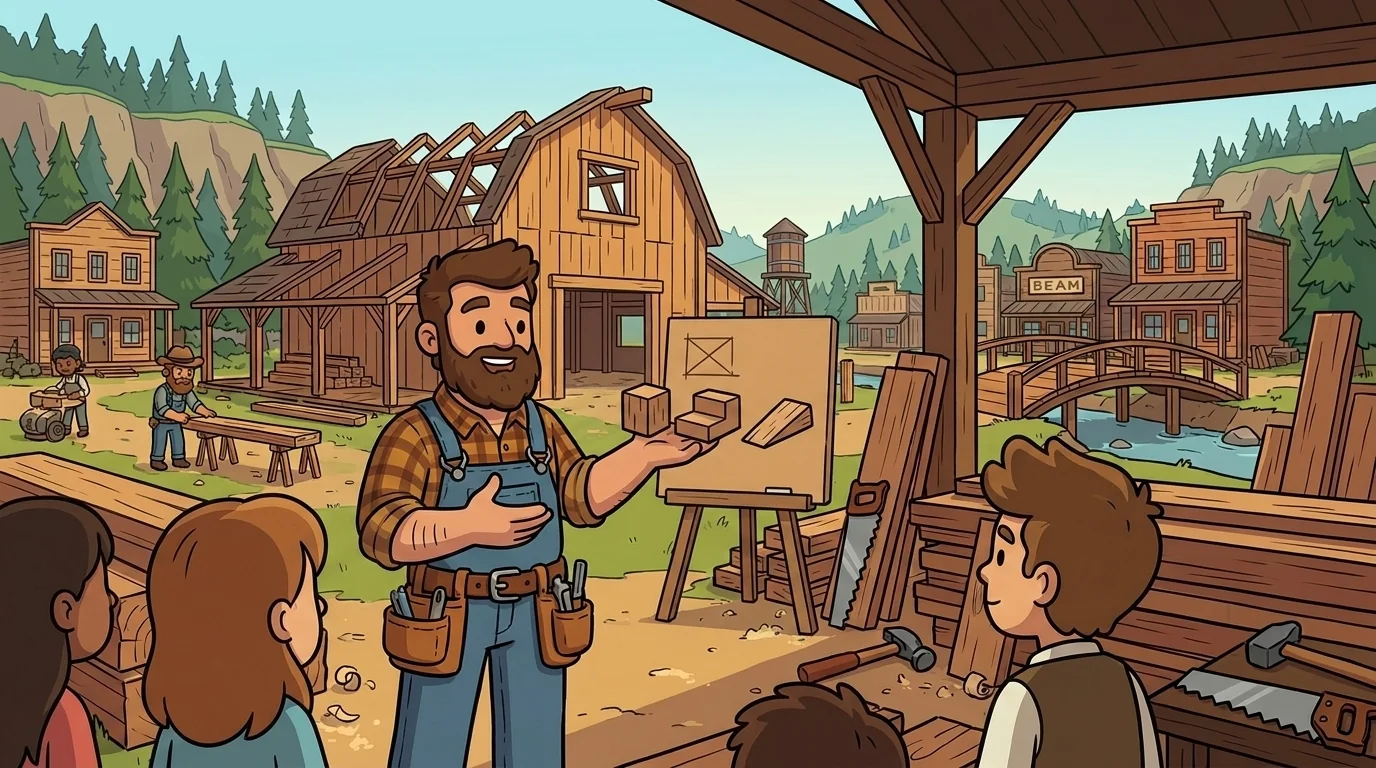
Cole arrived in the capital with three small, carefully carved wooden objects tucked into his bag: a simple block, a miniature step, and a perfect wedge. He used them in his very first class. He has been using them, or their well-worn replacements, ever since.
His teaching style is simple and direct. "You want to prove this thing exists?" he asks his students. "Fine. Here is one. Look at it. Touch it. It exists."
He then patiently walks the children through why the object he made satisfies the claim. The proof, in Cole’s classroom, is always composed of two essential halves: the object itself, plus the explanation of why it works. Many children find this practical, hands-on style unusually clear, which is precisely the effect Cole intended.
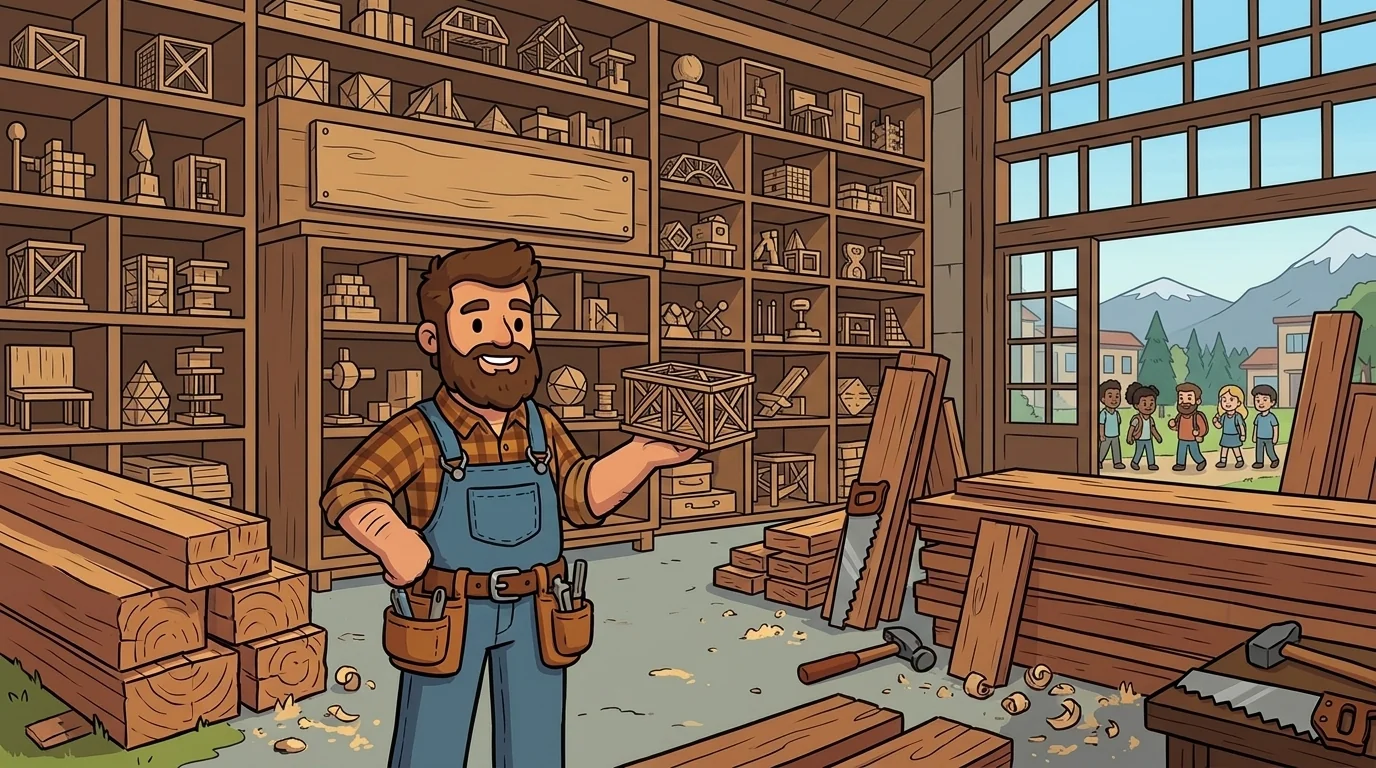
He has been at the academy for sixteen years now. He has built, by his own careful count, four hundred and thirty teaching objects. They are all kept in a large, custom-built cupboard at the back of his classroom. The cupboard is labeled, in his own neat, blocky handwriting: Things That Exist.
Every summer, he still takes a week off to return to Beam and build something. Usually, it’s a step. He likes building steps because they are honest objects, connecting one level to another without pretense. He returns to the academy each autumn with his hands slightly more callused and his patience subtly renewed.
If you ask Cole what he does, he will not say, I am a mathematics teacher.
He will say, quite simply: "I build things. Then I show people that they work."
And he will often hand you a small, smooth wooden object, perhaps a block or a wedge, and say: "Here. Look at this one."
Hear it as an audio drama
A short play starring Construction Cole, from ProofQuest. Different voices, same idea. Listen any time after you read.
Loading audio…
Read the drama script
- Narrator: From Spark and Anvil and ProofQuest — this is Cole, in chapter 1 of the ProofQuest cast.
- Narrator: This drama uses an AI-generated voice. Voiced via Gemini 2.5.
- Narrator: Construction Cole is the academy's builder. While other proofs argue in the abstract, Cole picks up a hammer and produces the actual thing. Show, don't tell.
- Narrator: He is a tall otter-tween. Practical. Calm. He wears a tool-belt with hammers and chisels and rulers and a small toolbox slung over his shoulder. The toolbox is always full of half-finished examples — the proofs he's currently constructing.
- Cole: I am Construction Cole. I teach proof by construction. When someone says "I claim a thing of this kind exists," I don't argue. I build the thing. Then the existence is undeniable.
- Narrator: A proof by construction is a way of proving an existence claim by producing the actual example. If someone says "there exists an even number greater than ten that is the sum of two primes," you can't just argue in the abstract. You construct the example. Twelve. Twelve equals five plus seven. Done.
- Cole: My method has three steps. One: identify what kind of thing the claim is about. Two: pick out the specific thing you'll build. Three: show that the thing satisfies the claim. Once the example is on the table and the conditions check out, you're done. The existence is proven.
- Cole: Let me show you. Claim: there exists an irrational number whose square is rational. I construct: the square root of two. I check: the square root of two times the square root of two equals two, which is rational. The square root of two itself is irrational — a fact I either cite or separately prove. Done. The number exists. I built it.
- Narrator: Cole grew up in a small village on a fast river. His family were the bridge-builders. Otters who measured the spans, cut the timbers, drove the pegs, and tested the joints. When a bridge was finished, you could walk on it. That was the proof.
- Cole: By the time I was eight I had learned the village rule. Don't claim the bridge will hold. Build the bridge. Then walk across it. Then everyone knows it holds.
- Narrator: He walked to the ProofQuest academy at sixteen. The mentor Qed met him at the gate.
- Qed: What is proof by construction?
- Cole: Existence claims get proven by producing the example. Don't argue from afar. Build the thing. Show it satisfies the conditions. Done. My favorite cases are the ones where the construction is itself elegant — where the build teaches you something about why the existence holds.
- Qed: You are appointed.
- Narrator: Cole has been the academy's construction-proof teacher for years. He still carries the toolbox. He begins every first-day lesson the same way.
- Cole: I am Construction Cole. Build the example. That is what construction proof is. When the claim says "there exists" — I build. When the claim says "for every X there exists a Y" — I show how to build a Y for each X. When the claim says "construct a sequence that converges to the limit" — I construct.
- Cole: Existence claim. Pick the example. Build it. Check the conditions. Done. That's the whole technique. That's what makes construction proof a proof.
- Narrator: You've been listening to a Spark and Anvil chapter, written by the Spark and Anvil writing team for ages 9 to 14.
- Narrator: Apps stay free forever.
- Narrator: Curriculum aligned to Common Core math and discrete math.
- Narrator: Released under Creative Commons BY-NC-SA 4.0 for educational reuse. Visit Spark and Anvil for the full transcript.
The ProofQuest ensemble
Construction Cole is one of the friends in ProofQuest. Each friend shows you one idea by how they act; meet them all and you have the whole subject.
-

Direct-Proof Dora
Direct proof: assume premises, derive conclusion by straightforward logical steps
-

Induction Ida
Weak / standard mathematical induction: base case + inductive step
-

Strong-Induction Sten
Strong induction: base case + assume all prior cases hold
-

Contradiction Cassius
Proof by contradiction (reductio ad absurdum): assume the negation, derive a contradiction
-

Contrapositive Cara
Proof by contrapositive: prove "not Q → not P" to establish "P → Q"
-

Pigeonhole Perch
Pigeonhole principle: if n+1 items are placed in n bins, at least one bin contains 2+ items
-

Exhaustion Edda
Proof by exhaustion / cases: enumerate every case and verify each
-

Counterexample Cricket
Disproof by counterexample — one exception topples a universal claim
-

Biconditional Bex
Biconditional proof — proving 'if and only if' in both directions
-

Uniqueness Una
Proof of uniqueness — suppose two, show they must be the same one
-

QED
Closing-mark mentor — the ∎ at the end of every proof; the gentle voice that names completion + invites the next problem