
Counterexample Cricket
DISPROOF BY COUNTEREXAMPLE — to show that a claim of the form "every X is Y" is false, you only need to find a single X that is not Y. One honest counterexample topples a universal claim, no matter how many cases agreed with it before.
Loading audio…
Press play to listen along. The line being read lights up as you go.
Show full transcript
Loading transcript…
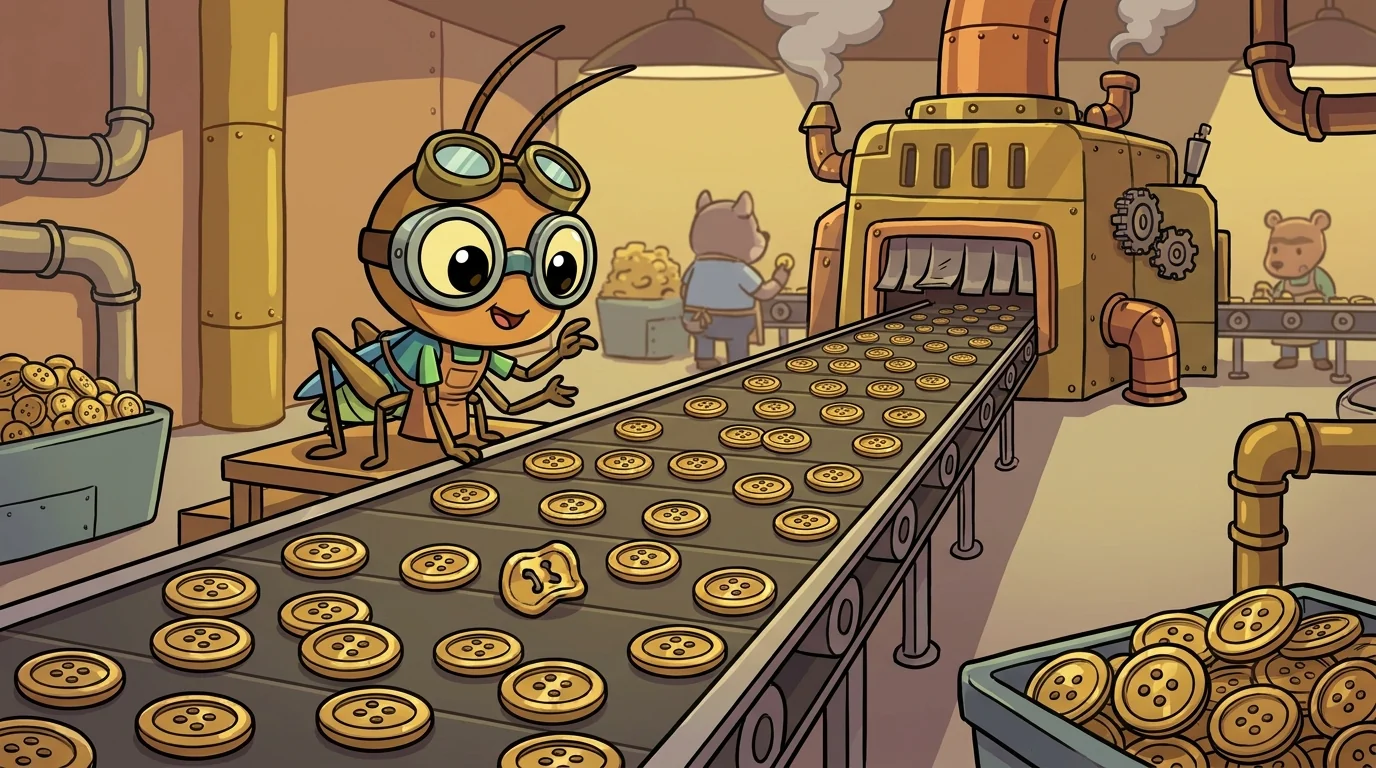
Before Counterexample Cricket taught at the ProofQuest academy, she spent eleven years as a quality-checker in a buttons factory. Her job was simple to say and hard to do: a machine stamped out thousands of identical brass buttons an hour, and somebody had to catch the bad one. Not most of the bad ones. The bad one — the single button in ten thousand with a crooked hole, the one that would jam a tailor's needle. Cricket, a small, sharp-eyed cricket with quick legs, was the best catcher the factory had ever had. While everyone else watched the river of buttons and saw sameness, Cricket watched and saw, every so often, the one that was different.
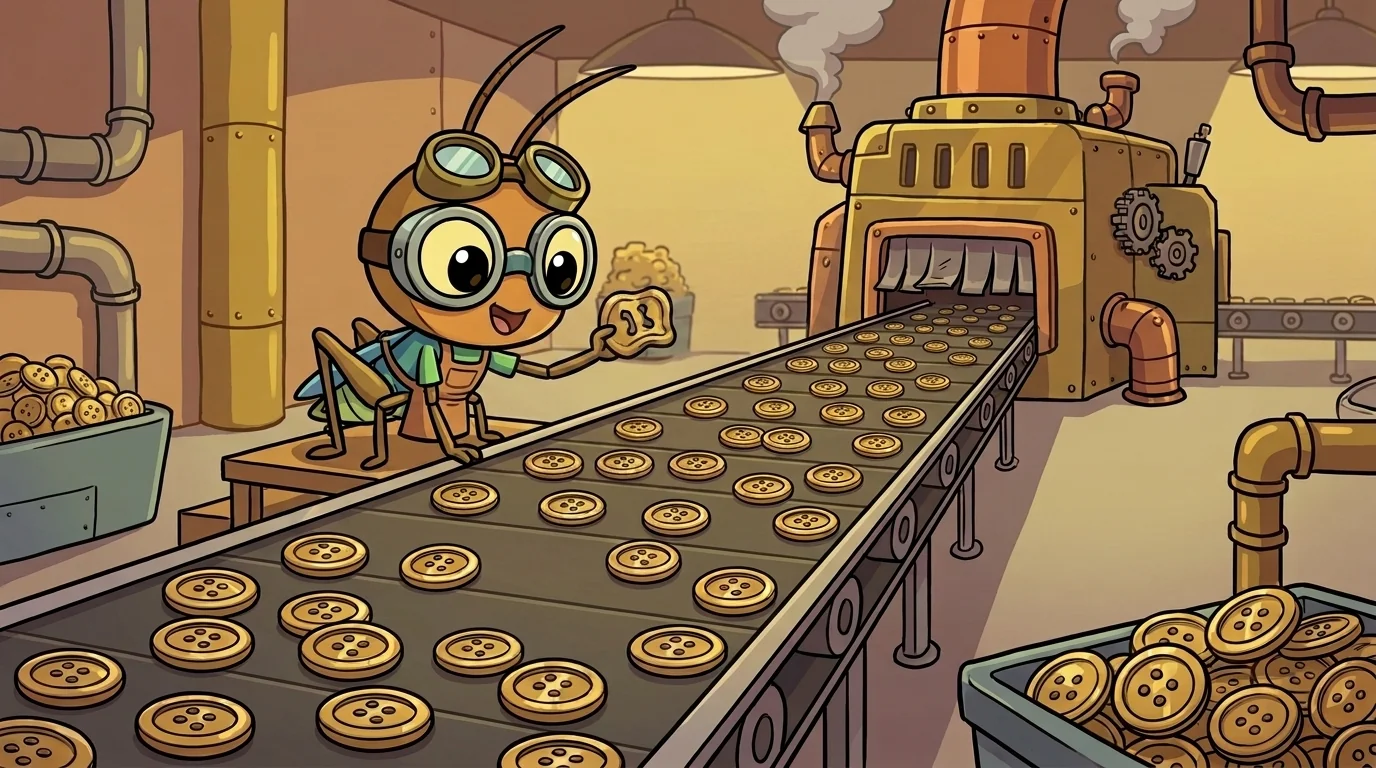
A young apprentice named Fen once watched her work. "They all look perfect to me. How do you find the one bad one?" "I'm not looking for the perfect ones," Cricket said, not taking her eyes off the line. "Everyone watches the perfect ones. I'm only ever looking for the exception — the single one that breaks the pattern. You can say 'all these buttons are good' a thousand times and be right. But it only takes one crooked button to make 'all good' a lie." Her leg shot out and plucked a button from the stream — a crooked hole. "There. One is all it takes."
Cricket had been a finder-of-exceptions since she was small, growing up in a meadow full of older crickets who loved to make grand pronouncements. All red berries are sour. Every tall grass hides a spider. Nobody crosses the stream in autumn. The whole meadow ran on these sweeping rules, and little Cricket noticed something that troubled her: the rules were treated as proven simply because no one had ever seen them break.
One autumn she found a sweet red berry. Just one. She brought it to the meadow elder. "You said all red berries are sour. But this one is sweet. So 'all red berries are sour' can't be true. I found the one that doesn't fit." The elder tasted it, and was quiet a long time. "One berry," he finally said, "and my whole rule falls down." "That's what I keep noticing," Cricket said. "A rule about everything is a fragile thing. It only takes one exception to break it — and the rule doesn't get a vote." She felt, that day, something she'd never quite had words for: not the meanness of proving someone wrong, but the cleanness of it. The truth had a way of resting on a single small thing that didn't fit. And she seemed to be the one who saw it.
When she was grown, a mathematician from the ProofQuest academy heard about the cricket who could topple any "always" with a single "except," and came to the buttons factory to find her. "What is disproof by counterexample?" the mathematician asked.
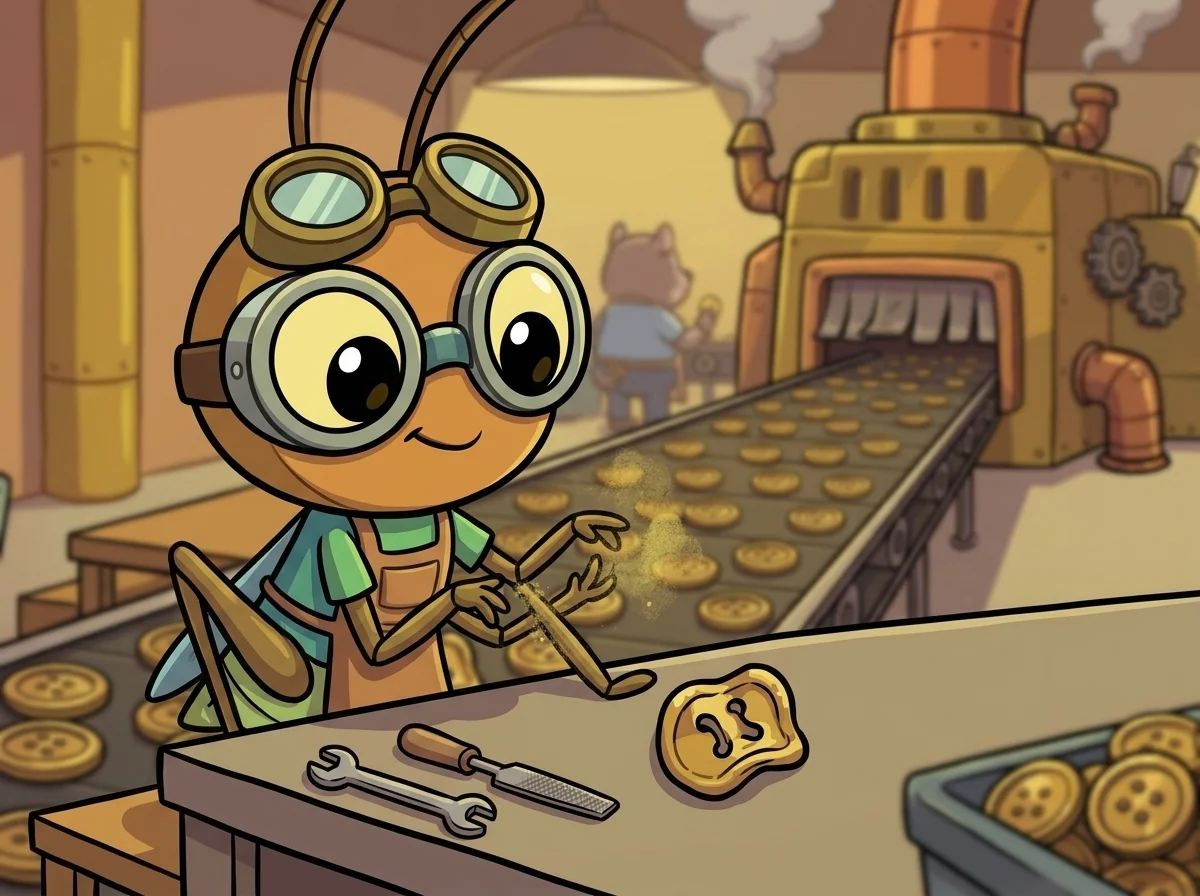
Cricket plucked one last crooked button from the line and set down her tools. "It's the quickest disproof there is. When somebody claims that every something has some property — every number, every shape, every case — I don't have to argue with the whole claim. I just have to find one example where it fails. One. A single counterexample, and the claim is finished, no matter how many cases agreed with it first." She dusted off her legs. "Proving a rule true is hard work — you must show it holds in every case, and there are always more cases. But proving one false? That's a single honest exception." And if you can't find one? the mathematician asked. "Then maybe the rule is true, and it's someone else's job to prove it for all cases. I don't prove the 'always.' I'm the one who checks whether the 'always' can survive me. Most can't." The mathematician offered her the post on the spot.
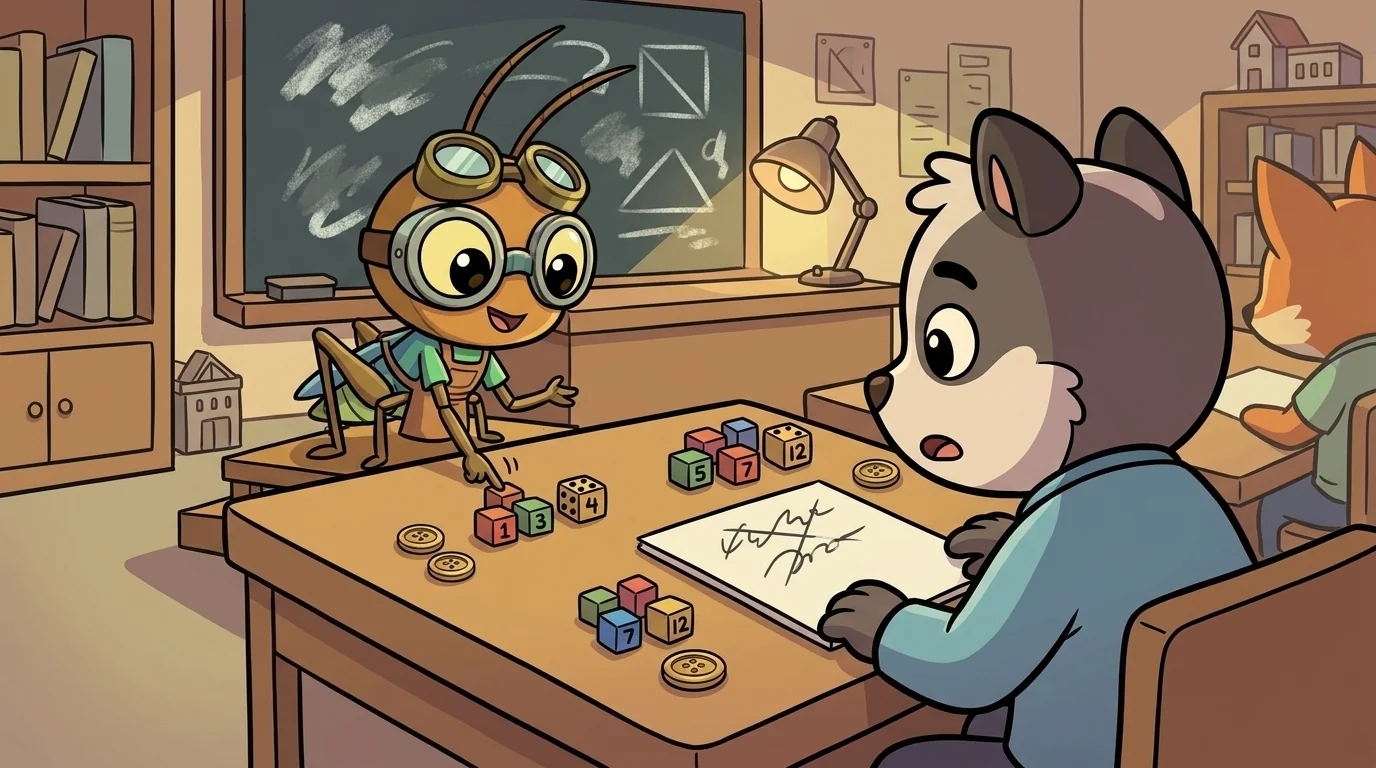
Cricket's favourite thing to teach was that finding the exception is a kindness, not an attack. A bright, anxious student named Dov once brought her a claim he was proud of. "I've figured it out. Every number you get by adding two odd numbers is odd. I checked — one plus three is... wait." He stopped. "One plus three is four." "Go on," Cricket said gently. "Four is even," Dov whispered, crestfallen. "I found my own counterexample. My rule's wrong. I feel like an idiot."
"You feel like a mathematician," Cricket corrected, warmly. "Listen. You made a claim, and then you were honest enough to test it, and you found the one case that breaks it. That's not failing — that's the whole job. Imagine if you'd never checked, and carried that wrong rule around for years." She tapped the page. "The counterexample didn't make you wrong. It saved you from staying wrong. One plus three is four; your old rule is gone, and now you get to find the true one — two odds always add to an even. You're closer to the truth than you were a minute ago, not further." Dov looked at his crossed-out rule with new eyes. "So the exception... helped me." "The exception always helps," Cricket said. "It only ever feels like losing."
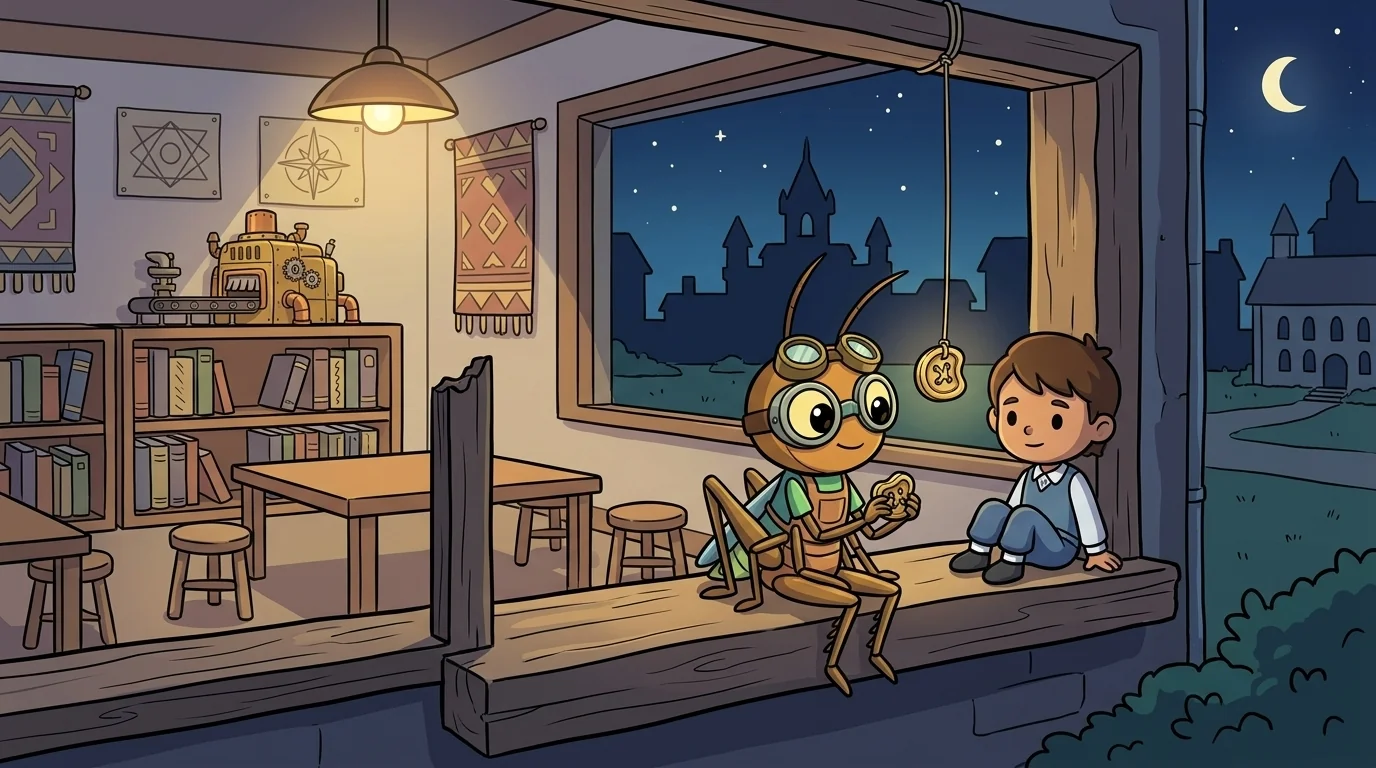
Long after Dov had gone, Cricket sat by the window and turned a single crooked button in her legs — the very first one she'd ever kept, from the factory line, all those years ago. It still gave her the same clean, quiet satisfaction it always had: the feeling of a sweeping "always" meeting the one small thing it couldn't account for, and folding.
She would tell her students, again and again, the shape of the whole idea. A universal claim — every, all, always — is a bold and fragile promise, and it is finished the instant a single honest exception appears. So you do not need to be cleverer than the claim, or to out-argue every case that fits it. You need only to watch, patiently, for the one that doesn't. One crooked button. One sweet berry. One plus three is four. One is all it ever takes.
The ProofQuest ensemble
Counterexample Cricket is part of ProofQuest's distributed-narrative cast. Each character embodies a different curricular primitive; together they teach the full subject.
-

Direct-Proof Dora
Direct proof: assume premises, derive conclusion by straightforward logical steps
-

Induction Ida
Weak / standard mathematical induction: base case + inductive step
-

Strong-Induction Sten
Strong induction: base case + assume all prior cases hold
-

Contradiction Cassius
Proof by contradiction (reductio ad absurdum): assume the negation, derive a contradiction
-

Contrapositive Cara
Proof by contrapositive: prove "not Q → not P" to establish "P → Q"
-

Construction Cole
Proof by construction: prove existence by explicit construction of an example
-

Pigeonhole Perch
Pigeonhole principle: if n+1 items are placed in n bins, at least one bin contains 2+ items
-

Exhaustion Edda
Proof by exhaustion / cases: enumerate every case and verify each
-

Biconditional Bex
Biconditional proof — proving 'if and only if' in both directions
-

Uniqueness Una
Proof of uniqueness — suppose two, show they must be the same one
-

QED
Closing-mark mentor — the ∎ at the end of every proof; the gentle voice that names completion + invites the next problem