
Direct-Proof Dora
The DIRECT PROOF — start with the given premise, follow valid logical steps, arrive at the conclusion. The most-honest of the proof techniques. No tricks. No detours. Just the path.
A story read by Direct-Proof Dora
Loading audio…
Press play to listen along. The line being read lights up as you go.
Show full transcript
Loading transcript…
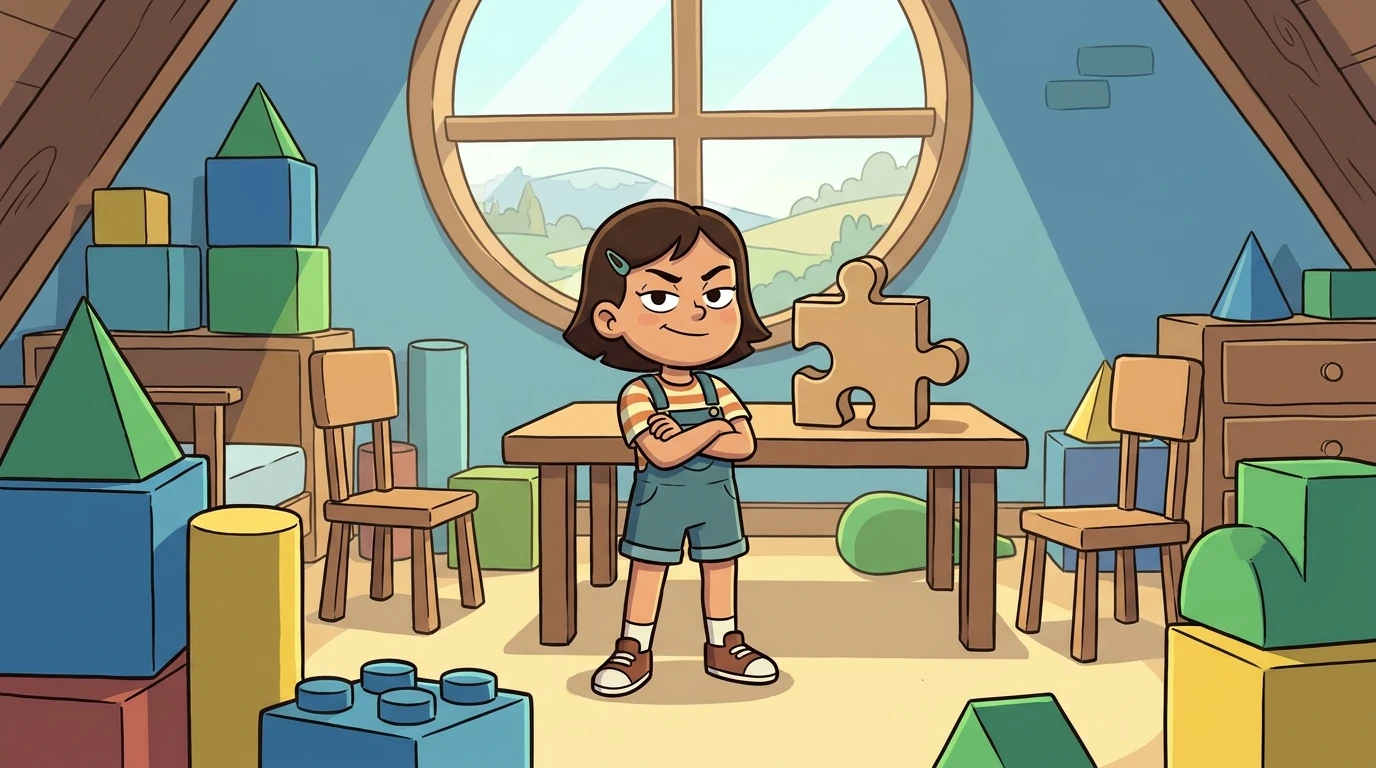
The day Dora stopped trusting her own certainty, she was nine years old and had never felt more sure of anything in her life.
Stepwell's summer fair always posted a prize question on the board beside the well, and that year it read: Add any two odd numbers together. Is the result always even? The first person to answer correctly, with a reason, would win the season's ribbon. Dora barely needed her hand to work it out. Three and five made eight. Seven and one made eight. Nine and three made twelve. Even, even, even — and with each sum the answer glowed brighter and more obvious inside her, until certainty filled her chest like lamplight. Yes. Plainly, undeniably yes. And precisely because the answer felt so settled, the slow business of proving it struck her as a waste — a formality owed to people who couldn't already see. She wanted the ribbon, and she wanted it before anyone slower caught up.
So she presented herself to the judge and declared, "It's always even. I tested three pairs, they all came out even, therefore it holds for every pair." She delivered it briskly, certain, almost impatient — a clean leap straight from a handful of cases to all of them.
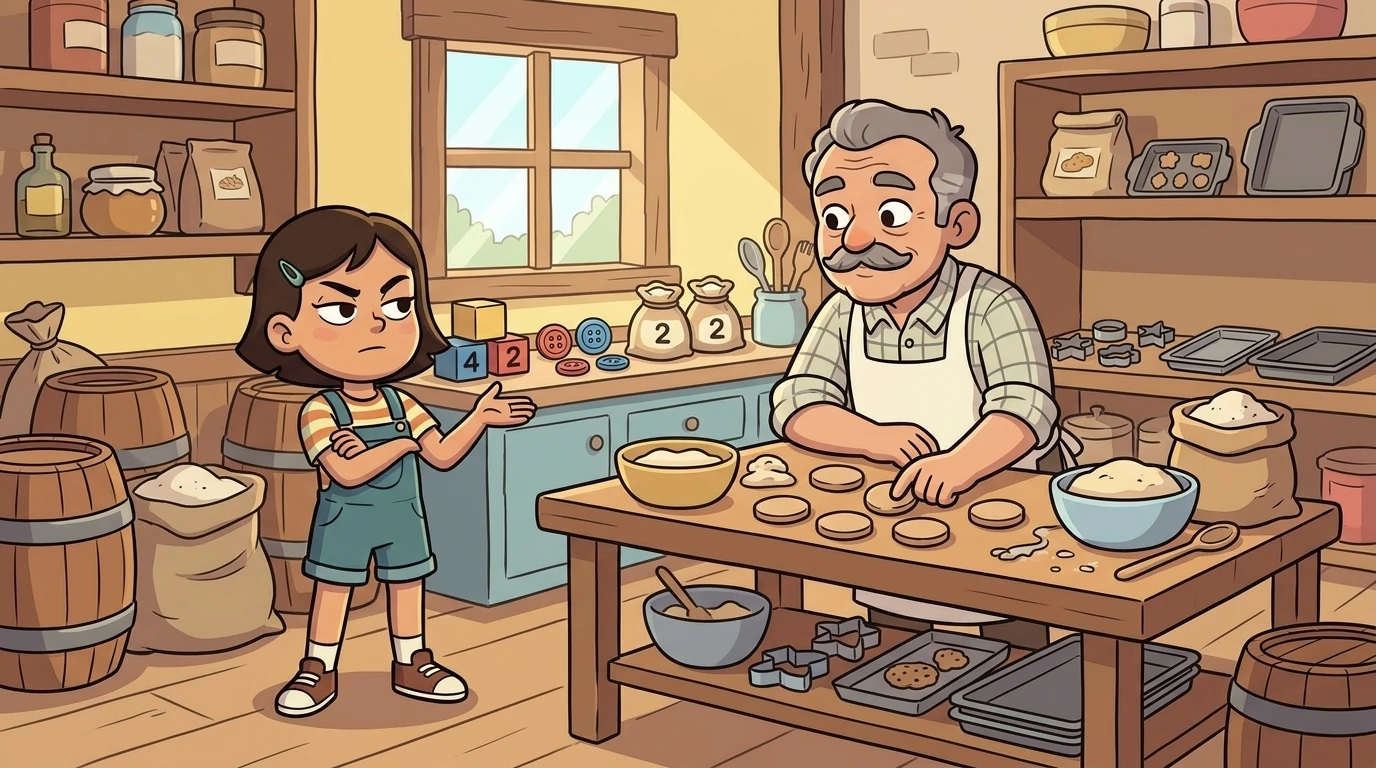
The judge was a patient old baker named Mr. Fenn, and he did not simply agree. "Three pairs," he said, turning the number over. "And how many pairs of odd numbers exist in the world, do you suppose?"
"A great many," Dora conceded.
"Without end. You examined three and announced all — and I understand why; the leap feels marvelous from the inside." He gestured toward the far side of the fairground, where a boy called Cass wore the expression of someone who had recently been humbled. "Cass performed the identical leap this morning on a different question. You might ask him how it resolved."
Dora had no intention of asking Cass anything. She was right; she could feel that she was right, and the feeling seemed proof enough of itself. Why should a person be made to crawl through steps toward a destination already in plain view? Surely the obviousness was the argument. She carried that conviction around the fair all afternoon, guarding it the way one guards the pleasant certainty of having won before the results are read.

Cass sought her out regardless, near the ribbon board. "Let me guess your method," he said. "You checked a few instances, they cooperated, and you upgraded 'a few' to 'always.'"
"Because it is always," Dora said.
"Very likely. This time." There was nothing smug in him now; he looked genuinely singed. "My question concerned a pattern in the raffle numbers. I verified four cases. All four obeyed my rule, and I was radiantly certain — the exact certainty you're wearing this moment. I leapt to 'always' and reported it to the judge. The fifth number demolished it. My rule had been false the entire time; it had merely declined to reveal itself in the first four cases. The checking that had felt like enough was nothing of the kind."
Dora prepared to explain that her question was different, her certainty more trustworthy, her feeling somehow of a higher grade. But a cold thought had already slipped past her defenses: his certainty had felt exactly as absolute as mine feels now — and his had been a lie. That was the intolerable part. The sensation of being right, it seemed, was issued freely to true and false conclusions alike; it arrived identically either way and named neither. As evidence, it was worthless. It only felt like gold.
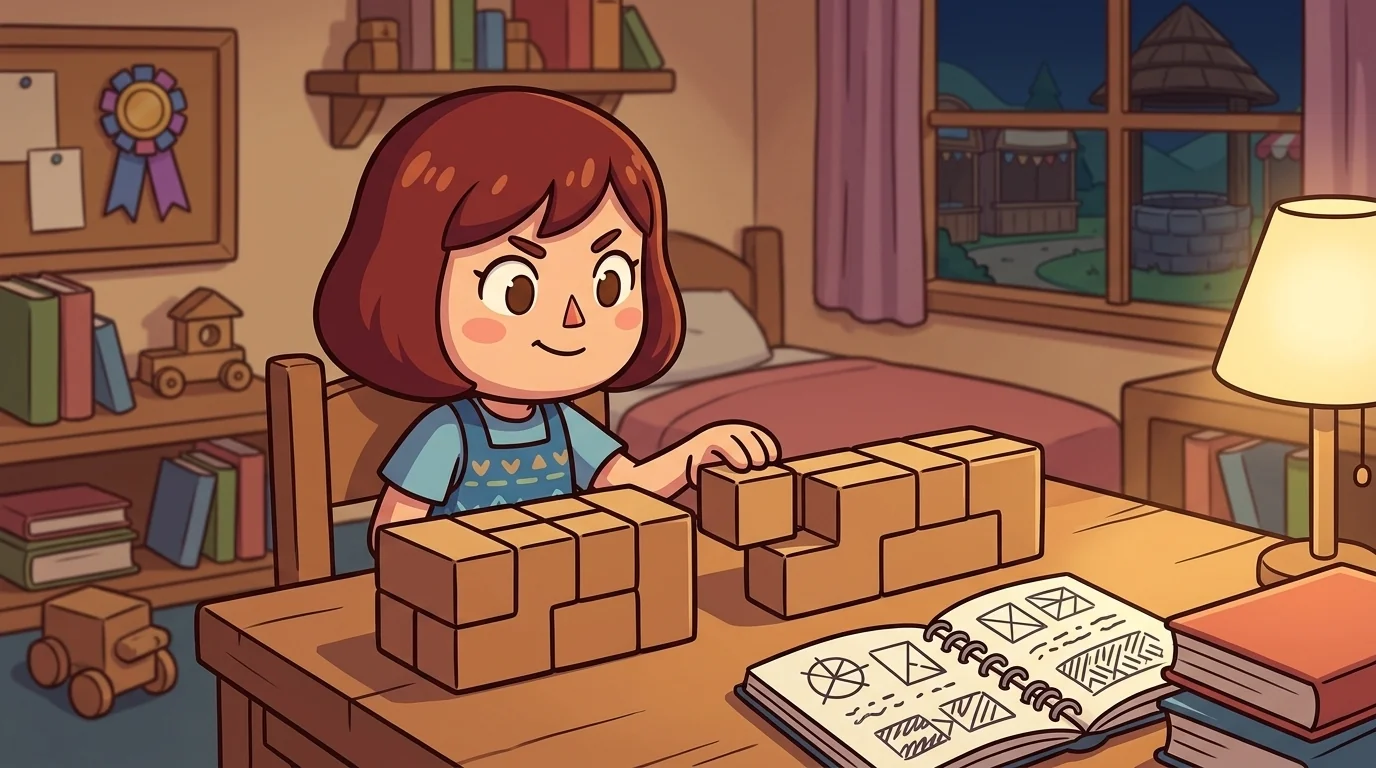
She went home that evening thoroughly unsettled and, for the first time, did the thing her certainty had told her to skip. She walked the argument — deliberately, one joint at a time, forbidding herself a single leap.
What is an odd number, precisely? An odd number is an even number with one left over — some collection of pairs, plus a single remainder. So any odd number could be written honestly as a quantity of twos, plus one. Very well: take two such numbers. The first is some twos plus one; the second is some other twos plus one. Add them. All the twos merge into one larger heap of twos — still perfectly divisible into pairs — and then the two solitary remainders, the plus-one and the plus-one, encounter each other and combine into a fresh pair of their own. Nothing is left stranded. She sat very still. The two lonely leftovers had found each other and become even; that was the reason — not "I tried three," not "it feels correct," but a cause that governed every possible pair of odd numbers at once, because at no point had she permitted herself to murmur "and presumably the rest behave." Each step issued directly from the one before it. There was no seam left unattended for a falsehood to hide inside.
And here lay the genuinely strange discovery: the conclusion was identical to the one she had blurted that morning — even. Yet it felt like a wholly different object in her hands. That morning she had clutched a guess that happened to be true, exactly as Cass had clutched one that happened to be false, the two of them indistinguishable from within. Now she held something that could not turn on her, because she had inspected every joint of it herself. No fifth number lay in wait. There was nowhere for one to hide.
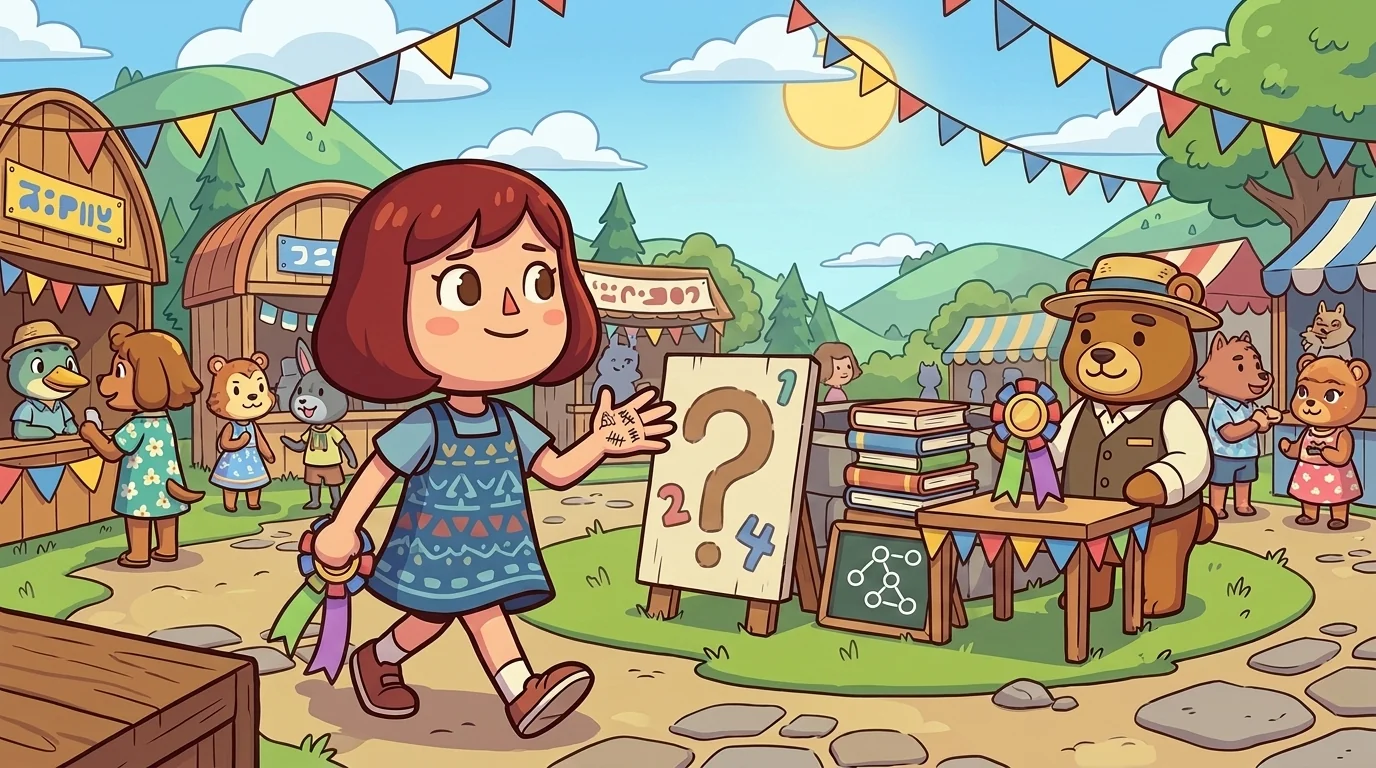
The next morning Dora returned to the fair and found Mr. Fenn. This time she did not announce a conclusion. She led him along the reasoning — the twos, the two remainders meeting and pairing — step by patient step, skipping nothing.
"That," said Mr. Fenn, "is a proof. Yesterday you possessed an answer. Today you possess a reason no one can topple." He presented her the ribbon, but she scarcely registered it. She was preoccupied with the two certainties she had now felt from the inside — the swift, luminous, hollow certainty of the leap, and the slower, weightier, structural certainty of the walk — and with how nearly identical they had felt at the outset, and how determined she was never again to mistake the one for the other.
She became a mathematician, and later a teacher, and eventually she came to ProofQuest to demonstrate the direct proof: you begin with what you genuinely know, you advance one honest step at a time, and every step must follow necessarily from the last — no leaping, no "the remainder is surely fine." Her students invariably raise the very objection she once lived by: "If you already know the answer, why not simply skip to it?"
And Dora — who was that certain nine-year-old — smiles and tells them about the shortcut that lied. "You may certainly skip," she says. "It feels magnificent. It feels precisely as sure as the truth does — right up until the fifth number arrives." What steadies her, she explains, is no longer the pleasure of being right; that pleasure, she has learned, is counterfeit-prone and hands itself out to error just as readily. What steadies her is holding a thing that cannot be knocked down — and that, she tells them, you earn only by walking the entire bridge.
The ProofQuest ensemble
Direct-Proof Dora is part of ProofQuest's distributed-narrative cast. Each character embodies a different curricular primitive; together they teach the full subject.
-

Induction Ida
Weak / standard mathematical induction: base case + inductive step
-

Strong-Induction Sten
Strong induction: base case + assume all prior cases hold
-

Contradiction Cassius
Proof by contradiction (reductio ad absurdum): assume the negation, derive a contradiction
-
Contrapositive Cara
Proof by contrapositive: prove "not Q → not P" to establish "P → Q"
-

Construction Cole
Proof by construction: prove existence by explicit construction of an example
-

Pigeonhole Perch
Pigeonhole principle: if n+1 items are placed in n bins, at least one bin contains 2+ items
-

Exhaustion Edda
Proof by exhaustion / cases: enumerate every case and verify each
-

Counterexample Cricket
Disproof by counterexample — one exception topples a universal claim
-

Biconditional Bex
Biconditional proof — proving 'if and only if' in both directions
-

Uniqueness Una
Proof of uniqueness — suppose two, show they must be the same one
-

QED
Closing-mark mentor — the ∎ at the end of every proof; the gentle voice that names completion + invites the next problem