Hush
SILENT LETTERS
Loading audio…
Press play to listen along. The line being read lights up as you go.
Show full transcript
Loading transcript…
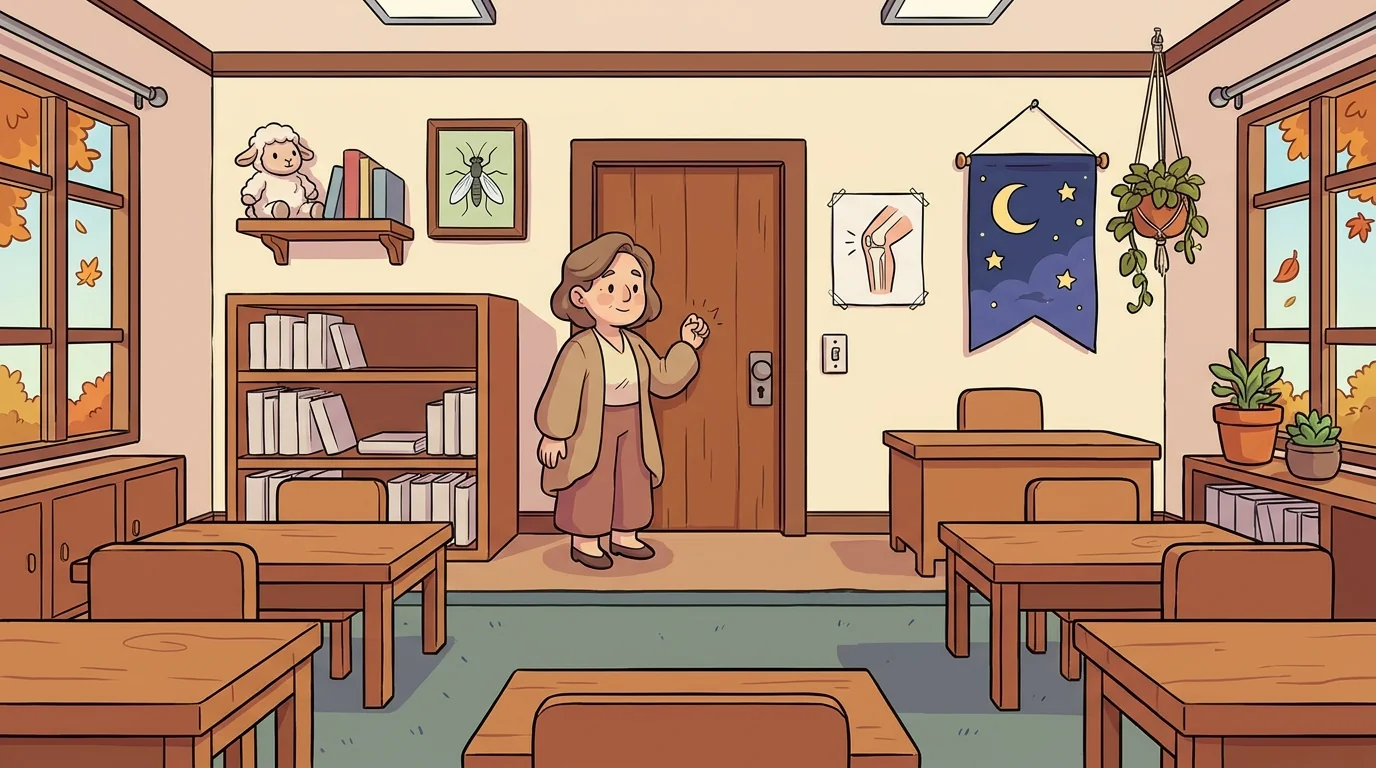
Hush is, of all the QuillSpell academy faculty, the quietest.
This is, given her area of specialty, fitting. Hush teaches silent letters — the letters in English words that do not get pronounced. Knee has a silent k. Gnat has a silent g. Write has a silent w. Lamb has a silent b. Night has a silent gh. Pneumonia has a silent p. Psychology has a silent p. English is, by Hush's careful count, full of silent letters — more than most other European languages — because English has preserved many old spellings that no longer match modern pronunciation.
Hush's first name is, fittingly, Hush. She has no other name on the academy's records. She did not arrive at the academy under a formal application; she simply appeared one autumn day, presented herself at the academy master's door, and said: "You have many silent letters in your curriculum. They need a teacher. I am the teacher."
The academy master at the time — a thoughtful woman named Cur — had asked Hush what her name was. Hush had pointed at her own throat and shaken her head. Cur had understood that Hush did not speak. Cur had asked Hush to write. Hush had written, in a careful neat hand:

"I do not speak, by choice. I have given my voice to the silent letters. I will teach them faithfully."
Cur had thought about this for a day. She had consulted the other faculty. The faculty had agreed: the academy did, in fact, need a silent-letters teacher, and a teacher who did not speak might be ideal for the role.
Hush was given a small set of rooms attached to the academy's library. She was given a wooden writing-slate, a supply of chalk, and a stipend. She was given the roving teaching role — she would not have a permanent classroom; she would appear in other teachers' classrooms whenever a silent letter came up in the lesson.
That was twenty-seven years ago.
Hush has been the academy's silent-letters teacher ever since. She has never spoken a word, in twenty-seven years, in any lesson. She communicates entirely by writing. She is, by appearance, small, slight, and slightly translucent-looking — the academy's children find her slightly thrilling without being afraid of her. (The Greek-roots specialist Sophia has, on several occasions, compared Hush's classroom presence to that of the Compass Wraith in the GeometryForge academy; the comparison is, Sophia says, deeply complimentary.)
In her teaching, Hush works like this:
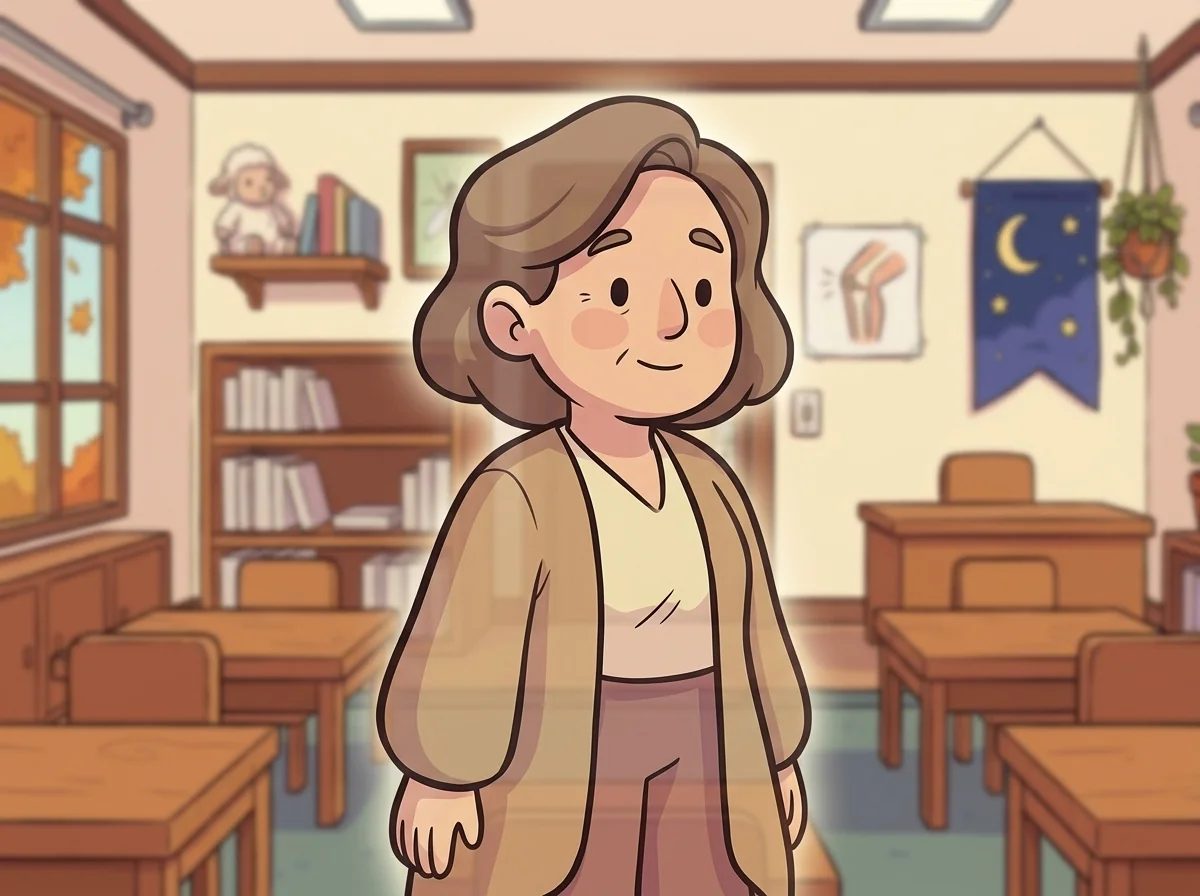
A child encounters a word with a silent letter. Most commonly this happens during one of the other teachers' lessons — Etyma is teaching Latin roots and the word psyche comes up; Sophia is teaching Greek roots and pneuma comes up; Birch is teaching Germanic roots and knee comes up. The other teacher pauses. The other teacher says, gently: "This is a job for Hush."
Hush appears. (She has a small alcove off the main academy hall where she waits; the other teachers send a young runner to fetch her.) She enters the classroom silently. She walks to the front. She picks up the chalk. She writes the word on the board.
Then she points at the silent letter.
She does not pronounce the word. She does not pronounce the silent letter. She just points. The silent letter sits on the board, unspoken. The children watch.
Hush then writes, beneath the word, a short note explaining why the letter is silent. The note is brief. Examples:
For knee: "Once we said k-nee. Old English had a real /k/ sound here. The /k/ went silent in the 1600s. The spelling did not change."
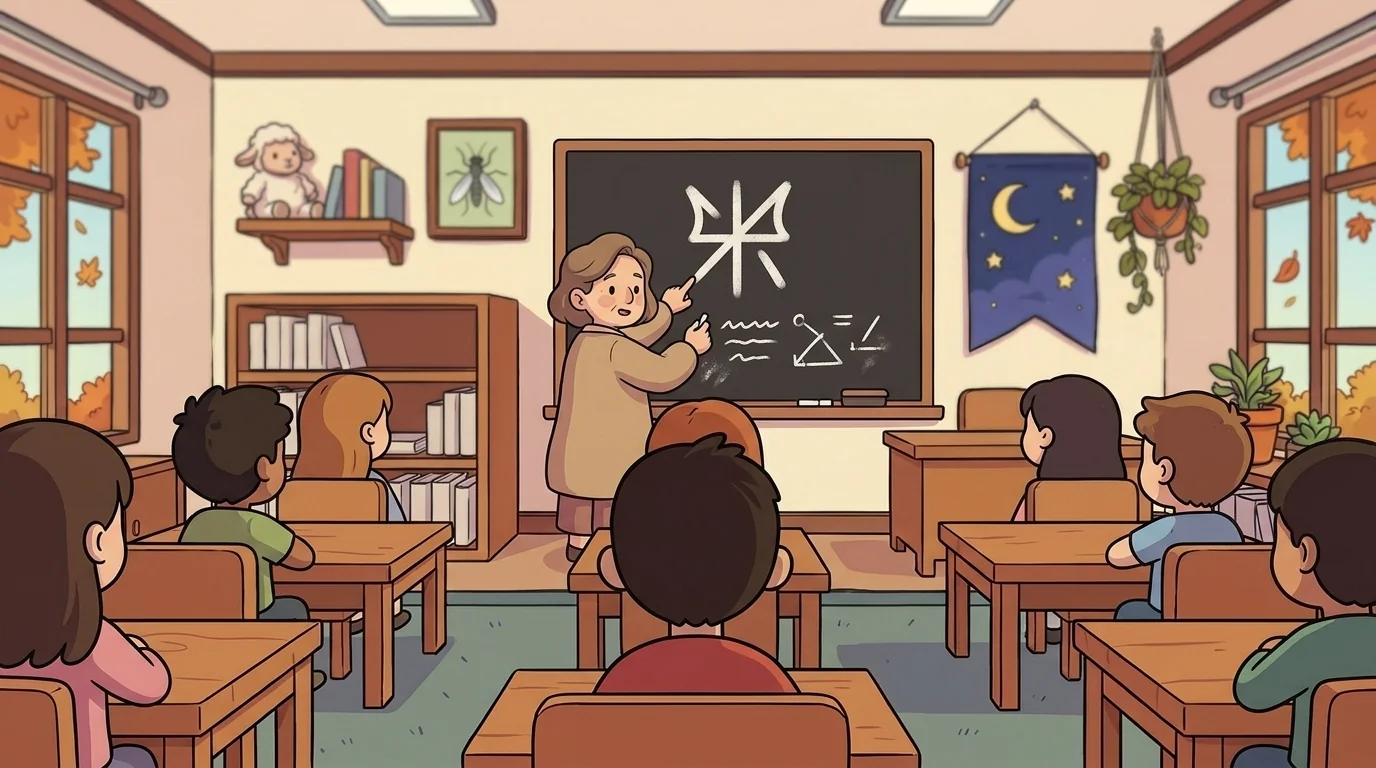
For pneumonia: "Greek word. Pn was a real sound in Greek. English speakers cannot easily pronounce /pn/. So we drop the /p/. The spelling honors the Greek origin."
For write: "Once we said w-rite. The /w/ went silent in early modern English. The spelling kept the w to mark the older pronunciation."
The notes are historical. They explain why a letter is silent rather than just that it is. Children find this satisfying. Children — Hush has noticed — like to know why.
Hush has been, over twenty-seven years, exceptionally consistent in her work. She has appeared in thousands of classrooms. She has written thousands of silent-letter explanations. She has never spoken.
Children sometimes ask her, after a few weeks of encountering her, why she does not speak. She writes, in her careful neat hand:
"I have given my voice to the silent letters. They cannot speak. So I do not speak with them. It is a small offering."
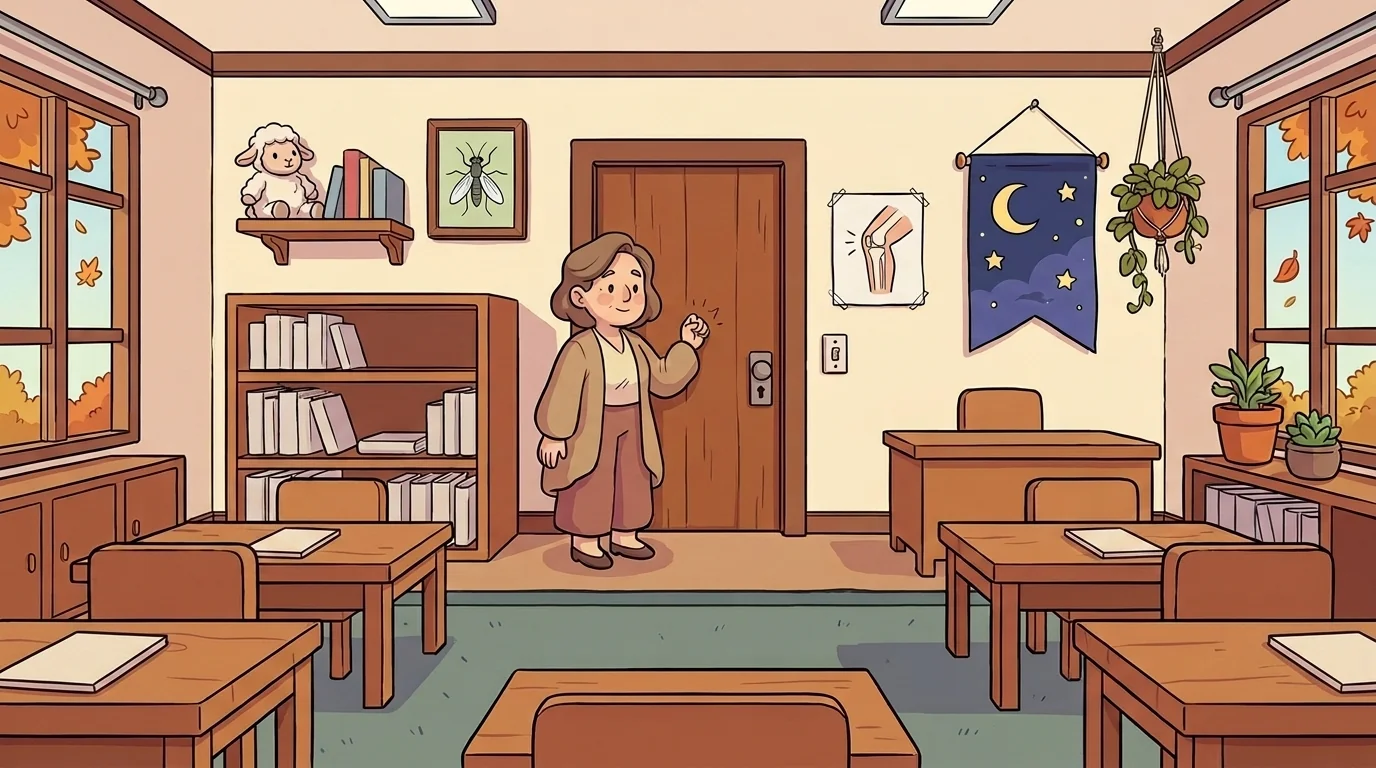
The children, after a few rounds of this, accept it. They stop asking. They start paying attention to the silent letters — which is, Hush has noticed, the whole point. By making the silent letters visible — by writing them on the board, pointing at them, explaining their history — Hush has given them a kind of voice. They have her voice. She does not need her own.
When children ask whether silent letters are hard to learn, Hush always writes the same answer:
"They are not hard. They are historical. Each silent letter was once spoken. The pronunciation changed. The spelling did not. Once you know that, the silent letters become memorable. The k in knee was once a /k/. The b in lamb was once a /b/. The gh in night was once a /x/ — a back-of-the-throat sound that English has lost. The spellings are the old language preserved in writing."
She still keeps the wooden slate and the chalk on her writing-table. The children sometimes ask to borrow them. She always lets them. She watches them write. She nods when they get it right.
She has never, in twenty-seven years, spoken a word at the academy. She has, however, taught more children to spell silent-letter words correctly than any other teacher in the academy's history.
And when a quiet child — the sort who never raises a hand, the sort who feels small and overlooked — finally spells one right and glances up at her, Hush feels something warm and steady unfold in her chest. It is a peaceful, glad feeling, and it seems to say: you do not have to be loud to matter. The silent letters have always known it. Now the child knows it too.
Hear it as an audio drama
A short play starring Hush, from QuillSpell. Different voices, same idea. Listen any time after you read.
Loading audio…
Read the drama script
- Narrator: From Spark and Anvil and QuillSpell — this is Hush, in chapter 1 of the QuillSpell cast.
- Narrator: This drama uses an AI-generated voice. Voiced via Gemini 2.5.
- Narrator: Hush is the quietest teacher at QuillSpell academy. She is small, slight, and seems almost translucent.
- Narrator: She communicates entirely by writing on a small wooden slate. She has never spoken a word.
- Hush: I have given my voice to the silent letters. They cannot speak, so I do not speak with them.
- Narrator: Hush teaches the letters in English that we no longer pronounce. The 'k' in knee, the 'g' in gnat, the 'w' in write.
- Hush: Silent letters are not hard. They are historical. Each one was once spoken, but the spelling did not change.
- Hush: The 'k' in knee was a real /k/ sound. The 'b' in lamb was a real /b/. The old language is preserved in the spelling.
- Narrator: Hush was not formally hired. She simply appeared one autumn day at the academy master’s door.
- Narrator: The master, a woman named Cur, asked Hush to state her purpose. Hush simply wrote on her slate.
- Hush: You have many silent letters in your curriculum. They need a teacher. I am the teacher.
- Narrator: The master considered this for a day, then appointed her. Hush was given a slate and chalk.
- Narrator: By being silent, Hush makes the silent letters visible. She gives them a kind of voice — her voice.
- Hush: A silent letter is just a story. Once you know that, they become memorable.
- Narrator: You've been listening to a Spark and Anvil chapter, written by the Spark and Anvil writing team for ages 9 to 14.
- Narrator: Apps stay free forever.
- Narrator: Curriculum aligned to Common Core English Language Arts.
- Narrator: Released under Creative Commons BY-NC-SA 4.0 for educational reuse. Visit Spark and Anvil for the full transcript.
The QuillSpell ensemble
Hush is one of the friends in QuillSpell. Each friend shows you one idea by how they act; meet them all and you have the whole subject.
-

Etyma
Latin Quarter — Latin roots (port, scrib, dict, vis, audi, port)
-

Sophia
Greek Acropolis — Greek roots (bio, geo, photo, log, graph, phon)
-

Birch
Germanic / Old English Grove — short, punchy Anglo-Saxon roots (mouth, hand, foot, hear, see, walk)
-

Saga
Old Norse Longhouse — northern roots (sky, take, gift, raise, weak, scant)
-

Margaux
French Chateau — Norman-French roots (royal, chef, ballet, garage, hotel, courage)
-

Zayn
Arabic Oasis — Arabic-origin English loans (algebra, algorithm, alchemy, zenith, sugar, cotton)
-

Twin
Double-consonant rule (running, beginning, hopped, planned — short-vowel-CVC + suffix)
-
Ember
Schwa-keeper (the unstressed-vowel "uh" — ‘about’, ‘pencil’, ‘lemon’, ‘circus’, ‘medium’)
-
Wren
Vowel-team duos (ai, ea, ee, oa, ow, ie, oi) — "when two vowels go walking"
-

Affix
Suffix-stack guardian (root + suffix + suffix: nation → national → nationalize → nationalization)
-

Cadence
Syllable-rhythm master (di-vid-ing words for spelling: VC/CV, V/CV, syl-lab-i-fi-ca-tion)