Margaux
NORMAN-FRENCH ROOTS
Loading audio…
Press play to listen along. The line being read lights up as you go.
Show full transcript
Loading transcript…
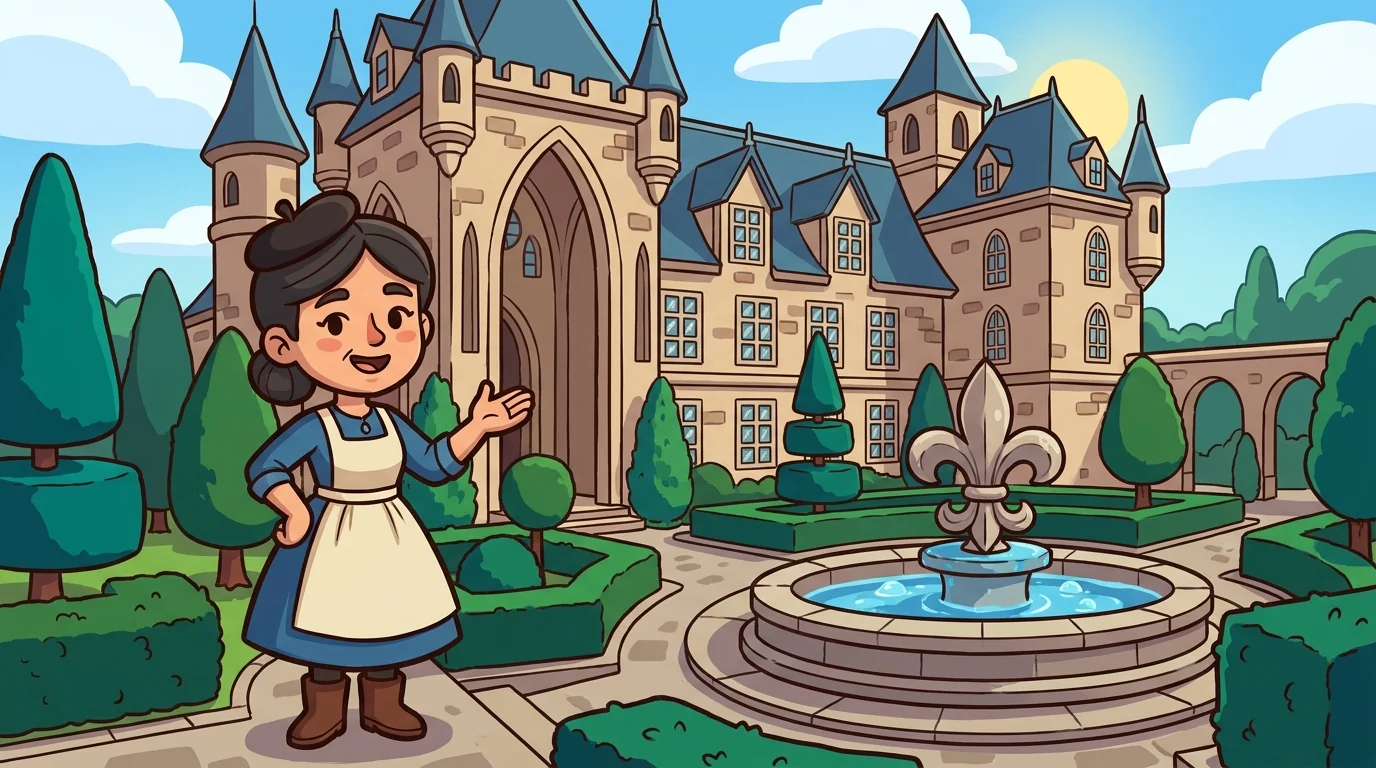
Margaux lived in the French Chateau.
This Chateau wasn't a real French chateau, of course. No actual French chateaux existed in the kingdom. But the academy's founders had wanted a French-roots neighborhood. So they built this place with high stone arches and tall, narrow windows. It looked like something from an old storybook. A small, formal garden sat out front. Academy gardeners kept the bushes clipped into perfect geometric patterns. This kind of garden was called a parterre. The Chateau stood on the academy's western edge. A fountain splashed gently in front, with a stone lily — a fleur-de-lys — carved into its center.
Margaux taught in the Chateau’s great hall. The hall had high ceilings that seemed to touch the sky. Sunlight streamed through the tall, narrow windows, landing on a long oak table in the middle. Old tapestries covered the walls. Retired teachers had donated them over the years. They showed scenes from all over the world: a fishing village by the sea, a deep forest in the north, a busy market in the desert. Even a medieval hunting party. The tapestries were ancient, and some edges had begun to fray.
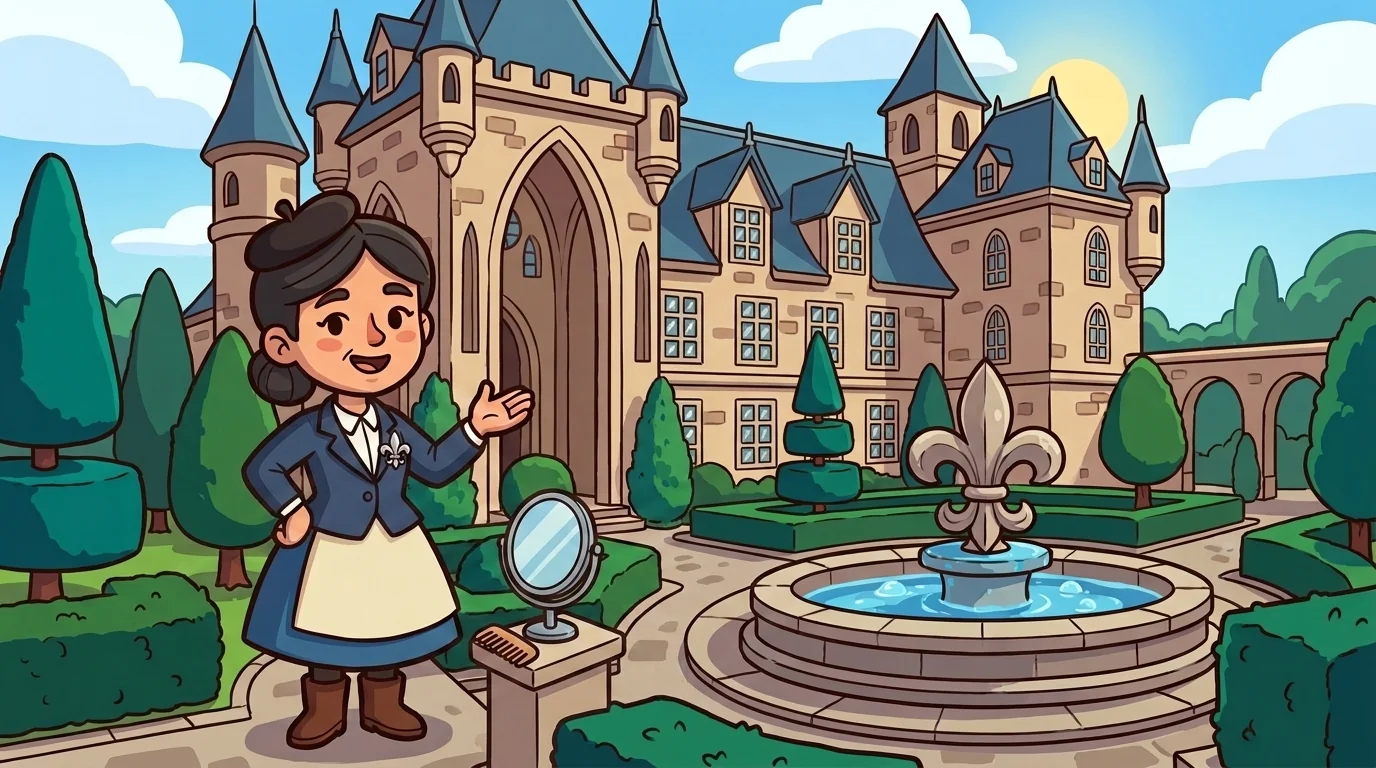
Margaux herself always looked perfectly put together.
If you asked, she would say it was "part of the Chateau's standards." This was the most formal part of the academy. Children coming for a lesson knew to brush their hair and straighten their collars. They did this before stepping inside. Margaux never scolded anyone. A small mirror hung by the door, and a comb rested on a side table. Most children, seeing these, understood the quiet expectation. Margaux always wore a navy-blue jacket and a crisp white blouse. A small silver pin, shaped like a fleur-de-lys, gleamed on her lapel. Her hair was always neatly arranged, not a strand out of place. She was a living example of the Chateau's quiet elegance.
Margaux’s real name was Marguerite. She grew up in a house where two languages were spoken at supper. One was the kingdom's common tongue. The other was a regional dialect, full of French-sounding words. Centuries ago, her family’s region had been part of a Norman-French duchy. That duchy was long gone, absorbed into the kingdom. But the local way of speaking still held onto many French words and sounds. Marguerite’s mother, Madeleine, insisted her children speak both clearly. The common tongue helped them get along in the world. The regional dialect honored their family tradition.
By the time she was a teenager, Marguerite had an incredibly sharp ear for words. She could hear tiny differences in how people pronounced things. French-derived words sounded different from Germanic-derived ones. Take the word garage. She noticed early on that it was French. But the kingdom’s southern dialect had changed it. They made it sound almost unrecognizable. The French way was gar-AHZH. It sounded clearer, more elegant, closer to its true beginning. The southern dialect’s GAR-ij always struck Marguerite as a little sad.
She would never say that aloud, of course. That would be rude. But when the chance came, she would gently say the French version. She hoped the people around her might notice.
They almost never did. Marguerite eventually accepted this. Still, she pronounced garage the French way. It was, she decided, her small daily contribution. A way to honor the word’s origin, one quiet syllable at a time.
When Marguerite was nineteen, she walked into the QuillSpell academy. She asked to be considered for the French-roots position. Lex, the head of the academy, interviewed her.
Lex leaned forward. "What is the etymology of royal?" she asked. Marguerite understood. Etymology meant the history of a word. "It comes from Old French, roial," she said. "From Latin, regalis. It means 'kingly' or 'of the king.' The word arrived in English with the Norman conquest. Before that, Old English had kynelic for 'kingly.' But the Norman nobles used roial. The English nobility started using it too. Royal became the fancy word. Kingly stayed the everyday word."
Lex nodded slowly. "And cuisine?"
"That's from Modern French, cuisine," Marguerite explained. "It means 'kitchen' or 'cooking.' It came into English much later, in the 1700s. French cooking was very popular back then. So cuisine kept its French pronunciation, kwee-ZEEN. We tend to keep the French sound when a word still feels very French. Think of garage, though. That word is older. Its pronunciation has become more English. But I am, personally, holding out for the French version."
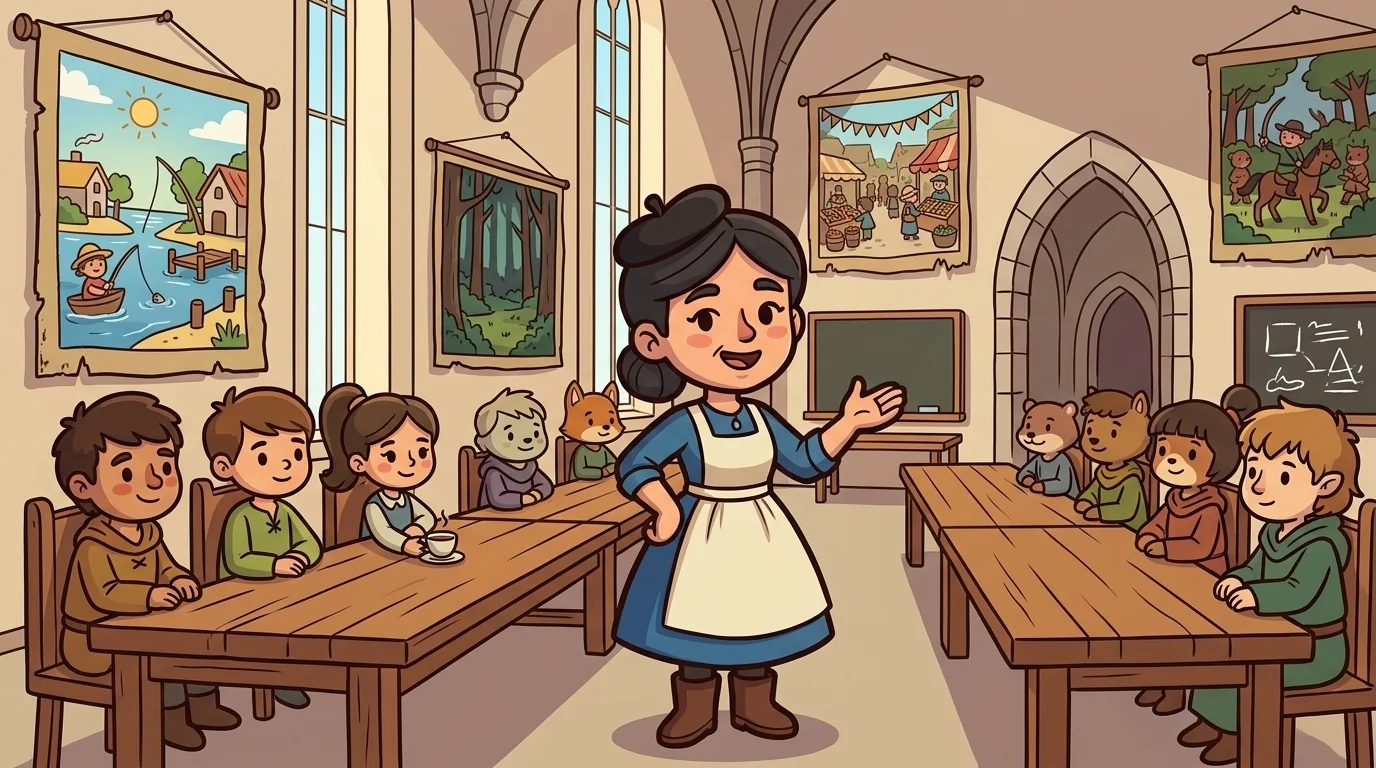
Lex set down her tea cup. A small smile touched her lips. "You are appointed to the Chateau," she said. "Take your academic name. Margaux — after the Bordeaux region. It honors your family's French heritage."
Marguerite became Margaux that day. She has been the Chateau's teacher for twenty-two years.
In the great hall, Margaux began every first-day lesson the same way. She stood by the long oak table, holding a small silver pin. It was shaped like a lily, a fleur-de-lys.
"This pin is a stylized lily," she would say. "In old French tradition, the lily was a symbol of royalty. It reminds me of the word royal. That's one of the most important French-derived words in English."
She explained how royal came into English. It arrived with the Norman conquest in 1066. Norman nobles brought their French words to England. Many words for how we govern, how we make laws, what we eat, and how we talk about art and fashion came this way.
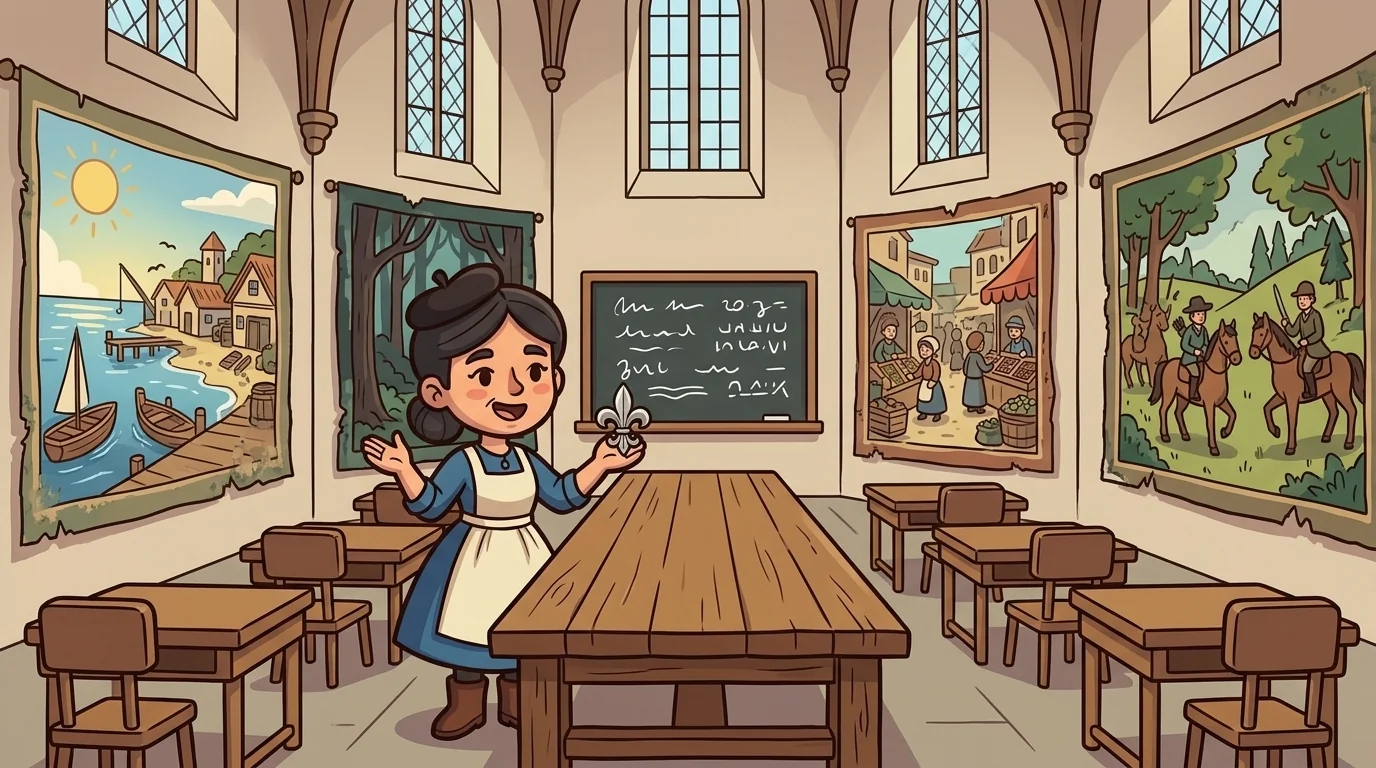
She would write the words on a slate. Royal, justice, jury, court, judge, attorney, parliament, government. "All these came from Norman-French," she'd say. Then she'd add more. Beef, pork, mutton, veal, poultry, cuisine. "All French." She'd list even more. Adventure, courage, marriage, beauty, courtesy. "Also French."
The list was huge, she pointed out. About thirty percent of all modern English words came from Norman-French. The old Germanic words formed the base of English. But the French words settled right on top, like a fancy frosting.
When children asked if French roots were hard to learn, Margaux always gave the same answer.
"They aren't hard at all," she'd say. "They are simply layered into English words in certain areas. Think about how we talk about government. That's Norman-French. Or law. Also Norman-French. What about food preparation? French. Fashion and high-culture? French again. The nobles in medieval England spoke French for two hundred years. The words they used became the important, fancy words for those topics. Once you spot the pattern, you start seeing French everywhere."
Margaux still wore the fleur-de-lys pin every day. Sometimes, children would ask to hold it. She always allowed them, but she was very strict about its return. The pin had belonged to her grandmother. It wasn't just a teaching prop; it was a personal heirloom. Still, she shared it, carefully.
Hear it as an audio drama
A short play starring Margaux, from QuillSpell. Different voices, same idea. Listen any time after you read.
Loading audio…
Read the drama script
- Narrator: From Spark and Anvil and QuillSpell — this is Margaux, in chapter 1 of the QuillSpell cast.
- Narrator: This drama uses an AI-generated voice. Voiced via Gemini 2.5.
- Narrator: Margaux lives in the Norman-French Quarter. It is the most elegant of the academy's quarters. Stone archways. Wrought-iron balconies. Cobblestones polished smooth by centuries of use. The words that live here arrived in English in 1066.
- Narrator: Margaux is a tall swan-tween. Graceful. Refined. She wears a long traveler's coat with brass buttons and carries a wooden walking-stick topped with a small silver swan. Her job is to guide visitors through the French-derived layer of English vocabulary.
- Margaux: I am Margaux. I am the Norman-French Quarter's guide. The roots that live here came into English at the Norman conquest. From William the Conqueror onward. French was the language of the court and the law and the kitchen, and it left its mark on thousands of English words.
- Narrator: After 1066, French was the language of England's ruling class for centuries. English peasants spoke Old English. French nobles spoke Norman French. Over time, the two languages blended. English borrowed thousands of French words — and many of them are still here.
- Margaux: Listen for the patterns. Words ending in -ION or -TION often came through me. NATION. STATION. COMPLETION. Words for cooked meat — BEEF, PORK, MUTTON, VEAL — came from me, while the living animals — COW, PIG, SHEEP, CALF — stayed Old English. That's because the Anglo-Saxon peasants tended the animals and the Norman lords ate the meat.
- Margaux: Words for law and government — ROYAL, JUSTICE, JURY, COURT, GOVERN, JUDGE — almost all came through me. Words for fashion and the arts — BALLET, COSTUME, COSTUME, GALLERY, MUSEUM — came through me. Words for fine cooking — CUISINE, RESTAURANT, MENU, SAUCE — came through me.
- Narrator: Margaux grew up in a small port town where French traders still came every spring. Her family were the tutors and translators — swans who helped local children read the French books in the town library.
- Margaux: By the time I was eight I had noticed something. Half the words in my history books came from the language across the channel. The court words. The kitchen words. The art words. All Norman.
- Narrator: She walked to the QuillSpell academy at seventeen. Headmistress Queen Vesper met her at the entrance.
- Queen Vesper: What is the Norman-French quarter?
- Margaux: The layer of English vocabulary that came in from Norman French after 1066. Royal. Justice. Jury. Court. Restaurant. Cuisine. Ballet. Costume. Most words for law, government, fine dining, and the arts come through me. They tend to be a syllable or two longer than the Old English equivalents, and many of them end in -tion or -ment or -age.
- Queen Vesper: You are appointed.
- Narrator: Margaux has been the academy's Norman-French teacher for years. She still carries the silver-swan walking-stick. She begins every first-day lesson the same way.
- Margaux: I am Margaux. The Norman layer. That is what the Norman-French quarter is. When you say RESTAURANT or COURT or JUSTICE, you're using one of my roots. When you order a CUISINE that comes with a SAUCE, both words came from me. When you go to a BALLET or visit a GALLERY, those words came from me.
- Margaux: Norman roots. Elegant register. Court, kitchen, arts. Arrived in 1066, still in use. That's the whole quarter. That's what makes Norman-French Norman-French.
- Narrator: You've been listening to a Spark and Anvil chapter, written by the Spark and Anvil writing team for ages 9 to 14.
- Narrator: Apps stay free forever.
- Narrator: Curriculum aligned to Common Core English Language Arts.
- Narrator: Released under Creative Commons BY-NC-SA 4.0 for educational reuse. Visit Spark and Anvil for the full transcript.
The QuillSpell ensemble
Margaux is one of the friends in QuillSpell. Each friend shows you one idea by how they act; meet them all and you have the whole subject.
-

Etyma
Latin Quarter — Latin roots (port, scrib, dict, vis, audi, port)
-

Sophia
Greek Acropolis — Greek roots (bio, geo, photo, log, graph, phon)
-

Birch
Germanic / Old English Grove — short, punchy Anglo-Saxon roots (mouth, hand, foot, hear, see, walk)
-

Saga
Old Norse Longhouse — northern roots (sky, take, gift, raise, weak, scant)
-

Zayn
Arabic Oasis — Arabic-origin English loans (algebra, algorithm, alchemy, zenith, sugar, cotton)
-

Hush
Silent-letter clan (kn-, gn-, wr-, mb, gh, pn-, ps-)
-

Twin
Double-consonant rule (running, beginning, hopped, planned — short-vowel-CVC + suffix)
-

Ember
Schwa-keeper (the unstressed-vowel "uh" — ‘about’, ‘pencil’, ‘lemon’, ‘circus’, ‘medium’)
-
Wren
Vowel-team duos (ai, ea, ee, oa, ow, ie, oi) — "when two vowels go walking"
-

Affix
Suffix-stack guardian (root + suffix + suffix: nation → national → nationalize → nationalization)
-

Cadence
Syllable-rhythm master (di-vid-ing words for spelling: VC/CV, V/CV, syl-lab-i-fi-ca-tion)