
Crosscut
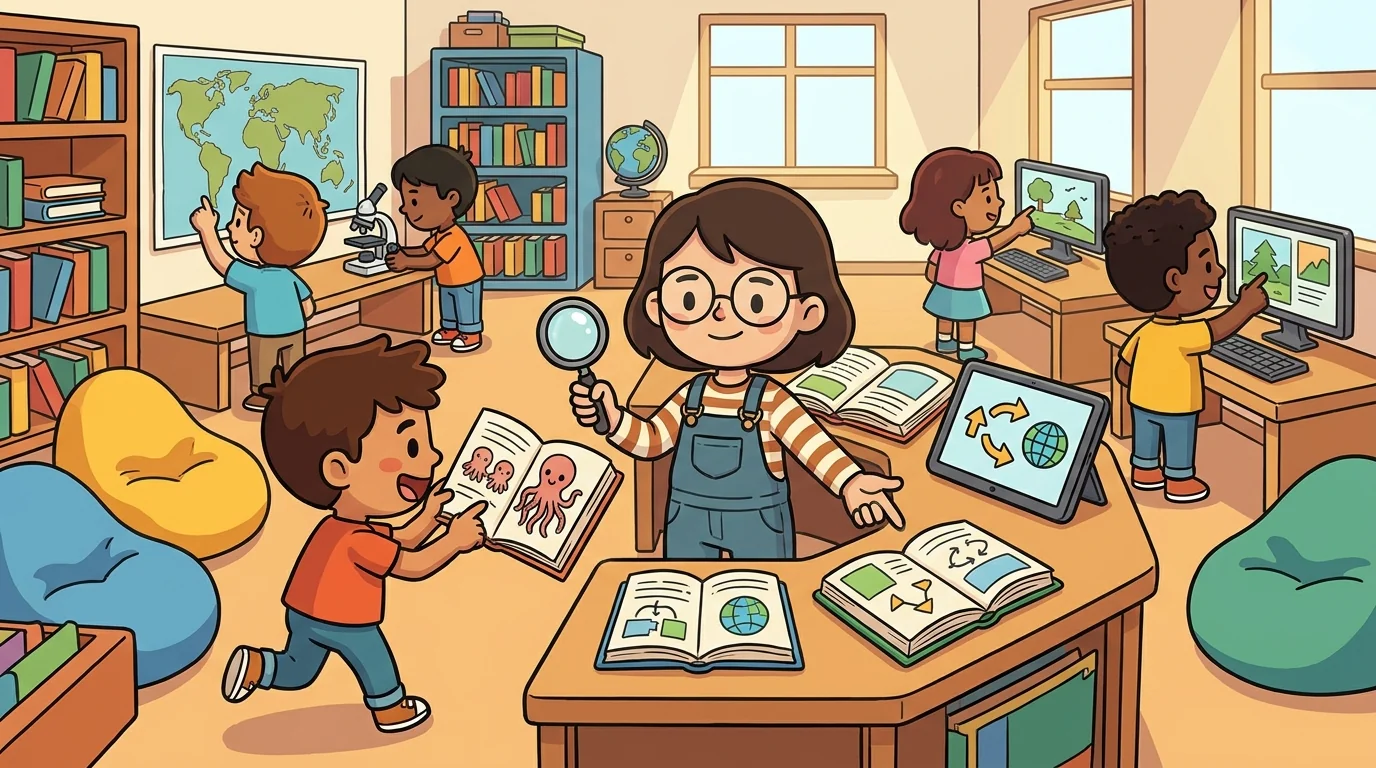
CROSS-CHECKING — don't trust one; cross to another. If several unrelated sources agree, the claim holds; if only one page says it, be careful.
Listen along — Crosscut
Loading audio…
Press play to listen along. The line being read lights up as you go.
Show full transcript
Loading transcript…
Chapter 6 — Crosscut and the Discipline of the Independent Check
At the ResearchQuest club, where every kid who investigated counted as a real researcher, Crosscut gathered the older members to explain the one habit she never broke: she never believed a surprising claim from a single page. “You’ve watched me do it,” she said, calm and sharp-eyed. “Someone runs in with ‘octopuses have nine brains!’ and I don’t say wow and I don’t say no way — I say let’s cross-check. Today I’ll show you the actual method underneath that, because cross-checking done carelessly is worse than not checking at all.”
She wrote a claim on the board and drew three arrows out from it. “Researchers call this corroboration or triangulation — you confirm a claim by finding it in several sources. But here’s the trap almost everyone falls into: they find the same claim on three websites, feel reassured, and stop. The question they forgot to ask is: are those three sources actually independent? If all three copied it from the same original — one press release, one Wikipedia line, one viral post — then you don’t have three witnesses. You have one witness, quoted three times. Three copies of one mistake is still one mistake. So the real skill isn’t counting how many places say it. It’s checking whether those places knew it separately.”
A careful club member named Tess frowned. “But how can you tell if they’re independent?”
“You trace their wording and their sources,” Crosscut said. “If three pages use the exact same phrasing, that’s a tell — they copied, they didn’t confirm. If each one cites a different origin — one points to a marine-biology study, another to an aquarium’s own records, a third to a researcher’s interview — now you’ve got genuinely independent lines pointing at the same fact, and that’s when it holds. Independence is the whole game. Two strong, unrelated sources that agree are worth more than ten that are all echoing one blog.”
She named the working discipline. “So my rule has three steps. First, when you find a claim, leave the page it’s on — don’t decide anything while you’re still staring at the one source that made you excited. Second, go find sources that reached it by a different road — different authors, different original data, ideally different kinds of source. Third, weigh the agreement honestly: several independent sources agree → the claim is solid; they disagree → dig into why before you pick a side; only the one page says it → treat it as unconfirmed, not false, but not yet trustworthy either. Unconfirmed isn’t a crime. Pretending unconfirmed is confirmed — that’s the mistake that ends up in your project.”
Crosscut had learned it the embarrassing way, and she told them so. Early on she’d built a whole project around one striking ‘fact’ she’d found stated so confidently, in such official-looking language, that she never thought to check it — and when a club mentor asked where it came from, the trail led to a single unsourced post that had simply made it up. “I’d trusted the confidence, not the corroboration,” she said. “The page sounded so sure. But sounding sure isn’t evidence — it’s just tone.” The sting of that had turned into her steadiest habit, and the never-trust-one, always-cross feeling settled into a calm, unshakeable ground.
“So when a claim makes you go wow — that’s exactly the moment to slow down,” Crosscut finished. “The more surprising the claim, the more independent confirmation it needs before it earns a place in your work. Leave the page. Find sources that got there on their own. And never mistake three echoes for three witnesses. Don’t trust one — cross to another, and make sure the other really is another.”
The ResearchQuest ensemble
Crosscut is part of ResearchQuest's distributed-narrative cast. Each character embodies a different curricular primitive; together they teach the full subject.
-

Wonder
Question-formulation — narrowing vague interest into focused, answerable research questions
-

Vet
Source-evaluation — CRAAP test (Currency, Relevance, Authority, Accuracy, Purpose)
-

Quote
Note-taking — quoting + paraphrasing + summarizing; keeping voices separate
-

Synth
Synthesis — combining evidence across multiple sources; finding agreement, disagreement, gaps
-

Tether
Citation — attribution + bibliography; gratitude + map back to sources
-

Survey
Background reading — read around a topic to learn the lay of the land before narrowing (W.7)
-

Trawl
Search strategy — cast a wide net of keywords, then pull it tight; refine when it comes back wrong (W.8)
-

Verdict
Forming a thesis — gather the evidence, then take a stand; 'here's what I think, and here's why' (W.1)
-

Wellspring
Primary vs secondary sources — trace a claim upstream to its original, firsthand source