
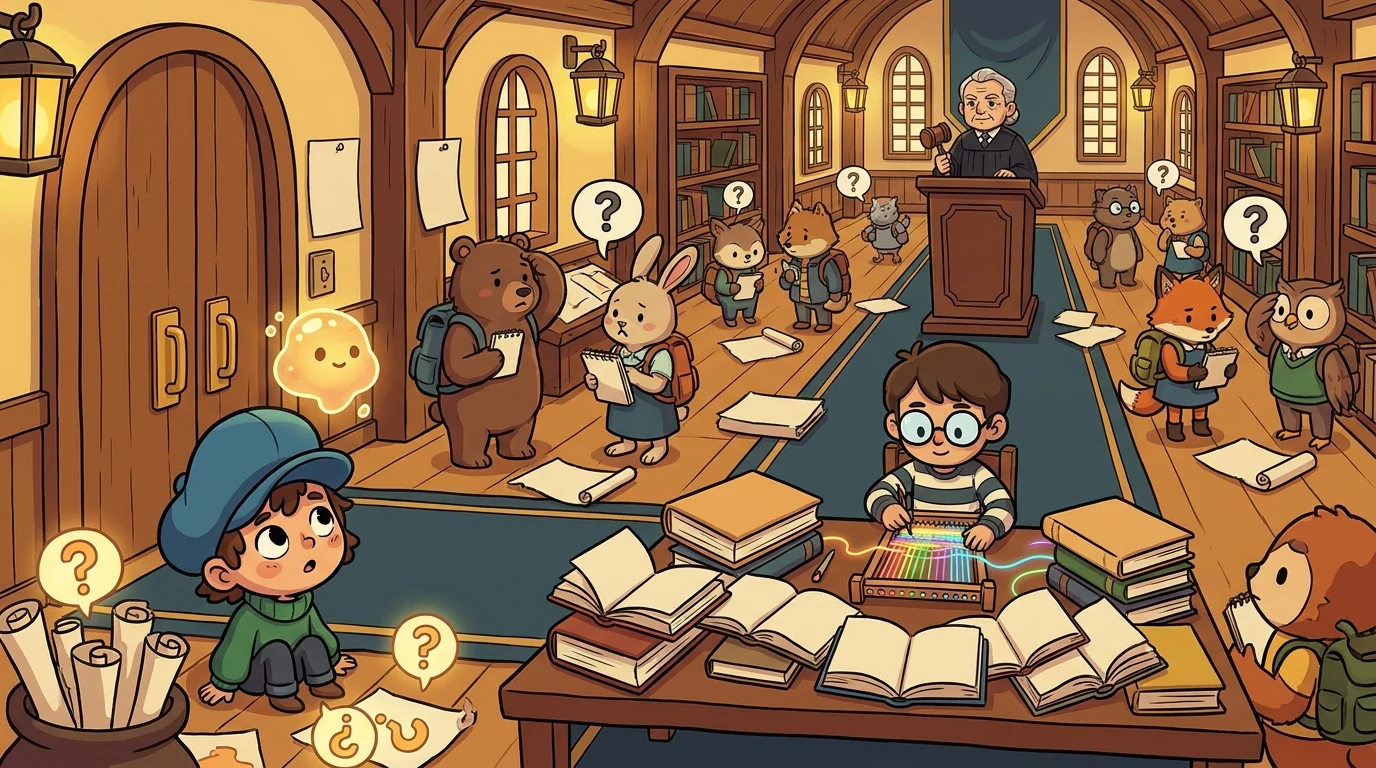
Wonder, Synth and Verdict
FROM WONDER TO VERDICT — research starts by turning a big vague interest into one focused, answerable question (Wonder), then combines what many sources say into a whole picture (Synth), then weighs the evidence and takes an honest stand (Verdict).
Listen along — Wonder, Synth and Verdict
Loading audio…
Press play to listen along. The line being read lights up as you go.
Show full transcript
Loading transcript…
Chapter 15 — Wonder, Synth, and Verdict, and the Whole Journey
At the ResearchQuest club, a new member named Pilar was overwhelmed. “Research is just… looking stuff up until you have enough, right?” she said. Three older researchers — Wonder, Synth, and Verdict — traded a look, because that sentence contained the exact misunderstanding that stalls most projects. “It’s not one lump,” said Wonder. “It’s a journey with stages. Let us walk you through ours — in order, because the order is the whole secret.”
Wonder went first, wide-eyed and eager. “It starts with me — but not the way people think. Pilar, what do you want to research?” “The ocean!” Pilar said. Wonder grinned. “That’s an interest, not a question — it’s a whole sea, you can’t research a whole sea. My job is turning a big vague interest into one focused, answerable question. Not ‘the ocean,’ but maybe ‘why is the ocean getting more acidic, and what does it do to shellfish?’ A good question is narrow enough to answer, real enough to care about, and open — it doesn’t already assume its answer. Get the question right and everything after it has a target. Get it wrong and you’ll research forever and never arrive.”
“And once Wonder hands me a real question,” said Synth, “I take over the middle — the longest part.” She spread her hands as if holding many threads. “My job is synthesis — and synthesis is not collecting. Anyone can pile up facts. I combine them into a whole picture: I read many sources, I notice where they agree and where they clash, I group what I find into themes, and I build a single understanding out of the pieces. A pile of quotations isn’t research — it’s a pile. Synthesis is when the pile becomes a view — ‘here is what the evidence, taken all together, seems to show.’ I’m the one who turns twenty sources into one coherent map.”
“But a map isn’t a destination,” said Verdict, steady and thoughtful, “so I take the last step — the one everyone wants to skip. Synth hands me the whole picture, and I have to weigh it and decide. My job is the thesis — an arguable stand of your own: not ‘here’s what people say,’ but ‘here’s what I think is true, and here’s why.’ It’s the scary part, because it means committing. But research that never reaches a verdict isn’t finished — it’s just collecting that got tired and stopped. I turn Synth’s picture into a claim you can actually defend.”
Pilar looked at the three of them, and the lump finally came apart into steps. “So it’s not ‘look stuff up until I have enough.’ It’s: Wonder sharpens a real question, Synth builds a whole picture out of many sources, and Verdict weighs it and takes a stand — in that order.” “In that order,” Wonder agreed. “Skip me and you research a fog. Skip Synth and you’ve got a pile, not a picture. Skip Verdict and you never actually say anything.” Synth nodded. “And when you get stuck — and you will — naming which stage you’re in is how you get unstuck. Lost? You’re missing a question — go back to Wonder. Drowning in notes? You’re skipping synthesis — come to me. Can’t finish? You’re afraid of the verdict — that’s Verdict’s wall, and it’s crossable.” The three of them walked Pilar’s ocean question through all three stages that afternoon, and by the end she wasn’t looking things up in a fog — she was on a journey, and she knew exactly where she stood on it.
The ResearchQuest ensemble
Wonder, Synth and Verdict is part of ResearchQuest's distributed-narrative cast. Each character embodies a different curricular primitive; together they teach the full subject.
-

Wonder
Question-formulation — narrowing vague interest into focused, answerable research questions
-

Vet
Source-evaluation — CRAAP test (Currency, Relevance, Authority, Accuracy, Purpose)
-

Quote
Note-taking — quoting + paraphrasing + summarizing; keeping voices separate
-

Synth
Synthesis — combining evidence across multiple sources; finding agreement, disagreement, gaps
-

Tether
Citation — attribution + bibliography; gratitude + map back to sources
-

Survey
Background reading — read around a topic to learn the lay of the land before narrowing (W.7)
-

Trawl
Search strategy — cast a wide net of keywords, then pull it tight; refine when it comes back wrong (W.8)
-

Crosscut
Lateral reading / corroboration — don't trust one page; cross-check a claim across independent sources
-

Verdict
Forming a thesis — gather the evidence, then take a stand; 'here's what I think, and here's why' (W.1)
-

Wellspring
Primary vs secondary sources — trace a claim upstream to its original, firsthand source