
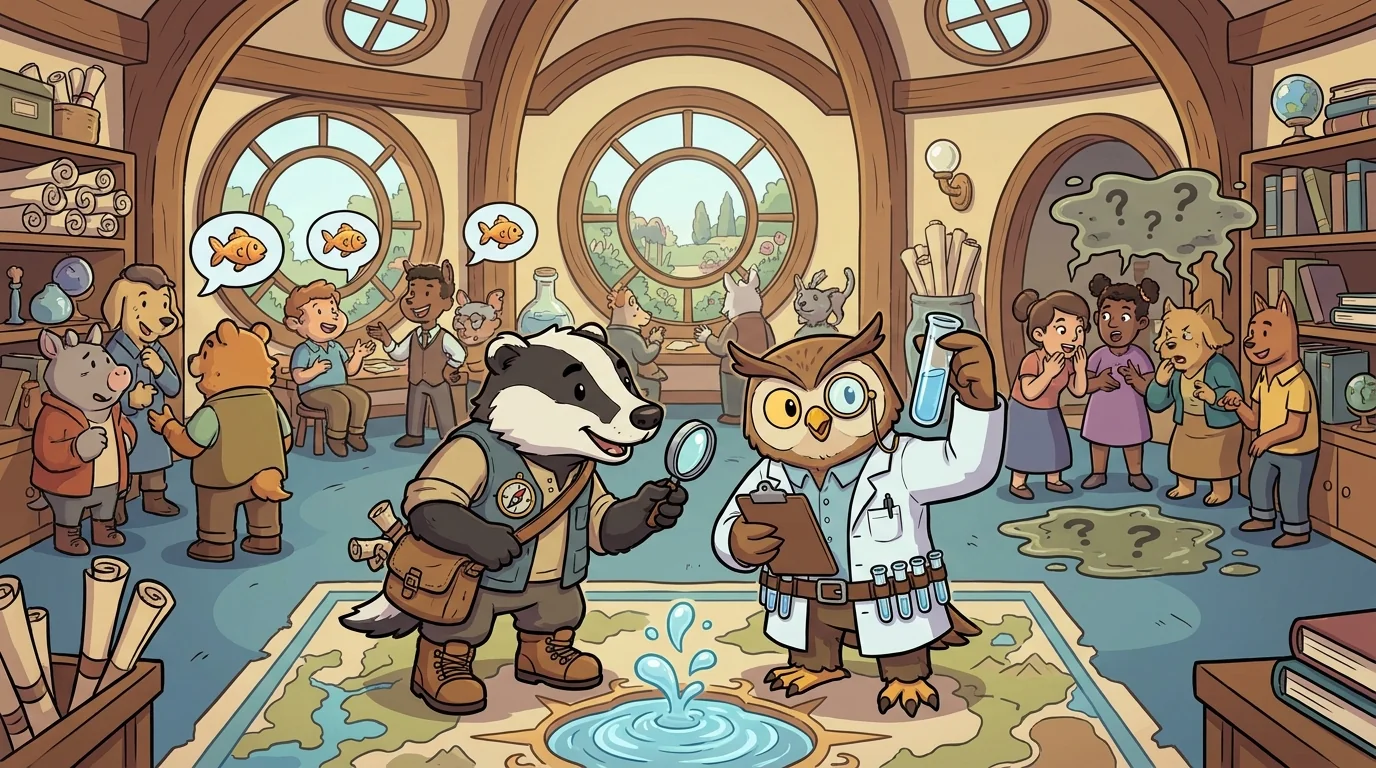
Wellspring and Vet
PUDDLE OR SPRING — a fact is only as good as where it comes from: Wellspring traces a claim back to its original source instead of a puddle downstream, and Vet checks that source for currency, authority, and honesty before you trust it — find the spring, then test the water.
Listen along — Wellspring and Vet
Loading audio…
Press play to listen along. The line being read lights up as you go.
Show full transcript
Loading transcript…
Chapter 16 — Wellspring and Vet and the Two Questions About a Fact
At the ResearchQuest club, a member named Cole held up a striking claim he’d found. “It’s from the original source,” he said proudly. “So it’s true, right?” Wellspring and Vet — who always worked as a pair — traded a glance, because Cole had done half of the two-part discipline and thought it was the whole thing. “Finding the spring is the first question,” said Wellspring. “But there’s a second,” said Vet. “Let us show you why a fact needs both of us.”
Wellspring went first, tracing her familiar river. “My job is where did this come from? Most claims you meet are downstream — a page repeating an article repeating a study. So I follow the citation chain back, past retelling after retelling, until I reach the primary source: the original data, the firsthand account, the actual document. Because facts drift as they travel — each retelling rounds off or mis-hears — so I never trust the puddle where I found a claim; I walk upstream to the spring. Cole did this well. He found the original. That’s real work, and it’s necessary.” She turned to Vet. “But it isn’t sufficient.”
“Right — because being the original doesn’t make it trustworthy,” said Vet. “That’s my question: can this source be trusted? An original source can still be out of date, written by someone with no expertise, sloppy with its facts, or pushing an agenda. So I run the CRAAP test — five checks. Currency: is it recent enough for this topic? Relevance: does it actually fit my question? Authority: who made it, and do they know this field? Accuracy: is it supported, careful, checkable? Purpose: why was it made — to inform, or to sell or persuade? A primary source that fails these is still a puddle, even if it’s the original puddle.”
Cole blinked. “So a source can be the real original… and still not trustworthy?” “Exactly,” said Vet. “Imagine the firsthand account is a hundred years out of date for a science question, or the ‘original study’ was written by a company selling the very thing it praises. It’s primary — and you still shouldn’t lean on it. Finding the spring tells you where the water starts. Testing the water tells you whether it’s safe to drink. You need both answers before you build your work on a fact.” Wellspring nodded. “Trace-to-source without evaluation trusts any old original. Evaluation without tracing tests whatever puddle you happened to land in. Neither half is enough alone.”
Cole looked at the two of them and finally saw why they were always together. “So for every fact that matters: Wellspring, where did it come from — walk it back to the spring. Then Vet, can that spring be trusted — run the CRAAP test on it.” “Both questions, in that order,” said Wellspring. “Find the spring.” “Then test the water,” said Vet. “A fact is only as good as where it comes from — and whether that source holds up.” The three of them took Cole’s striking claim through both steps that afternoon: upstream to its origin, then through the five checks — and only when it passed both did Cole finally write it into his project, this time knowing exactly why he trusted it.
The ResearchQuest ensemble
Wellspring and Vet is part of ResearchQuest's distributed-narrative cast. Each character embodies a different curricular primitive; together they teach the full subject.
-

Wonder
Question-formulation — narrowing vague interest into focused, answerable research questions
-

Vet
Source-evaluation — CRAAP test (Currency, Relevance, Authority, Accuracy, Purpose)
-

Quote
Note-taking — quoting + paraphrasing + summarizing; keeping voices separate
-

Synth
Synthesis — combining evidence across multiple sources; finding agreement, disagreement, gaps
-

Tether
Citation — attribution + bibliography; gratitude + map back to sources
-

Survey
Background reading — read around a topic to learn the lay of the land before narrowing (W.7)
-

Trawl
Search strategy — cast a wide net of keywords, then pull it tight; refine when it comes back wrong (W.8)
-

Crosscut
Lateral reading / corroboration — don't trust one page; cross-check a claim across independent sources
-

Verdict
Forming a thesis — gather the evidence, then take a stand; 'here's what I think, and here's why' (W.1)
-
Wellspring
Primary vs secondary sources — trace a claim upstream to its original, firsthand source