
Survey
BACKGROUND READING — read around it before you dig in; learn the lay of the land before you narrow the question.
Listen along — Survey
Loading audio…
Press play to listen along. The line being read lights up as you go.
Show full transcript
Loading transcript…
Chapter 6 — Survey and the Map You Draw Before the Dig
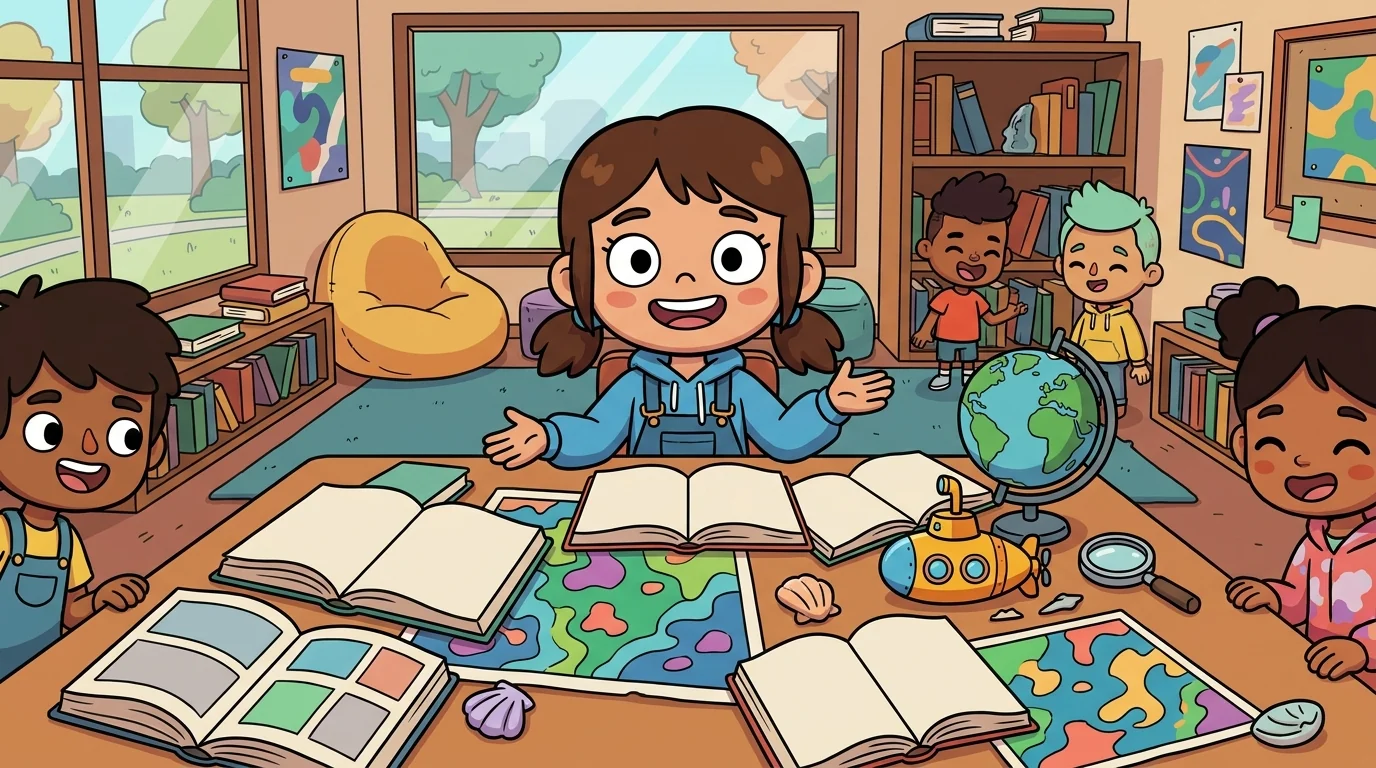
At the ResearchQuest club, where kids learned that anyone who investigates is a real researcher, Survey gathered the older members to defend the part of research everyone wants to skip: the beginning, before you even know what your question is. “You’ve seen me do it,” she said, easy and wide-eyed. “Someone shows up buzzing — ‘I want to research the ocean!’ — and instead of forcing them to narrow it right away, I go exploring with them first. Today I’ll show you why that isn’t wasting time. It’s the step that makes every step after it possible.”
She drew a huge blank circle on the board. “This is your topic when you start — a big, foggy shape you can barely see the edges of. Now, the instinct everyone has is to narrow fast — pick a specific question in the first five minutes so you feel like you’re ‘really researching.’ But a question you ask before you understand the topic is almost always a bad question — too broad, or based on a wrong assumption, or aimed at a corner that turns out to be a dead end. Researchers have a name for the fix: background reading, or a pre-search survey. Before you narrow, you read widely — a little about this, a little about that — to learn the lay of the land.”
A quick club member named Reed shifted impatiently. “But that feels like not-real research. Like I’m just… browsing.”
“It feels that way, and it’s the opposite,” Survey said. “Here’s what the wide reading actually gives you, and none of it is browsing. First, the vocabulary — every field has words that unlock its good sources, and you can’t search well for a thing you can’t name. Second, the big pieces — what are the main parts of this topic, so you can see which corner is even worth narrowing to. Third, what’s already known versus what’s still argued — so you don’t spend a week ‘discovering’ something every source states in its first paragraph, or accidentally pick a question no one can answer yet. And fourth, a sense of scale — is this a topic for one paragraph or one lifetime? You can’t tell until you’ve walked its edges.”
She named the discipline. “So the move is: read broad before you read deep. Start with the overview sources — an encyclopedia entry, a good survey article, the introduction of a solid book — the ones that give you the whole shape fast, even though you’ll never cite them as your main evidence. Take light notes on the landscape, not the details. And only then, when the fog has lifted and you can see the parts, do you narrow — because now your question can be sharp, answerable, and aimed at a corner you actually know is there.”
Survey had learned it by skipping it, and she admitted it freely. Her first big project, she’d narrowed in the first two minutes to a question that had sounded brilliant and turned out to be built on a total misunderstanding of the topic — she’d wasted two weeks before she realized she’d been asking something that didn’t even make sense. “If I’d spent one afternoon reading around it first,” she said, “I’d have seen the mistake before I built on it.” The frustration of that had become her calmest habit, and the must-narrow-immediately feeling eased into the patient pleasure of getting the lay of the land first.
“So resist the rush to a sharp question,” Survey finished, tapping the big foggy circle. “Read around your topic until you can see its shape — its words, its parts, its known-and-argued, its size. Then narrow. A sharp question aimed at a landscape you understand is worth more than ten clever questions aimed at fog. Read around it before you dig in.”
The ResearchQuest ensemble
Survey is part of ResearchQuest's distributed-narrative cast. Each character embodies a different curricular primitive; together they teach the full subject.
-

Wonder
Question-formulation — narrowing vague interest into focused, answerable research questions
-

Vet
Source-evaluation — CRAAP test (Currency, Relevance, Authority, Accuracy, Purpose)
-

Quote
Note-taking — quoting + paraphrasing + summarizing; keeping voices separate
-

Synth
Synthesis — combining evidence across multiple sources; finding agreement, disagreement, gaps
-

Tether
Citation — attribution + bibliography; gratitude + map back to sources
-
Trawl
Search strategy — cast a wide net of keywords, then pull it tight; refine when it comes back wrong (W.8)
-

Crosscut
Lateral reading / corroboration — don't trust one page; cross-check a claim across independent sources
-

Verdict
Forming a thesis — gather the evidence, then take a stand; 'here's what I think, and here's why' (W.1)
-
Wellspring
Primary vs secondary sources — trace a claim upstream to its original, firsthand source