
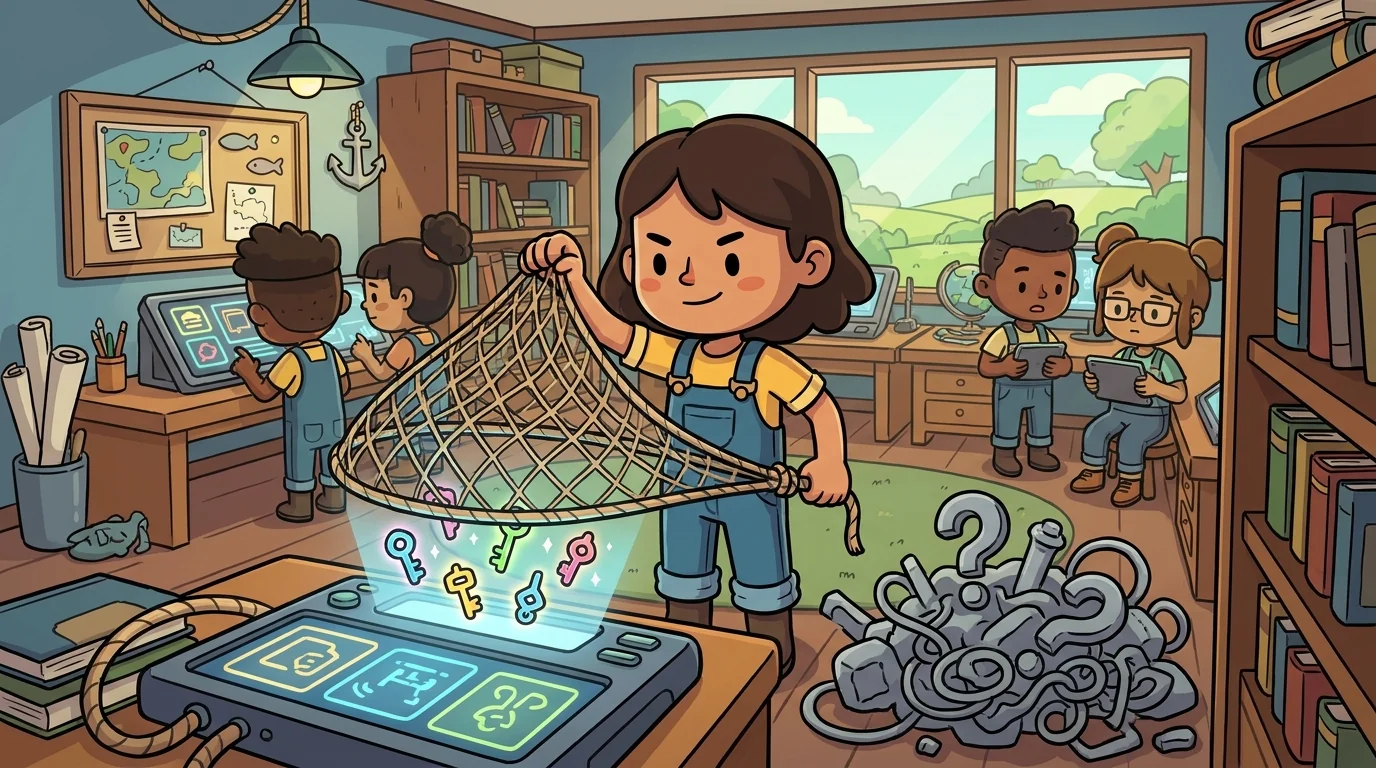
Trawl
SEARCH STRATEGY — cast a wide net, then pull it tight; choose strong keywords, know where to look, and refine when the first net comes back wrong.
Listen along — Trawl
Loading audio…
Press play to listen along. The line being read lights up as you go.
Show full transcript
Loading transcript…
Chapter 6 — Trawl and the Net You Cast on Purpose
At the ResearchQuest club, where every curious kid counted as a real researcher, Trawl rolled up her sleeves and gathered the older members around the search box, because searching was the skill everyone thought they already had and almost nobody did well. “You’ve seen the disaster,” she said. “Someone types their whole question — ‘why do volcanoes erupt and is it dangerous to live near one’ — into the box and gets buried under a thousand useless results. Searching like that is throwing a fishing line anywhere and hoping. Today I’ll show you how to fish on purpose.”
She wrote the messy full-sentence search on the board, then crossed most of it out. “First move: strong keywords, not sentences. A search engine doesn’t understand your question the way a person would — it matches words. So the sentence buries the two or three words that actually matter under a dozen that don’t (‘why,’ ‘do,’ ‘is,’ ‘it,’ ‘to’). Pull out the load-bearing terms — volcano, eruption, cause — and search those. Fewer, stronger words, a tighter net. And use the field’s real vocabulary once you know it: ‘magma,’ ‘tectonic plates’ will catch better sources than ‘hot melty rock.’”
A club member named Jae leaned in. “Is there a trick to make the net tighter?”
“Several, and they’re worth learning,” Trawl said. “Quotation marks lock an exact phrase — \"ocean acidification\" finds that phrase together, not the two words scattered. Adding a word narrows; removing one widens — if you get too much, add a term; too little, drop one. And the biggest one nobody teaches you: where you cast matters as much as how. The open web is one fishing ground, but it’s not the only one — your library’s databases hold vetted articles the open web won’t surface, and they let you filter by date, by type, by whether it’s been reviewed. Choosing the right pond is half of a good catch. A great search in the wrong place still comes back empty.”
She named the discipline that ties it together. “Here’s the mindset shift that changes everything: your first search is a draft, not a verdict. Beginners cast once, get bad results, and conclude ‘there’s nothing on this.’ Experts expect to refine — cast the net, read what comes back, notice which words the good results use, and re-cast with better terms. Cast wide first to see the shape of what’s out there, then pull it tight with the vocabulary you just learned. Three or four refined casts will out-fish a hundred lazy ones.”
Trawl had learned it by drowning in results, and she said so plainly. Her first real project, she’d typed paragraph-long questions into the box, gotten ten thousand hits, skimmed the useless first page, and decided the topic was ‘too hard to find anything on’ — when really she’d just been fishing with the whole tackle box dumped in the water. A mentor showed her three keywords and one database, and the same ‘empty’ topic filled with exactly what she needed. The helplessness of that had become her practical confidence, and the throw-it-all-in-and-hope feeling sharpened into the calm of a well-aimed cast.
“So don’t pour your whole question in and don’t give up after one try,” Trawl finished, sleeves still rolled. “Pick the strong words. Use quotes and add-or-drop to tune the net. Choose the right pond — the open web and the databases. And treat every search as a draft you’ll refine. Cast wide, then pull it tight. That’s fishing on purpose.”
The ResearchQuest ensemble
Trawl is part of ResearchQuest's distributed-narrative cast. Each character embodies a different curricular primitive; together they teach the full subject.
-

Wonder
Question-formulation — narrowing vague interest into focused, answerable research questions
-

Vet
Source-evaluation — CRAAP test (Currency, Relevance, Authority, Accuracy, Purpose)
-

Quote
Note-taking — quoting + paraphrasing + summarizing; keeping voices separate
-

Synth
Synthesis — combining evidence across multiple sources; finding agreement, disagreement, gaps
-

Tether
Citation — attribution + bibliography; gratitude + map back to sources
-

Survey
Background reading — read around a topic to learn the lay of the land before narrowing (W.7)
-

Crosscut
Lateral reading / corroboration — don't trust one page; cross-check a claim across independent sources
-

Verdict
Forming a thesis — gather the evidence, then take a stand; 'here's what I think, and here's why' (W.1)
-
Wellspring
Primary vs secondary sources — trace a claim upstream to its original, firsthand source