
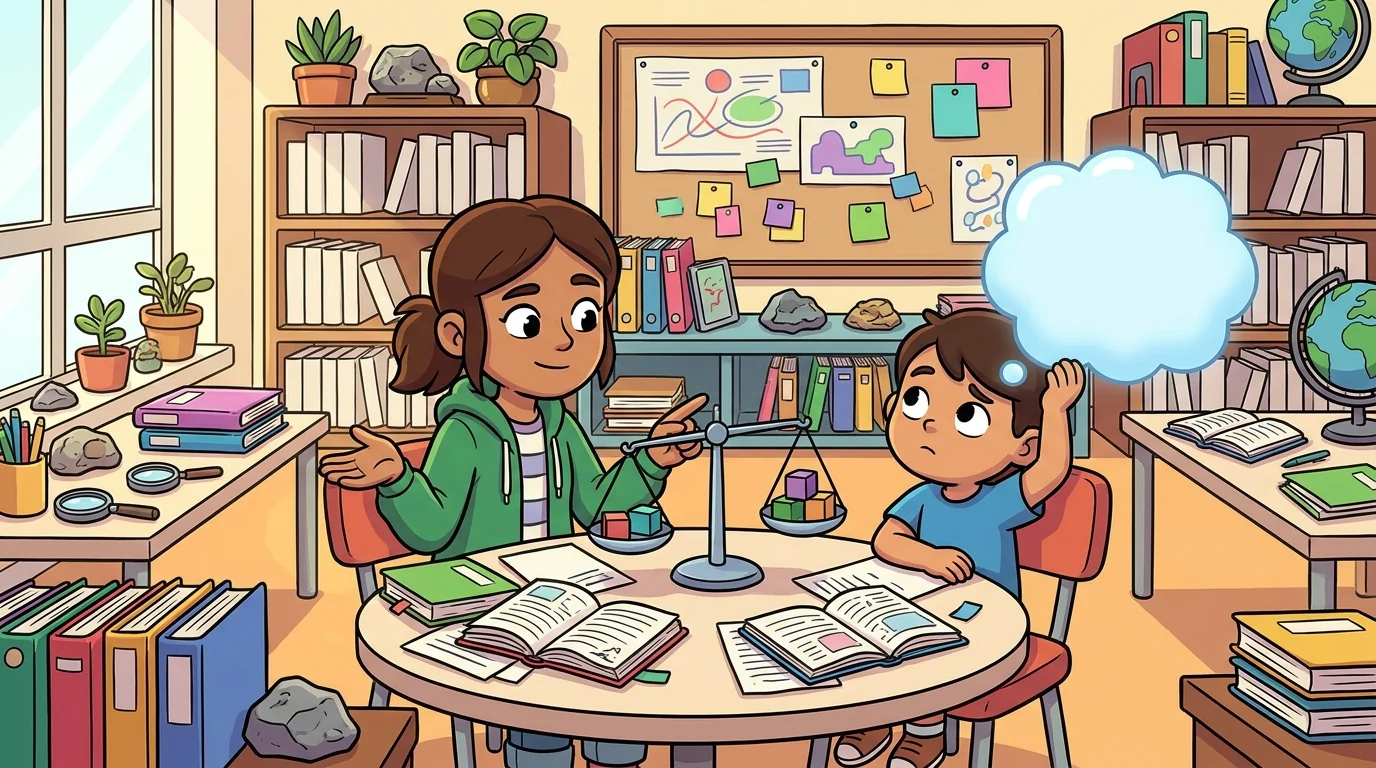
Verdict
FORMING A THESIS — gather the evidence, then take a stand; commit to your OWN arguable answer, not just 'here are things people say.'
Listen along — Verdict
Loading audio…
Press play to listen along. The line being read lights up as you go.
Show full transcript
Loading transcript…
Chapter 6 — Verdict and the Moment You Have to Decide
At the ResearchQuest club, where every kid who investigated was a real researcher, Verdict gathered the older members for the hardest moment in any project — the one where you stop collecting and finally have to say what you think. “You’ve all hit this wall,” he said, steady and thoughtful. “You’ve got a mountain of notes and you’re stuck: ‘I found SO many facts, but I don’t know what to say.’ That stuck feeling isn’t a sign you need more facts. It’s the sign you’ve reached the real work. Today I’ll show you how to cross it — how to turn a pile of evidence into a thesis.”
He stacked a tall pile of index cards on the table. “Here’s the mistake that keeps people stuck forever: they think the goal is to report — to arrange all the facts neatly and let them speak for themselves. But facts don’t speak. A report that says ‘some people say this, others say that, here’s a bunch of information’ has no spine. A thesis is the spine: your own arguable answer to your question. Not ‘here are things people say’ — but ‘here’s what I think is true, and here’s why.’ Research isn’t finished when the collecting stops. It’s finished when you’ve weighed what you found and committed.”
A thoughtful club member named Mara looked nervous. “But what if I’m wrong? Isn’t it safer to just report what the sources say?”
“Safer, and empty,” Verdict said gently. “Here’s the test for a real thesis, and it’s a strange one: it has to be arguable. If no reasonable person could possibly disagree with your statement — ‘volcanoes are hot,’ ‘reading is important’ — it’s not a thesis, it’s a fact, and there’s nothing to write about it. A thesis is a claim a thoughtful person could push back on — which is exactly what makes it worth defending. Being arguable isn’t a weakness; it’s the whole point. And ‘what if I’m wrong’ has a good answer: a thesis isn’t a guess you’re stuck with. It’s a stand you support with the evidence you gathered, and if the evidence genuinely points the other way, you change the thesis. Taking a stand doesn’t mean pretending to be certain. It means being honest about where the evidence leads and brave enough to say it.”
He named the move. “So the method is three steps. First, weigh, don’t just stack — sort your evidence by what it actually shows, not by the order you found it, and notice where it points. Second, state an arguable claim — one sentence a reasonable person could dispute, answering your question with your answer. Third, line the evidence up behind it — this is why, and here’s the source, and here’s the counter-argument I’ve considered and why my claim still holds. A thesis with its evidence marching behind it is what turns a pile of notes into an actual piece of research.”
Verdict had learned it by hiding, and he told them so. For his first several projects he’d written pure reports — heaps of ‘some say / others say’ — because taking a stand felt risky and reporting felt safe, and every one of them had come back with the same note: what do YOU think? “I kept collecting to avoid deciding,” he said. “But collecting forever is just a fancy way of never finishing.” The first time he weighed his evidence and committed to an arguable claim, the whole project finally had a shape, and the afraid-to-be-wrong feeling settled into the steady confidence of a stand he could actually defend.
“So when you’re drowning in notes and can’t figure out what to say,” Verdict finished, tapping the pile, “you don’t need more facts. You need to weigh them and decide. State a claim someone could argue with, then put your evidence behind it. Gather the evidence — then take a stand. That’s the moment research becomes yours.”
The ResearchQuest ensemble
Verdict is part of ResearchQuest's distributed-narrative cast. Each character embodies a different curricular primitive; together they teach the full subject.
-

Wonder
Question-formulation — narrowing vague interest into focused, answerable research questions
-

Vet
Source-evaluation — CRAAP test (Currency, Relevance, Authority, Accuracy, Purpose)
-

Quote
Note-taking — quoting + paraphrasing + summarizing; keeping voices separate
-

Synth
Synthesis — combining evidence across multiple sources; finding agreement, disagreement, gaps
-

Tether
Citation — attribution + bibliography; gratitude + map back to sources
-

Survey
Background reading — read around a topic to learn the lay of the land before narrowing (W.7)
-

Trawl
Search strategy — cast a wide net of keywords, then pull it tight; refine when it comes back wrong (W.8)
-

Crosscut
Lateral reading / corroboration — don't trust one page; cross-check a claim across independent sources
-

Wellspring
Primary vs secondary sources — trace a claim upstream to its original, firsthand source