
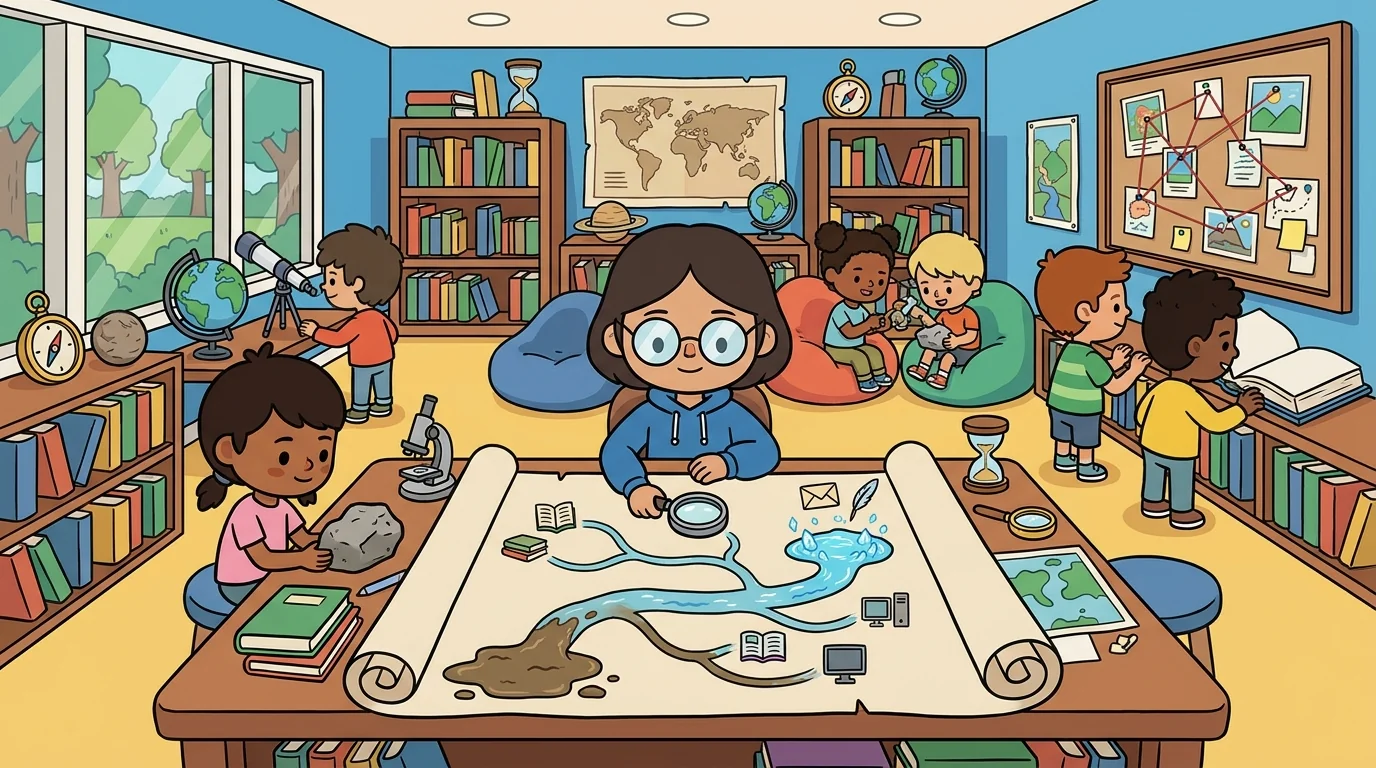
Wellspring
GO TO THE SOURCE — find the spring, not the puddle downstream; trace a claim back to the original primary source.
Listen along — Wellspring
Loading audio…
Press play to listen along. The line being read lights up as you go.
Show full transcript
Loading transcript…
Chapter 6 — Wellspring and the Long Walk Upstream
At the ResearchQuest club, where every curious kid counted as a real researcher, Wellspring gathered the older members by the whiteboard and drew a winding river. “You’ve watched me do the thing I love most,” she said, calm and clear-eyed. “Someone repeats a striking claim — ‘this painting took twenty years!’ — and I ask, gently, where did that page get it? And we follow the stream back: this page got it from that article, which got it from a third, until we reach the origin. Today I’ll show you why that walk upstream matters, and how to know when you’ve reached the spring.”
She marked two points on her river — one near the mouth, one at the source. “Researchers split sources into two kinds. A primary source is the original — the firsthand account, the actual data, the real letter, the artist’s own diary. A secondary source talks about it — an article summarizing the data, a book describing the letter. Both are useful, but they do different jobs, and the number-one skill is simply knowing which one you’re holding. Because facts change as they travel downstream. Each retelling simplifies, rounds off, sometimes mis-hears — so by the time a claim has been copied five times, it can be quietly, confidently wrong, and everyone downstream is just repeating the last person’s paraphrase.”
A club member named Ivo frowned. “So secondary sources are bad?”
“Not at all — that’s the trap,” Wellspring said. “Secondary sources are how you find the primary ones, and a good secondary source has already done careful work you can build on. The danger isn’t using them. The danger is mistaking a puddle for the spring — treating a summary of a summary as if it were the original, and never checking whether the retelling got it right. So for your big, load-bearing claims — the ones your whole argument leans on — you trace them back. You follow the citation chain: this page cites that article, that article cites this study, and you keep walking until you reach the firsthand source, and then you check whether what everyone downstream said it says is what it actually says. Often it is. Sometimes it isn’t — and finding the difference is the most valuable thing a researcher does.”
She named the discipline. “So two moves. First, always know which you’re holding — ask of every source, is this the original, or is it talking about the original? Second, for your key claims, walk upstream — follow the citations back toward the primary source, and read it yourself instead of trusting the last retelling. You don’t have to do this for every tiny fact. You do it for the ones your argument stands on. Find the spring; test the water there; and only then build your work on it.”
Wellspring had learned it the hard way, and she told them. Early on she’d built a project around a dramatic quotation she’d found on three different pages — until a mentor asked her to find who said it, and the trail dissolved into pages quoting pages quoting a source that, when she finally reached it, said something different. “Three pages, all downstream, all repeating one distortion,” she said. “The quote I’d trusted had never actually been said that way.” The unsettling of that had become her calmest habit, and the trust-the-retelling feeling settled into the patient satisfaction of the walk upstream.
“So when a claim matters, don’t drink from the puddle where you found it,” Wellspring finished, tracing her river back to its source. “Know whether you’re holding the original or a retelling. Follow the citation chain upstream for your key claims. Read the spring yourself. A fact is only as trustworthy as the source it came from — so find the spring, not the puddle downstream.”
The ResearchQuest ensemble
Wellspring is part of ResearchQuest's distributed-narrative cast. Each character embodies a different curricular primitive; together they teach the full subject.
-

Wonder
Question-formulation — narrowing vague interest into focused, answerable research questions
-

Vet
Source-evaluation — CRAAP test (Currency, Relevance, Authority, Accuracy, Purpose)
-

Quote
Note-taking — quoting + paraphrasing + summarizing; keeping voices separate
-

Synth
Synthesis — combining evidence across multiple sources; finding agreement, disagreement, gaps
-

Tether
Citation — attribution + bibliography; gratitude + map back to sources
-

Survey
Background reading — read around a topic to learn the lay of the land before narrowing (W.7)
-

Trawl
Search strategy — cast a wide net of keywords, then pull it tight; refine when it comes back wrong (W.8)
-

Crosscut
Lateral reading / corroboration — don't trust one page; cross-check a claim across independent sources
-

Verdict
Forming a thesis — gather the evidence, then take a stand; 'here's what I think, and here's why' (W.1)