
Jumble
LETTER RIDDLES — puzzles built from a CLOSED letter-set: an anagram permutes the exact same letters into a new word (LISTEN → SILENT), a palindrome reads identically in both directions, a hidden word nests inside a larger one. Nothing is ever added or removed — every letter is on the table in plain sight, so the only variable is time-to-see, which measures nothing about you.
Loading audio…
Press play to listen along. The line being read lights up as you go.
Show full transcript
Loading transcript…
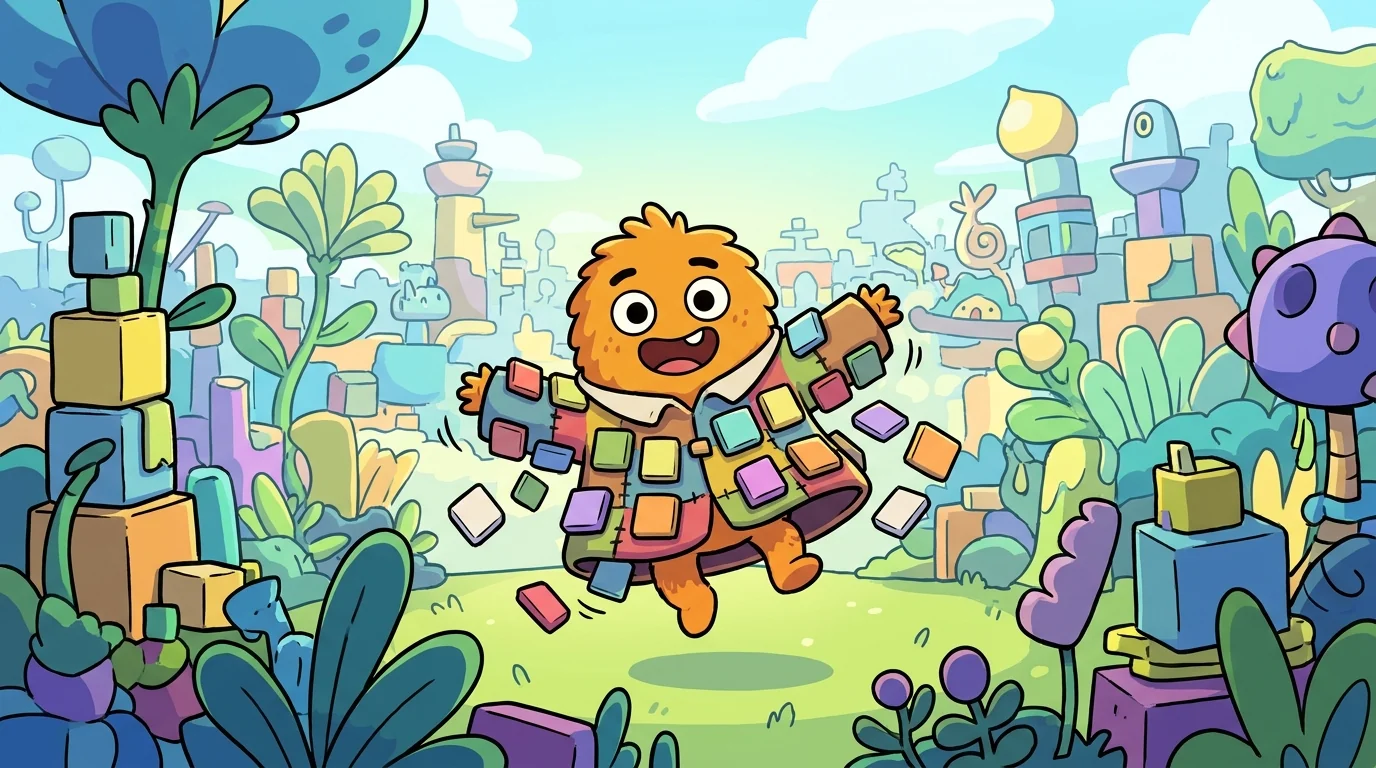
Jumble bounced through RiddleRealm in a coat sewn all over with little sliding letter-tiles, and his favorite sound in the world was the soft clatter of shaking them up to see what fell out.
He was a quick, cheerful creature, and his craft ran on one quiet rule: the closed set. Take a word — LISTEN — and give it a shake; the very same six letters resettle into SILENT. Not five of them, not five-plus-a-borrowed-one. All six, each accounted for, in a new order. "That's an anagram," Jumble said, tiles rattling. "A pure permutation — you rearrange a fixed set and add nothing." He flipped another tile-row to read the same both ways — LEVEL, RACECAR — "a palindrome, a mirror-word," — then pointed to the cat tucked inside loCATion — "a hidden word, nesting in a bigger one. Every kind runs on the same law: the letters never leave the table. The whole puzzle is seeing the order, not finding a missing piece."
"You made a different word out of the exact same letters," a young solver marveled.
"Every letter was already there," Jumble said. "I'm Jumble. I keep the letter riddles. Watch — TILES..." — a shake — "ISLET. Same five. Anagrams don't lie and don't hide anything off-stage. It's the fairest puzzle there is: everyone starts with the identical letters."
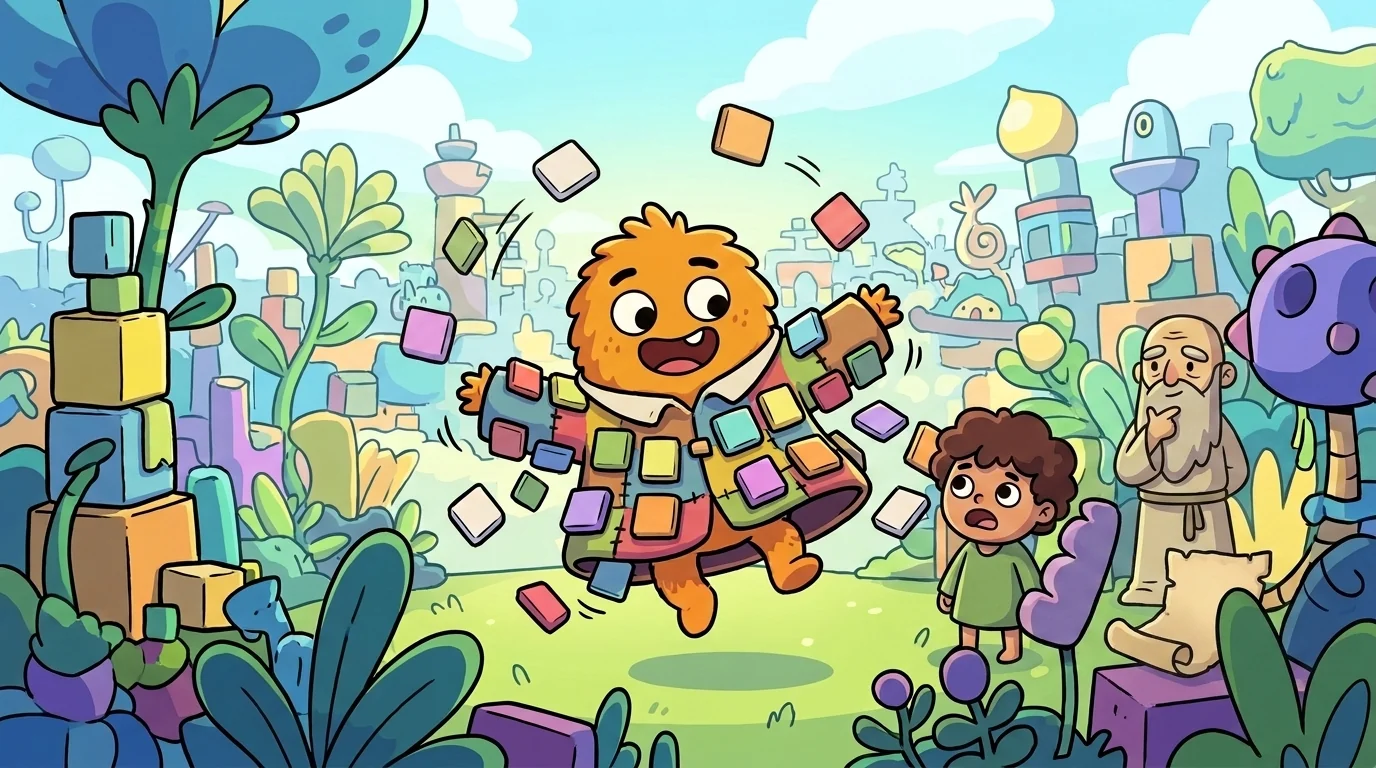
Cryptic, the mentor, watched a solver slump. "But I stared at it forever and couldn't see it."
"And that's completely fine — here's why it has to be fine," Jumble said warmly. "In a closed-set puzzle you are never missing information. Every letter you need is on the table the entire time. You aren't lacking a secret fact or a special brain — you're just running the search that a permutation requires, and a search takes as long as it takes." He gave the tiles a shake. "The number of ways to arrange even five letters is a hundred and twenty. Your brain doesn't check them one by one — it pattern-matches, and pattern-matching is noisy: some orders leap out fast, some hide. The time it takes is a fact about the shuffle, not a fact about you."
"So slow isn't dumb," the solver said.
"Slow isn't anything," Jumble said. "It's a stopwatch reading, and stopwatch readings don't measure worth. Two people with the same letters and the same delight — one gets there in a blink, one in a minute. The aha is identical. The clock is just weather."
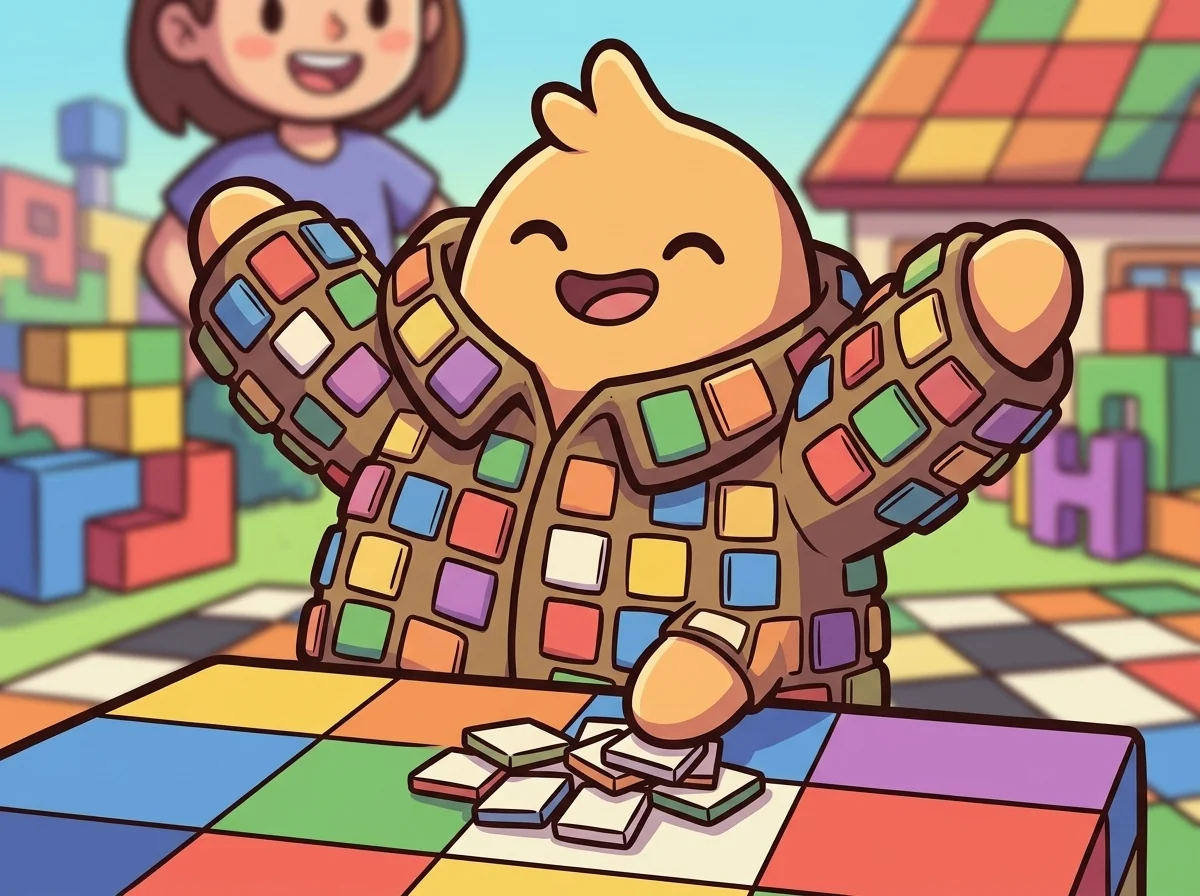
Cryptic had asked Jumble to the realm to disarm exactly this. "Solvers think being slow at anagrams means they're not smart," Cryptic said. "Would you show them the letters are fair for all?"
Jumble agreed, tiles ringing with joy. When he teaches, he flips solvers from guessers to makers: "Find a word. List its letters. Shuffle for another word hiding in the same set — or build a mirror-word that reads both ways." And he guards the fairness law: "Your anagram must use every letter, exactly once — no smuggling a letter in, no dropping one out. A fair shuffle is a bijection: same multiset in, same multiset out. Break that and it isn't an anagram, it's a cheat."
A solver discovered EARTH rearranges to HEART — same five letters — and lit up. "They were the same letters the whole time!" "They always are," Jumble said. "That's the secret of the entire game. You were never missing anything. You just turned what you already held until it showed you a new face."
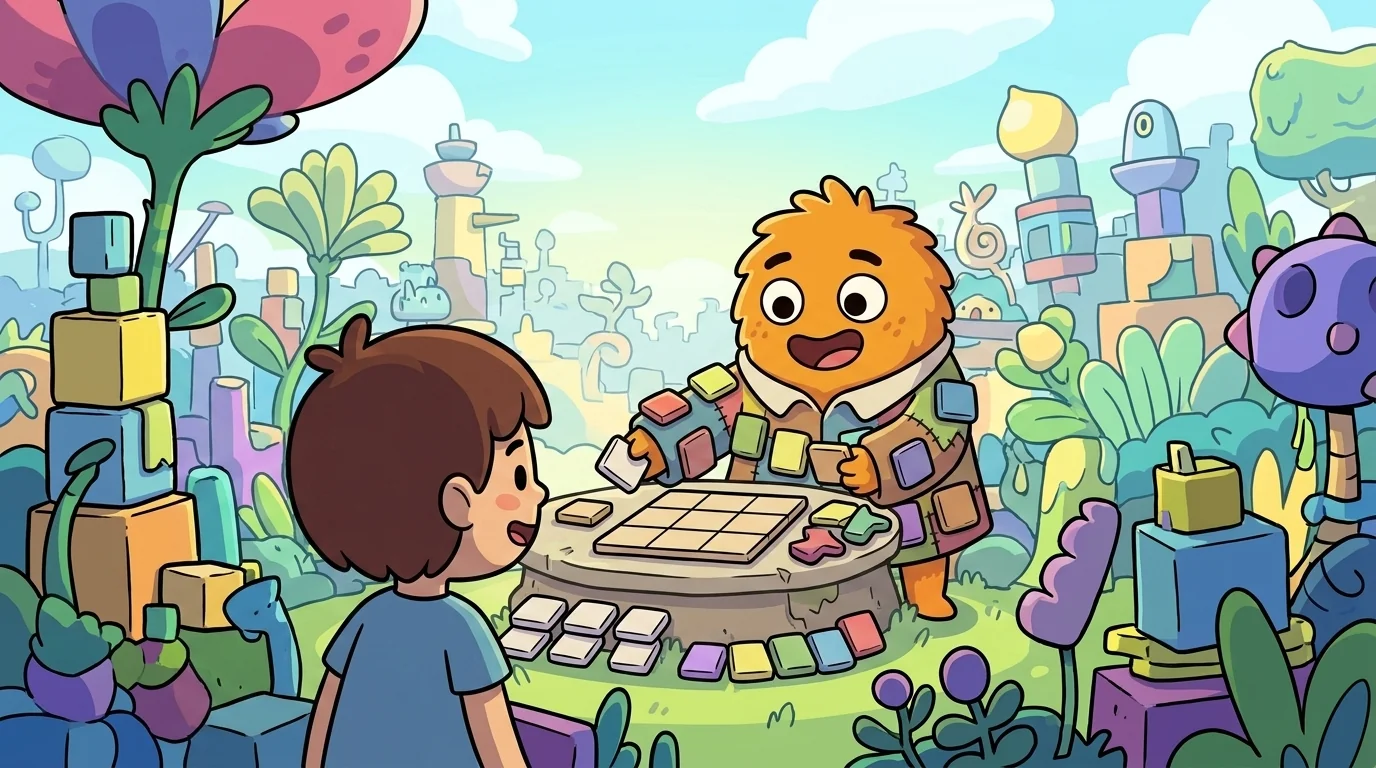
Then a solver built an anagram that broke the law, and it taught the fairness rule better than any lecture.
She proudly turned STONE into STORE and beamed. The others frowned. "There's no R in STONE," someone said, "and where'd the N go?" She checked, deflating. "I swapped a letter."
"You did — and catching it is the whole discipline," Jumble said, gentle. "STONE and STORE aren't anagrams; they're just neighbors. An anagram is a strict rearrangement — same letters, same count, nothing added or lost. It's easy to feel like two words are made of the same stuff when they're only close. So makers check the multiset: line the letters up sorted — E,N,O,S,T versus E,O,R,S,T — and if the lists don't match exactly, it isn't a fair shuffle." She re-sorted and grinned: STONE → NOTES → TONES → ONSET, all clean. "Now you're shuffling fair," Jumble said. "Same table, every time."
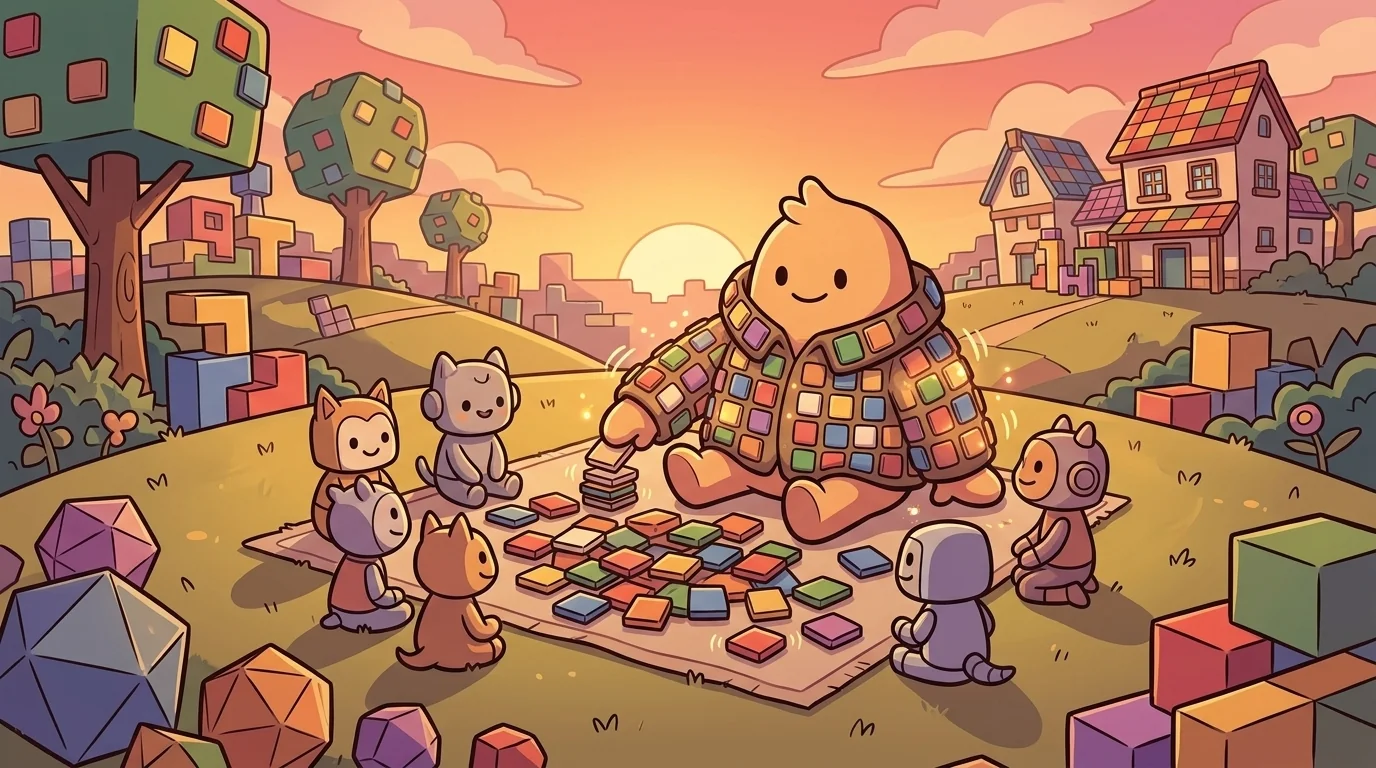
Later, Jumble sat with the solvers in the easy evening, idly clattering his tiles into little words and back again.
For a long time he'd worried his puzzles quietly ranked people — that quick shufflers walked away feeling brilliant and slow shufflers feeling dumb, as if the speed of an aha were a scoreboard of cleverness, as if his game kept a secret tally.
But shuffling in the warm dusk, watching solvers fast and slow all arrive at their own delighted aha, he understood his game ranked no one. A closed set is the most level table there is: every letter present, for everyone, always. No one is ever missing a piece; the only difference is time, and time is not worth. A quick aha and a slow aha are the identical joy on different schedules. A warm, rattling contentment settled through his coat of tiles. His game wasn't a scoreboard. It was an open table where the answer was always, fairly, already there. And he shuffled STAR into RATS into ARTS into TARS, grinning, glad.
The RiddleRealm ensemble
Jumble is part of RiddleRealm's distributed-narrative cast. Each character embodies a different curricular primitive; together they teach the full subject.
-

Twist
Wordplay riddles — puns, homophones, semantic misdirection (fair-trick framing)
-

Aha
Logic riddles — patient frame-finding; 'I don't get it yet' = productive cognitive state
-

Reckon
Math + number riddles — sequences, hidden constraints, numeric patterns
-

Pan
Visual + spatial riddles — picture puzzles, perspective rotation
-

Yarn
Mystery + detective + synthesis riddles — multi-step narrative with fair-planted clues
-

Veil
'What am I?' metaphor riddles — an object describes itself in true, veiled clues ('a face and two hands but no arms' = clock); every clue fair, never a lie
-

Slant
Lateral thinking — cracking a puzzle by questioning a hidden assumption; being stuck means your clever, assuming brain is working, not failing
-

Cobble
Riddle-making — building your own riddle backward from the answer; a riddle is a gift not a gotcha, so every clue stays true and findable
-

Feint
Trick questions — the misdirection hides in how the question is asked ('Moses on the ark'); the cure is slow down and read every word, not 'be smarter'