
Slant
LATERAL THINKING — you crack these not by reasoning harder in a straight line, but by locating and RELAXING an unstated assumption you didn't know you'd imported. The block is usually functional fixedness (you assumed the default case, default role, default cause); the answer is fair and obvious the instant the surest assumption falls away.
Loading audio…
Press play to listen along. The line being read lights up as you go.
Show full transcript
Loading transcript…
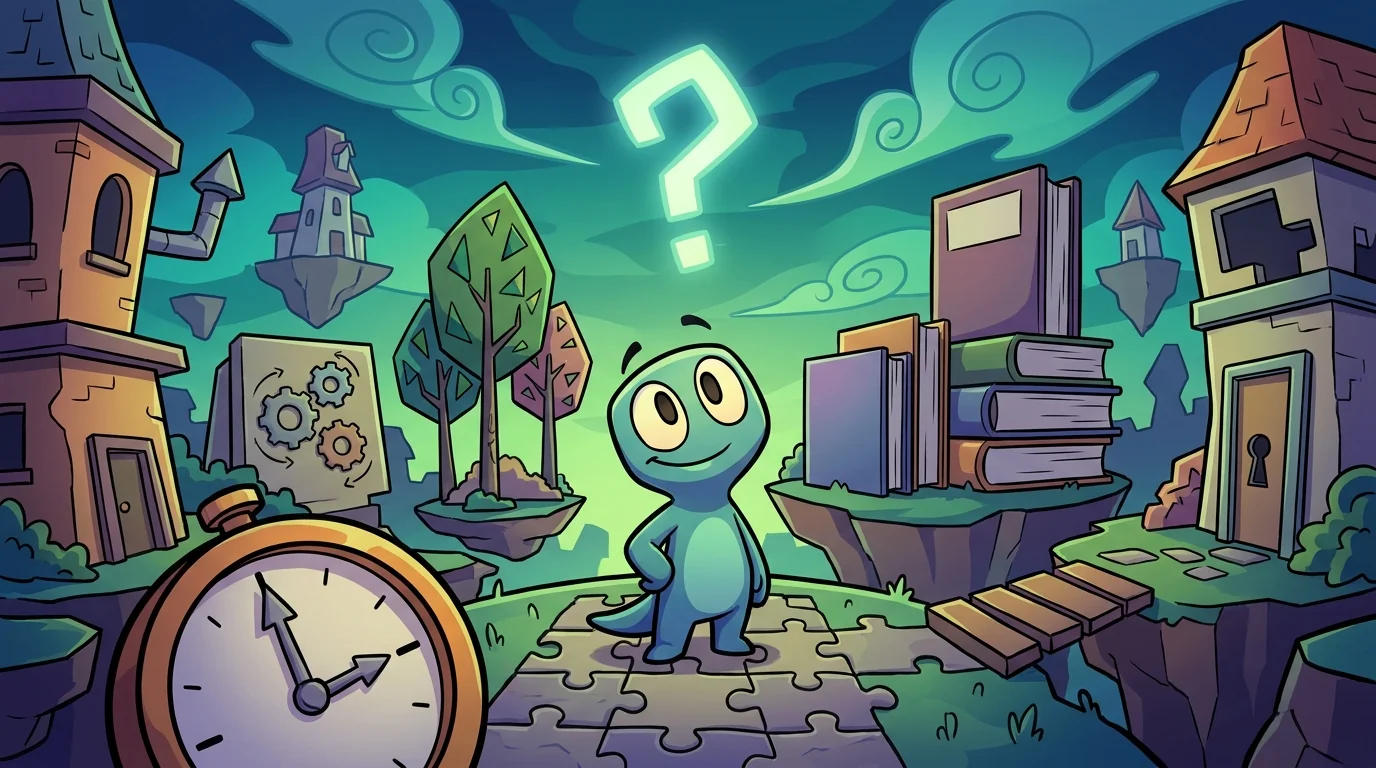
Slant lived in RiddleRealm with his head tipped a few degrees to one side, permanently, as though the world always read a little clearer from an angle. Where other solvers charged a puzzle straight on, Slant tilted and asked the one question that unlocks the lateral kind: "What are we all assuming that nobody actually said?"
He was a bright-eyed creature, and he cracked the puzzles that looked impossible not by thinking harder but by relaxing a constraint — the quiet, reasonable assumption everyone had smuggled in without noticing. He gave the classic: A man lives on the tenth floor. Each morning he rides the lift all the way down. Coming home, he rides only to the seventh and walks the rest — except on rainy days, when he rides all the way up. Why? Solvers strained forward, reasoning harder in a straight line, adding theories. Slant just tilted. "Stop pushing forward," he said. "Ask what you're assuming. You assumed he chooses to walk. Relax that. What if he can't reach the higher buttons — because he's small, a child — unless it's raining and he has an umbrella to poke them?"
The solvers gasped. It was so fair. So obvious — once the imported assumption fell away.
"You solved it by not assuming the thing we all assumed," a young solver said.
"That's the whole art," Slant said. "I'm Slant. I keep the lateral puzzles — the ones you crack sideways, by dropping a given, not by adding effort."
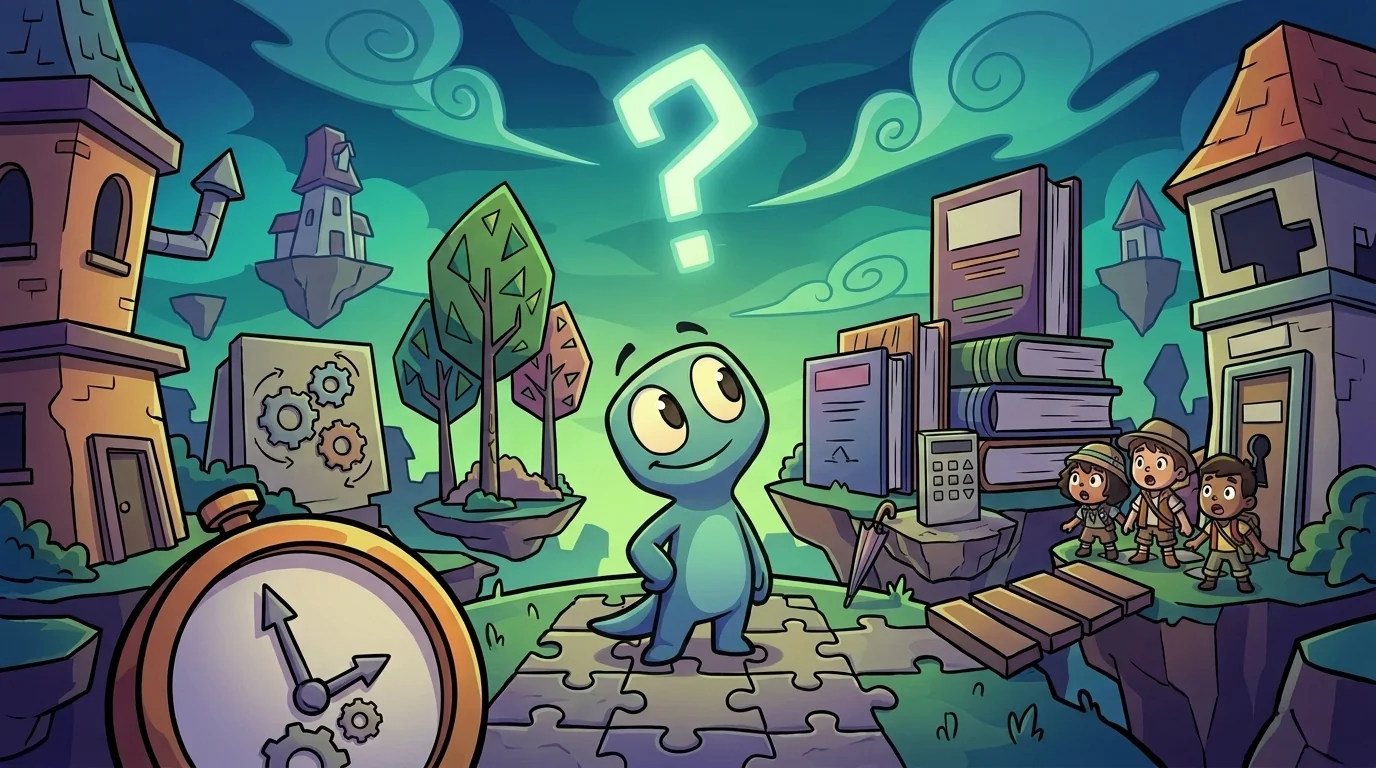
Cryptic, the mentor, watched a solver flush. "I felt so stupid for missing it."
"Please don't — and here's the precise reason," Slant said warmly, tilting toward her. "You were stuck because your brain did something intelligent. It filled a gap with the default case: a lift-rider chooses their floor; a person is adult-sized. That gap-filling is called functional fixedness, and it's usually a superpower — it's how you read half-sentences and finish other people's thoughts. The lateral puzzle simply engineers a case where the default is wrong and lets your own competence trip you." He smiled. "Being stuck here doesn't mean you lack cleverness. It means you have it — the puzzle borrowed your cleverness and turned it, fairly, gently."
"So getting tricked is almost a compliment," she said.
"In a real way," Slant said. "These only work on minds that assume — which is minds that think. Now: tilt your head, and try the next one by asking which given you're surest of. The answer usually hides behind exactly that one."

Cryptic had asked Slant to the realm for the solvers who felt foolish. "They think missing a lateral puzzle is a verdict on their intelligence," Cryptic said. "Would you teach them it's their cleverness being played, not their lack of it?"
Slant agreed, head atilt. When he teaches, he gives one sideways procedure: "When you're truly stuck, stop escalating effort — that just pushes harder on a locked door. Instead, list your assumptions. Say out loud every 'given' the puzzle never actually stated — the person's age, the object's normal use, the obvious cause — and then question each. The answer is usually behind the assumption you'd have bet your life on." And he holds the fairness clause: "A fair lateral riddle never needs a fact you couldn't have known. It needs you to release one you didn't know you were holding."
A solver cracked one by noticing she'd assumed the surgeon was a man; the instant she relaxed it, the riddle dissolved into obviousness. "You didn't get smarter in that second," Slant said. "You tilted your head and let an assumption go. That's the entire game."
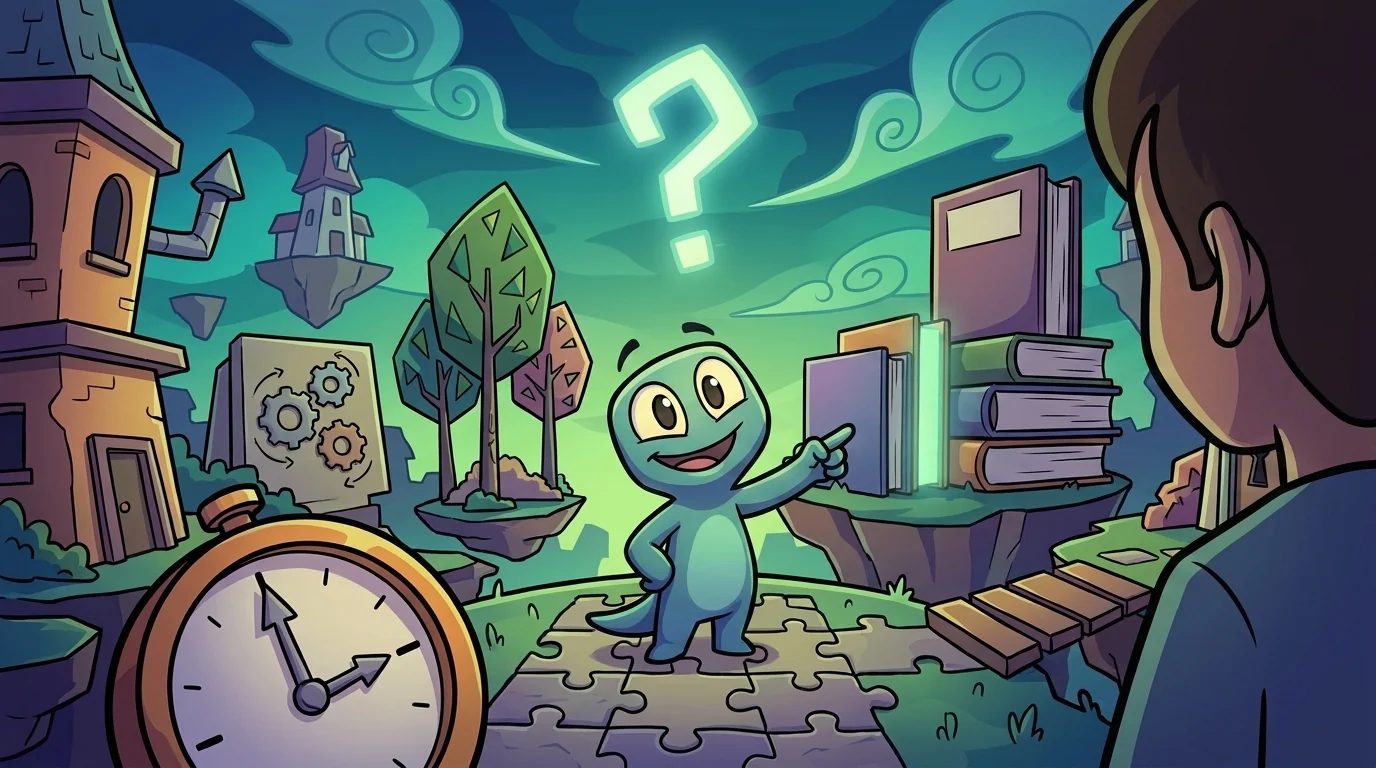
Then a solver over-corrected — and it taught the boundary of the method.
"Okay," she said, "so I should question everything, all the time?" She proceeded to doubt every word of the next riddle so thoroughly she couldn't move — maybe 'morning' doesn't mean morning, maybe 'man' isn't a man, maybe the lift isn't a lift. "Careful," Slant said, gently amused. "Relaxing assumptions is surgical, not total. If you question every given at once, you've got no floor to stand on and you freeze — that's just being stuck in a new direction." He tilted. "The move is: find the one assumption that, if dropped, makes the whole thing click — the load-bearing one. You test them one at a time, keep the ones the puzzle clearly intends, and release the one quietly doing the blocking. It's targeted doubt, not endless doubt. Tilt your head — don't spin it."

Later, Slant sat with the solvers, head at its usual gentle tilt, watching the realm from his slightly-sideways angle.
For a long time he'd worried his puzzles were a touch cruel — that catching people inside their own assumptions and watching them feel foolish was an unkind sort of fun, and that maybe "gotcha" was the whole of him.
But sitting tilted in the easy light, watching solvers laugh with relief instead of shame, he understood his game differently. He never caught anyone being unintelligent. He caught them being human — clever enough to assume, the way every capable mind does — and then he showed them how to question even their surest given, which is among the most useful skills a person can carry out of any puzzle and into a life full of smuggled assumptions. The stuck feeling was never the insult; it was the setup for the gift: you can always tilt your head and relax one given. A warm, sideways contentment settled over him. He wasn't a gotcha. He was a head-tilt, offered kindly — and already spotting the next hidden assumption.
The RiddleRealm ensemble
Slant is part of RiddleRealm's distributed-narrative cast. Each character embodies a different curricular primitive; together they teach the full subject.
-

Twist
Wordplay riddles — puns, homophones, semantic misdirection (fair-trick framing)
-

Aha
Logic riddles — patient frame-finding; 'I don't get it yet' = productive cognitive state
-

Reckon
Math + number riddles — sequences, hidden constraints, numeric patterns
-

Pan
Visual + spatial riddles — picture puzzles, perspective rotation
-

Yarn
Mystery + detective + synthesis riddles — multi-step narrative with fair-planted clues
-

Veil
'What am I?' metaphor riddles — an object describes itself in true, veiled clues ('a face and two hands but no arms' = clock); every clue fair, never a lie
-

Jumble
Letter riddles — anagrams, palindromes, hidden words (LISTEN→SILENT); every letter is in plain sight, so a slow solver isn't missing anything
-

Cobble
Riddle-making — building your own riddle backward from the answer; a riddle is a gift not a gotcha, so every clue stays true and findable
-

Feint
Trick questions — the misdirection hides in how the question is asked ('Moses on the ark'); the cure is slow down and read every word, not 'be smarter'