
Veil
METAPHOR RIDDLES — the classic 'what am I?', where an object describes itself through a mapping of its real attributes onto human or living images (a clock's dial → a face; its arms → hands). Every clue is LITERALLY TRUE once you invert the mapping; the riddle never lies, it only veils, so the solver's job is attribute-mapping, not fact-finding.
Loading audio…
Press play to listen along. The line being read lights up as you go.
Show full transcript
Loading transcript…

Veil drifted through RiddleRealm wrapped in soft, shifting layers of gauze, and she never once told you her name straight out. She spoke only in self-description — clues that mapped her plain attributes onto living images, each one true but slanted, hiding the ordinary word behind a small poem.
She was a gentle, mist-grey creature, and her craft was the oldest riddle there is: the metaphor riddle, the "what am I?" "I have a face and two hands," she might say, "but no arms — and I tell you something all day without ever speaking." She'd wait, patient and warm, while you turned it over. A clock. And the moment you saw it, every clue snapped into place, all of them literally true: the dial is called a face, the pointers are called hands. "That's the mechanism," she said softly. "I take a real object, and I map each of its true parts onto a human or living image — dial to face, pointers to hands, ticking to speaking without a mouth. You don't solve me with a hidden fact. You solve me by inverting the mapping — reading each image back to the plain part it stands for."
"You hid the answer behind pictures," a young solver said, finally grinning.
"The oldest craft there is," Veil said. "I'm Veil. I keep the 'what am I?' riddles. I have a bed but never sleep; I run but never walk; I have a mouth but never eat. What am I?" She waited. A river. "A river-bed. A river runs. A river-mouth. Every clue true. I never lied. I only veiled."

Cryptic, the mentor, watched a solver frown. "But it felt impossible until, suddenly, it wasn't."
"That's the design — and the fairness," Veil said. "A good metaphor riddle cannot cheat, because every clue must survive the inversion: once you know the answer, each image has to resolve to a real, literal property of the thing. The river truly has a bed. The clock truly has a face. I'm not deceiving you with a falsehood — I'm dressing a true attribute in a figurative word and trusting you to undress it." She drifted closer. "And the 'impossible-then-obvious' feeling isn't a flaw. It's the signature of the form. A metaphor riddle is built to feel impossible until the mapping flips, at which point it feels like you always knew. The 'oh, of course!' is the whole gift — and it belongs to everyone who keeps looking, at whatever pace."
"So being stuck a while is just part of it," the solver said.
"It's the best part," Veil said. "The longer the veil holds, the brighter the lifting. Speed isn't worth here. The delight is identical whether it comes in a second or a minute."

Cryptic had asked Veil to the realm to retire an old lie. "Solvers think these ancient riddles are about being born clever," Cryptic said. "Would you show them they're fair play for everyone?"
Veil agreed, her layers glowing. When she teaches, she flips solvers into makers: "Pick an object. List its real parts and actions. Then map each onto a human or living image — a face, hands, a bed, a mouth, teeth — and never say the plain name." And she guards the honesty clause: "Keep every clue literally true. A metaphor riddle that includes a false image isn't clever, it's a lie wearing a costume. The art is hiding the answer fairly, so a solver can always invert their way home."
A solver wrote one: I have teeth but cannot bite; I help you most when your hair's a fright. The others puzzled, then lit up — a comb! "Every clue true," Veil said warmly. "A comb has teeth; it does help with hair. You veiled it honestly. That's a real riddle."
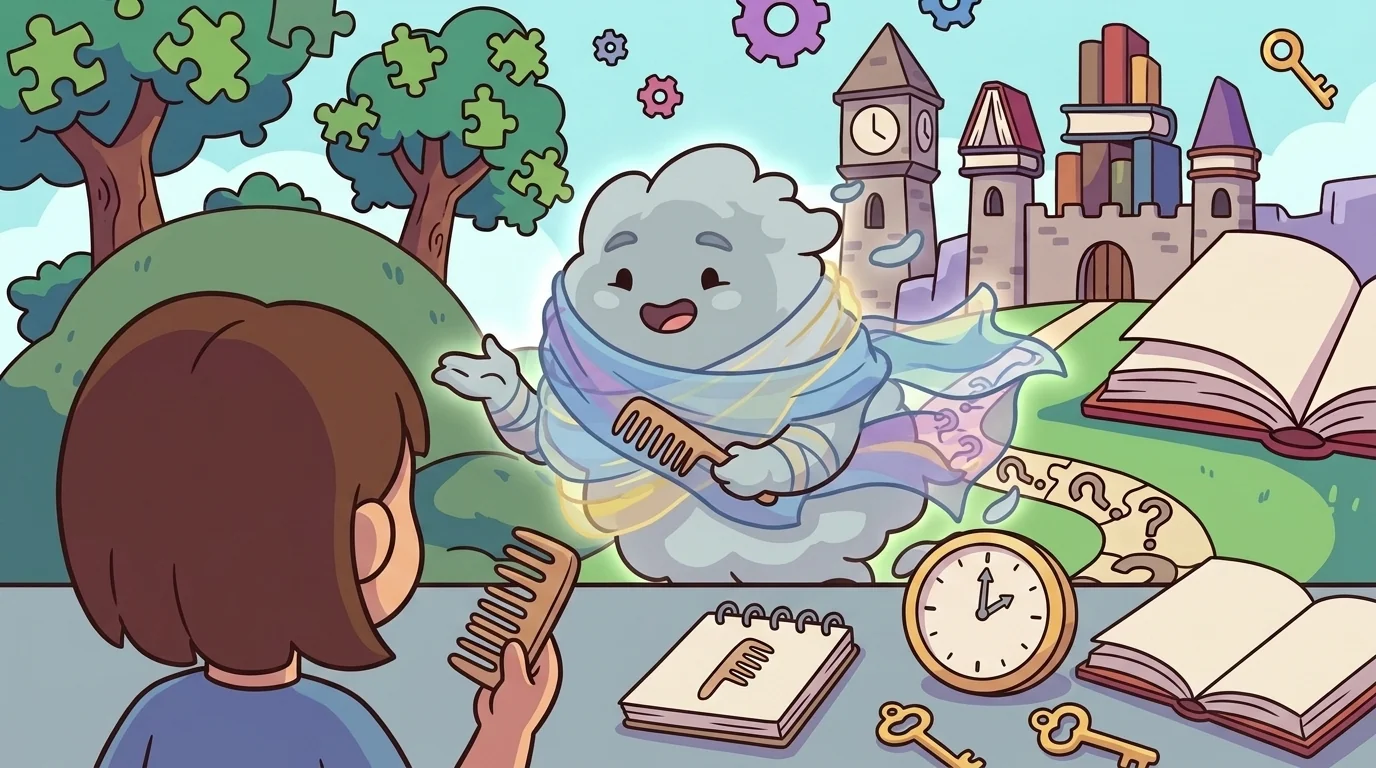
Then a solver wrote a "riddle" that quietly lied, and it taught the honesty clause the clean way.
Her riddle for the sun included the line I sing you awake each dawn. The others guessed a rooster, then argued. "The sun doesn't sing," someone said. She frowned. "I thought it was just poetic."
"Here's the fine line," Veil said gently. "Metaphor is allowed — bright, rising, a golden eye — because each still maps to something literally true of the sun: it is bright, it does rise, it looks like an eye. But 'sings you awake' maps to nothing true of the sun; it's borrowed from the rooster. That's not a veil — it's a false clue, and a false clue makes the riddle unsolvable-by-honesty: a fair solver inverts it and lands on the wrong thing." She smoothed the page. "Change it to I open every eye without a hand — true, image-rich, honest. Now the veil is thick but never lying." The solver rewrote it; the others solved it, delighted. "Now it's fair," Veil said. "Thick veil, honest thread underneath."

Later, Veil drifted among the solvers in the soft evening, her layers settling gently.
For a long time she'd worried her riddles made people feel stupid — that every solver who sat stuck and frowning was being hurt by her hiding, and that veiling things might be a little unkind.
But drifting in the warm dusk, watching solvers grin at their own "oh, of course!" moments, she understood her gift was the opposite of unkind. She never hid an answer out of reach — only out of sight, fairly, every clue literally true and the mapping always invertible. The stuck feeling wasn't an insult; it was the held breath before the delight, and the delight belonged to everyone who kept looking, fast or slow. A soft, settled warmth glowed beneath her layers. She wasn't making anyone feel stupid. She was giving everyone the identical gift: the joy of lifting a veil that was honest all along. And she wrapped her gauze close, content, already composing her next gentle hiding.
The RiddleRealm ensemble
Veil is part of RiddleRealm's distributed-narrative cast. Each character embodies a different curricular primitive; together they teach the full subject.
-

Twist
Wordplay riddles — puns, homophones, semantic misdirection (fair-trick framing)
-
Aha
Logic riddles — patient frame-finding; 'I don't get it yet' = productive cognitive state
-

Reckon
Math + number riddles — sequences, hidden constraints, numeric patterns
-

Pan
Visual + spatial riddles — picture puzzles, perspective rotation
-

Yarn
Mystery + detective + synthesis riddles — multi-step narrative with fair-planted clues
-
Jumble
Letter riddles — anagrams, palindromes, hidden words (LISTEN→SILENT); every letter is in plain sight, so a slow solver isn't missing anything
-

Slant
Lateral thinking — cracking a puzzle by questioning a hidden assumption; being stuck means your clever, assuming brain is working, not failing
-

Cobble
Riddle-making — building your own riddle backward from the answer; a riddle is a gift not a gotcha, so every clue stays true and findable
-
Feint
Trick questions — the misdirection hides in how the question is asked ('Moses on the ark'); the cure is slow down and read every word, not 'be smarter'