
Veil and Twist
WHAT AM I? — language hides answers two distinct ways: METAPHOR (semantic disguise — describe a plain thing as if it were something grand; solve by inverting the mapping to the ordinary thing underneath) and POLYSEMY / HOMONYMY (one sound carrying two senses — bark, trunk, leaves; solve in the little snap when the word flips to its other meaning). Two mechanisms, one delight: words are not fixed, single things.
A story read by Veil and Twist
Loading audio…
Press play to listen along. The line being read lights up as you go.
Show full transcript
Loading transcript…
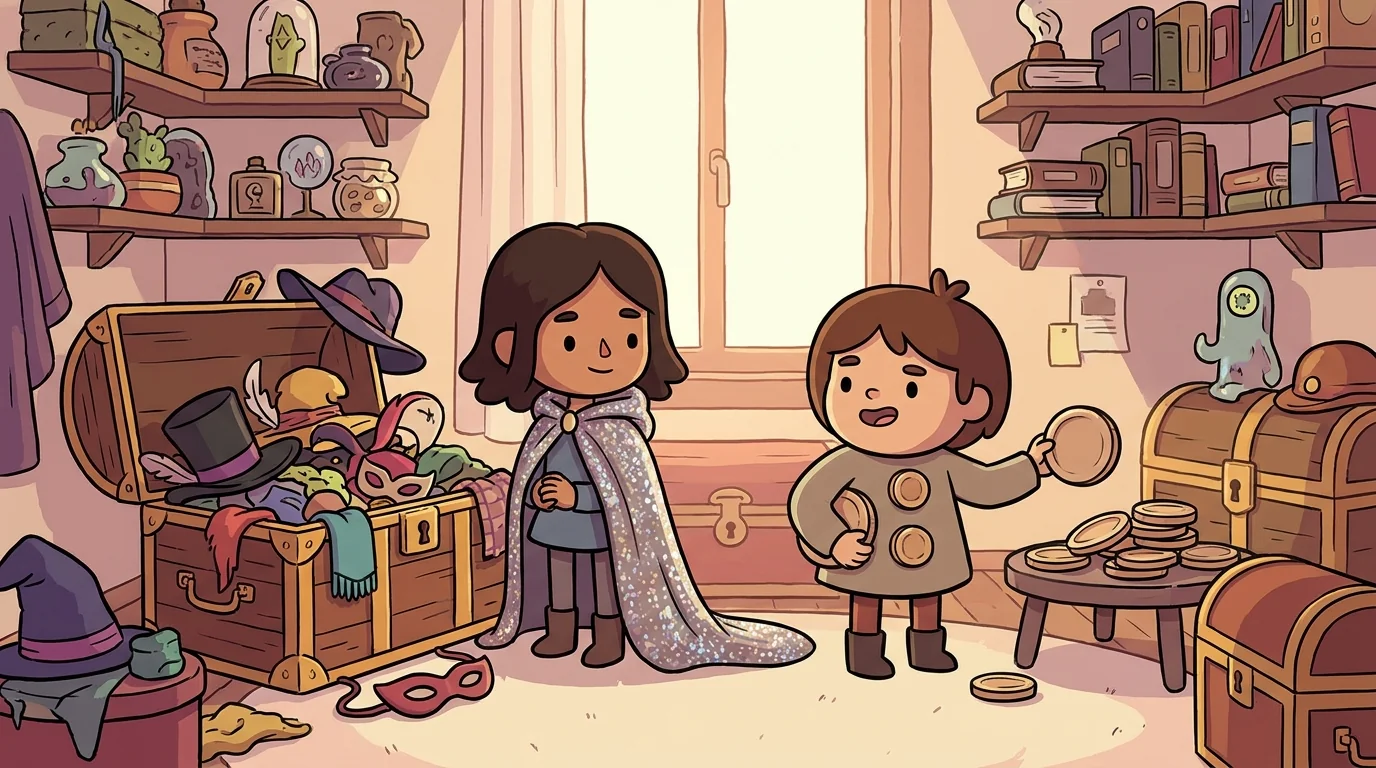
There are two kinds of riddle that hide their answers not in logic but in language itself, and the two friends who loved them best were as different as a costume and a coin.
Veil wore a long shimmering cloak and dressed plain things up as mysteries — her mechanism was semantic disguise, hiding an ordinary object inside grand, image-rich words. Twist carried a little two-headed coin and loved the instant a single word flipped to show its other face — her mechanism was polysemy, one sound quietly holding two meanings at once. "I hide things behind disguises," said Veil, drawing the cloak close. "And I hide them behind sounds," said Twist, flipping the coin. "Two different tricks — watch, we'll show them side by side, because knowing which trick a riddle is using is half of solving it."
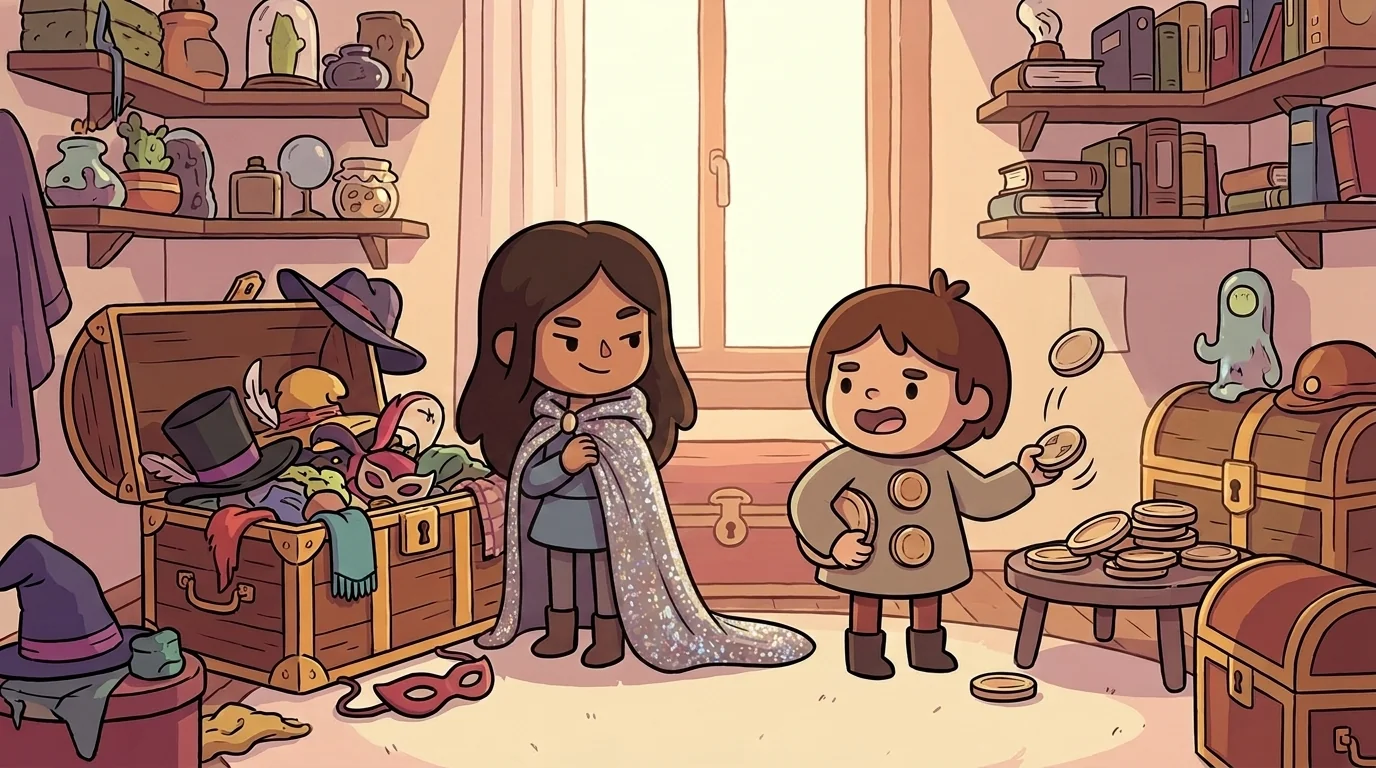
Veil went first and unfurled a riddle like a magician's cloth: "I have a face and two hands, but no arms at all. I run all day and never move an inch. What am I?"
The listeners frowned. A face? Two hands? Something alive, surely — and that was exactly the disguise doing its work. "That's my whole mechanism," Veil said, delighted. "I take a completely ordinary thing and I dress it up — I map each of its real parts onto a grand, living image, so it sounds strange and mysterious. You don't solve me with logic. You solve me by inverting the mapping — reading each fancy image back to the plain part underneath. Face → the dial. Hands → the pointers. Runs → ticks. The costume is thick, but every thread is literally true."
"A face... two hands... runs all day, never moves..." A listener's eyes went wide. "A clock!"
"A clock," said Veil, sweeping the cloak aside to reveal an ordinary wall clock, suddenly obvious. "Nothing magical — just a clock in a fancy cloak. A metaphor riddle: the answer is always something you know perfectly well, disguised in a description that dresses it up. See past the costume, and there it plainly is."
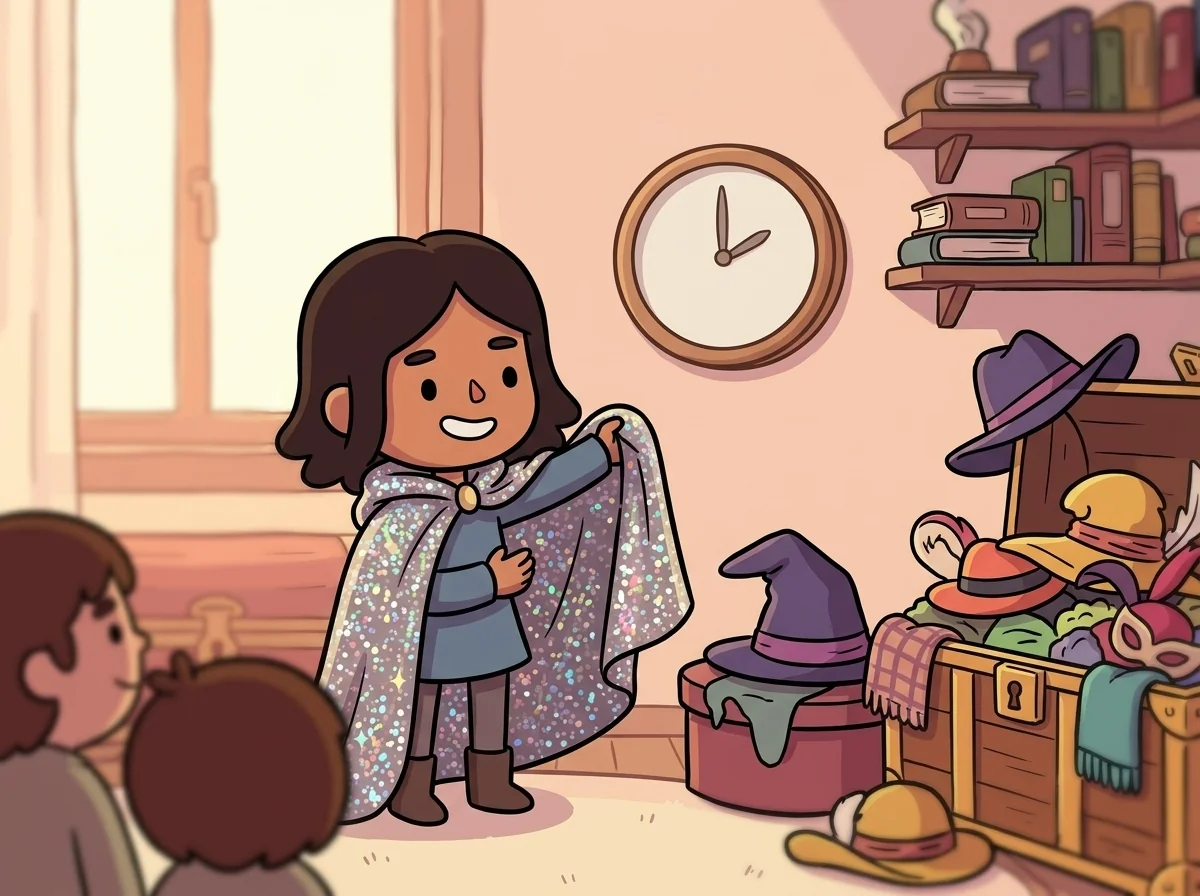
Then Twist flipped the two-headed coin and offered a wholly different kind: "What has a bark but no bite, a trunk but no suitcase, and leaves but never arrives?"
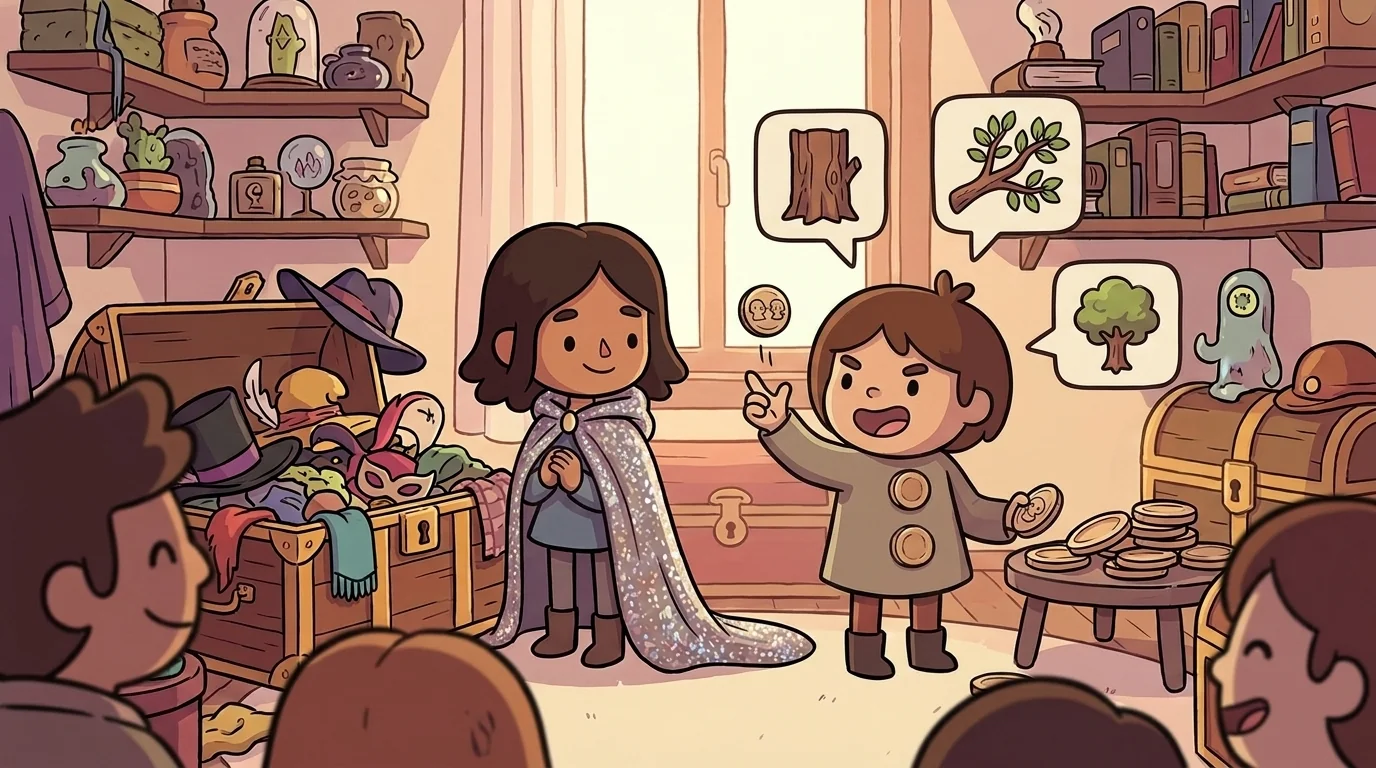
The listeners groaned — a happy, dawning groan — because they could feel a different trick coming. "This is my mechanism," said Twist, grinning. "I don't disguise a thing in a costume. I hide a second meaning inside a single word, and the answer lives in the little snap when the word flips. That's polysemy — one sound, two senses — and the riddle stacks three of them." He flipped the coin. "Bark — you pictured a dog, but it's also the skin of a—. Trunk — you pictured luggage, but it's also the body of a—. Leaves — you heard leaving, but they're also the green things on a—."
"A tree!" three listeners said at once, groaning and grinning together.
"A tree," Twist agreed, catching the coin. "Every clue was one word wearing two meanings, each flipping from the sense you first grabbed to the sense about a tree. The joy isn't the answer, exactly — it's the snap, the groan-and-grin, when the word turns over and shows its other face. Language is a toy, and this is my favourite way to play with it."
Then a listener asked the question that reveals why naming the mechanism matters: "How do I know which kind a riddle is — costume or coin?"
"Best question in the room," said Veil, and Twist nodded. "Listen for what the words are doing," Veil said. "If the whole description could be about one plain thing dressed grandly — a face, hands, running — you're inside a costume: invert the images to the ordinary object." "But if a few particular words each feel like they could mean two things," said Twist — "bark, trunk, leaves — you're inside a coin: don't picture one grand object, hunt for the word that flips." He grinned. "Metaphor asks what plain thing is this describing? Polysemy asks which word here has a second face? Same family — 'what am I?' — two different keys. Reach for the wrong key and you'll stall; name the mechanism first, and the door opens."
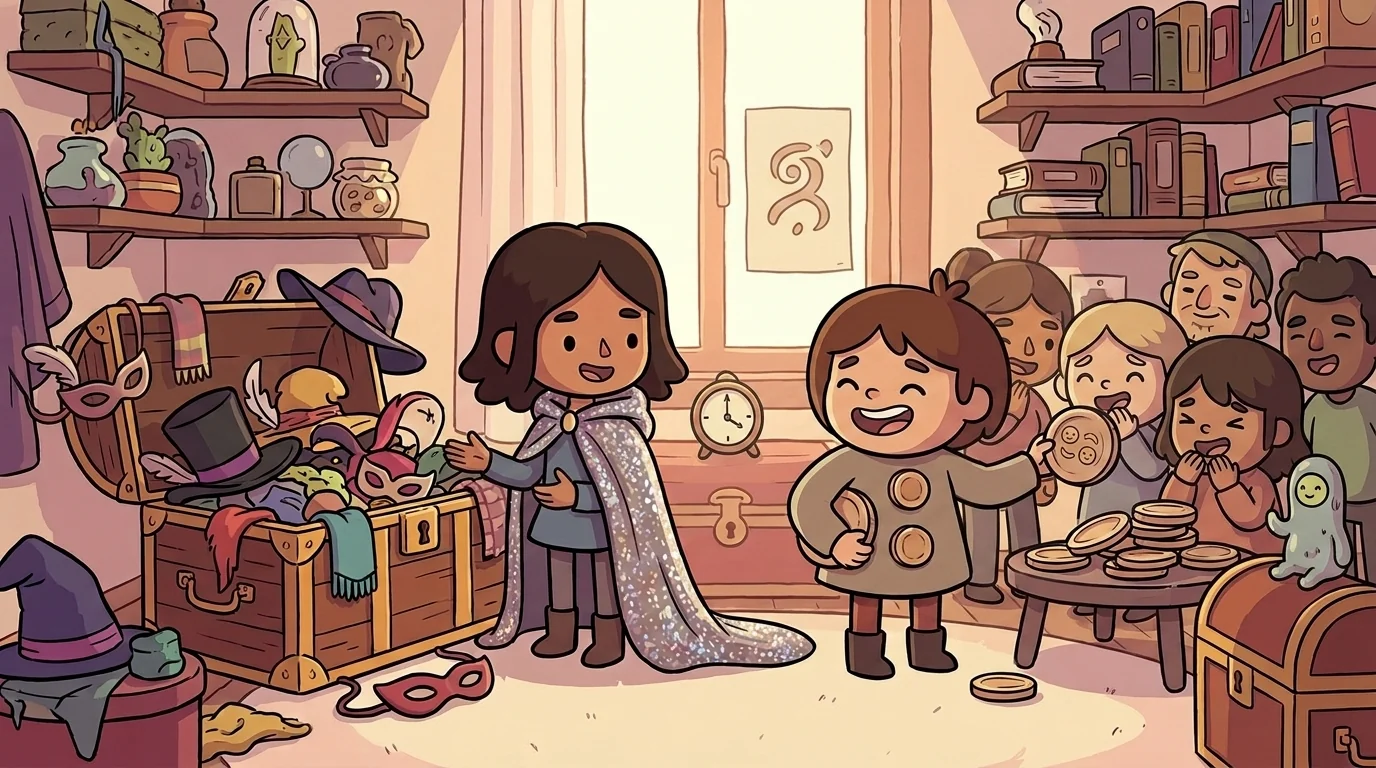
The two friends stood back — one with a cloak full of disguised things, one with a pocket full of double-faced words — both grinning at the same delighted, groaning crowd.
"Good disguise," said Twist.
"Good snap," said Veil.
There is a special, giggling joy in the riddles that hide inside language — the metaphor that dresses a clock as a living mystery, and the pun that packs two meanings into one small sound. Between them they teach something sneaky and wonderful about words: that they are not fixed, single, serious things but slippery, double-faced toys you can turn over and over to find new faces. Learn to name which trick you're facing — costume or coin, metaphor or polysemy — and reach for the matching key, and the whole of language becomes a playground: full of hidden clocks and double-faced words, waiting for anyone who likes to look, and listen, a little sideways.
The RiddleRealm ensemble
Veil and Twist is part of RiddleRealm's distributed-narrative cast. Each character embodies a different curricular primitive; together they teach the full subject.
-

Twist
Wordplay riddles — puns, homophones, semantic misdirection (fair-trick framing)
-
Aha
Logic riddles — patient frame-finding; 'I don't get it yet' = productive cognitive state
-

Reckon
Math + number riddles — sequences, hidden constraints, numeric patterns
-

Pan
Visual + spatial riddles — picture puzzles, perspective rotation
-

Yarn
Mystery + detective + synthesis riddles — multi-step narrative with fair-planted clues
-

Veil
'What am I?' metaphor riddles — an object describes itself in true, veiled clues ('a face and two hands but no arms' = clock); every clue fair, never a lie
-
Jumble
Letter riddles — anagrams, palindromes, hidden words (LISTEN→SILENT); every letter is in plain sight, so a slow solver isn't missing anything
-

Slant
Lateral thinking — cracking a puzzle by questioning a hidden assumption; being stuck means your clever, assuming brain is working, not failing
-

Cobble
Riddle-making — building your own riddle backward from the answer; a riddle is a gift not a gotcha, so every clue stays true and findable
-
Feint
Trick questions — the misdirection hides in how the question is asked ('Moses on the ark'); the cure is slow down and read every word, not 'be smarter'