
Steep
STEEP — let it sit in warmth and it gives up its flavor. herbs, spices, and aromatics release their taste into a warm liquid over time. you don't chase the flavor; you wait, and it comes to you.
Loading audio…
Press play to listen along. The line being read lights up as you go.
Show full transcript
Loading transcript…
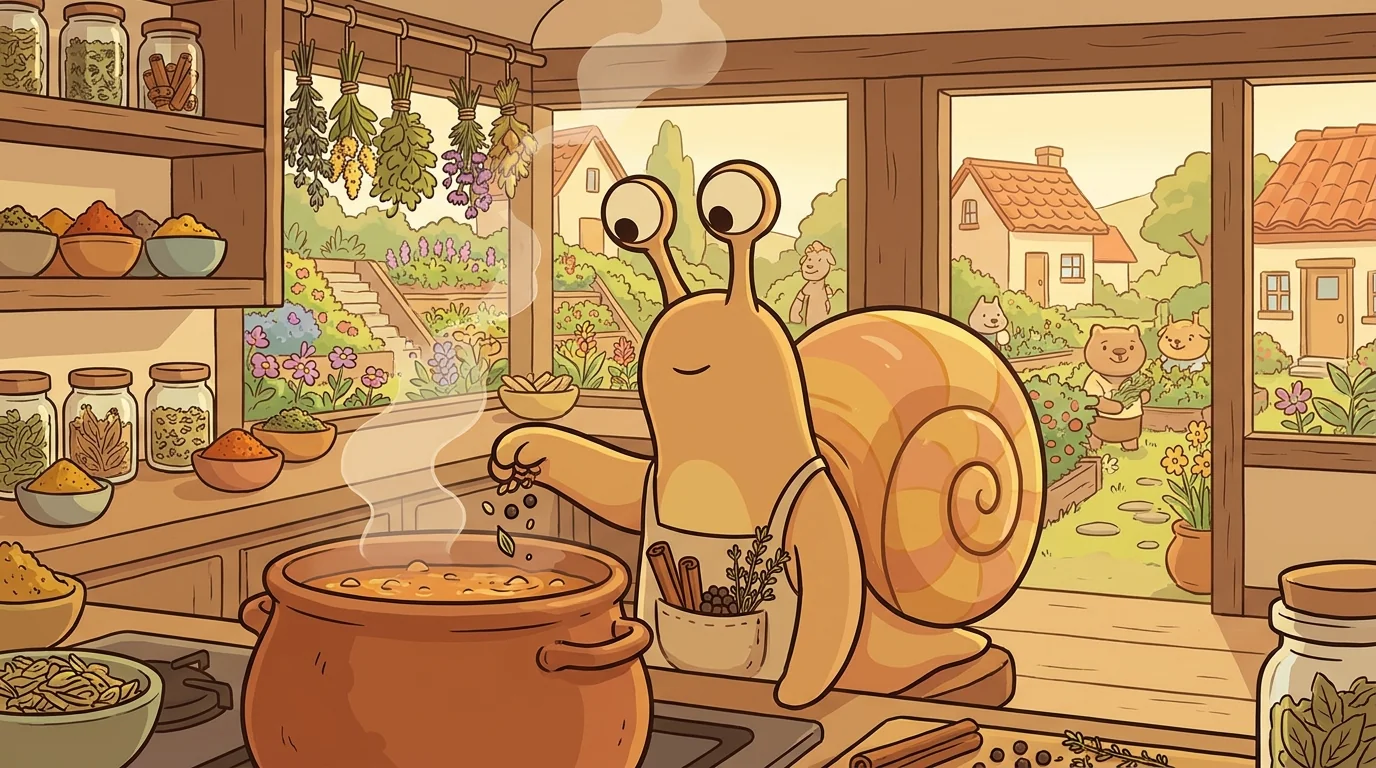
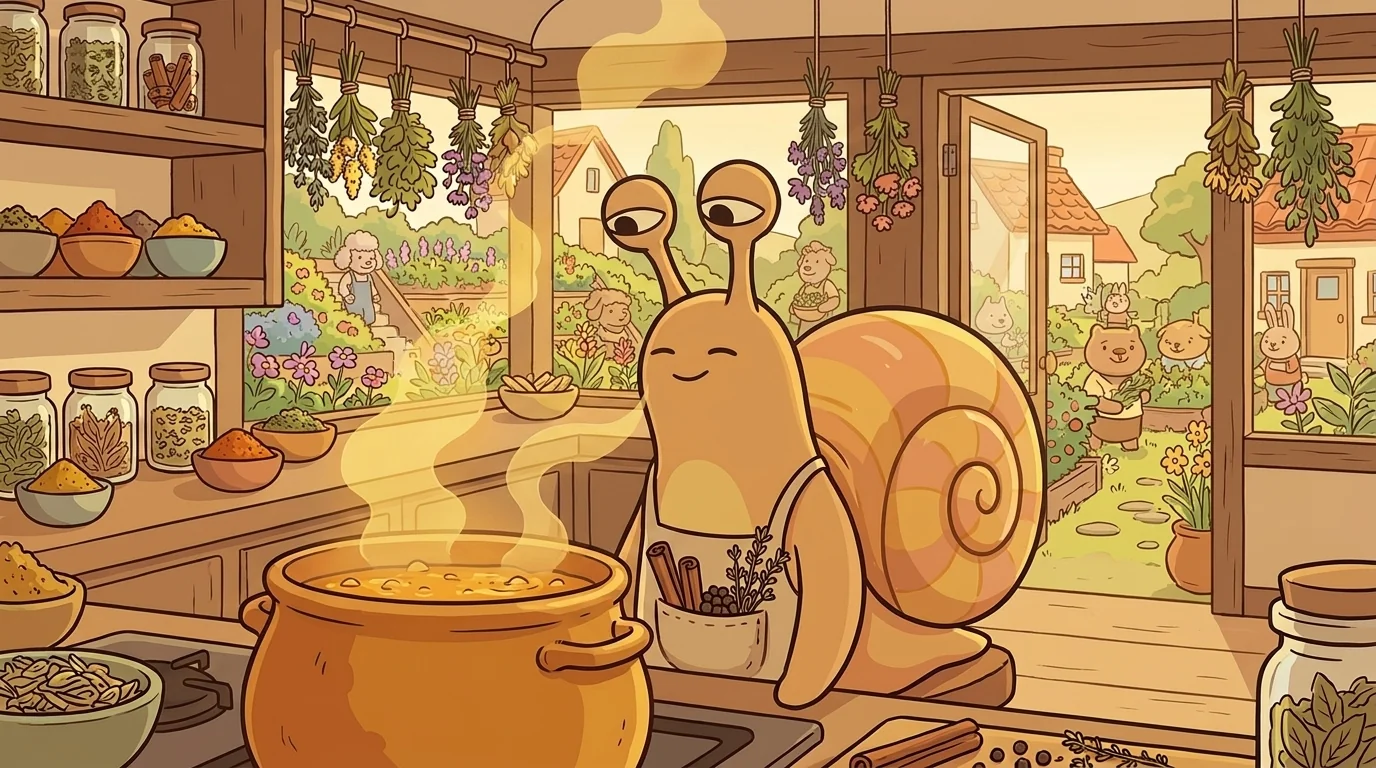
In the SaffronLab kitchen, over a pot that smelled of cinnamon and thyme, a small, unhurried snail named Steep dropped his aromatics into warm water and then simply waited — while a young cook beside him was boiling his own spices as hard as the flame would go, sure that more heat meant more flavor, faster.
Steep was slow and calm, his spiral shell soft amber, a pocket of whole spices in his tiny apron. The young cook — a jittery chipmunk — had his pot at a furious, rattling boil, spices tumbling violently inside. "I want the flavor NOW," he said, cranking the flame higher. "So I boil it hard. Hard boil, fast flavor, right?"
Steep shook his head, gently, from his own barely-steaming pot. "That's not how flavor comes out. Watch mine — no boil, just warm, and time." He lifted his spoon; the broth was already deeply fragrant. "Herbs and spices hold their flavor inside, and warmth coaxes it out slowly, into the water, over time. That's infusion — steeping. But a hard boil doesn't coax; it bullies. It bruises the delicate flavors, boils off the fragrant oils as steam, and can even turn some spices bitter. You're not pulling flavor out faster. You're driving it away — and scorching what's left." He stirred once, slow. "The trick is the opposite of what you'd think. You don't chase the flavor with more heat. You give it gentle warmth and a little patience, and the flavor comes to you."
The chipmunk turned his roaring flame down, doubtful, and leaned over Steep's quiet pot. It smelled far better than his own. "So boiling it harder was... chasing the flavor away?"
"Most good flavor runs from a chase," Steep said. "It comes when you wait for it."
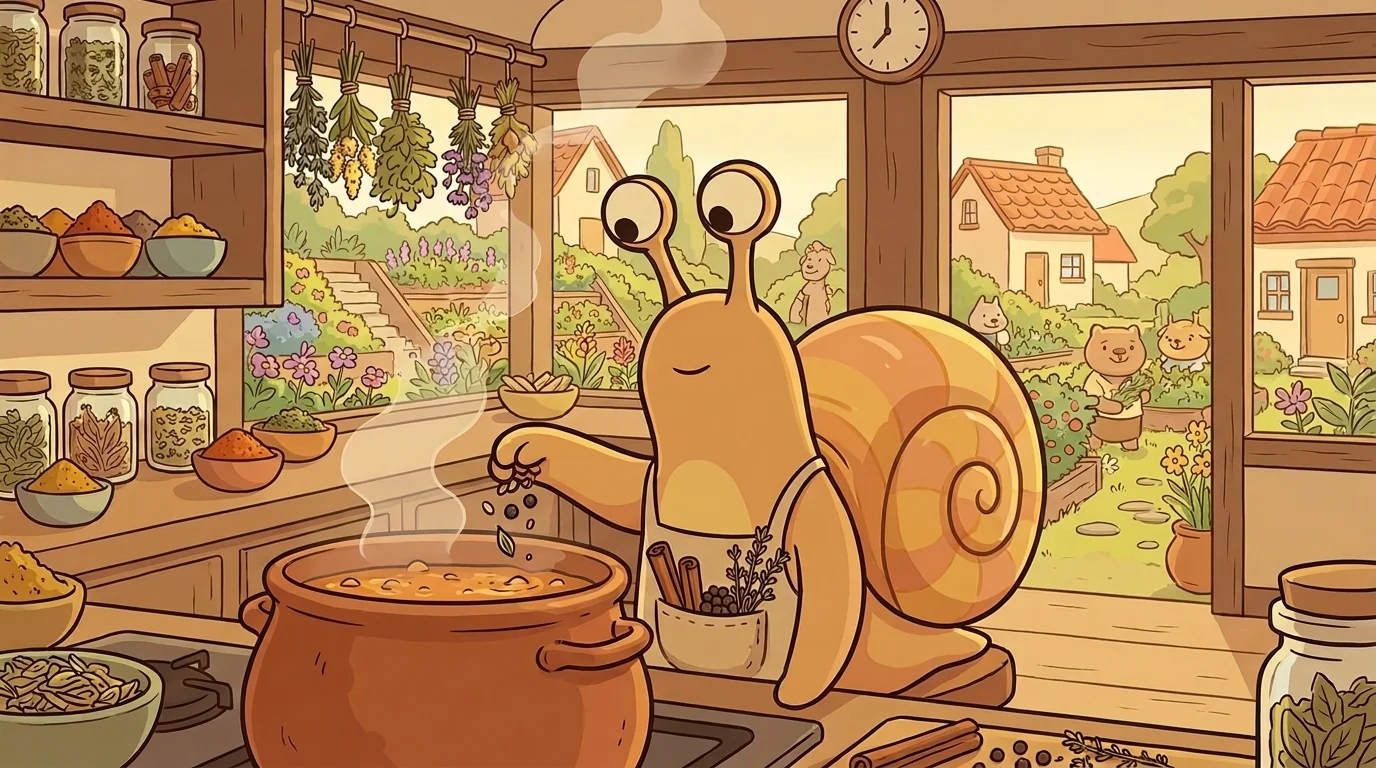
Steep had not always been patient. When he was young — well, young for a snail — he'd been a chaser, always sure that pushing harder got things faster.
He'd wanted to make his grandmother's fragrant spice-broth, the one that filled the whole burrow with warmth, and he'd wanted it immediately. So he'd boiled his spices as violently as he could, certain the roar of the boil meant flavor pouring out. What he got was a broth that was somehow both bitter and weak — the delicate fragrances boiled off into the air, the harsh notes scorched into what remained. He'd stood over the ruined, acrid pot, baffled and frustrated, certain he must be missing some secret ingredient. The secret wasn't an ingredient. It was that he'd been bullying the spices instead of inviting them.
His grandmother, slowest snail in the village, showed him. She dropped her spices into water barely warm enough to steam, covered it, and did nothing — for a long while. "You keep chasing the flavor with fire," she said. "Flavor doesn't come to the one who chases. It comes to the one who waits." And when she uncovered the pot, the broth was rich and round and fragrant, everything the boiled one hadn't been. Steep never forgot the strange lesson: that the fastest way to ruin something delicate is to hurry it, and the surest way to draw it out is to slow down and let it come.
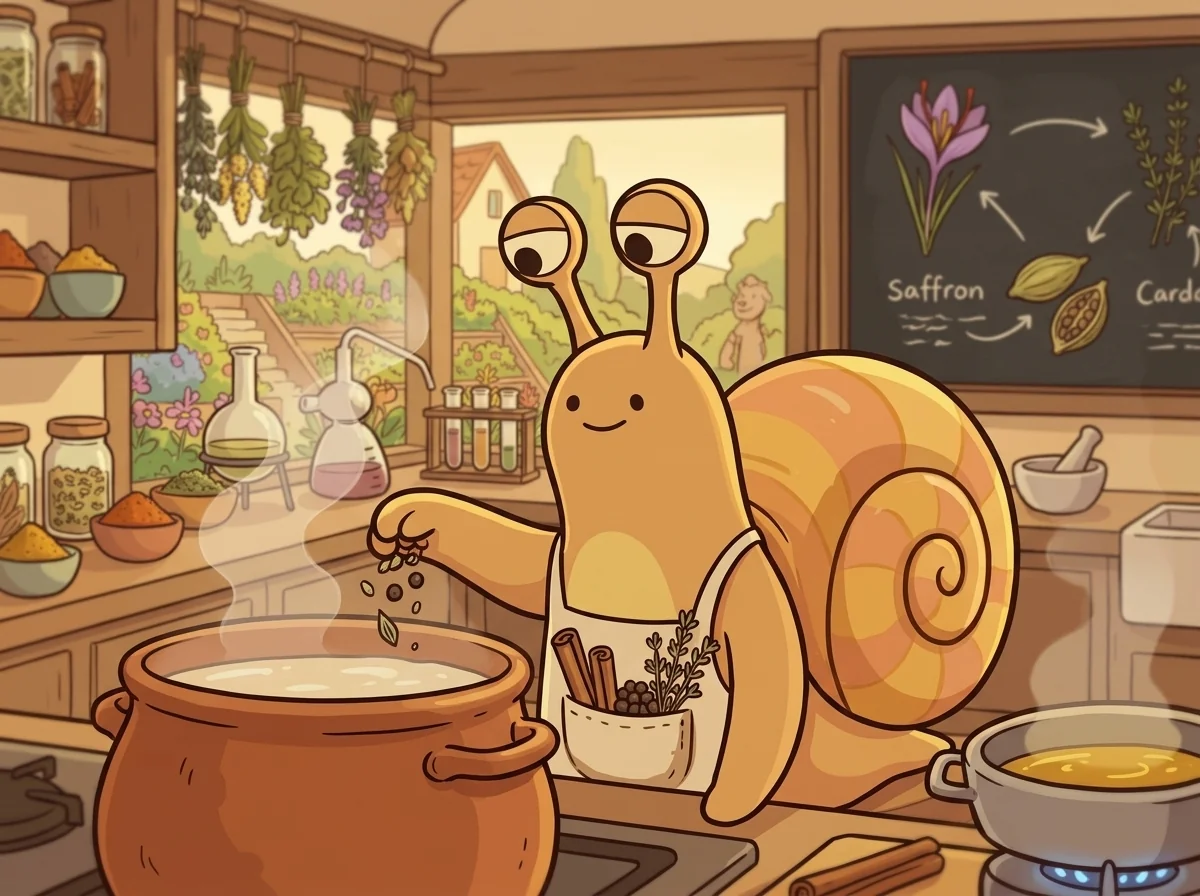
He came to the SaffronLab kitchen as a young cook, drawn to the one place that treated slowness as a technique rather than a flaw.
The head cook, an old otter named Roux, set a jar of whole spices and a pot of water before him. "Make me the most fragrant broth you can, fast as you like," he said, and watched.
The old chasing-Steep would have cranked the flame to a boil. This Steep set it to the barest steam. "Fast wouldn't make it better — it'd make it bitter and thin," he said. "The fragrant way is the patient way." He steeped the spices low and slow, covered, and waited, and when he finally lifted the lid the whole kitchen turned toward the smell.
Roux breathed it in. "Most young cooks boil my spices to rags trying to rush the flavor out," he said. "You barely heated them and waited — and made the most fragrant broth in the kitchen. That patience is the craft itself. You belong here."
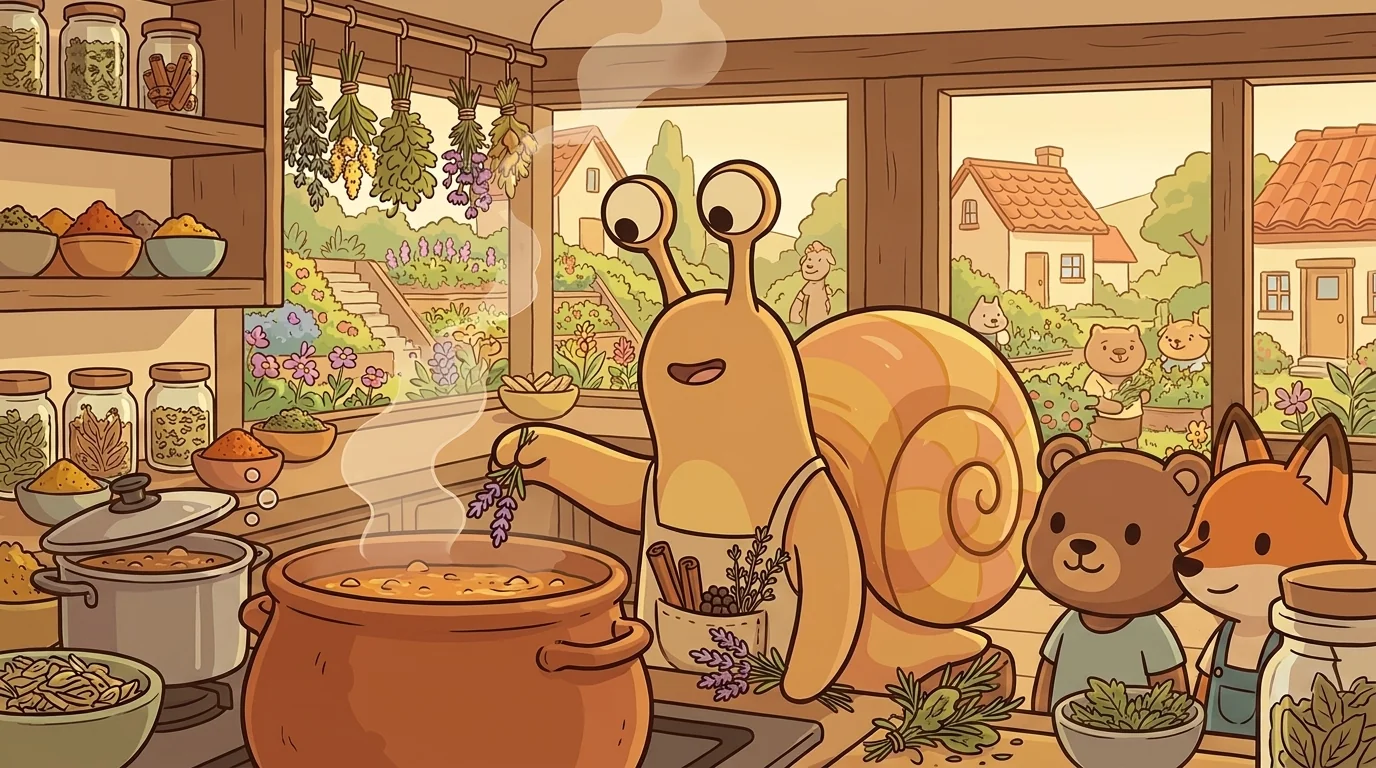
Over the seasons, Steep's quiet pot drew every cook who was trying to force a delicate thing to hurry.
One afternoon an impatient young wren brought over a pale, harsh tea. "I steeped it fast — rolling boil, two minutes, done. But it's bitter and weak at the same time. How is that even possible?" Steep nodded, unsurprised. "Because you chased it. A hard, fast boil scorches out the harsh, bitter parts and blows off the delicate fragrant ones — so you get the worst and lose the best, both at once." He made her a fresh cup: just-off-the-boil water, poured over the leaves, then waiting — no boiling, no stirring, no rushing. When it was ready it was fragrant and smooth. "Gentle warmth. A little time. That's all. You don't wring flavor out of a thing. You let it give its flavor, in its own time." The wren sipped, astonished. "So the harder I pushed, the worse it got?" "With delicate things, almost always," Steep said. "The push is what ruins them. The wait is what draws them out whole." The wren cradled her fragrant cup, and Steep watched the impatience settle out of her like leaves sinking slow to the bottom.
When the kitchen had quieted, the wren came back with a smaller question.
"Doesn't it drive you mad," she asked, "waiting? Just sitting there while the pot does nothing you can see?"
Steep thought about a bitter, boiled-to-rags broth, and a grandmother who did nothing and drew out everything.
"It used to," he said. "When I was young I thought waiting was nothing — wasted time, an empty pot." He drew his slow spiral shell a little straighter. "But the waiting isn't nothing. While the pot sits, the flavor is quietly leaving the spice and entering the water — the whole thing is happening, just too slow for the eye. The wait is the work. I'm not doing nothing; I'm giving the flavor the one thing it needs, which is time. Chasing feels like doing more. But with the delicate things, the patience is what does the most."
He felt it as he said it — a deep, unhurried calm settling through him, his small body easy, his breath slow as the steam curling off the pot. Not the jittery heat of chasing flavor with fire. The round, patient gladness of setting the warmth just right and letting the flavor come to him, in its own good time.
"That's the feeling I cook toward now," he told the wren, and the fragrant steam curled up between them. "Not the chase. The gentle warmth, the quiet wait — and the flavor arriving on its own."
The SaffronLab ensemble
Steep is part of SaffronLab's distributed-narrative cast. Each character embodies a different curricular primitive; together they teach the full subject.
-

Whisk
Mixing + emulsions — the energetic hummingbird-tween who treats mixing as conversation between ingredients ('quick wrists, patient eyes — air goes in, lumps come out')
-

Simmer
Heat application + states of matter — the patient tortoise-tween who treats heat as the slow-revealer ('heat moves slow, food changes slower; watch the bubbles — they're telling you')
-

Rise
Fermentation + leavening — the wise badger-elder who treats fermentation as the patient art of working with living things, foregrounding cross-cultural traditions ('living things take time — wait; the bread knows when it's ready')
-

Crisp
Maillard + caramelization — the focused fox-tween who treats browning as the flavor-creating frontier ('sugar meets heat, protein meets heat — new flavors are born')
-

Brine
Preservation + food safety — the careful axolotl-tween who treats food safety as care-for-the-eater, foregrounding cross-cultural preservation traditions ('salt remembers, vinegar remembers, cold remembers — food keeps if it's kept right')
-

Bind
Thickening — roux, reduction, how a sauce comes together — 'Patience turns liquid into silk.'
-

Mince
Knife-work — uniform cuts + mise-en-place — 'Prep first. Cook calm.'
-

Savor
Seasoning — salt as flavor-amplifier; taste as you go — 'Taste, then decide.'
-

Zest
Acidity + brightness — balancing richness — 'A squeeze wakes it all up.'