
Zest
ZEST — a squeeze of something sour lifts the whole dish. acid is the sunlight of flavor. when food tastes heavy or dull, often it is not more salt it needs, but a little bright sour.
Loading audio…
Press play to listen along. The line being read lights up as you go.
Show full transcript
Loading transcript…

In the SaffronLab kitchen, over a rich, heavy stew, a bright-eyed lemur named Zest squeezed in the smallest bit of lemon — while a young cook beside her kept adding more butter and more salt to a dish that only grew heavier with every spoonful.
Zest was lively and quick, her long ringed tail swishing, a basket-pocket of lemons and a little jar of vinegar in her apron. The young cook — a weary mole — stirred his stew glumly. "It's too heavy. It just sits there, rich and dull and thick on the tongue. I keep adding butter and salt to make it better and it keeps getting worse." He reached for more butter.
Zest caught his paw with a grin. "Stop — you're pouring gasoline on a heavy fire. Your stew doesn't need more depth. It's drowning in depth. It needs brightness." She squeezed in a few drops of lemon and stirred. "Taste." He did, and blinked — the whole heavy stew suddenly seemed to lift, the richness cut through, every flavor sharper and cleaner. "Acid," Zest said, delighted. "A squeeze of sour — lemon, lime, vinegar. When a dish is heavy and dull, adding more salt and fat just piles on more heaviness. But a little acid does the opposite: it cuts through the richness, it brightens, it makes everything taste fresher and more alive. I call it the sunlight of flavor — it's like opening a window in a stuffy room." She squeezed one more drop. "The mistake almost everyone makes is fixing 'heavy' with more of the heavy thing. The fix for heavy is usually its opposite: bright."
The mole tasted again, amazed. "So all that butter I was adding... was the wrong direction entirely?"
"You were adding more of the problem," Zest said kindly. "Heavy doesn't lift heavy. Bright lifts heavy."

Zest had not always known to reach for the opposite. When she was young, she'd been a fix-it-with-more cook — and it had cost her a whole feast.
She'd made a rich, creamy sauce for a family gathering, and partway through it tasted flat and heavy to her, so — panicking — she'd added more: more cream, more butter, more salt, doubling down on richness to try to make it "better." Each addition made it heavier, flatter, more cloying, until it was a thick, dull paste no one wanted, and she'd sat there mortified, sure she just had no palate. The failure wasn't her palate. It was that she'd tried to fix too much of a thing by adding even more of that thing.
The kitchen's brightest elder, an old cook named Citron, tasted the ruined sauce and laughed — not unkindly — and squeezed in a little lemon. Just a little. And the heavy paste came alive — the cream tasted like cream again, the whole thing lifted and balanced. "You kept answering heavy with heavy," Citron said. "When something's too much of one thing, you don't add more of that thing. You reach for what balances it. A rich dish is crying out for something bright and sour — not another spoon of the very thing that's weighing it down." Zest never forgot it: that the answer to "too much" is almost never "more," but its opposite, in a small, bright dose.

She came to the SaffronLab kitchen as a young cook, drawn to the one place that understood a dish could be fixed by adding the opposite of what it had too much of.
The head cook, an old otter named Roux, set before her a bowl of stew so rich it was almost a solid. "Fix it," he said, watching, a butter dish conspicuously within her reach.
The old more-is-more Zest would have grabbed the butter. This Zest reached past it for a lemon. "It doesn't need more richness — it's already too rich. It needs a lift." A squeeze, a stir, a taste. The heavy stew brightened and balanced. "There. The butter would have buried it. The acid opened a window."
Roux tasted the lifted stew. "Most young cooks reach for the butter I left right in front of them," he said. "You reached past it for the lemon. Knowing that heavy needs bright, not more heavy — that's the balance at the heart of the craft. You belong here."
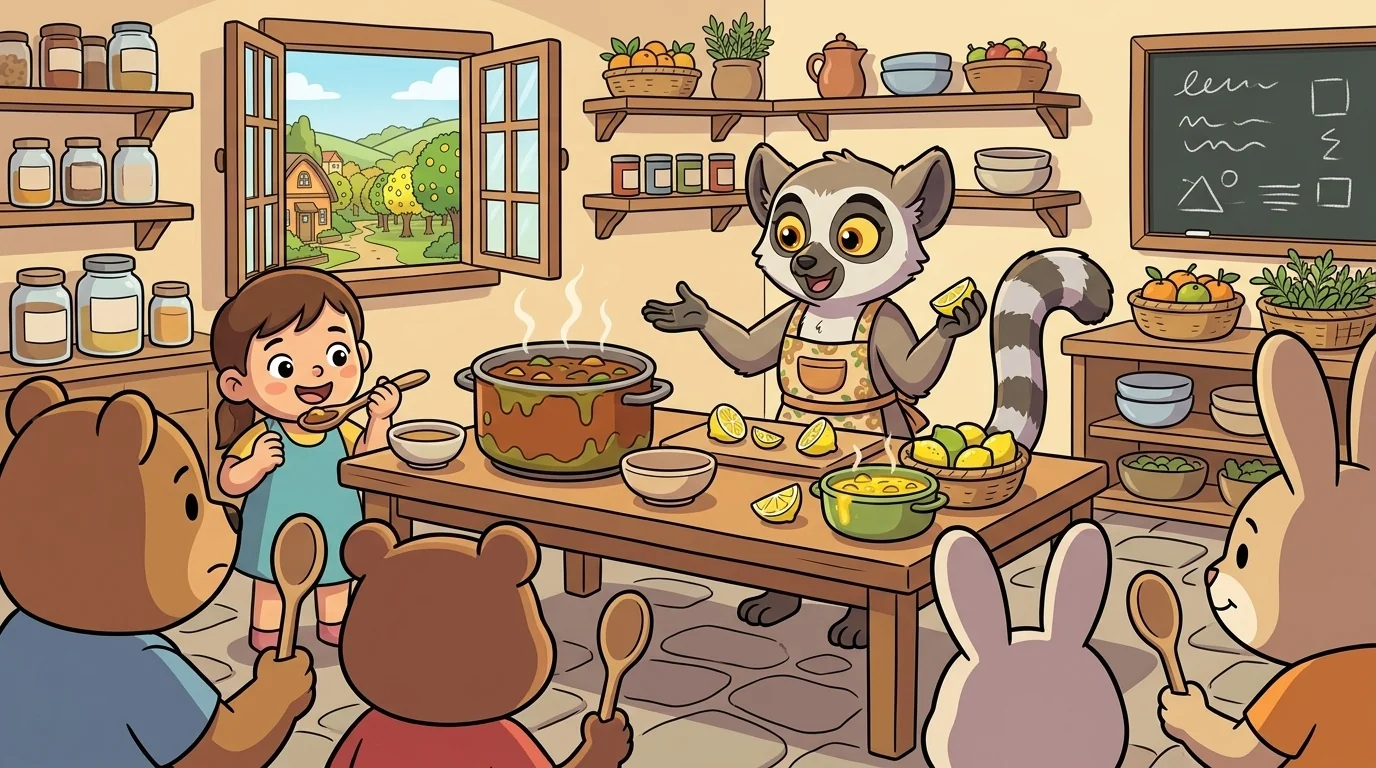
Over the seasons, Zest's basket of lemons drew every cook stuck fixing heavy with more heavy.
One afternoon a frustrated young otter brought over a pot of dense lentil stew. "It's like eating a blanket," she groaned. "Filling but so dull and heavy. I've added more spices, more oil, more everything, and it just gets more blanket-y." Zest laughed warmly. "More is the trap. You can't fix a blanket by adding more blanket. Watch." A squeeze of lime, a stir, a taste offered over. The otter's eyes went wide. "It's — awake! It tastes light and fresh and I can taste each thing now!" "A splash of acid," Zest said. "It cut right through the heaviness and lifted the whole thing. Remember this whenever a dish feels heavy, flat, or dull: before you add one more thing that's rich or salty, ask if what it's really missing is bright. A little sour is the fastest way to wake a tired dish." The otter squeezed in a touch more herself. "So the whole time I needed less like this and a little of this?" "You needed the opposite of what you kept reaching for," Zest said. "That's not a failure of taste. That's just the one trick nobody teaches first." The otter stirred her suddenly-bright stew, and Zest watched the weariness lift off her like a window thrown open.

When the kitchen had quieted, the otter came back with a smaller question.
"How do you know," she asked, "when to reach for the opposite instead of adding more of what's working?"
Zest thought about a ruined cream sauce and an elder named Citron and a single squeeze of lemon.
"I learned it by getting it wrong," she said. "I once tried to fix 'too rich' with more richness and made a paste nobody could eat." Her ringed tail curled thoughtfully. "The trick I use now: when a dish feels like too much of something — too heavy, too rich, too flat — that's exactly the moment to stop adding more and reach for the balancing opposite. Bright for heavy. Sour for rich. A dish, like a lot of things, doesn't always get better by piling on more of what it already has. Sometimes it gets better the instant you add a small, bright dose of what it's been missing."
She felt it as she said it — a light, lifting brightness spreading through her, her quick tail easy, her whole self as fresh and open as a window in a stuffy room. Not the heavy dead-end of more-and-more. The bright, glad clarity of the small sour squeeze that lets a whole dish breathe.
"That's the feeling I cook toward now," she told the otter, and a lemon gleamed in her paw. "Not more of the heavy thing. The bright squeeze — the sunlight — that lifts the whole pot alive."
The SaffronLab ensemble
Zest is part of SaffronLab's distributed-narrative cast. Each character embodies a different curricular primitive; together they teach the full subject.
-

Whisk
Mixing + emulsions — the energetic hummingbird-tween who treats mixing as conversation between ingredients ('quick wrists, patient eyes — air goes in, lumps come out')
-

Simmer
Heat application + states of matter — the patient tortoise-tween who treats heat as the slow-revealer ('heat moves slow, food changes slower; watch the bubbles — they're telling you')
-

Rise
Fermentation + leavening — the wise badger-elder who treats fermentation as the patient art of working with living things, foregrounding cross-cultural traditions ('living things take time — wait; the bread knows when it's ready')
-

Crisp
Maillard + caramelization — the focused fox-tween who treats browning as the flavor-creating frontier ('sugar meets heat, protein meets heat — new flavors are born')
-

Brine
Preservation + food safety — the careful axolotl-tween who treats food safety as care-for-the-eater, foregrounding cross-cultural preservation traditions ('salt remembers, vinegar remembers, cold remembers — food keeps if it's kept right')
-

Bind
Thickening — roux, reduction, how a sauce comes together — 'Patience turns liquid into silk.'
-

Mince
Knife-work — uniform cuts + mise-en-place — 'Prep first. Cook calm.'
-

Savor
Seasoning — salt as flavor-amplifier; taste as you go — 'Taste, then decide.'
-

Steep
Infusion — drawing flavor from aromatics + herbs — 'Give it time to open up.'