
Sketch, Fiber and Seal
BEFORE ANYONE TOUCHES IT — evidence only tells the truth if it's handled right and in the right order: record the whole scene first (Sketch), collect the trace every contact leaves behind (Fiber), then bag, label, and log every hand it passes through (Seal)
A story read by Sketch, Fiber and Seal
Loading audio…
Press play to listen along. The line being read lights up as you go.
Show full transcript
Loading transcript…
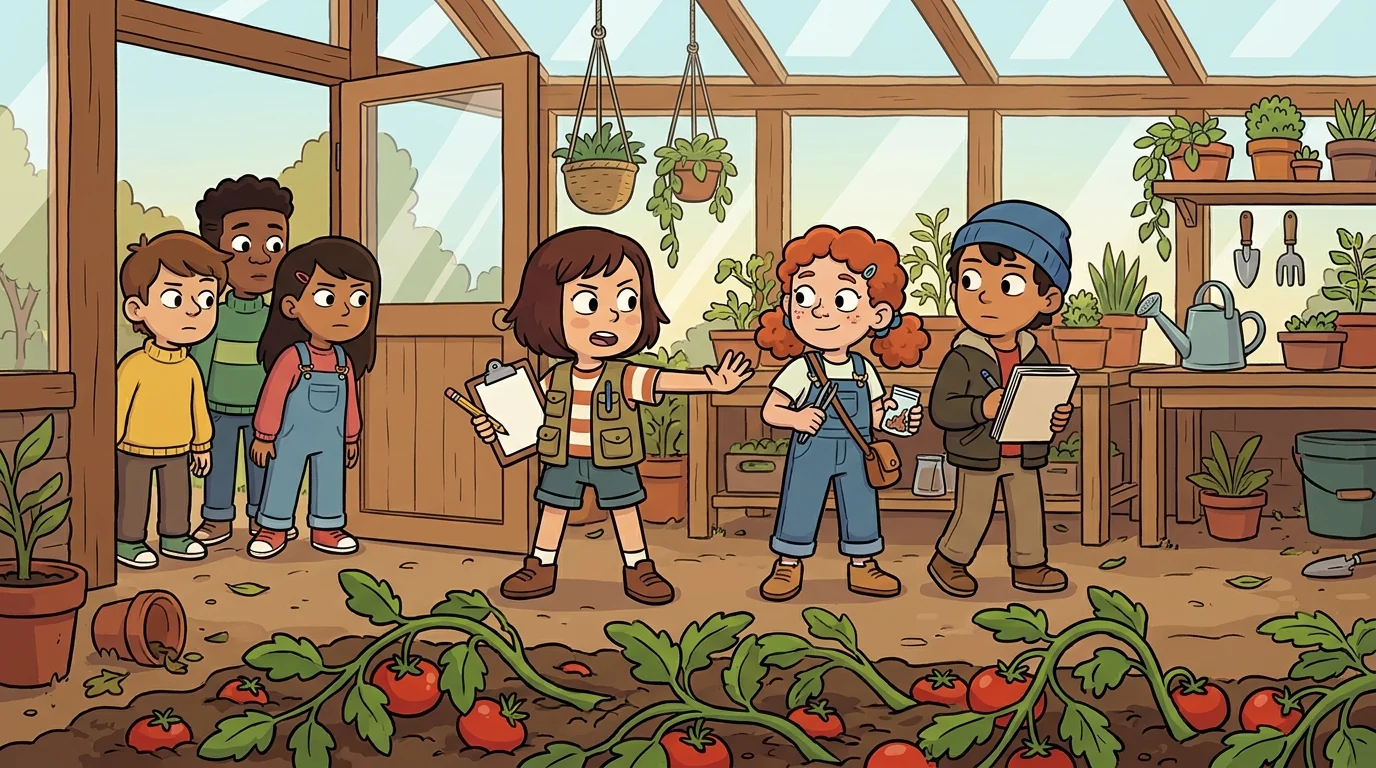
The greenhouse door stood open, and inside, a whole row of prize tomato plants lay knocked flat, and everyone wanted to rush in at once.
"Stop," said Sketch — quietly, but everyone stopped. "Before anyone touches it. Before one thing moves. Let me record it exactly as it is." Because that was the first rule the three of them lived by, and it ran against every impatient bone in a body: the scene only tells its story if you preserve it before you disturb it, and disturbance is irreversible. Once you've walked through, once you've lifted something, once you've just moved this to see underneath — the original arrangement is deleted, and no wishing restores it. So three of them went in slowly, together: Sketch with a clipboard, Fiber with tweezers and tiny bags, Seal with a logbook and pen. "Everyone else," said Seal at the door, "waits out here. Not because you'd lie — because every foot in that room adds noise we'll never separate out again."
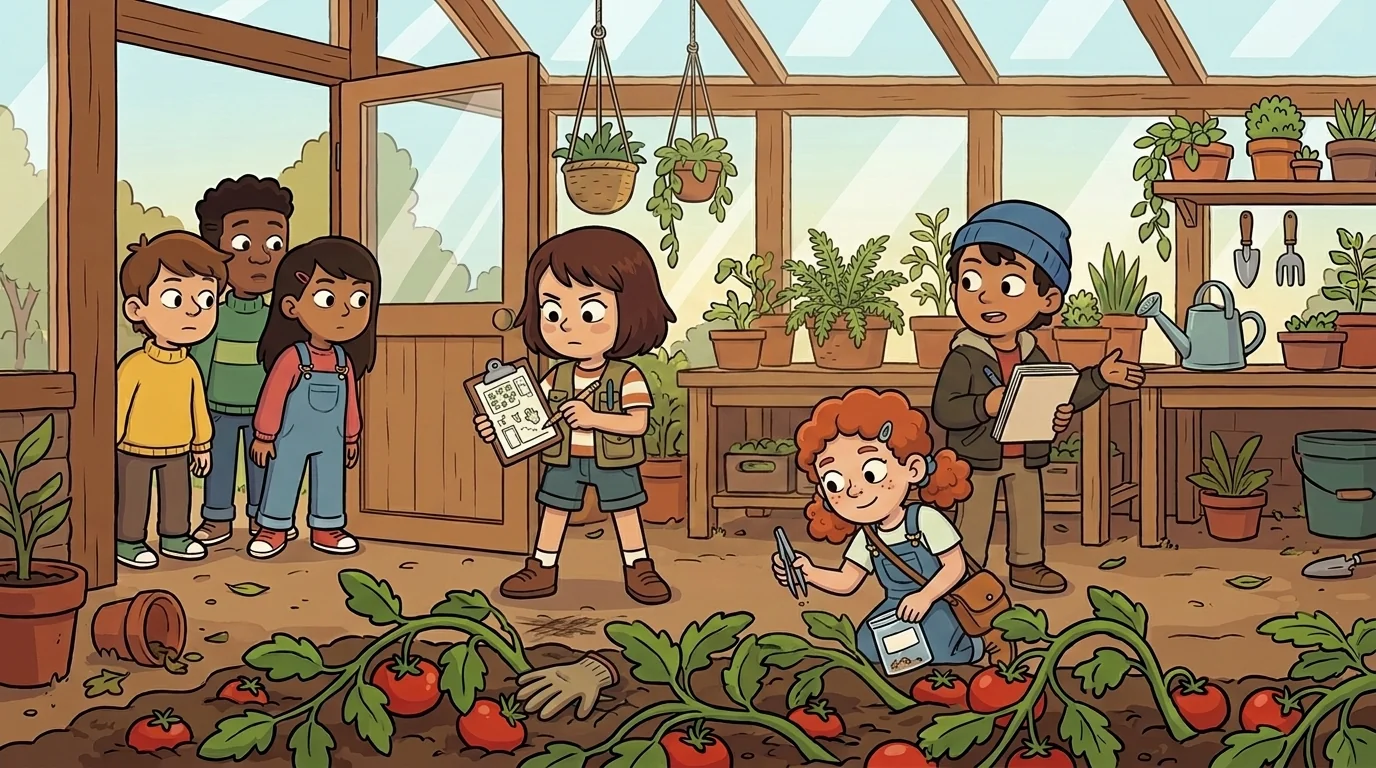
Sketch went first, and Sketch touched nothing. Sketch's whole discipline was to make the scene permanent before anyone changed it — so Sketch drew. Where each flattened plant lay and which way it fell. The scuff by the third pot. The open door, the closed window. The exact position of one dropped glove. Measurements down the margin, a time at the top. "People think this part's pointless," Sketch admitted, noting an angle, "all this drawing while everyone itches to grab clues. But the spatial arrangement is the evidence — the direction of a fall, the gap where nothing landed, that's a sentence written once. The instant we start collecting, this configuration is gone, and my drawing becomes the only version that will ever exist of how it truly was. Document before you decide — because the second you have a favorite theory, you stop seeing the parts that argue with it." Sketch finished the last measurement. "Now it's safe to collect. The scene is remembered."
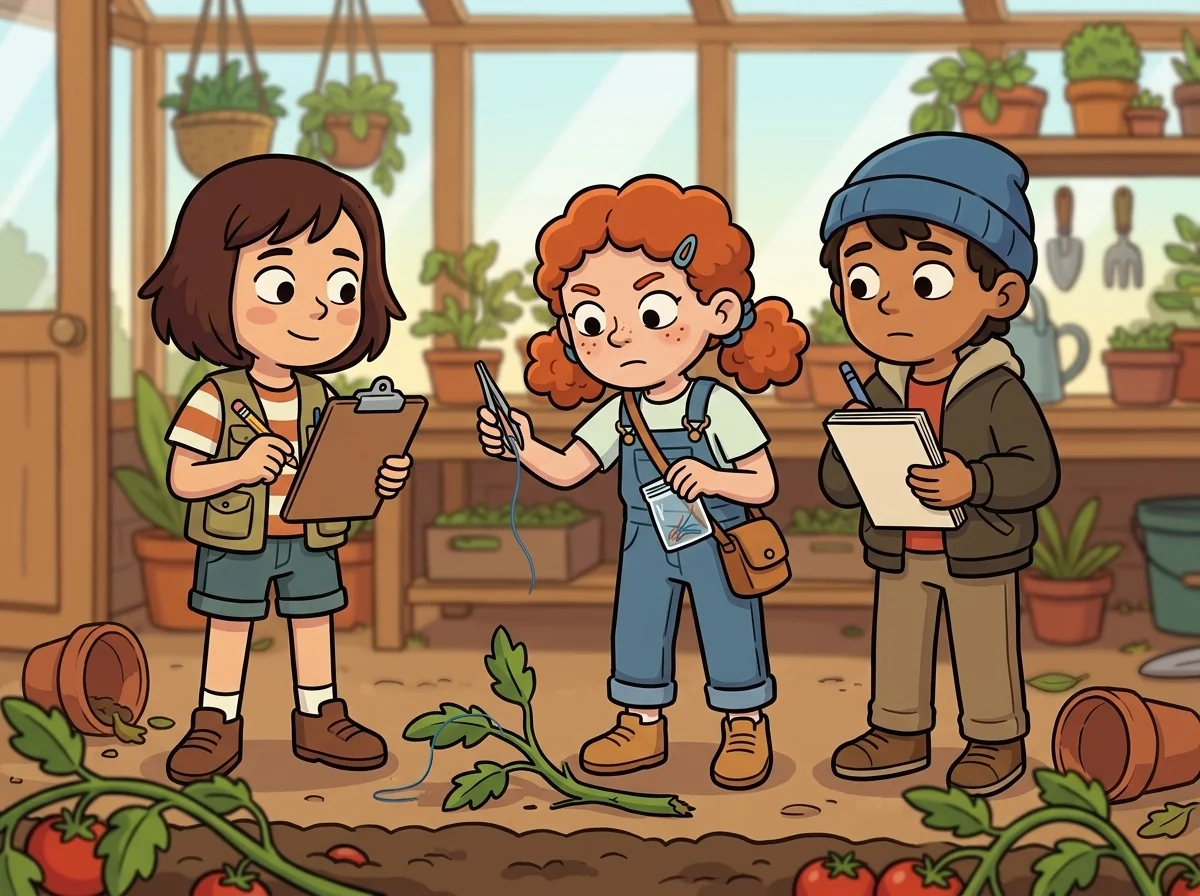
Now it was Fiber's turn, working from a principle so small and so reliable it felt like magic: every contact leaves a trace. Whoever knocked those plants flat had touched this room — and Fiber knew, with quiet certainty, that they could not have touched it without leaving something and taking something away. This is Locard's exchange principle, the physical law under all trace evidence: contact is a two-way transfer. A thread snagged on a broken stem. A fleck of paint. A single hair. A smear of soil dropped indoors that didn't match the greenhouse's own. Tiny, easy to miss, extremely hard to fake — and Fiber gathered them one patient piece at a time into labeled bags. "You cannot enter a place and leave it exactly as it was," Fiber murmured, lifting a blue thread with tweezers. "So the person who did this left part of themselves here without knowing it. Test the trace; don't infer the story from a glance. The thread doesn't lie. The soil doesn't lie. They just quietly report who was present."
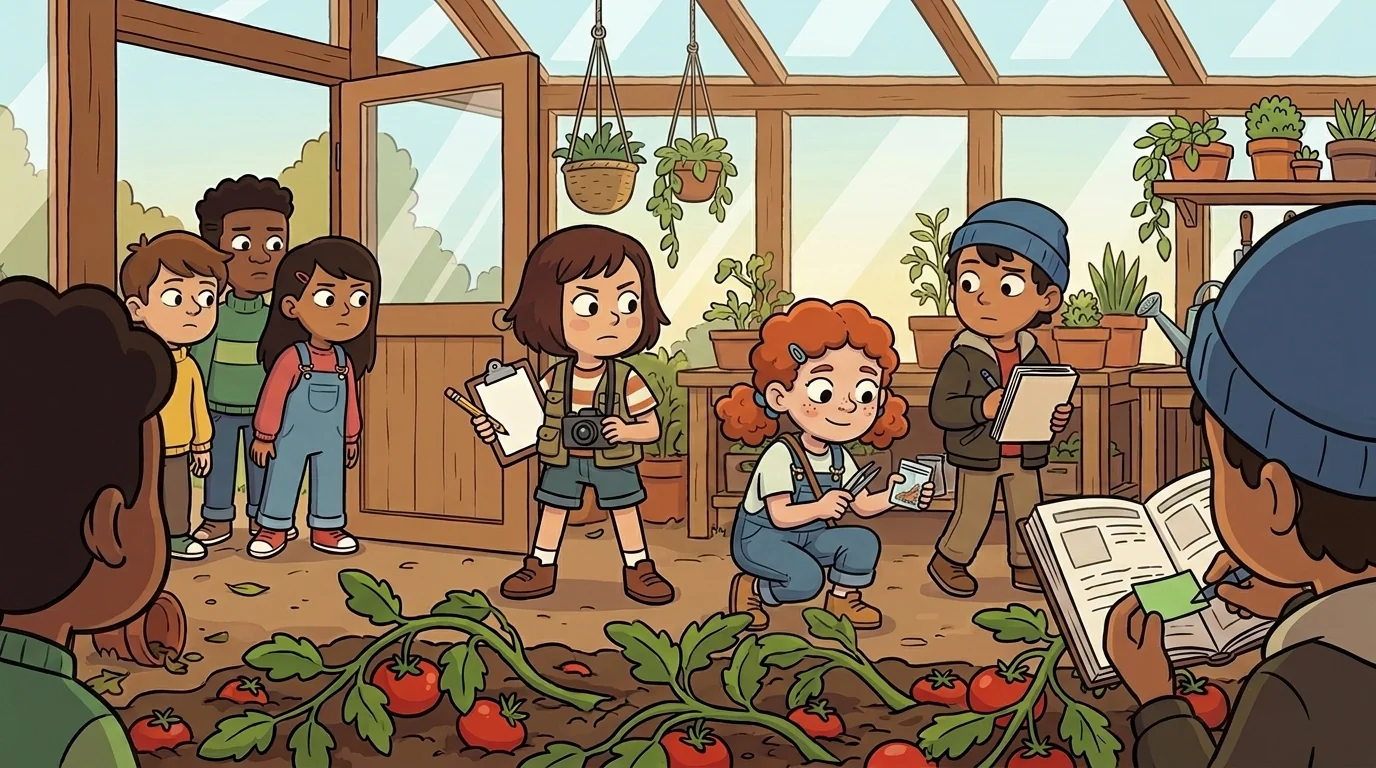
But a trace is only worth what you can trust about its whole history — and that was Seal's entire careful life. The moment Fiber lifted anything, Seal was there with the logbook: bag it, label it, log it. Every piece got its own bag, its own label — blue thread, third stem, 4:15 — and then, most important, a written record of every hand it passed through from that instant on. Fiber to Seal. Seal to the box. Box to the desk. Each step, each hand, timed and signed. "Here's the part nobody likes to hear," Seal said, logging the thread. "A clue is only as strong as its chain of custody — its unbroken, documented provenance. One gap where nobody can say where this thread was or whose hands held it, and the whole clue collapses to zero, because now anyone can propose it was swapped or contaminated and you can't disprove them. A broken chain isn't a weaker clue. It's a rumor with mud on it." Seal signed the line. "So I write down everything. Every hand. Unbroken. That's how the truth stays the truth all the way to whoever needs it."

By the time they stepped back out, the scene was fully recorded, every trace collected, each one bagged, labeled, and logged in an unbroken chain. Nothing rushed. Nothing lost. The truth of that room — whatever it turned out to be — would survive intact, all the way to whoever it mattered to. "Good record," said Fiber. "Good collecting," said Seal. "Good chain," said Sketch, closing the clipboard. There is a steadiness in doing a careful thing carefully — in refusing to hurry the part that matters, in being patient on purpose because something important rides on getting it right. The three of them were slow, and they were slow deliberately, and that slowness was a form of respect: for the truth, for the people it would matter to, for the quiet certainty that if you handle something with enough care, it stays trustworthy long after you've set it down. Each of them owned one link — record, collect, account — and the case held only because none of the three let their link slip.
The SleuthLab ensemble
Sketch, Fiber and Seal is part of SleuthLab's distributed-narrative cast. Each character embodies a different curricular primitive; together they teach the full subject.
-

Loop
Impression evidence — fingerprints, shoeprints, toolmarks (class vs individual evidence)
-

Fiber
Trace evidence — fibers, hairs, paint, glass (Locard's exchange principle)
-

Drop
Chemical evidence — chromatography, pH, spectroscopy (test-don't-guess)
-

Stroke
Document analysis — handwriting, ink, paper (comparison methodology)
-

Witness
Biological + digital evidence — DNA + digital footprints (statistical-match, not certainty)
-

Seal
Chain of custody — bag it, label it, log every hand it passes through; a broken chain can't be trusted; otter with evidence bags + logbook
-
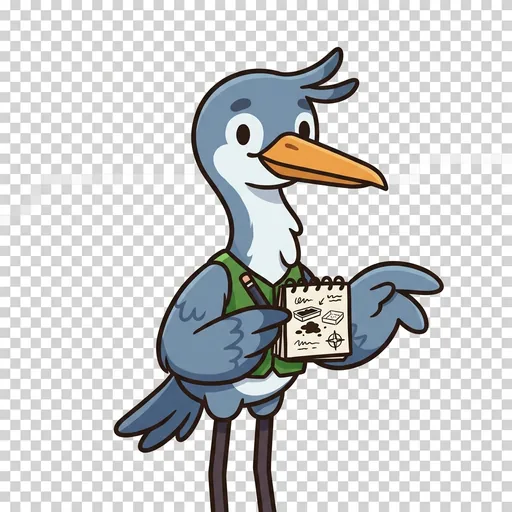
Sketch
Scene documentation — record the scene before anyone touches it; the scene only tells its story once; heron with a measuring notebook
-

Tick
Timeline reconstruction — put every event in order on the clock; the sequence is where the answer hides; mouse with a paper timeline
-

Branch
Alternative explanations — ask 'what else could explain this?' and test each branch before choosing; squirrel with a whiteboard of possibilities
-

Account
Testimony reliability — ask open questions and listen; memory is fragile and a confident witness isn't always correct; rabbit with a gentle notebook